
Garmin Cirqa Workout Features: Screenless Band, Complete Training
Home gym owners wonder if a screenless band can track their workouts properly. The Garmin Cirqa packs a full training stack — 80+ activity profiles, strength rep counting, HR broadcasting, and subscription-free recovery metrics — but its rep-counting accuracy on narrow form factor and battery drain during continuous HR broadcasting need independent validation.
| Category | wearable |
|---|---|
| Folded / stored footprint | Small |
| Price | $199.99 |
| Monthly subscription | $0 |
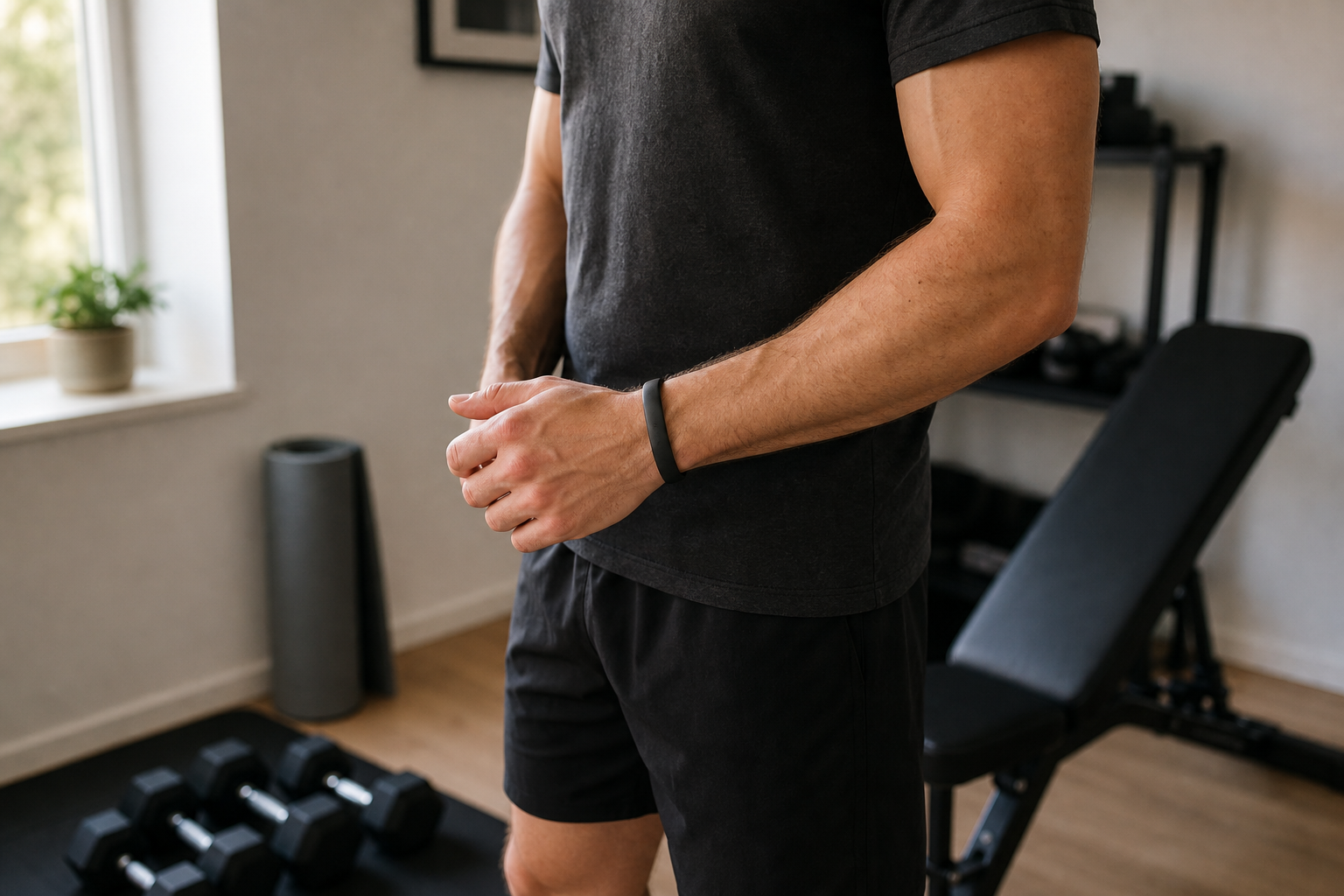
A screenless fitness tracker sounds like a downgrade until the first time a watch face hits a barbell knurl, digs into the floor during push-ups, or turns into a sweat-smeared touchscreen during intervals. In a small home gym, the annoying parts of workout tracking are usually physical: wrist extension, straps snagging, screens waking at the wrong time, and equipment sitting close enough that every extra millimeter matters.
That is the useful way to look at the Garmin Cirqa. It is not interesting just because Garmin removed the screen. It is interesting because Garmin put a fairly complete workout stack into a 20 g band, priced it at $199.99, and did not attach a subscription to the training and recovery metrics that home-gym users actually check after a session.[1][2]
The early verdict is straightforward: Cirqa's workout features look unusually strong for people training with dumbbells, benches, mats, bike trainers, rowers, and mixed conditioning circuits at home. The two places to slow down are strength rep-counting accuracy on this narrow band and battery drain during long continuous heart-rate broadcasting. Those are workout-specific questions, and neither has enough independent validation yet.
The important part is not the missing screen
For outdoor running, a screen can be useful. For a compact home setup, it can become one more thing to manage. A band with no display will not show your interval timer on the wrist, but it also will not force you to protect a watch face during goblet squats, plank variations, yoga transitions, kettlebell work, or bench-supported rows.
That trade matters only if the tracker still records the workout properly. A minimalist band that only counts steps and sleep would miss the point. Cirqa is more promising because Garmin did not limit it to a thin wellness feature set. DC Rainmaker’s hands-on report says Cirqa includes more than 80 activity profiles from Garmin’s existing catalog, including Strength, HIIT, Cardio, Yoga, Pilates, Indoor Cycling, Rowing, Jump Rope, and Boxing.[1]
Those labels map cleanly to the way a lot of home training actually happens. A folding bench session can be logged as Strength. A jump-rope finisher does not have to hide under generic cardio. Indoor cycling and rowing are first-class modes rather than afterthoughts. Yoga and Pilates matter because floor work is exactly where bulky wrist hardware can become irritating.
The activity catalog looks closer to Garmin watch territory than wellness-band territory
The 80-plus profile count is not proof that every mode is equally deep, but it does answer the first home-gym worry: Cirqa is not being positioned as a step counter with a few workout names attached. The practical value is that the session starts with a closer label, and Garmin’s training system can interpret the load in a familiar context.
| Training situation | Cirqa workout feature that matters |
|---|---|
| Dumbbell or bench strength session | Strength profile, optional rep counting, Garmin load and recovery metrics |
| Apartment HIIT circuit | HIIT and Cardio profiles without a watch screen getting in the way |
| Bike trainer or Peloton-style ride | Indoor Cycling profile plus ANT+/Bluetooth heart-rate broadcasting |
| Rower against a wall | Rowing profile plus external heart-rate display support |
| Yoga, Pilates, mobility, or floor work | Yoga and Pilates profiles in a narrow screenless form factor |
| Outdoor run or ride from home | Connected GPS using the paired phone |
This is where Cirqa has a real edge over the idea of a “simple” tracker. Home training is rarely one sport. A week might include two dumbbell sessions, one trainer ride, a short row, one mobility day, and a jump-rope block because the weather is awful. If the device makes those feel like supported workouts instead of hacks, it has already removed friction.
Garmin also includes auto-detection for common activities, according to available reporting.[1] That can help when a session starts casually and becomes real, but it should not replace deliberately starting the correct profile for structured training. If load, recovery, and workout history matter, the cleaner habit is still to choose the activity before the first set or interval.
Strength logging is useful, but rep counting still needs proof on this band
Strength tracking is the feature that will make many home-gym users pause. Garmin’s owner’s manual information says Cirqa can use optional strength rep counting, configured per session, and that automatic detection works after 4 consecutive reps.[3]
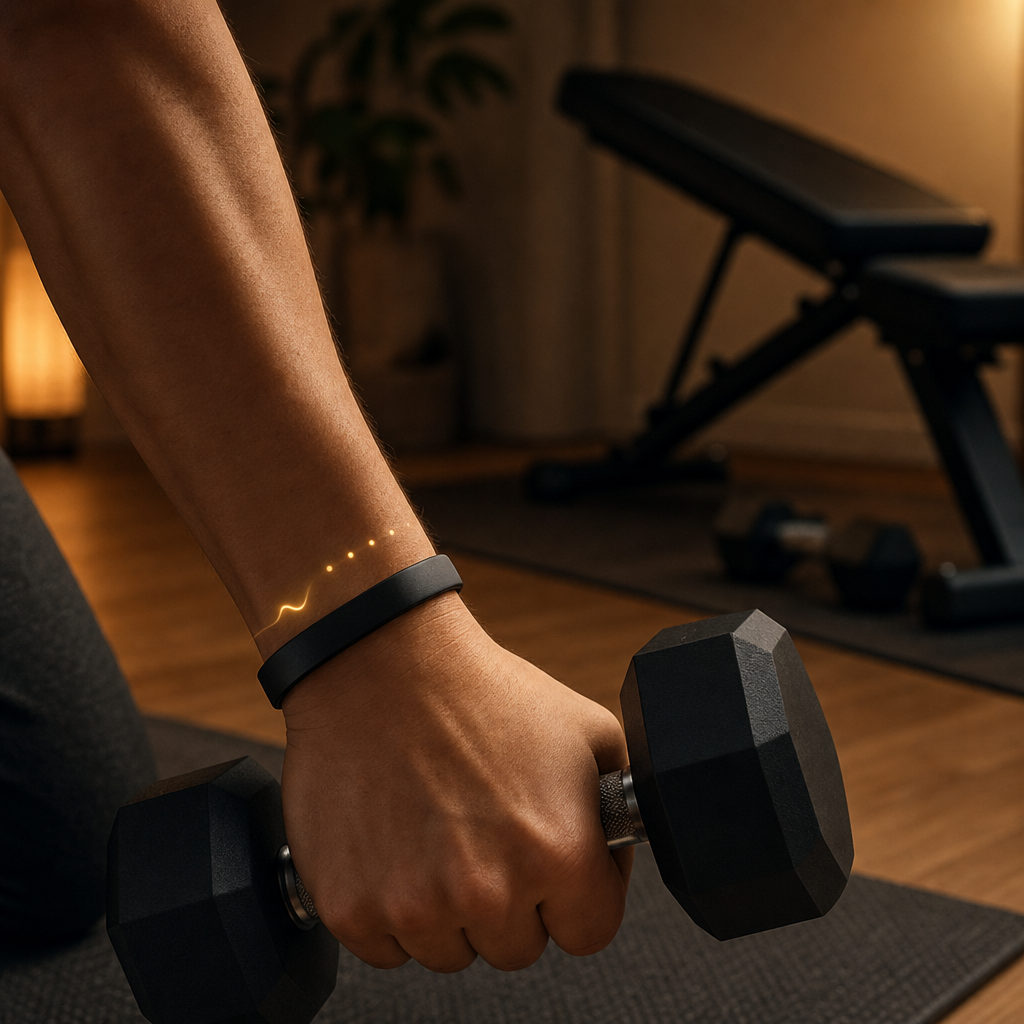
That could be genuinely helpful when training alone. Logging a messy home strength session usually means choosing between interrupting the workout to edit every set or accepting a vague record afterward. If Cirqa can catch simple, repeated movements well enough, it reduces the amount of tapping and correcting that normally pushes people away from strength logs.
The caution is just as important. “Detects after 4 consecutive reps” is not the same as “accurately handles every home-gym movement.” Deadlifts, pull-ups, carries, kettlebell complexes, tempo work, partial ranges, and alternating movements can be harder for wrist-based systems to interpret. The available evidence supports the existence and basic behavior of the feature, not a broad accuracy claim for those movement patterns on Cirqa specifically.
Cirqa uses Garmin’s Gen 4 Elevate heart-rate sensor rather than the newer Gen 5 generation. DC Rainmaker notes that the accuracy delta is “pretty minor” and “totally negligible” for non-workout usage, but that comment should not be stretched into a complete strength-tracking validation.[1] Heart-rate accuracy, rep detection, and movement classification are related only loosely in a garage-corner workout with changing grips and wrist angles.
The clean way to treat the feature is this: use it if you want less manual logging, but do not buy Cirqa primarily on the assumption that it will perfectly count every lift. For basic dumbbell sets, it may become one of the band’s best workout conveniences. For barbell and bodyweight movements where the wrist barely moves, independent testing matters.
Heart-rate broadcasting may be the most practical home-gym feature
The feature that sounds boring on a spec sheet may be the one that gets used constantly: Cirqa can broadcast heart rate over ANT+ and Bluetooth, and DC Rainmaker says broadcasting is toggled by holding the side button for 3 seconds.[1]
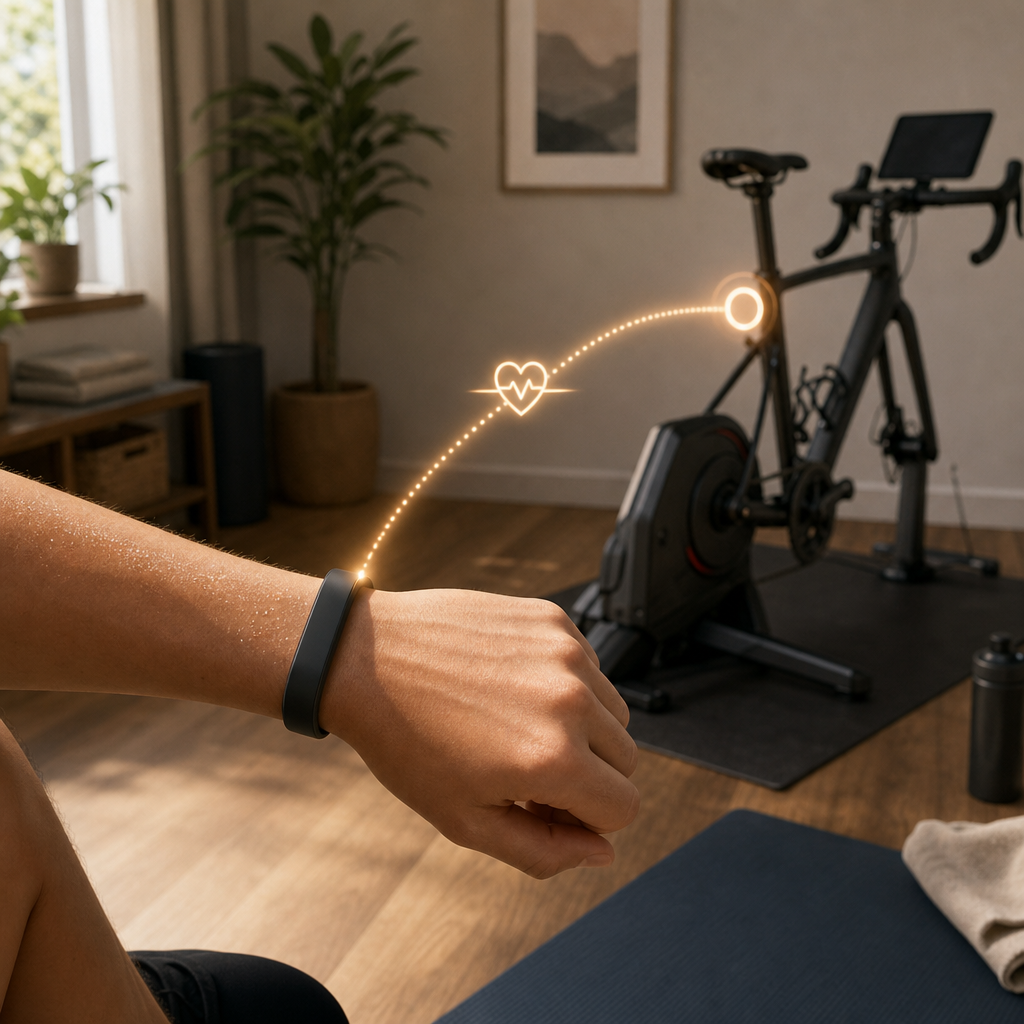
That matters because a lot of home cardio already has a screen somewhere else. Zwift, Peloton-style setups, rower monitors, bike computers, and gym consoles do not need another display on your wrist; they need a reliable heart-rate source. A screenless band that can sit quietly on the wrist and feed heart rate to the device doing the workout display job fits that workflow well.
The 3-second side-button hold also matters more than it sounds. Touchscreens are at their worst when hands are sweaty, chalky, or wrapped around equipment. A physical button shortcut is more believable during intervals than a tiny on-screen menu. For broader compatibility context, FitAtHome’s guide to fitness tracker app compatibility is the better next stop than a generic smartwatch comparison.
There is one unresolved ownership question: battery life while broadcasting. Garmin claims up to 10 days of typical use for Cirqa, but the available material does not provide a separate runtime figure for continuous HR broadcasting during long indoor sessions.[4] That gap matters if your normal Saturday is a long trainer ride, a row, and accessories with heart rate streaming the whole time.
Connected GPS is enough for occasional outdoor work
Cirqa does not need onboard GPS to be useful in a home-gym routine. Engadget reports that it uses connected GPS from a paired phone for outdoor runs and rides, without requiring the phone screen to be active.[5]
For a runner who wants maps and pace visible on the wrist, that is a compromise. For someone who mostly trains indoors and occasionally heads outside with a phone anyway, it is probably the right compromise. The band records the session, the phone supplies location, and the wrist stays uncluttered.
The optional $59 armband is also worth noting because it addresses a real training nuisance rather than a lifestyle accessory gap.[4] Moving the sensor off the wrist can help when the wrist position itself is the problem: push-ups, front-rack work, certain kettlebell positions, or anything where the band would be compressed, bent, or knocked around.
The recovery stack is where the no-subscription model gets serious
After the workout, Cirqa becomes less about the band and more about Garmin’s training ecosystem. The Verge reports that Training Readiness, Acute Load, and Recovery Time are included without a subscription.[2] Training Effect and VO2 Max are also part of the broader Cirqa training stack.[1][2]
Those metrics are not decoration for home training. Acute Load helps show whether several short sessions are adding up to more stress than they feel like individually. Recovery Time gives a rough signal before stacking another hard ride or leg session. Training Readiness is useful when sleep, soreness, and recent intensity disagree with the plan on paper.
The subscription-free part changes the value calculation. Cirqa’s $199.99 upfront price is twice the $99.99 Fitbit Air figure, so it is not the cheapest entry point. But compared with Whoop’s paid recovery model, with membership at $199 or more per year, Garmin’s no-subscription approach can look stronger over a 2- to 3-year ownership window.[2]
That does not make Cirqa automatically better for everyone. If upfront price is the main constraint, the Garmin Cirqa vs Fitbit Air comparison is the cleaner buying comparison. If avoiding recurring fees is the main issue, FitAtHome’s subscription-free fitness trackers roundup is the more relevant lens.
Where Cirqa still needs independent workout testing
The main limitations are not vague “first-generation product” worries. They are specific to how home-gym users would rely on the device.
- Rep counting is documented, optional, and triggered after 4 consecutive reps, but accuracy on Cirqa’s narrow screenless form factor has not been independently validated for deadlifts, pull-ups, mixed circuits, or other awkward home-gym patterns.[3]
- Heart-rate broadcasting supports ANT+ and Bluetooth, but long-session battery impact has not been independently quantified, and Garmin’s available typical-use claim does not answer that specific use case.[1][4]
- The Gen 4 Elevate sensor is one generation behind Garmin’s latest sensor, even if the available hands-on assessment describes the practical difference as small for non-workout use.[1]
- The lack of a screen helps during lifting and floor work, but anyone who wants live pacing, maps, interval prompts, or workout controls on the wrist should compare the form factor against a watch or ring-style setup.
That last point is preference, not a flaw. The best form factor depends on where the screen should live during training. In a home gym with a phone, tablet, bike display, or rower console already nearby, Cirqa’s missing display may remove more friction than it creates. For a wider form-factor comparison, FitAtHome’s smart ring vs fitness watch workout guide is the better context.
Conditional verdict for home-gym training
For home-gym users who want Garmin-level workout tracking without a watch face, Cirqa looks like a strong fit. The combination of more than 80 activity profiles, home-relevant modes, optional strength rep counting, ANT+/Bluetooth heart-rate broadcasting, connected GPS, and subscription-free recovery metrics covers the way many small-space athletes actually train.[1][2][3][5]
The best buyer is someone who already values Garmin’s training ecosystem but wants the hardware to disappear during lifting, floor work, indoor cycling, rowing, yoga, or HIIT. The buyer who should wait is someone purchasing mainly for strength rep accuracy or for long HR-broadcast sessions where battery life needs to be proven, not assumed.
References
- Garmin Cirqa: Everything You Need to Know, DC Rainmaker, 2026-07, link
- Garmin made a screenless fitness tracker to take on Whoop, The Verge, link
- CIRQA Smart Band, Garmin Wiki, link
- Meet Cirqa smart band, the screen-free health and fitness tracker from Garmin, Garmin, link
- Garmin finally made a screenless fitness tracker, Engadget, link
Verify further before you buy:
Price or spec changed since we checked? Report it below.
Comments
Join the discussion with an anonymous comment.