
It's not the app – it's what you don't know
Here is a number that should stop you: 77% of daily active users of workout apps vanish within three days of installation. That means out of every four people who download, three have already checked out before the first weekend. Day-30 retention across the industry settles somewhere between 8 and 12 percent. I don't treat these numbers as a precise benchmark – the source aggregates industry data – but the scale is hard to argue with. I've watched this pattern for years. It's not because the apps are broken. It's because beginners walk in blind, and the app doesn't teach them what the first month actually feels like.
The reaction I usually hear is that the apps must be bad. They are not. The problem is that beginners don't know what the first month actually feels like, and the apps often fail to provide the structure and expectation-setting that would keep someone from quitting on day two when their legs ache and they wonder if this is normal.
Week 1: Three days, 15 minutes each, and soreness is part of the deal
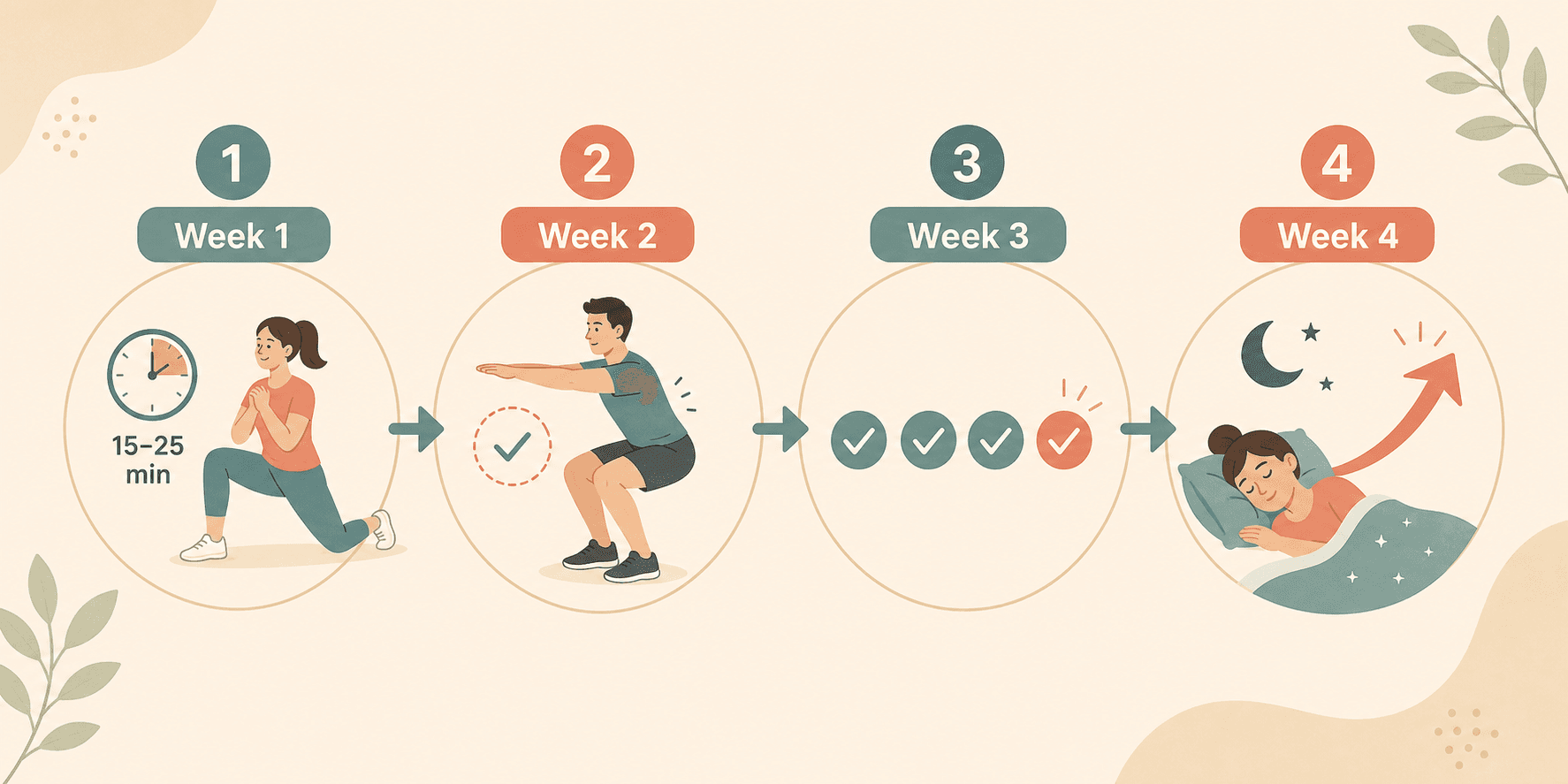
The first week is about showing up, not about effort. Start with three workout days, each session lasting 15 to 25 minutes. That is short enough that you cannot talk yourself out of it and long enough to feel like you did something. You will be sore on day 2 and day 3. That is not a sign of injury — it is a sign that your muscles are adapting to work they have not done in a while. The soreness fades by the next session. Do not skip a day because of it.
At this stage, your only task is to pick any structured beginner program and follow it. Do not browse the library. Do not compare apps. The program itself matters less than the fact that it exists and that you stick to it. Session length of 15 to 25 minutes in the first month reduces burnout. Longer sessions increase dropout — a direct, measurable consequence.
Week 2: Same workouts, different feeling – that's early adaptation
Repeat the same workouts from week 1. They will feel slightly easier. That is not placebo. Early strength gains in beginners come from neurological adaptations — the brain and body learning to coordinate muscle groups more efficiently. A study in the Canadian Journal of Applied Physiology (Griffin & Cafarelli, 2005) showed that the first measurable strength increases are driven by neural rewiring, not muscle growth. You are getting better at the movement itself. That is real progress, even though you cannot see it in the mirror.
This is the week where form matters more than intensity. Watch the demonstration video in your app. Use modifications if offered. Your goal is not to finish the workout exhausted — it is to finish it with control. If an on-demand video moves too fast, find an app that lets you watch a single exercise demonstration as many times as you need.
Week 3: Add a fourth day – but don't increase session length dramatically
In week 3, add a fourth workout day. Your sessions can move toward the longer end of the beginner range — 20 to 25 minutes — but do not jump to an hour. A single extra day and a modest increase in duration is enough stimulus for a body that is still adapting. Three to four sessions per week is plenty for the first month. Rest days are not optional; they are when your body actually makes the adaptations.
Some apps will try to push you into longer classes or more challenging programs at this point. Ignore that. You are building a base, not chasing a leaderboard. Stay with beginner classes that are slightly longer or slightly harder, but still within the same structure.
Week 4: More energy, better sleep – but don't look for a mirror change
By now you have done 12 to 16 sessions. The soreness is mild or gone. You feel measurably more energetic during the day and you fall asleep more easily at night. That is the real reward of the first month. Body composition has not changed much yet — four weeks of bodyweight work does not produce visible muscle or fat loss — but movement is starting to feel natural. You are no longer thinking about every step of a squat. The neural rewiring is paying off.
Do not let an app's lack of a progress picture feature trick you into thinking nothing happened. You are fitter than you were four weeks ago. The mirror is the wrong measurement.
What your app should give you at each stage – and what to avoid
The single most important feature for a true beginner is a guided, progressive program — not a library of 1,000 classes. A library invites choice paralysis; a program removes the decisions. You open the app, it tells you what to do, you do it. That is the difference between a workout and a browse session.
Here is how your needs shift over the four weeks:
- Week 1: Structured progression and form coaching with visible modifications (low-impact, seated, no-jumping options). You need to know exactly which workout to do and how to do it safely.
- Week 2: Variety within a guided path. The same program structure but different exercises or slight variations to keep things interesting without breaking the progression.
- Week 3: Accountability features — reminders, streaks, or the ability to share progress with a friend. Social features can increase retention (some app platforms claim 30% improvement, though those figures come from the companies selling the feature and I take them with a grain of salt).
Free apps like Nike Training Club offer structured beginner programs that cover all of these phases. For a full list of options that do not cost anything, see our guide to the best free workout apps for your specific fitness goal.
Red flags to watch for
- Apps that offer an hour-long beginner class. A 15‑minute difference in session length can be the difference between finishing and quitting. If the shortest class in the app is 45 minutes, you will burn out in week 1.
- Apps that drop you into a library with no recommended starting point. You should not have to design your own workout as a beginner. That is like being handed a kitchen and told to cook dinner without a recipe.
- Apps without visible modifications. If a squat is shown only in perfect form with a full range of motion and no alternative version, you will either hurt yourself or feel like you are failing when you cannot match it.
The roadmap matters more than the app
I have watched hundreds of people start and stop using workout apps. Almost never is the app itself the reason someone quits. They quit because they started too long, expected too much too soon, or had no idea what the first month would feel like.
The roadmap you just read — start short, expect soreness, repeat workouts for neural adaptation, add a fourth day cautiously, measure progress by energy and sleep — is the real tool. Any app that provides a guided, progressive program will work if you follow that roadmap. An app with a thousand classes and no plan will fail even if it has the best production quality in the world.
The first 30 days are about showing up, not transforming. Now you know what that looks like. Download an app with a structured beginner program, follow the week‑by‑week plan, and ignore everything else until the month is over.
Comments
Join the discussion with an anonymous comment.