
The annoying part is not that exercise apps cost money. Coaching costs money. Good programming costs money. A tool that keeps you training when you would otherwise drift can be worth paying for. The problem is that exercise apps now arrive in a life already full of recurring charges: streaming, meal planning, wearables, sleep tools, recovery apps, maybe a gym membership that is still hanging around because canceling it feels like admitting something.
So when an app says it is “only $10 a month,” that is no longer a tiny claim. It is asking to become another permanent line in your budget. Among the best exercise apps, the right question is not which one has the glossiest library or the friendliest progress animation. It is whether the app still helps you train after the trial ends, and whether the paid tier removes a real obstacle you could not solve with a strong free option.
The market is giving us a pretty clear signal that people are tired of fuzzy value. Mobile Squad’s 2026 fitness app statistics report cites Sensor Tower data showing monthly churn rising from 8.2% in 2023 to 11.7% in 2025. In the same report, poor value-for-money was the top cancellation reason, named in 42% of cancellations in a Sensor Tower survey of 3,200 respondents across the U.S., U.K., Germany, and Australia. Searches for “one-time purchase gym app” were also up 134% since 2023, according to Mobile Squad’s citation of App Store data [1].
Those numbers are not a universal law of fitness behavior. The cancellation figure is survey-based and limited to four countries. But it matches the practical pattern many home exercisers already know: people do not always cancel because they stopped working out. Often, they cancel because the app never became useful enough to defend itself when the credit card bill arrived.
The subscription math is less cute once apps start stacking
A single subscription can look harmless in isolation. The real test is total cost. Garage Gym Reviews reported that the average workout app costs $34 per month [2]. PCMag’s pricing judgment is much less forgiving: it says $25 per month is too high for a fitness app, while $10 to $15 per month is a better rate [3].
Even the lower end adds up when your “fitness system” becomes three apps instead of one. Mobile Squad gives a total-cost example: training at $10 per month, nutrition at $8 per month, and recovery at $9 per month comes to $322 per year, or 46% of a median gym membership annually [1]. That is the part most app pricing pages politely avoid. The workout app is rarely competing only with other workout apps; it is competing with every other thing you already pay for to stay healthy.
If you want the full cost lens before you start comparing plans, it is worth looking at How Much Do Workout Apps Really Cost in 2026? rather than judging each price tag one at a time.
| What you are paying for | When it may be worth it | When free is probably enough |
|---|---|---|
| Workout videos and basic plans | You strongly prefer that instructor or format and use it consistently | You just need guided strength, mobility, cardio, or beginner routines |
| Workout logging | The paid tier adds analysis you actually use to progress | You only need sets, reps, weight, and history |
| Progressive programming | The app adjusts training over time or gives structured progression | You are following a simple repeatable routine |
| Human coaching | A real coach reviews your work, adapts your plan, or keeps you accountable | You only receive generic reminders or prewritten encouragement |
| Integrated fitness workflow | It replaces several tools you would otherwise pay for separately | It mainly makes the interface nicer |
Free is not the same as useless
The biggest mistake in this category is assuming the free tier is only there to frustrate you into paying. Some free exercise apps are absolutely built that way. Others are good enough to carry a normal home routine for months, especially if your goal is to train consistently rather than optimize every variable.
Across the consensus ranking summarized from Forbes, PCMag, and Garage Gym Reviews, Nike Training Club stands out as the strongest free option because it is fully free and rated five stars for free-tier quality. Caliber’s basic version and Hevy’s free tier both land as strong four-star options. FitOn and Jefit are more limited, each rated three stars for free-tier quality in that same summary [2][3][4].
| App | Free-tier quality in the research brief | Practical read |
|---|---|---|
| Nike Training Club | ★★★★★ | Best starting point if you want a no-cost routine without immediately budgeting for an upgrade |
| Caliber basic | ★★★★☆ | Strong if you want structure and can live within the basic tier |
| Hevy free | ★★★★☆ | Strong if workout logging is the main job |
| FitOn free | ★★★☆☆ | Useful, but check the limits before building your routine around it |
| Jefit free | ★★★☆☆ | Potentially helpful, but more likely to require tradeoffs |
That ranking matters because it changes the default move. A beginner, a returning exerciser, or someone rebuilding consistency at home does not need to subscribe first and figure it out later. Start with a serious free app. Give it a few weeks. See whether the actual bottleneck is the app or the habit.
A free app is enough when it gives you all of the following:
- A complete routine you can repeat without needing a paid upgrade
- Clear exercise instructions or demonstrations
- A way to track what you did, even if it is basic
- Enough variety to avoid quitting out of boredom, not so much that you never choose
- No paywall blocking the core training plan after the first few sessions
For specific no-cost picks, use Best Free Workout Apps for Home as the shopping list. The point here is simpler: free should be the baseline until the missing feature is obvious.
The paid tier has to change behavior, not just remove irritation
There is a difference between paying because an app helps you train and paying because the app has made the free version slightly annoying. Removing ads, unlocking a cleaner dashboard, or adding more classes can be pleasant. Pleasant is not the same as necessary.
A paid subscription is easier to defend when it changes one of the hard parts of home fitness: choosing the right work, progressing it at the right pace, modifying it when life interferes, or staying accountable when nobody is expecting you to show up. Human coaching, advanced programming, individualized feedback, and a genuinely integrated workflow belong in a different category from a larger video shelf.
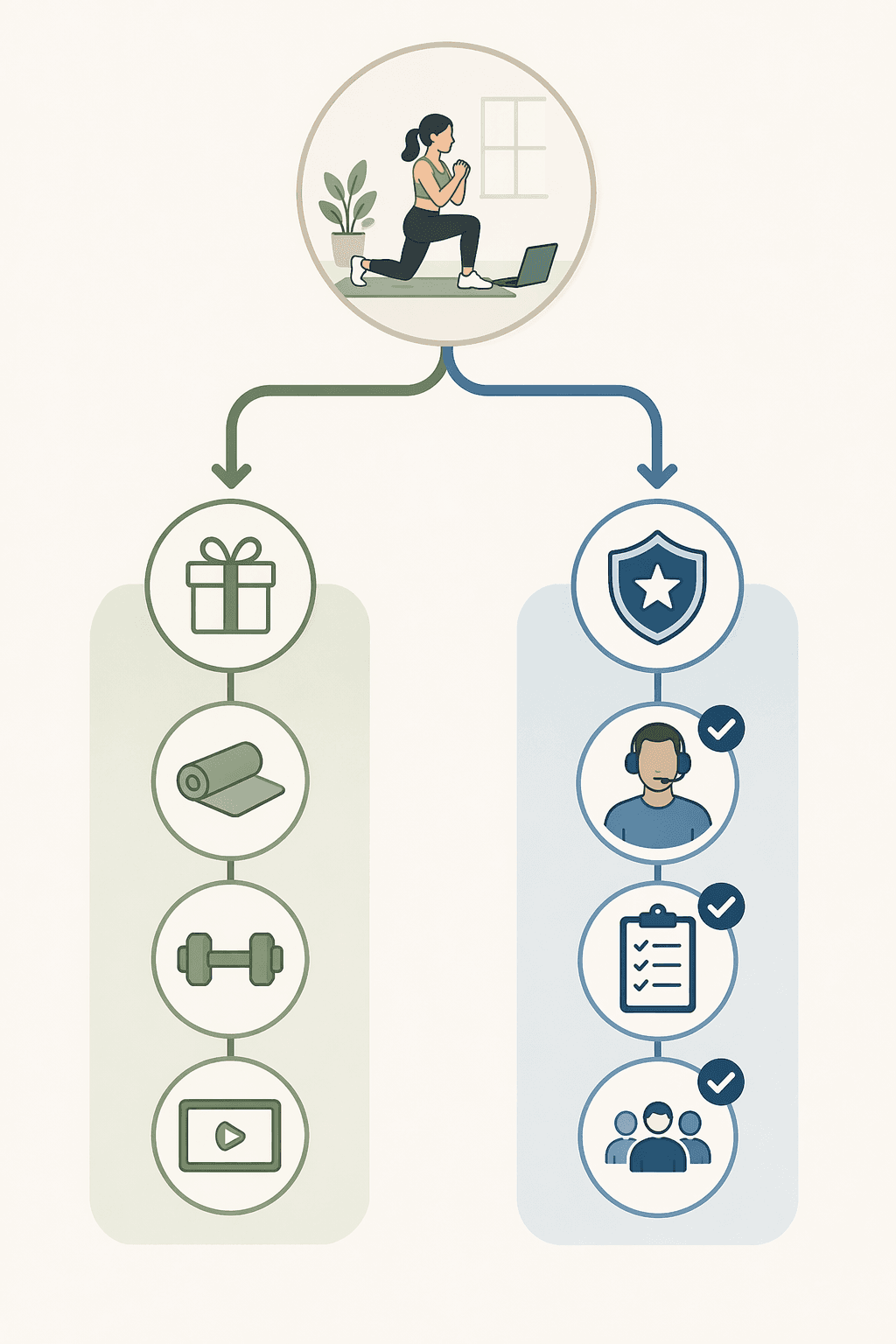
This is where the expensive ceiling case is useful. Future costs $199 per month, which would be absurd if judged as a normal workout-video app. But Future is not really selling a video library as its main product; it is selling one-on-one remote coaching. At that point, the comparison shifts from “paid app versus free app” to “remote coaching service versus other coaching options” [5].
That does not make $199 per month broadly reasonable. It just clarifies the standard. The more an app charges, the more it needs to behave like a service that actively changes your training, not like a prettier container for workouts you could have found elsewhere.
A paid app is defensible when you can name the missing job
Before starting a trial, finish this sentence: “I am paying because the free app cannot ______.” If the blank is vague — motivate me, keep me on track, make fitness easier — wait. If the blank is specific, the case is stronger.
- “The free app cannot adjust my workouts around knee pain or equipment limits.”
- “The free app cannot build a progressive strength plan beyond beginner sessions.”
- “The free app cannot review my training and tell me what to change.”
- “The free app cannot combine the planning, logging, and accountability tools I am currently paying for separately.”
Those are different from “the free app has fewer classes” or “the paid screen looks better.” More content can help if you use it. It can also become a bigger menu that delays the workout.
Watch the trial, not the homepage
Most app homepages are designed to make the subscription feel inevitable. The trial is where the truth shows up. By the third workout, you should know whether the app is giving you a complete training path or simply letting you preview the useful part before locking it.
A good trial answers practical questions quickly:
- Can you complete a full week without hitting a paywall?
- Does the app tell you what to do next, or only offer a large library?
- Does logging take less effort than your current method?
- If the app claims personalization, what actually changes in your plan?
- If the app claims accountability, who or what is holding you accountable?
- Can you cancel before billing without hunting through menus?
This is also where freemium traps matter. A free app that hides the real plan, blocks progression, or waits until you have invested time before revealing the useful tier is not free in any meaningful planning sense. For a deeper warning list, see What Free Workout Apps Don’t Tell You — 5 Red Flags.
What the best exercise apps should earn
The best exercise apps for a budget-conscious home exerciser are not always the ones with the longest feature lists. They are the ones that make a clear bargain: here is what you can do for free, here is what payment adds, and here is why that paid feature might change your training.
A free app deserves the first shot when your main needs are consistency, basic strength training, simple cardio, mobility, or workout logging. A paid app deserves consideration when the free option fails at a specific job that matters to your progress. The distinction sounds small, but it is the difference between buying help and collecting subscriptions.
Use this spending rule before starting any new fitness-app trial: start with the strongest free app that fits your training style, then pay only if you can name the exact feature the free tier lacks and explain how that feature will change what you do next week.
References
- 2026 Fitness App Statistics Report, Mobile Squad
- Best Workout Apps, Garage Gym Reviews
- The Best Workout Apps, PCMag
- Best Fitness Apps, Forbes
- Future Personal Training App Pricing, Future
Comments
Join the discussion with an anonymous comment.