
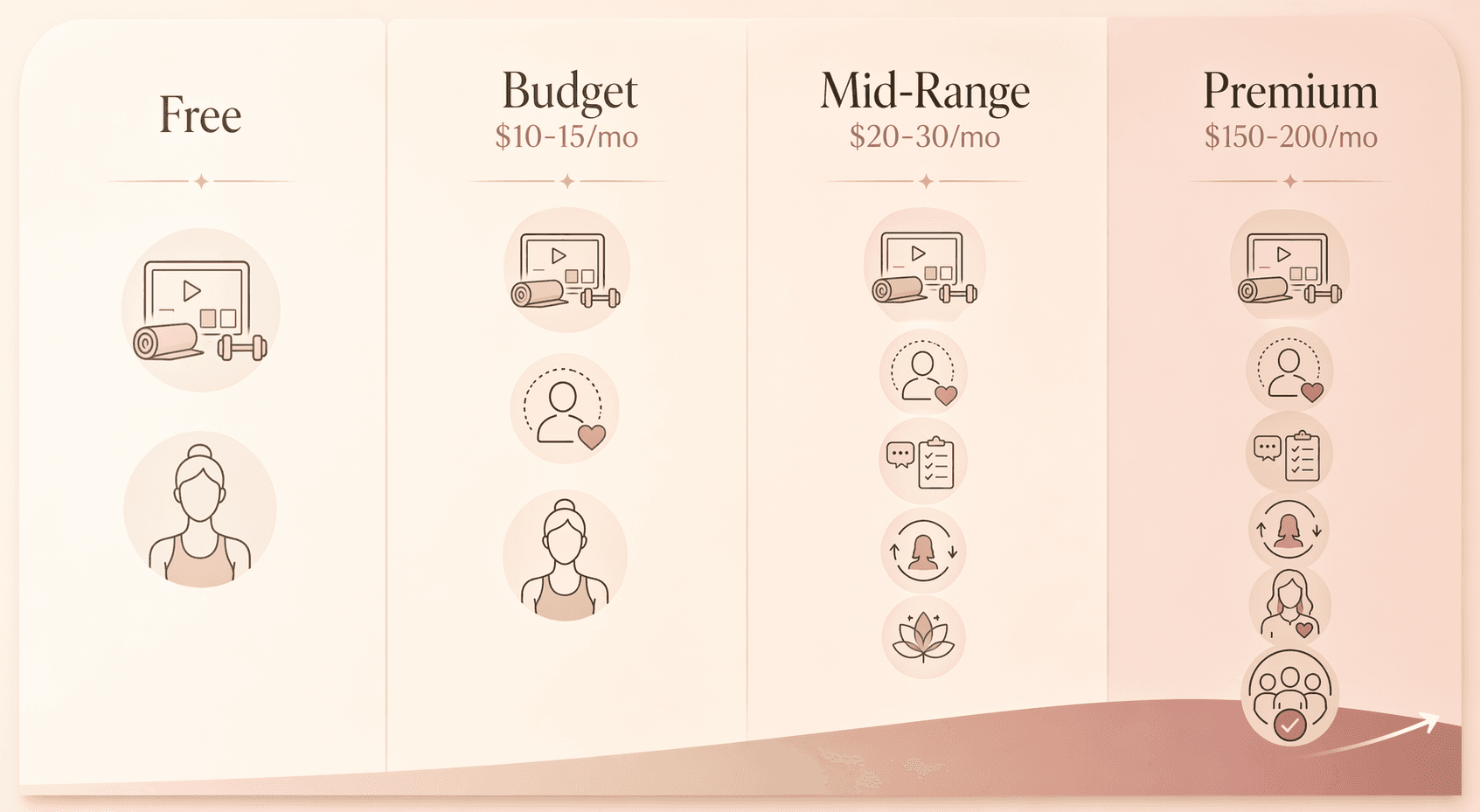
If you are comparing fitness apps for women in 2026, the uncomfortable truth is that “paid” no longer automatically means “better.” Free apps have become good enough that another monthly charge only makes sense when it removes a specific ceiling you are actually hitting: you need progression, a coach who responds, nutrition that connects to your training, or programming for pregnancy, postpartum, perimenopause, menopause, or cycle-related symptoms.
That is different from paying because an app has prettier branding, more classes, a pinker dashboard, or a seven-day “free” trial that quietly becomes one more subscription. Workout quantity is no longer the scarce thing. The scarce thing is useful direction.
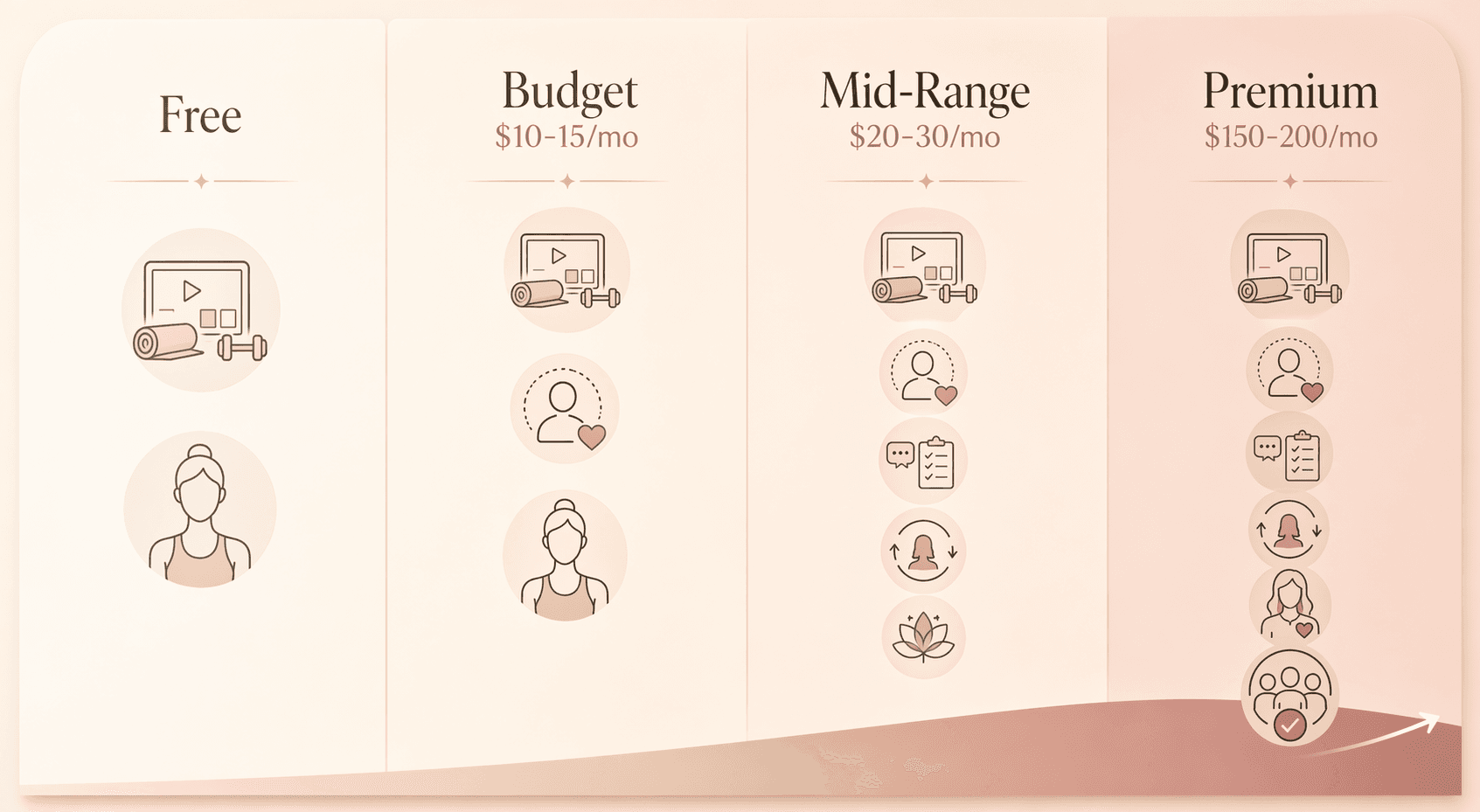
What you usually get at each price tier
Prices move constantly, especially when apps test annual plans, launch discounts, or route subscriptions through Apple and Google. So the cleaner way to compare tiers is not “which app wins?” It is: what kind of problem does this tier usually solve, and what does it still leave you to manage alone?
| Tier | Typical monthly cost | What it usually includes | What it often still lacks | Who should stop here |
|---|---|---|---|---|
| Free | $0 | Large on-demand workout libraries, video instruction, trainer-led classes, beginner-to-advanced variety, often no ads in the strongest free options | True progressive overload, individualized programming, nutrition integration, cycle-syncing, moderated accountability, coach feedback | You want variety, instruction, and consistency, and you can choose your own plan without getting lost |
| Budget paid | $10–15/month | More structured plans, better filtering, saved programs, habit tools, sometimes basic personalization or simple meal guidance | Limited coaching, limited adaptation, generic “personalization,” lighter community moderation | You need structure more than coaching and want a low-cost upgrade from browsing workouts |
| Mid-range | $20–30/month | Women-focused programs, multi-week strength plans, app communities, trainer-branded programming, pregnancy/postpartum or cycle-related options in some apps, nutrition add-ons in some plans | Human feedback may still be limited; “personalized” can mean quiz-based plan assignment rather than active adjustment | You need programming that shapes your week and are willing to pay if it changes what you actually do |
| Premium | $150–200/month | Higher-touch coaching, more direct accountability, individualized adjustments, check-ins, specialized support, sometimes deeper nutrition coaching | Cost, coach quality variation, and the risk of paying for intensity when you mainly needed a better plan | You need a human in the loop, have a specific constraint, or consistently stall without outside accountability |
The average workout app cost has been reported around $34/month, while many women-focused apps sit closer to the $15–25/month band, which makes the mid-range feel almost normal even when it is still a meaningful recurring cost [1]. That price normalization is exactly why the upgrade decision deserves more scrutiny, not less.
Free is no longer the throwaway tier
The biggest reason to pause before paying is simple: some free apps are no longer stripped-down teasers. Nike Training Club and Alo Wellness Club have both been identified in current workout-app roundups as fully free options with substantial workout libraries led by certified instructors [2][3]. That changes the baseline.
For many women, that baseline is enough. If your real need is “give me a solid 30-minute strength session,” “help me do yoga without opening YouTube,” or “let me train at home without ads,” a strong free library can do the job. You can build a week from full-body strength, mobility, Pilates-style sessions, yoga, HIIT, core, and recovery work without handing over your card.
This is where I would be slow to upgrade. If the paid app is mainly offering more workouts, ask yourself whether more choice has ever been the thing missing from your routine. Often it is not. More choice can become more scrolling, more switching, and more unfinished programs.
Free makes the most sense when you already know how to select workouts for your goal. A beginner can still use free apps well, but she may need to follow a simple self-made rule: choose three strength workouts per week, repeat them for several weeks, and add difficulty gradually. Without that kind of constraint, even a high-quality library can become a fitness buffet.
Where free starts to break down
The free ceiling usually appears when you stop needing instruction and start needing progression. A video can show you how to squat. It may not tell you when to increase load, when to deload, how to balance lower-body volume with running, or what to do when your cycle, sleep, joint pain, childcare, travel, or perimenopause symptoms interrupt the plan.
Free apps also tend to leave nutrition and accountability separate. That is fine if you like keeping food, training, recovery, and habit tracking in different places. It becomes annoying when the reason you are stuck is not effort, but coordination. A free workout library can be excellent and still fail to answer the question: “What should I do next week based on what happened this week?”
- Stay free if you mainly need guided workouts, instructor quality, and variety.
- Consider paying if you repeat random workouts but are not getting stronger, more consistent, or more confident.
- Do not pay just because an app calls a workout calendar “personalized.” Check what actually changes when you log fatigue, missed workouts, pain, equipment, or progress.
The budget tier: worth it only if it reduces decision fatigue
The $10–15/month tier is where a paid app has to earn its keep against very competent free options. At this price, the upgrade is rarely about elite coaching. It is usually about structure: better programs, better filters, workout calendars, simple progress tracking, habit streaks, saved favorites, and sometimes basic meal guidance.
That can be enough. If you open a free app and spend ten minutes deciding between glutes, Pilates, HIIT, strength, barre, and mobility, a budget plan that says “do this today” may be worth more than a giant library. The value is not glamour. It is fewer tiny decisions before you train.
But this is also the tier where vague language gets slippery. “Personalized” may mean you took a quiz once and the app placed you into a prebuilt plan. That is not useless, but it is not the same as programming that adapts because you missed two workouts, increased your dumbbell weight, reported pelvic discomfort, or hit a plateau.
Before paying at this tier, look for the boring details: Can you preview the full program? Does the plan tell you when to repeat workouts? Does it track weights, reps, or perceived effort? Can you swap exercises around your equipment without breaking the plan? If the app cannot answer those questions, you may be paying for a neater interface around the same self-direction you already had for free.
Mid-range apps are where the upgrade question gets harder
The $20–30/month tier is where many recognizable fitness apps for women cluster. This is also where the marketing becomes most emotionally fluent: strength, confidence, hormones, community, accountability, transformation. Some of that is meaningful. Some of it is packaging.
Sweat is the obvious benchmark because it is one of the most established women-first paid fitness apps, with more than 1 million monthly active users reported and pricing around $25/month in the market data used for this comparison [4][5]. It is useful less as a “winner” than as a reference point: if an app charges in that neighborhood, it should be doing more than serving a pile of workouts.
Apps in this range, including names such as Sweat, EvolveYou, Ladder, WeGLOW, and similar women-focused platforms, should be judged by the problem they solve. A strength-focused app should help you progress, not just sweat. A trainer-led app should give you a plan that makes sense across weeks. A community-heavy app should show signs of moderation, specificity, and actual accountability, not just a feed of strangers posting wins.
This is the tier where I would pay if the app changed the shape of my week. For example, if it gives you a four-day lifting plan, tells you which exercises to repeat, tracks load or reps, includes substitutions for home equipment, and keeps you from restarting every Monday, that has real value. If it also gives you credible prenatal, postpartum, perimenopause, or menopause-aware programming, the case can get stronger for someone in that life stage.
Cycle-syncing and life-stage programming need a sharper filter
Cycle-syncing is one of the clearest paid differentiators right now, but it should not be treated as magic. It can be useful if an app helps you adjust intensity, recovery, or workout selection when symptoms affect your training. It is less useful when it simply renames workouts by cycle phase and acts as if every woman responds the same way.
The same caution applies to pregnancy, postpartum, perimenopause, and menopause content. A paid app can absolutely be worth it if it gives you safer modifications, pelvic-floor-aware progressions, lower-impact options, strength programming that respects recovery, or education that helps you stop guessing. But the value is in the specificity, not the label. “Menopause program” or “hormone-friendly training” is only meaningful if the actual workouts and guidance change.
If life stage is the reason you are shopping, compare apps on content depth rather than brand tone. How many weeks of programming are there? Who teaches it? Are modifications built into the session, or buried in a blog post? Does the app explain when to seek clinical guidance instead of pretending fitness programming can solve everything?
Community is only valuable when it changes behavior
A community tab can be helpful. It can also be a very expensive comment section. The difference is whether the community creates useful accountability: check-ins, small groups, coach participation, challenge structure, moderation, or support around a specific goal or life stage.
If you are paying mid-range prices partly for community, inspect what you are buying. A large user base does not automatically mean better support. A smaller, moderated space around strength training after pregnancy or lifting through perimenopause may be more useful than a huge general feed full of motivation posts.
Premium pricing should mean a human is actually involved
At roughly $150–200/month, the app should stop behaving like a content library and start behaving like a service. The most defensible reason to pay premium pricing is direct coaching or a high-accountability model: someone reviews what you did, adjusts the plan, answers questions, and notices when the plan and your life are no longer matching.
This tier can make sense if you have a specific goal, a history of stopping and restarting, a complicated schedule, a return-from-injury context that has already been cleared by an appropriate clinician, or a life-stage need that generic programming has not handled well. It can also be overkill. If what you need is a progressive dumbbell program and a calendar, a premium coaching app may be solving a more expensive problem than the one you actually have.
The word to interrogate here is “coaching.” Automated nudges are not the same as coaching. A chatbot is not the same as a qualified trainer reviewing your form notes, training logs, and constraints. Even a real coach can vary in quality, response time, and scope. Before paying premium prices, confirm how often you get feedback, who provides it, what credentials they have, whether nutrition is included, and what happens when you miss workouts.
Why the pricing pressure feels so targeted
The pressure to subscribe is not accidental. Fitness app revenue is heavily subscription-driven, with one 2026 industry statistics source reporting that subscriptions account for 65% of fitness app revenue and that iOS users spend twice as much as Android users [5]. Business of Apps reports that women contribute 67% of health and fitness app revenue [4]. If you feel like the upgrade prompts are built around you, they probably are.
That does not make paid apps bad. It does mean the buyer has to be more disciplined than the funnel. Women are not a side audience in this category; they are a major revenue center. Pastel branding, empowerment copy, cycle language, and “community” features are all easier to launch than genuinely adaptive training.
Market-size estimates also vary depending on whether a source includes wearable companion apps, wellness platforms, meditation-adjacent apps, or broader women’s health tools. Precedence Research, for example, tracks the women’s health app market as a large and growing category, including fitness and nutrition within a broader health-app landscape [6]. Treat those market numbers as directional context, not as proof that any one subscription is worth your money.
A practical upgrade test
Before starting another trial, write down the exact ceiling you are trying to solve. If you cannot name it, stay free for now. A vague desire to be more motivated is not enough information to choose a subscription tier.
| If your current problem is... | The tier most likely to help | What to check before paying |
|---|---|---|
| You are bored and want different workouts | Free | Whether Nike Training Club, Alo Wellness Club, or another genuinely free app already gives you enough variety |
| You waste time deciding what to do | Budget paid | Whether the app gives you a clear weekly plan, not just better browsing |
| You are not progressing in strength or fitness | Mid-range | Whether it tracks progression, repeats key workouts, and tells you when to increase difficulty |
| You need pregnancy, postpartum, perimenopause, menopause, or cycle-aware programming | Mid-range or premium | Whether the content is specific, taught by credible instructors, and built into the program |
| You need someone to notice, respond, and adjust the plan | Premium | Whether a real coach reviews your training and how often feedback happens |
| You want nutrition connected to training | Mid-range or premium | Whether the nutrition tools are integrated, realistic, and within the provider’s scope |
The cleanest decision is this: stay free if workout variety and quality instruction are enough. Move to budget paid if structure removes friction. Move to mid-range if progression, women-specific programming, nutrition, or a useful community would change what you do week to week. Consider premium only when real coaching and accountability would solve a problem that content alone has not solved.
A paid app is worth it when it changes your behavior in a way a free library does not. If it only gives you more workouts to scroll through, keep your money.
References
- Best Workout Apps, Garage Gym Reviews, 2026, https://www.garagegymreviews.com/best-workout-apps
- Best Workout Apps, Good Housekeeping, 2026, https://www.goodhousekeeping.com/health-products/g27112869/best-workout-apps/
- Best Workout Apps for Women, Women's Health, 2025, https://www.womenshealthmag.com/fitness/g21971119/best-workout-apps-for-women/
- Fitness App Market, Business of Apps, 2026, https://www.businessofapps.com/data/fitness-app-market/
- Fitness App Industry Statistics, WifiTalents, 2026, https://wifitalents.com/fitness-app-industry-statistics/
- Women's Health App Market, Precedence Research, 2026, https://www.precedenceresearch.com/womens-health-app-market
Comments
Join the discussion with an anonymous comment.