
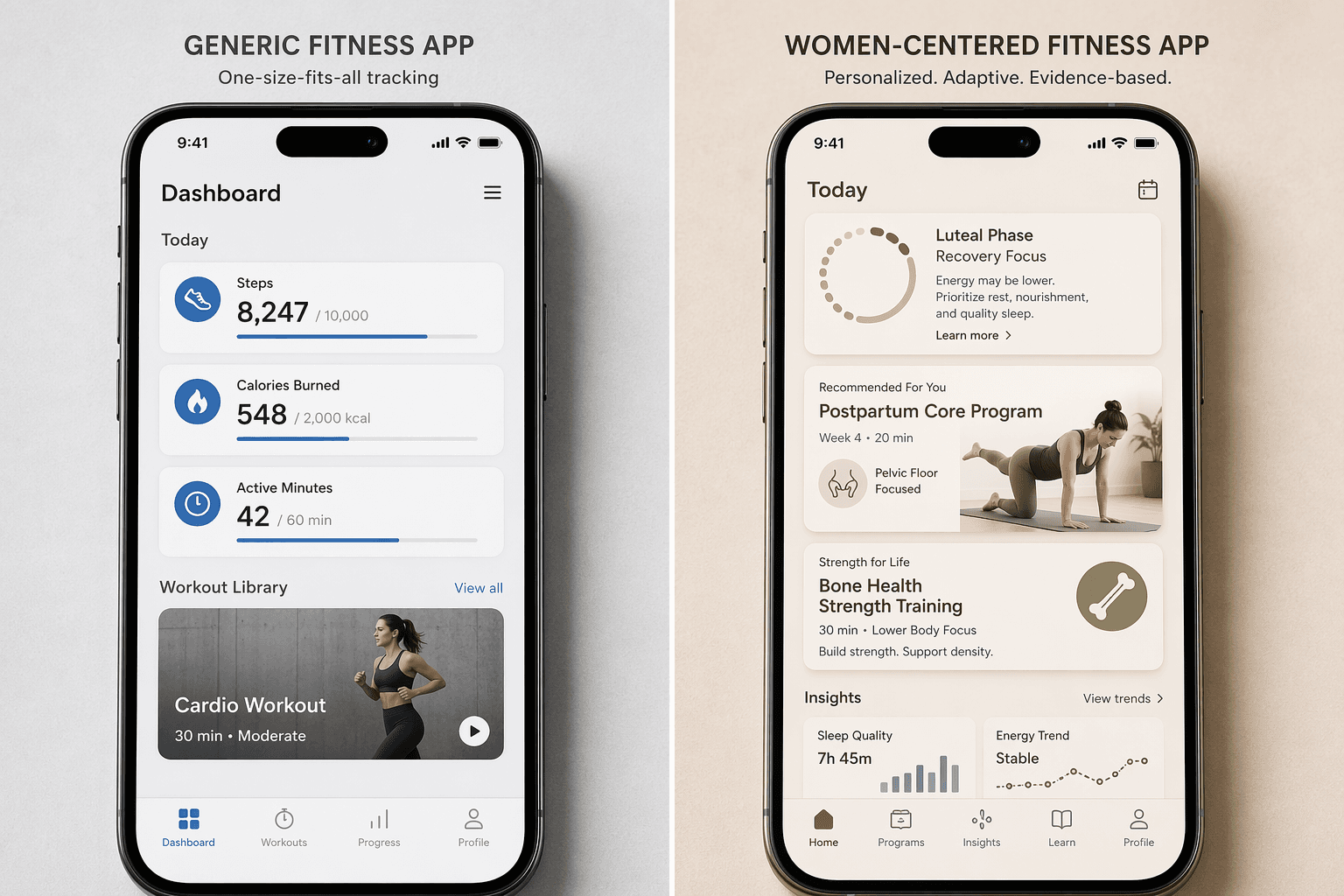
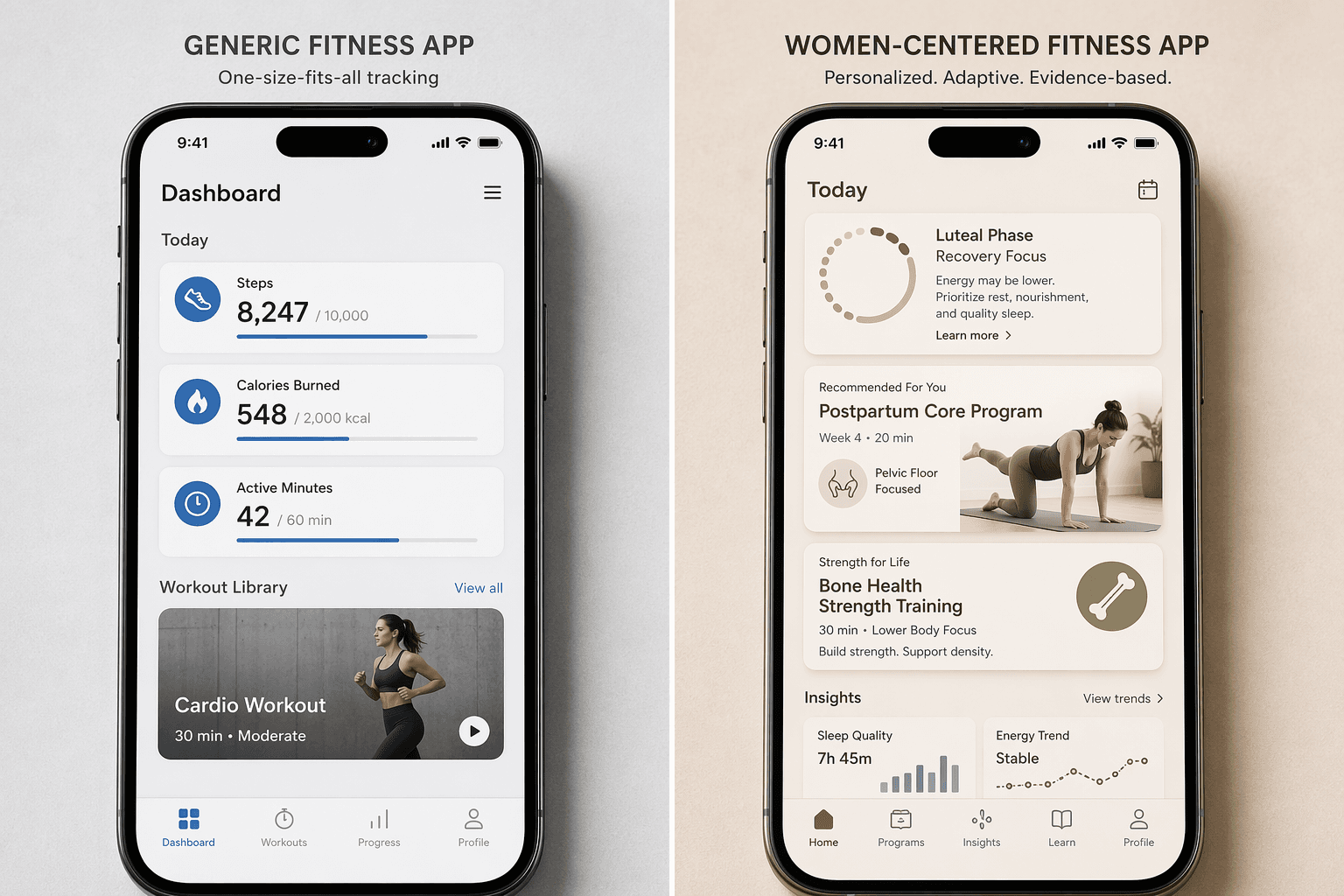
If you've shopped for a fitness app in the last year, you've seen the pitch: cycle-synced workouts. Wild.AI tracks five phases of the menstrual cycle and adjusts training accordingly. WeGLOW has more than 2,500 workouts it claims are cycled. Obé offers cycle-syncing classes plus perimenopause support. The message is seductive—what if your workouts could match your hormones and unlock better results?
It would be great if it were that simple. But the evidence for phase-based workout timing is thinner than the marketing suggests. And the real differentiator in women’s fitness apps might be something else entirely.
What the McMaster Study Actually Found
In March 2025, researchers at McMaster University published a randomized controlled trial in the Journal of Physiology that directly tested whether menstrual cycle phase affects muscle protein synthesis after heavy resistance exercise. The answer was clear: no effect. The study monitored participants’ cycles for three months to confirm normality, then tested muscle protein synthesis at different phases. Lead author Lauren Colenso-Semple put it plainly:
We saw no differences, regardless of cycle timing.
This directly challenges the core premise of cycle-synced training—that timing resistance workouts to a specific phase gives a hormonal advantage for muscle growth. For apps that market phase-based workout timing as a performance differentiator, this study pulls the rug out. Clue, the period-tracking app, goes further: it states that the evidence for cycle-syncing is limited and that cycles vary greatly from person to person and cycle to cycle, making rigid phase-based prescriptions misleading.
Important: The McMaster study measured muscle protein synthesis in young women. It did not test other claimed benefits of cycle-syncing such as injury prevention, perceived energy, or adherence. The study's conclusion is specific, but it hits the central claim that most apps use.
The study also noted that only about 12% of women have a consistent 28-day cycle with ovulation on day 14—the textbook cycle that many phase-based recommendations assume. If the premise rarely matches reality, the prescription becomes more guesswork than science.
Where Cycle Tracking Still Helps
None of this means cycle tracking is useless. There is reasonable evidence that hormonal fluctuations, particularly in the luteal phase, increase ligament laxity and raise the risk of ACL tears—something Wild.AI cites in its injury-prevention features. Tracking one’s own energy levels and adjusting accordingly, as Clue recommends, is a sensible approach for self-awareness and adherence, even if the research hasn’t yet proven performance gains.
But the gap between what the science supports and what many apps claim remains wide. So where should a woman looking for a genuinely differentiated fitness app place her attention?
The Real Differentiator: Life-Stage Support, Not Phase Timing
The strongest evidence in women’s fitness programming aligns not with the menstrual cycle’s four-to-five phases, but with the broader, structurally consequential transitions of life: prenatal, postpartum, and perimenopause. These stages involve documented physiological changes—pelvic floor weakening, muscle atrophy, bone density loss—that respond well to targeted exercise. Apps that offer programming for these life stages rest on far more straightforward reasoning and better evidence.
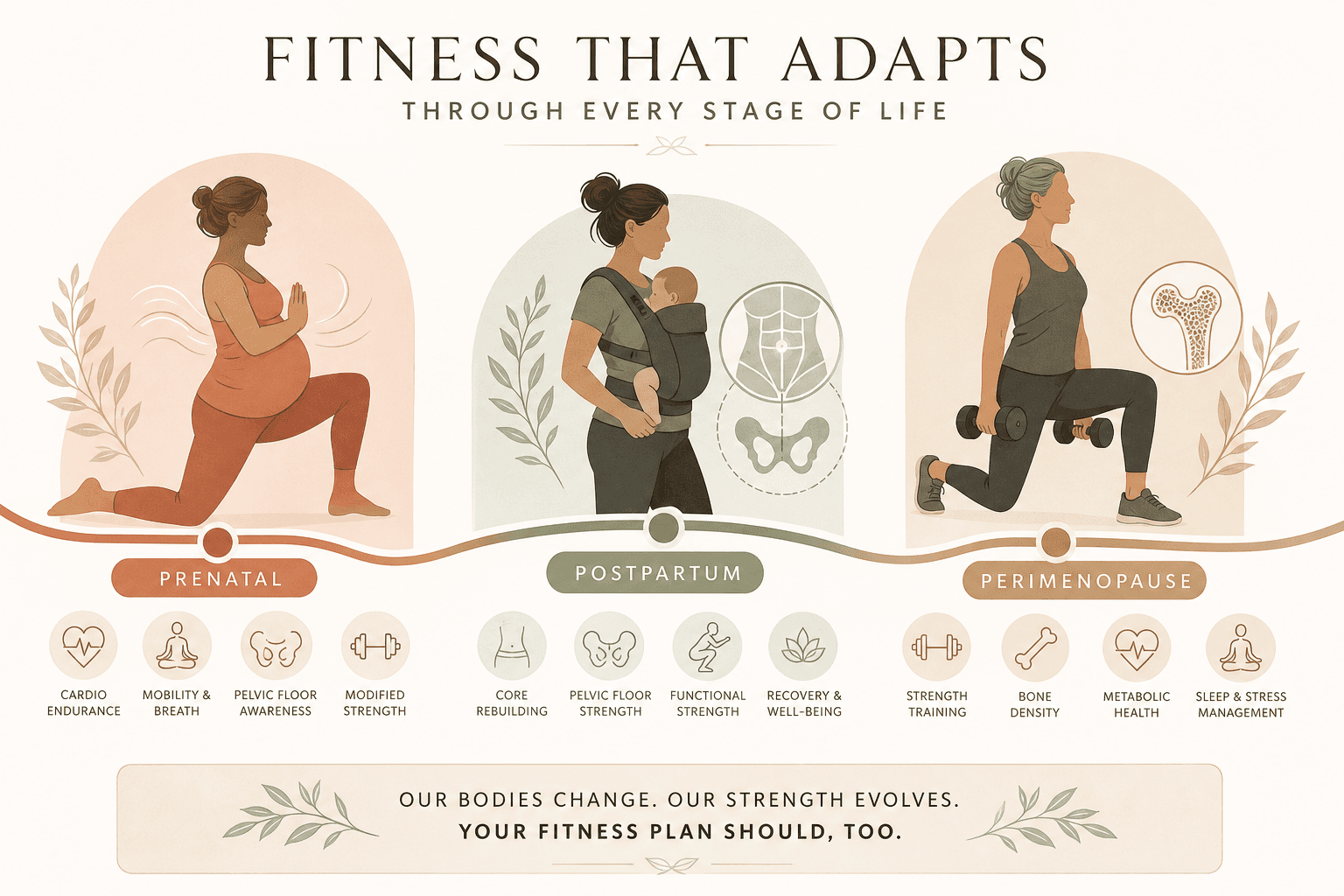
Take prenatal and postpartum programming. Bloom Method offers a $29.99/month plan focused on core and pelvic floor recovery. Sweat (1 million+ users, $25/month) includes dedicated post-pregnancy programs. Menovation is perimenopause-specific, and Obé ($27/month, 16,000+ classes) now offers perimenopause support alongside its cycle-syncing workouts. The Sweat blog cites Watson et al. 2018 on load-bearing exercise improving bone density in postmenopausal women, and Westcott 2012 on two sessions per week of progressive resistance training halting muscle atrophy. This is concrete, applicable physiology—no phase calibration required.
The market is paying attention. The workout apps for women segment was valued at $5.64 billion in 2026 and is projected to grow at a 17% CAGR. That demand is unlikely to be driven by phase-based timing alone. Women want programming that understands their body through pregnancy, postpartum recovery, and perimenopause—stages that involve years, not days.
How to Choose: A Short Decision Framework
When you evaluate a women’s fitness app, shift your questions away from phase-based gimmicks. Instead, ask these three things:
- Does the app offer programming for the life stage you are in—prenatal, postpartum, perimenopause? This is the single most evidence-backed differentiator.
- Does it let you track your own energy and cycles without prescribing rigid workouts by phase? Flexibility beats prescription when cycles vary so dramatically.
- Is the price justified by features that are actually useful to you? Bloom Method ($29.99/mo), Sweat ($25/mo), and Obé ($27/mo) offer very different scopes. A free app like Nike Training Club might give you all you need if cycle-syncing isn't a priority.
For a deeper dive into the specific features of cycle-tracking apps, see our comparison of apps that sync with your cycle. For perimenopause-specific programming, read our guide to hormone-conscious training for women over 40. When the question is free vs. paid, check our verdict on when a subscription is actually worth it. And for a broad 2026 comparison across training style and pricing, see the full feature-by-feature roundup.
Cycle-syncing may one day be supported by stronger research. For now, the most honest answer a fitness app can give you is not “timed to your period” but “designed for your life.”
Comments
Join the discussion with an anonymous comment.