
The Four Monetization Models Behind 'Free' Fitness Apps
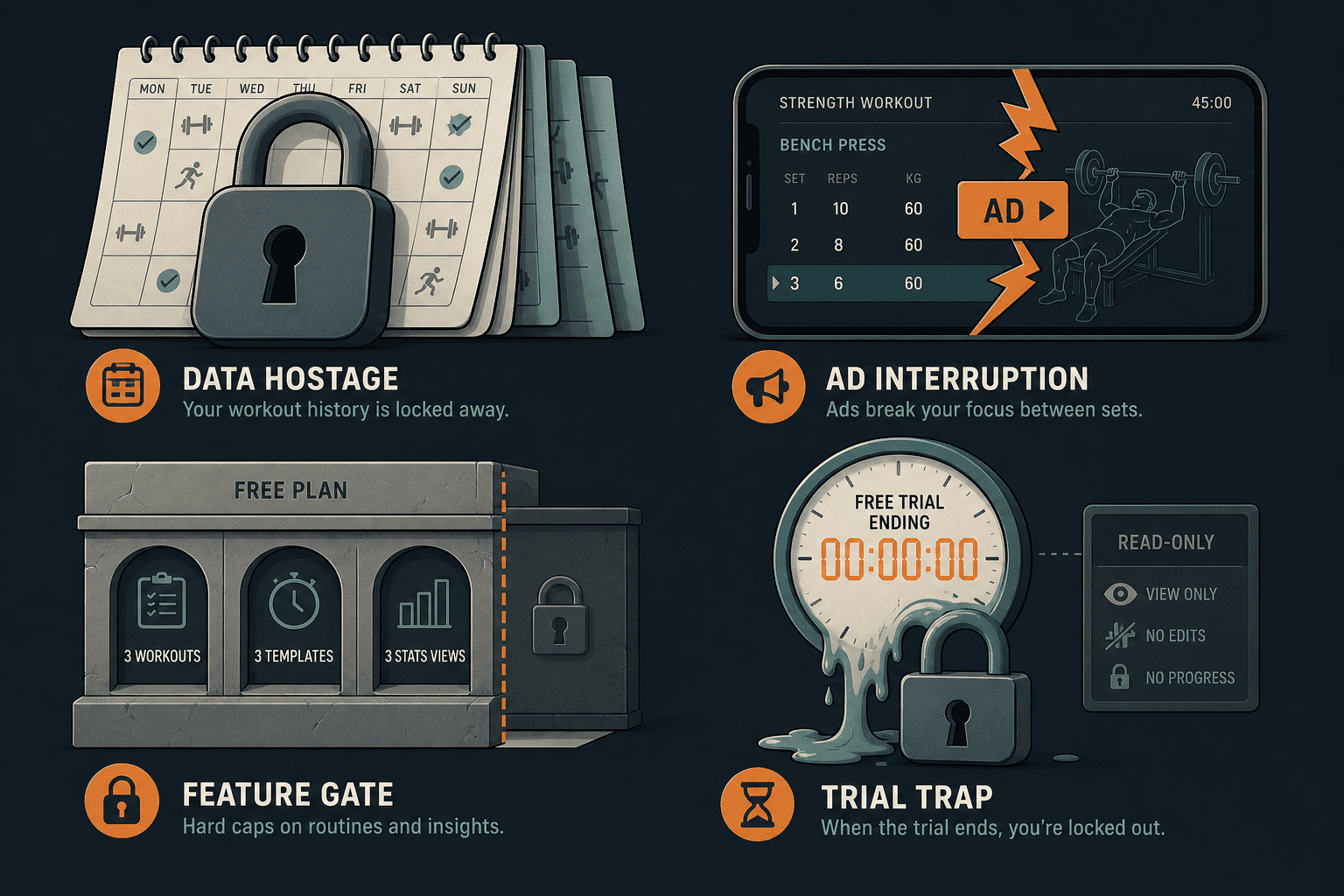
The fitness app industry has perfected a set of psychological locking mechanisms that turn your own workout data into a subscription conversion tool. These aren't bugs — they're deliberate design patterns. Understanding the four primary monetization models gives you a detection framework that works regardless of which app you're evaluating.
Every "free" fitness app falls into one or more of these categories:
- Data hostage: The app lets you log workouts freely, then restricts access to your own history after 30–90 days unless you subscribe. Your accumulated progress becomes leverage.
- Ad interruption: The free tier fires full-screen interstitials between sets, disrupting your workout flow and rest timing. This is particularly damaging for strength training where rest periods directly affect performance.
- Feature gating: The free version imposes hard caps — three custom routines, ten exercises, no set-history pre-fill. The cap is set just high enough to get you started, then frustratingly low once you're invested.
- Trial trap: A short free trial (7–14 days) that converts to a read-only state where you can view but not log new data. This is the most aggressive model and the easiest to spot if you know what to look for.
The rest of this guide walks through each model in detail, then audits the most popular free fitness apps against all four. By the end, you'll have a repeatable test you can run on any app before committing your workout history to it.
The Data Hostage Model: Your Workout History as Leverage
The data hostage model is the most insidious because it feels fair at first. You download the app, start logging sets, and everything works. After a month or two of consistent tracking, you've built a detailed record of your progress — weights lifted, reps achieved, body measurements, personal records. Then the app informs you that viewing anything older than 30 days requires a subscription.
This isn't a storage limitation. It's a deliberate conversion funnel. The app knows that your workout history is valuable to you — it represents months of effort and progress data you can't easily recreate. By restricting access to that history, the app creates a psychological lock-in that makes you more likely to pay than to start over elsewhere.
Which apps use this model?
Jefit restricts free users to viewing only the most recent 30 days of workout history. Older logs are hidden behind the Elite subscription. Strong limits free users to three custom routines — enough for a first month, frustrating by month two when you want to rotate through different splits. Both apps are otherwise functional for logging, which makes the restriction feel arbitrary and punitive.
Which apps don't?
Hevy, Caliber, and Boostcamp all offer unlimited workout history on their free tiers. You can scroll back through months or years of logged sessions without hitting a paywall. Nike Training Club, which has been completely free since 2020, also imposes no history restrictions — though its focus is guided workouts rather than strength logging, so the data hostage dynamic is less relevant there.
| App | Free Tier History Limit | Export Available? |
|---|---|---|
| Jefit | 30 days | No |
| Strong | 3 custom routines (effectively limits history organization) | No |
| Hevy | Unlimited | Yes (CSV) |
| Caliber | Unlimited | Yes (CSV) |
| Boostcamp | Unlimited | Yes (CSV) |
| Nike Training Club | Unlimited (guided workouts only) | N/A |
The Ad Interruption Model: Stealing Your Rest Periods
For strength training, rest periods between sets are not downtime — they're a training variable. A 90-second rest between heavy squats is part of the program. A 30-second ad that plays during that rest window is not just annoying; it actively interferes with your workout structure.
The ad interruption model places full-screen video interstitials between logged sets. You finish a set, tap "Complete," and instead of seeing your rest timer, you're served a 30-second ad for a protein powder or a meditation app. By the time you dismiss it, your rest period is either cut short or extended unpredictably, which compromises the training stimulus you're trying to achieve.
Which apps use this model?
FitOn, Freeletics, and the free tier of many guided workout apps rely on ad revenue. FitOn's free version includes video ads between workout segments. Freeletics uses a freemium model where the free tier includes ads and limited access to its AI-coached workouts. Jefit's free tier also displays banner ads, though they're less intrusive than full-screen interstitials.
Which apps are ad-free?
Nike Training Club is completely ad-free on its free tier. Hevy, Caliber, and Boostcamp are also ad-free — they rely on premium subscriptions for revenue rather than advertising. Strong's free tier has no ads either, though its feature limitations (three custom routines) serve a similar friction purpose.
The Feature Gate Model: Hard Caps on Core Functionality
Feature gating is the most common monetization model among strength-tracking apps. The free tier provides a functional logging experience, but with hard caps on features that become essential as your training becomes more structured.
The most frequently gated features:
- Set-history pre-fill: When you open an exercise, the app automatically shows the weight and reps you used in your last session. This is the single most valuable free feature for progressive overload because it removes the friction of remembering what you lifted last week. Without it, you're guessing or flipping through notes.
- Custom routine limits: Strong limits free users to three custom routines. That's enough for a push/pull/legs split, but if you want to add a fourth routine for a specific goal or deload week, you're blocked.
- Exercise library restrictions: Jefit's free version reorders your exercises alphabetically and doesn't let you reorder them without the Elite subscription — a deliberate friction point that makes your workout feel disorganized.
- Progress charts and analytics: Many apps reserve graphs, volume tracking, and strength estimates for paid tiers. Without these, you're logging in the dark — you can see individual sessions but not trends.
Which apps gate set-history pre-fill?
This is the critical test. Jefit and Strong both reserve set-history pre-fill for their paid tiers. Hevy, Caliber, and Boostcamp offer it for free. If you're a strength trainee, this single feature determines whether the app supports progressive overload or forces you to remember last week's numbers.
| Feature | Hevy (Free) | Caliber (Free) | Boostcamp (Free) | Jefit (Free) | Strong (Free) |
|---|---|---|---|---|---|
| Set-history pre-fill | Yes | Yes | Yes | No | No |
| Custom routines | Unlimited | Unlimited | Unlimited | Limited (Elite) | 3 max |
| Exercise reordering | Yes | Yes | Yes | No (Elite) | Yes |
| Progress charts | Limited | Yes | Limited | No (Elite) | No |
| Ads | No | No | No | Banner ads | No |
The Trial Trap Model: 7 to 14 Days Then Read-Only Mode
The trial trap is the most aggressive monetization model because it doesn't even pretend to offer a sustainable free experience. You get a short window — typically 7 to 14 days — of full functionality. After that, the app switches to a read-only state where you can view your existing data but cannot log new workouts.
This model is common among apps that position themselves as premium from the start. Freeletics, for example, offers a limited free trial of its AI-coached training plans, after which users must subscribe to continue receiving personalized workouts. The app doesn't pretend to be free — it's a paid service with a trial period — but the marketing language often blurs the line.
The trial trap is less common among strength-tracking apps and more common among guided workout platforms and AI-coached programs. Nike Training Club is a notable exception — it was previously a subscription service but moved to a completely free model in 2020 and has remained free since.
App-by-App Audit: What Each App's Free Tier Actually Delivers
The following audit evaluates seven popular fitness apps against the four monetization models. The key question: can you use this app for a full year without paying, without ads disrupting your workouts, and without losing access to your own data?
| App | Data Hostage | Ad Interruption | Feature Gate | Trial Trap | Passes 'Free for a Year'? |
|---|---|---|---|---|---|
| Nike Training Club | No | No | No (full access) | No | Yes |
| Hevy | No | No | Minimal (limited charts) | No | Yes |
| Caliber | No | No | No (full access) | No | Yes |
| Boostcamp | No | No | Minimal (limited charts) | No | Yes |
| Jefit | Yes (30-day history) | Banner ads | Yes (exercise reorder, charts) | No | No |
| Strong | Yes (3 routine cap) | No | Yes (routine limit, no history pre-fill) | No | No |
| FitOn | No | Yes (video ads) | Yes (limited workout library) | No | Partial |
| Freeletics | N/A | Yes | Yes (limited AI coaching) | Yes (7-day trial) | No |
Notes on specific apps:
- Nike Training Club: Completely free since 2020. No ads, no subscription, no data hostage. However, it's a guided workout platform — you can't log your own custom strength routines. Best for users who want structured classes rather than self-directed training.
- Hevy: The strongest free tier for strength tracking. Unlimited routines, set-history pre-fill, ad-free, and CSV export. The only gated features are advanced analytics and custom charts — nice to have, not essential.
- Caliber: Similar to Hevy but with a coaching-oriented interface. Free tier includes unlimited tracking, set-history pre-fill, and progress charts. The paid tier adds personalized coaching programs.
- Boostcamp: Free tier includes access to community-created programs and unlimited tracking with set-history pre-fill. Gated features include advanced analytics and program creation tools.
- Jefit: The most restrictive free tier among major strength apps. 30-day history limit, no exercise reordering, banner ads, and no set-history pre-fill. The Elite subscription unlocks everything, but the free version feels deliberately crippled.
- Strong: Three custom routine limit is the primary gate. No ads, clean interface, but the routine cap becomes frustrating quickly for anyone running more than a basic split.
- FitOn: Free tier includes a large library of guided workouts but with video ads. The ad frequency makes it less suitable for strength training but acceptable for cardio and bodyweight sessions where rest periods are less critical.
- Freeletics: Primarily a paid service with a 7-day trial. The free tier after trial is extremely limited. Not suitable as a long-term free option.
The Data Portability Problem: Can You Export Your History?
Data portability is the ultimate test of whether an app serves your interests or holds your data hostage. If you can export your workout history as a CSV or JSON file, you retain the ability to switch apps without losing your progress data. If you can't, your history is effectively locked in — and that lock-in is a feature for the app, not a bug.
Which apps allow export?
| App | Export Format | Export Available on Free Tier? |
|---|---|---|
| Hevy | CSV | Yes |
| Caliber | CSV | Yes |
| Boostcamp | CSV | Yes |
| Jefit | None | N/A |
| Strong | None | N/A |
| Nike Training Club | N/A (no custom data to export) | N/A |
| FitOn | None | N/A |
| Freeletics | None | N/A |
The 'Log Three Sets, Close, Reopen' Test
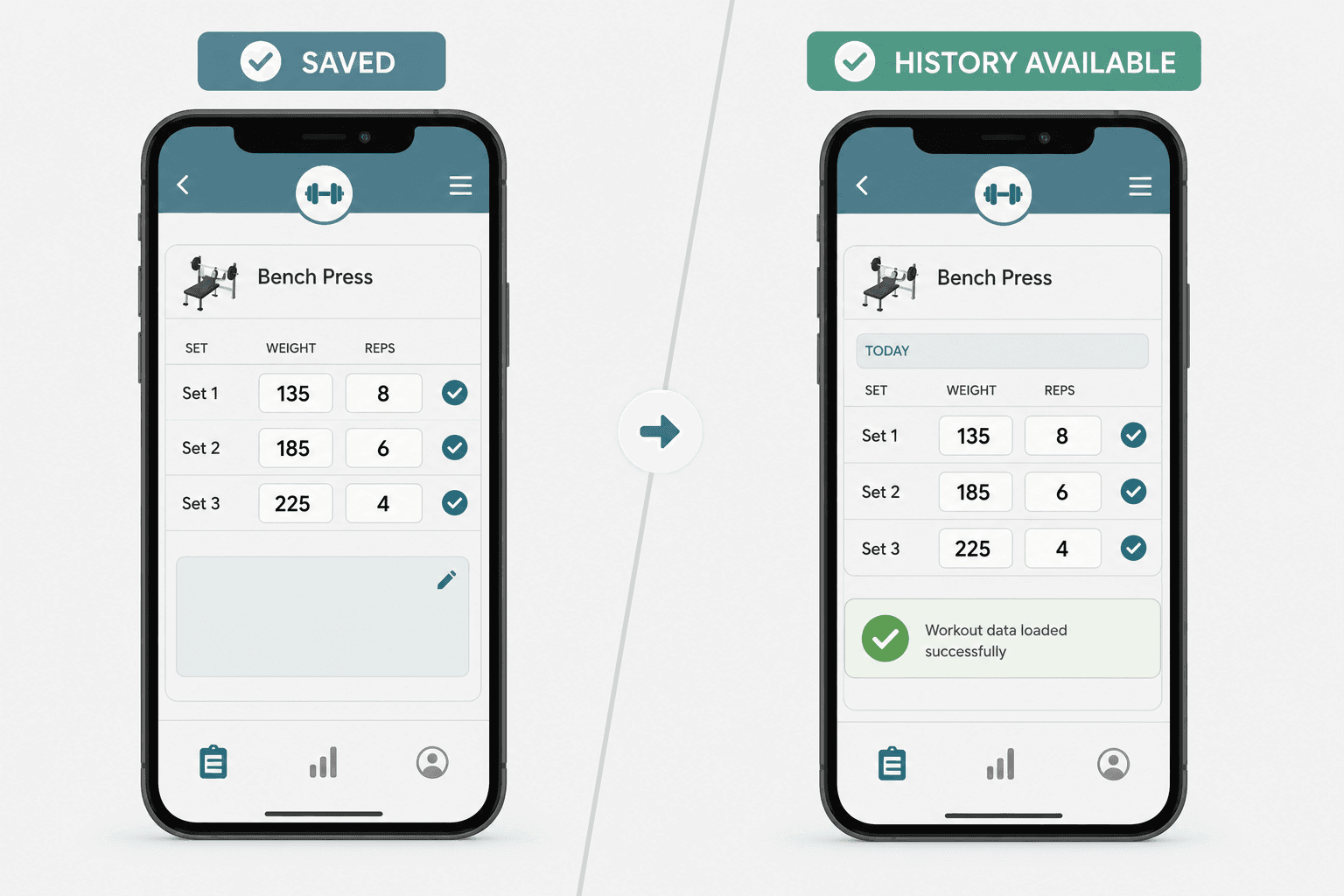
Here's a simple, repeatable test you can run on any fitness app before committing to it. It takes about two minutes and reveals which monetization model the app uses.
- Create a new workout. Add three sets of any exercise — bench press, squats, whatever. Log the weight and reps for each set.
- Close the app completely. Swipe it away from your recent apps list so it's forced to reload from scratch.
- Reopen the app. Navigate back to the workout or the exercise log.
- Check what happened to your data.
What each outcome reveals:
- Data is still there, and the app shows your last workout's weights when you start a new session: The app passes the test. It has set-history pre-fill (the most valuable free feature) and doesn't gate your own data. Hevy, Caliber, and Boostcamp all pass.
- Data is still there, but the app shows blank fields for weight and reps: The app stores your history but gates set-history pre-fill behind a subscription. You can see past workouts by scrolling, but you can't see last session's numbers while logging. Jefit and Strong behave this way.
- Data is gone or the app prompts you to subscribe: You've hit a trial trap or a data hostage wall. The app either deleted your session because the trial ended, or it's restricting access to your history. Delete the app and move on.
Verdict: Which Apps Pass the 'Free for a Year' Test?
After auditing the major free fitness apps against all four monetization models, three apps emerge as genuinely sustainable free options for strength training, and one for guided workouts.
- Hevy — Best overall free strength-tracking app. Unlimited routines, set-history pre-fill, ad-free, CSV export. The only gated features are advanced analytics that most users won't miss.
- Caliber — Best for users who want coaching-oriented tracking. Free tier includes everything you need for progressive overload, plus progress charts that Hevy gates.
- Boostcamp — Best for users who want community-created programs. Free tier includes unlimited tracking and set-history pre-fill, plus access to a library of programs created by other users and coaches.
- Nike Training Club — Best for guided workouts. Completely free, ad-free, no subscription. Not suitable for self-directed strength tracking, but excellent for structured classes, yoga, and bodyweight sessions.
The fitness app industry has indeed perfected psychological locking. But once you understand the four models — data hostage, ad interruption, feature gating, and trial traps — you can evaluate any app in minutes rather than months. The apps that pass the 'free for a year' test are the ones that treat your workout data as yours, not as leverage.
Comments
Join the discussion with an anonymous comment.