
You Didn’t Fail. The List Did.
You opened the App Store, found twenty “best for beginners” lists, downloaded the top recommendation, opened it three times, and then stopped. That pattern is not a motivation problem. It is a matching problem. The lists assume you have a gym membership, a clear goal, and a personality that thrives on following a video alone. If any of those is wrong, you quit. I have watched this happen enough to know: the app didn’t fail you. The list failed you.
This article doesn’t give you another ranked list. It gives you four questions to ask before you download anything. The fourth question is the one that determines whether you’ll still be opening the app on day 15.
Four Questions to Answer First
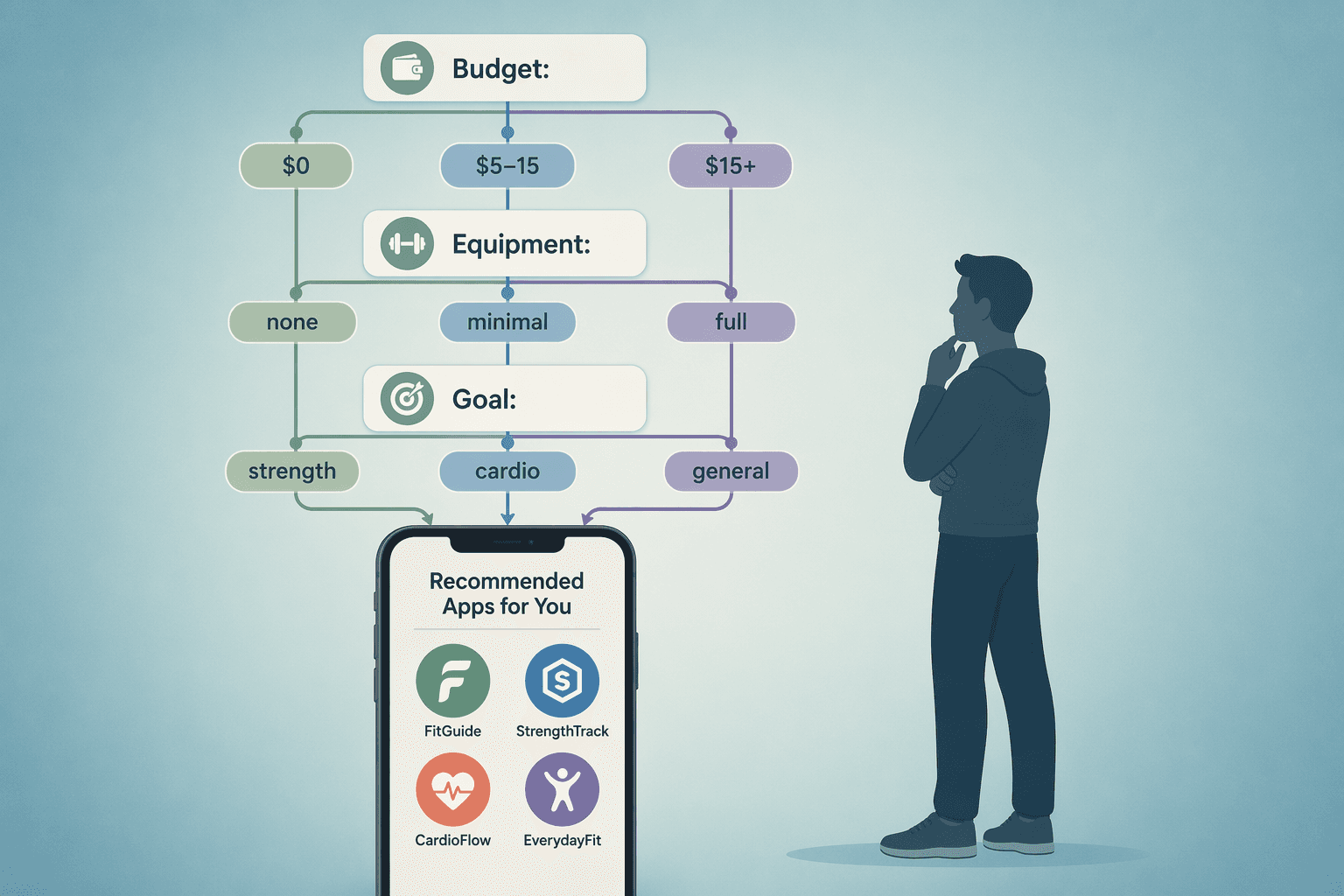
Before you look at any app, map yourself on four scales:
- Budget — $0, $5–15, or $15–200 a month. Not what you can afford—what you are ready to commit.
- Equipment — None (bodyweight), minimal (dumbbells, bands, a mat), or full gym. Your setup now is your starting point.
- Goal — Strength, cardio, weight loss, or general fitness. You don’t need one perfect answer; the app you choose will still bias toward one.
- Accountability style — Self-directed (you plan and track alone), community (you show up because others do), or coach-led (someone checks in with you). Most lists ignore this. It kills motivation fastest when mismatched.
The One That Decides Everything
Two beginners. One downloads a free app with on-demand videos, opens it three times, quits. The other signs up for Future at $199 a month and sticks for six months. Lazy? No. The first person needed a human coach. The second got one. Future testers gave it a perfect score for accountability because a real coach designs workouts and checks in daily. That $199 is not a luxury—it is the price of a mechanism that works for people who need someone watching.
At the other end, Caliber offers free (self-directed), Pro at $19/month (group coaching), and Premium at $200+/month (1:1). Same app, three accountability tiers. The free version works if you are self-directed. If not, you will abandon it and blame yourself. The app’s quality is not the issue—the fit is. (And when you see Caliber’s “34% faster progress” claim, treat it as promotional data. The independent rating worth looking at is 4.6/5 from Garage Gym Reviews, which reflects real tester experience.)
Your Match in One Table
Start with your accountability style. Then combine it with budget, equipment, and goal. The table below maps realistic constraint combinations to apps that fit.
| Accountability | Budget | Equipment | Goal | Best match |
|---|---|---|---|---|
| Self-directed | $0 | None / minimal | Strength | Caliber (free) |
| Self-directed | $0 | Any | General fitness / variety | Nike Training Club |
| Self-directed / community | $0 | Minimal | Guided workouts | FitOn (free) |
| Community | $13/mo | Any (cardio focus) | Cardio / general | Peloton App One |
| Coach-led | $199–200/mo | Any | Any | Future |
| Self-directed | $14.99/mo | Minimal / none | Cardio / general | Aaptiv |
| Self-directed | $0 | None | Beginner strength / general | Daily Burn True Beginner (8-week program) |
A note on the 2–3 week dropout figure: it appears often in habit-formation discussions and user reviews, but no single study proves it. Treat it as a strong directional signal, not a precise statistic. What I know for sure is that mismatched accountability leads to abandonment faster than any other factor.
Comments
Join the discussion with an anonymous comment.