
Three Days After Install
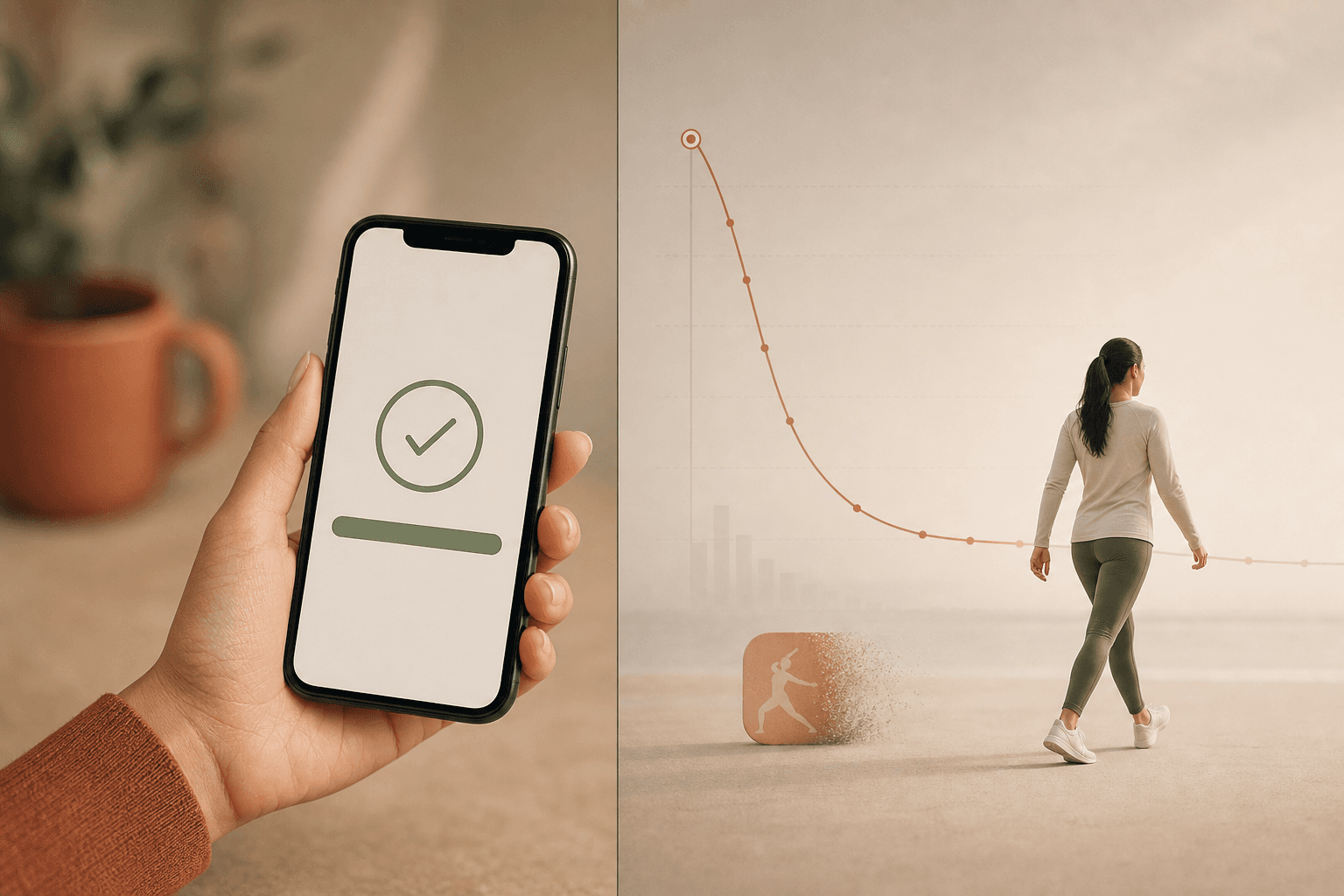
That number — 77% of daily active users lost within 72 hours of install — is the fitness app industry’s least advertised benchmark. But what does it actually count? It is an average across all apps. Top-quartile apps achieve 25% 30-day retention. The gap shows that design choices matter.
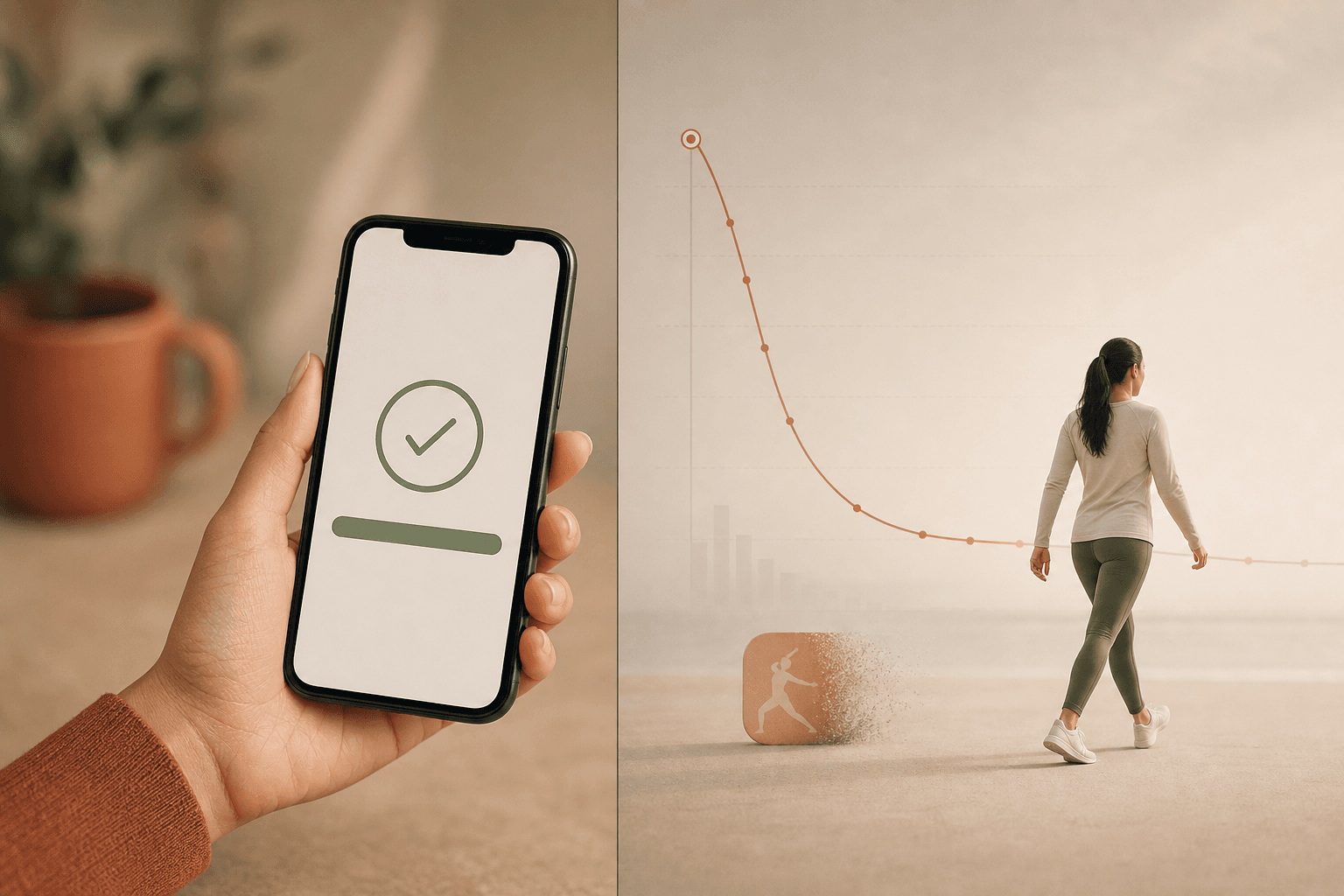
Women make up 55% of the active user base globally. They download more, they start with intent. But by day 30, retention for the average fitness app settles between 8% and 12%. This is not a user problem. It is a design problem.
The financial case for fixing retention is straightforward. Acquiring a single U.S. user costs $5 to $25; keeping that user costs 5 to 25 times less. A 5% increase in retention can boost profits by 25–95% — but that is a general business statistic, not specific to fitness apps. I would not use it as a formula. The direction is clear: apps in the top retention quartile see monthly recurring revenue grow 15–20% year over year. The question is not whether retention matters. It is why most fitness apps for women fail to keep them — and what the ones that break the curve actually do differently.
Why Women Quit: The Psychology
I have seen product teams react to retention problems by adding more workout videos, more instructors, more filters. It never works. The fix is not variety. It is psychological need-support.
Self-Determination Theory identifies three basic psychological needs that drive sustained motivation: autonomy, competence, and relatedness. A 2026 study in Frontiers in Psychology tested exactly this model on 721 female fitness app users across 12 cities in 9 Chinese provinces. The result: fitness app need support had a total effect of 0.341 on exercise adherence behavior — statistically significant, with a 95% confidence interval of [0.281, 0.400]. More importantly, 58.65% of that effect was mediated through self-efficacy and perceived health control. Self-efficacy alone (β = 0.440) was the strongest predictor. Women who felt capable and in control stayed with the program. Women who did not, left.
The study is geographically specific — Chinese women in nine provinces. SDT mechanisms are well-established cross-culturally, but the exact effect sizes may differ in other populations. The structural insight is what generalizes: needs matter more than features.

Three Design Decisions That Work
Let me translate the psychology into design decisions. The three pillars are not abstract — they are structural choices visible the moment you open the app.
Autonomy: Can you set your own schedule?
Apps that let women customize their workout schedule, skip a day without penalty, and choose their training style score higher on autonomy. The opposite is a rigid calendar that punishes deviation. 30% of users cite 'lack of time' as the reason they churn. An app that bends to a woman's schedule — not the other way around — addresses that directly.
Competence: Does it show you improvement?
This is where self-efficacy gets built. 40% of users abandoned an app because logging data was too complicated. Apps that provide clear visual progress — strength improvements over weeks, consistent streaks, achievement badges — feed competence. The simplest version: every time you finish a workout, the app shows you something that says "you are stronger than last week."
Relatedness: Are you in it alone?
The most persuasive data here comes from Strava. When it introduced the Challenges feature, its 90-day retention jumped from 18% to 32%. Daily active users rose 28% and premium subscriptions increased 15%. The mechanism is not complicated — a shared goal with a leaderboard and a community thread creates accountability. Social sharing features in general lift engagement by 22%. The 30% retention lift often attributed to 'social features' in aggregate probably mirrors Strava's specific implementation. Not every chat room or comments section will replicate that effect. But the principle holds: a feeling of being part of something keeps people coming back.
Cycle-Aware: Promising, Not Proven
This is the section where I need to be careful. Cycle-syncing — aligning workout intensity and type with menstrual phase — has become a buzzword in fitness apps for women. Obé offers a 'Working Out on Your Cycle Collection' and 'Cycle Insights' feature. LES MILLS+ has cycle-syncing programming. Apple Watch includes cycle tracking.
The idea is grounded in real endocrinology. The follicular phase (rising estrogen) increases metabolic rate and recovery, making it good for strength and cardio. The ovulatory phase (estrogen and testosterone peak) is ideal for HIIT. The luteal phase (declining estrogen, rising progesterone) brings lower energy — better for yoga, Pilates, barre. The menstrual phase (low hormones) calls for restorative movement.
But here is the caveat: the method was developed and trademarked by one person (Alisa Vitti). The Obé blog itself notes that direct research on cycle-synced workouts is limited. Broader research on hormone-exercise interaction is solid — we know estrogen affects ligament laxity and recovery — but the prescriptive 'do HIIT on day 14, restorative on day 2' lacks rigorous controlled trials.
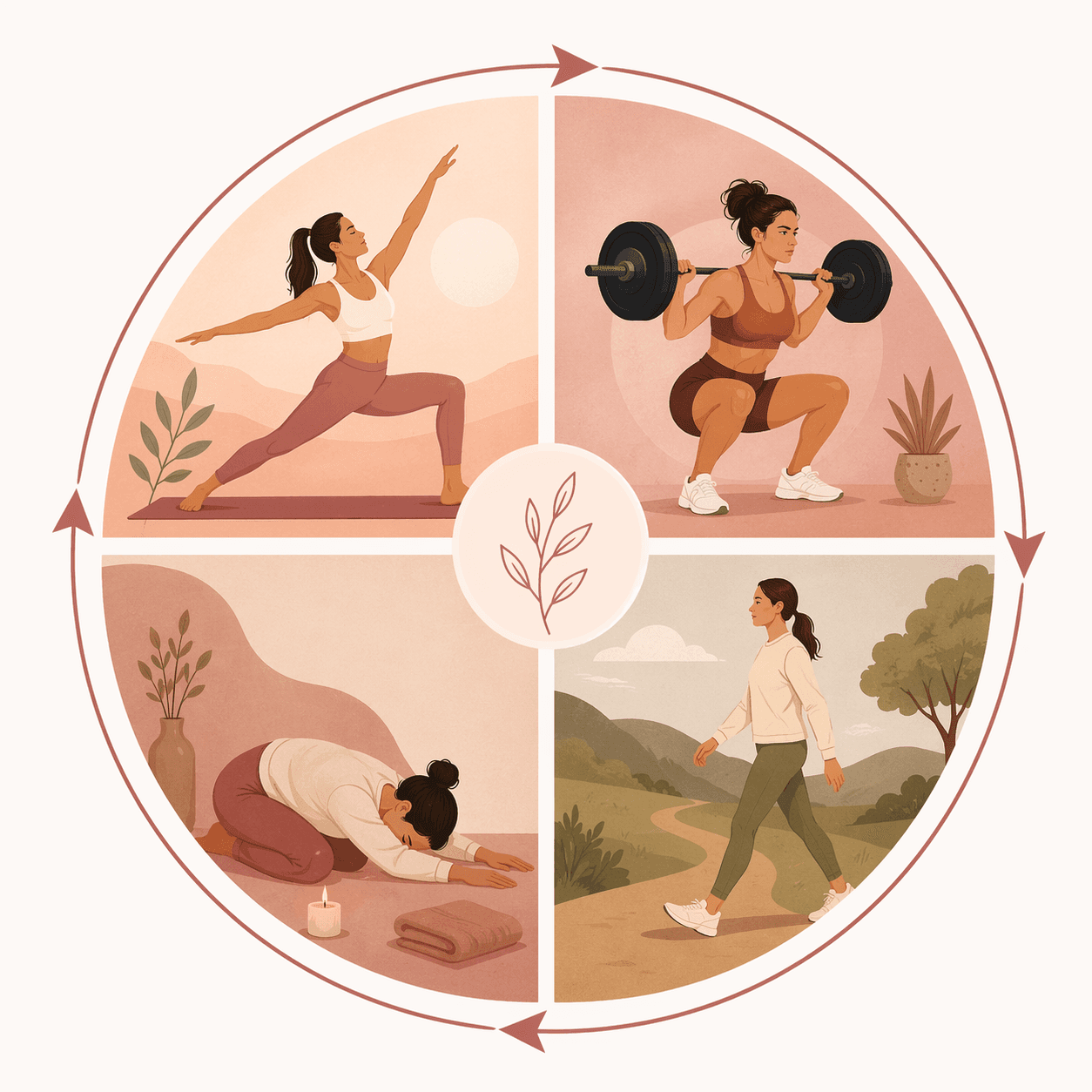
I would call cycle-aware programming an emerging differentiator. It is plausible, it aligns with existing hormone science, and it clearly resonates with users who feel their cycle affects their training. But it is not a replacement for the three pillars. An app that adds cycle-aware workouts without fixing autonomy, competence, and relatedness will still leak users within three days.
What Women Over 40 Need
The same three pillars apply — but the implementation shifts. Autonomy becomes more about scheduling flexibility around fatigue, sleep disruptions, and hot flashes. Competence means progressive strength training that supports bone density and muscle mass, with clear safety cues. Relatedness means finding a community of women at a similar life stage, not 25-year-old fitness influencers. Cycle-aware programming becomes even more relevant during perimenopause, when cycles become erratic. An app that ignores this stage is essentially telling a large demographic 'you are not our target.'
How Five Apps Stack Up
Let me apply the framework to five popular apps that appear on every 'best apps for women' list. Pricing and user counts come from CNET's mid-2026 roundup — note that models change (Sweat was acquired by iFit, Alo recently went free), so verify before subscribing.
| App | Price | Autonomy | Competence | Relatedness | Cycle-Aware |
|---|---|---|---|---|---|
| Sweat | $25/mo or $135/yr | Moderate — fixed programs, limited customization | Good — structured progress tracking, clear progression | Strong — large community, forums, trainer interaction | Not built-in |
| Stronger By The Day | $15/mo | Moderate — weekly schedule, but you can rearrange | Excellent — science-based periodization, load tracking | Weak — minimal community features | No |
| EvolveYou | $22.99/mo or $119/yr | Strong — fully customizable routines, 8–67 week programs | Good — nutrition plan included, video demos | Moderate — community features present but not core | No |
| Alo Wellness Club | $20/mo or $100/yr | Moderate — large library but limited progression structure | Good — extensive class library with levels | Weak — mostly solo practice | No |
| Alive by Whitney Simmons | $14.99/mo | Moderate — 100+ daily workouts, but set plans | Good — video demonstrations, variety | Moderate — community presence, challenges | No |
No single app hits all three pillars. Sweat leads on relatedness; Stronger By The Day on competence; EvolveYou on autonomy. None yet integrates cycle-aware programming as a core feature (Obé stands alone there, but is not in this table because it offers live classes rather than a structured app). The takeaway: the best choice depends on which pillar matters most to you.
A Quick Test Before You Install
Stop asking 'how many workouts does it have?' Start asking these questions:
- Can I skip a workout without losing my streak or feeling penalized?
- Does the app show me improvement over time — not just calories burned, but strength gains, consistency, or skill progression?
- Is there a way to work out with a friend, join a challenge, or interact with a coach or community?
- Does the app adjust recommendations based on my cycle phase, or at least let me log it?
- Does it offer programs for menopause, postpartum, or other life stages — or is it one-size-fits-all?
- Is logging simple enough that I can do it in under 30 seconds after a workout?
If an app scores 'yes' on at least four of these, it is built for retention. If it scores 'no' on most, treat it as a transient download.
The 77% loss within three days is not inevitable. Top-quartile apps prove 25% 30-day retention is achievable — triple the average. The gap is not about workout variety. It is about whether the app was designed to support autonomy, competence, and relatedness. Cycle-aware programming adds another layer. The evidence is early, but the logic is sound: an app that understands your biology is more likely to keep you engaged. The apps that combine all four — psychological need-support, social accountability, life-stage awareness, and cycle adaptation — will define the next generation of fitness apps for women.
Before you hit 'install,' ask one more question: was this app built to get my download, or was it built to keep me coming back?
Comments
Join the discussion with an anonymous comment.