
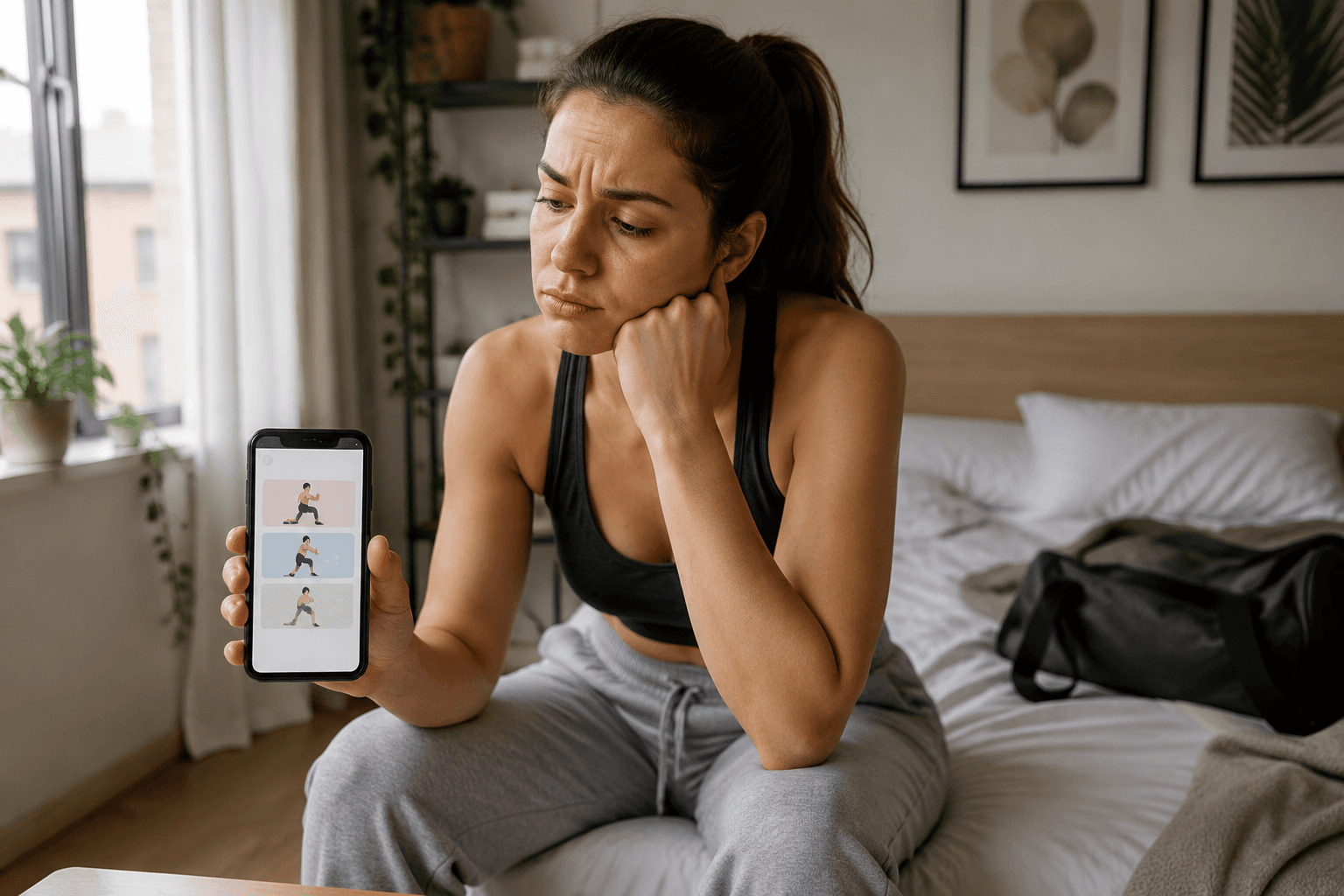
The quitting moment is usually much quieter than the app makes it look. You open it after missing a few days, scroll past a workout that suddenly feels too long, notice the streak is gone, and close the screen with the private conclusion that you are bad at consistency.
That conclusion deserves more scrutiny than most fitness apps give it. One qualitative study on female fitness app users cites earlier churn data showing that 74% of fitness app users stop within 10 uses, while women make up nearly 60% of fitness app users.[1] In other words, this is not a small group of unmotivated women failing to appreciate a useful tool. Women are a central audience for these products, and a large share still leave almost immediately.
Some people do quit because they picked the wrong training style, overestimated their available time, or disliked exercising at home. But the research points to a more useful explanation: many fitness apps fail at the exact moment a user needs support. They do not help her understand what to do next, adjust the plan without shame, feel connected to someone, or believe that a small session still counts.
The Problem Is Usually Fit, Not Character
The phrase "fitness apps for women" often gets treated as a shopping category: softer colors, cycle tracking, Pilates, glutes, pregnancy, meal plans, a few celebrity-led programs. Some of those features can be useful. None of them automatically answers the harder question: will this app help a woman come back after the third, fourth, or seventh imperfect week?
A 2026 study of 721 female fitness app users gives a stronger way to think about that question. The researchers examined how fitness app need support relates to exercise adherence, and found a total effect of 0.341 with a 95% confidence interval of [0.281, 0.400].[2] More important than the size of the number is the route it took: self-efficacy and perceived health control mediated 58.65% of the total effect.[2]
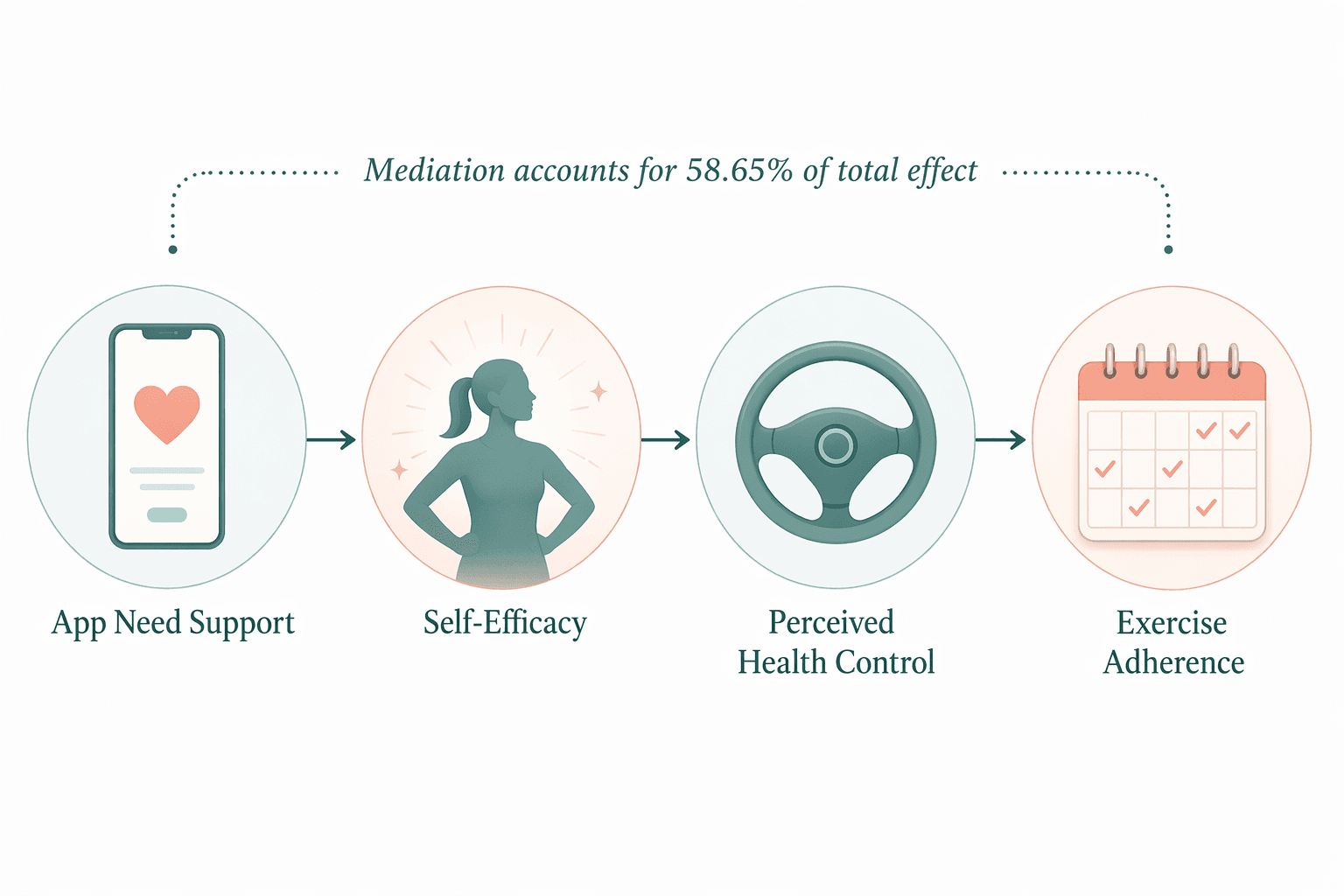
Put plainly, an app is more likely to support adherence when it helps a user feel capable, then helps her feel some control over her health behavior. That is different from simply delivering a larger workout library. A woman can have access to hundreds of videos and still feel unsure which one is right, whether she is doing it correctly, or how to restart after soreness, travel, illness, caregiving, or a week of poor sleep.
The strongest evidence here comes from studies of Chinese female users, so it should not be flattened into a universal claim about every woman in every setting.[1][2] The older 74% churn figure also comes through a cited prior study, not a fresh 2026 measurement.[1] Those limits matter. Still, the psychological mechanisms involved are not obscure app-industry guesses. Autonomy, competence, relatedness, self-efficacy, and perceived control are exactly the kinds of forces that show up in ordinary exercise behavior, especially when someone is trying to restart after repeated false starts.
What Need Support Looks Like Inside an App
Need support sounds abstract until you watch what happens inside a real workout app. Autonomy is whether the app gives you meaningful choices instead of trapping you in a plan that stops matching your life after three days. Competence is whether it teaches clearly enough that you know what to do, how hard to work, and how to modify. Relatedness is whether you feel seen, accompanied, or at least not completely alone with the restart.
An app can undermine autonomy while pretending to be motivating. It can make every missed workout look like a failure, push a plan that assumes predictable evenings, or require a beginner to choose between options with names that mean nothing to her yet. When the app gives choice without guidance, the user is technically free and practically stranded.
Competence is where many apps lose people fastest. A beginner does not only need a workout labeled "beginner." She needs to know whether knee discomfort means she should modify or stop, whether a 12-minute session is enough today, whether she should repeat the same workout tomorrow, and what progress is supposed to feel like before it looks impressive. Without that, she is left grading herself with sweat, soreness, and guilt, which are poor teachers.
Relatedness is often treated as an optional social layer, but the qualitative study identified interaction as one of the attributes women valued for sustained use, and linked peer support with enjoyment of life and self-fulfillment values.[1] That does not mean every woman wants public leaderboards or group chats. It does mean that feedback, encouragement, shared experience, and responsive coaching can affect whether the app feels like a cold content library or a place where returning is normal.
This is why the first week with an app can be misleading. Download-day enthusiasm is cheap. The better test arrives when the original plan collides with a real week and the app has to help you adapt without making the whole attempt feel ruined.
Use Five Attributes as Filters, Not a Feature Checklist
The 2024 qualitative study identified five attributes that predicted sustained female use: instructiveness, personalization, interaction, ease of use, and convenience.[1] These are more useful than the usual app-store categories because they describe what the app does for the user during the vulnerable parts of adherence.
| Attribute | What to Look For |
|---|---|
| Instructiveness | Clear teaching, exercise cues, modifications, progression guidance, and explanations of why a session fits your goal. |
| Personalization | Plans that adjust to your fitness level, schedule, equipment, preferences, limitations, and life stage. |
| Interaction | Useful feedback, coaching, peer support, community, or accountability that makes returning feel normal. |
| Ease of use | Fast navigation, readable screens, simple workout selection, and no needless setup before starting. |
| Convenience | Sessions that fit your real time, space, equipment, and energy, including short or low-friction options. |
Instructiveness: the app should teach before it asks for loyalty
Instructiveness is not the same as having polished videos. A workout can look beautiful and still leave a user guessing. The app should show how to set up an exercise, what the movement is meant to feel like, what common substitutions are reasonable, and how to choose the next session. This matters most for women who are returning after a long break, managing pain or fatigue, or moving from walking and light activity into structured strength or interval training.
A well-instructed session reduces the number of private decisions the user has to make while already feeling uncertain. Instead of asking, "Am I doing this wrong?" she can ask, "Which version fits today?" That is a different psychological position. It builds competence instead of testing whether she already has it.
The practical test is simple: after one or two workouts, can you explain what the app is asking you to do next and why? If the answer is no, the app may be entertaining, but it is not yet coaching you. For a beginner or a returning exerciser, that distinction matters more than the number of workouts in the library.
Personalization: the plan has to survive contact with your week
Personalization is often advertised as a quiz at signup. A quiz helps only if the app continues to adapt after it learns what your life is actually like. A plan that asks for five workouts a week when you can reliably manage three is not ambitious in any useful sense. It is a churn machine with nice graphics.
A better app lets you change the session length, intensity, equipment, and training focus without making you feel as if you have broken the program. It offers a reasonable option when you have 10 minutes, when you are sore, when you are traveling, when your period changes your energy, when childcare eats the evening, or when you are postpartum and need a more specific kind of progression. It should also remember enough context that restarting does not feel like reintroducing yourself to a stranger.
Personalization supports autonomy because it gives the user meaningful control. Not fake control, where every choice leads back to the same program. Real control lets a woman preserve the habit while changing the dose. For adherence, that flexibility is not softness; it is infrastructure.
Interaction: support is part of the workout environment
Interaction does not have to mean posting progress photos or competing with strangers. For some women, those features are motivating. For others, they are enough reason to delete the app. The more useful question is whether the app creates appropriate contact at the moments when isolation usually wins.
That contact can come from coach feedback, form checks, thoughtful reminders, small-group programs, live classes, private communities, or a simple system that notices when a user has paused and offers a doable return. The qualitative research matters here because it does not treat peer support as decoration; it connects peer support with enjoyment of life and self-fulfillment values among female users.[1]
The wrong kind of interaction can backfire. Leaderboards, public streaks, and aggressive notifications may help some users, but they can also turn ordinary inconsistency into a performance. Good interaction should make returning easier, not make absence more embarrassing.
Ease of use and convenience: friction gets a vote
Ease of use is less glamorous than coaching philosophy, but it decides many sessions before motivation has a chance to speak. If the app buries saved workouts, takes too long to load, hides modifications, makes casting difficult, or forces you through too many screens before starting, it is asking for more executive function than many tired people have available.
Convenience is the same kind of filter. An app that requires equipment you do not own, floor space you do not have, or session lengths that rarely fit your day may still be excellent for someone else. It is not excellent for you right now. The app should offer realistic defaults for your actual setting: apartment workouts, no-equipment options, short strength sessions, low-impact choices, or gym-based plans only if those match your routine.
These two attributes will not create deep motivation by themselves. They simply prevent the app from losing before the workout starts.
The Market Is Large Enough to Do Better
The fitness app industry is not operating at the edge of consumer attention. Fitness app revenue reached $3.4 billion in 2025, up 24.5% year over year, and subscription models accounted for 62.2% of women's app market share.[3] Another market report projects the workout apps for women market will reach $16.93 billion by 2033 at a 17% compound annual growth rate.[4]
Market numbers do not prove that apps work. They prove that women are already interested enough to download, try, and often pay. That makes the early drop-off more irritating, not less. The problem is not that women need more persuasion to care about exercise. Many need an app that handles the predictable psychology of restarting with more skill.
This is also why app roundups can be useful but incomplete. A list can tell you which apps have strength training, meal planning, prenatal programs, free trials, or wearable integrations. It cannot tell you whether you will feel more capable after session three unless you evaluate the experience while you are using it.
A Better Third-Session Test
Do not judge a fitness app only on the first workout. First workouts are often designed to impress. Judge it by the third or fourth session, when novelty has thinned and the app has had enough time to either support you or expose its gaps.
- Do I know what workout to do next without spending several minutes searching?
- Do I understand how to modify the session if my energy, time, equipment, or body feels different today?
- Do the cues make me feel safer and more capable, or more aware of what I do not know?
- If I miss a few days, does the app give me a reasonable way back?
- Does any community, coaching, or feedback feature make exercise feel less solitary without making me feel watched?
- Can I start a useful session quickly on a normal day, not just on a highly motivated day?
If an app fails most of those questions, deleting it is not evidence that you lack discipline. It may mean you recognized a poor fit before spending another month trying to force a habit through bad design.
The app worth keeping is not necessarily the one with the biggest library, the most famous trainer, or the sharpest discount timer. Choose the one that makes you feel more capable, more in control, and less alone by the third or fourth session. Sustained use is rarely predicted by how inspired you feel at download. It is built by repeated experiences that make exercise feel doable enough to return to.
References
- Exploring female fitness app users' motivations and perceptions: A qualitative study, PMC, 2024
- The impact of fitness app need support on women's exercise adherence behavior, Frontiers in Psychology, 2026
- Fitness App Market, Business of Apps
- Workout Apps for Women Market, Coherent Market Insights
Comments
Join the discussion with an anonymous comment.