
Nike Training Club is 100% free. Has been since 2020. No premium tier, no in-app purchases, no „upgrade to unlock.” Just periodized programming with certified instructors, on-demand and live classes, for every level. That one fact should make you question everything you think you know about workout app subscriptions.
I've tested dozens of these apps. Most of them want you to believe that a paid subscription is the only way to get serious value. But the gap between genuinely useful free tiers and intentionally crippled ones is wider than most reviews admit. Here's what I found after digging through the fine print and the feature grids.
How I Sort Free Tiers: Three Kinds of 'Free'
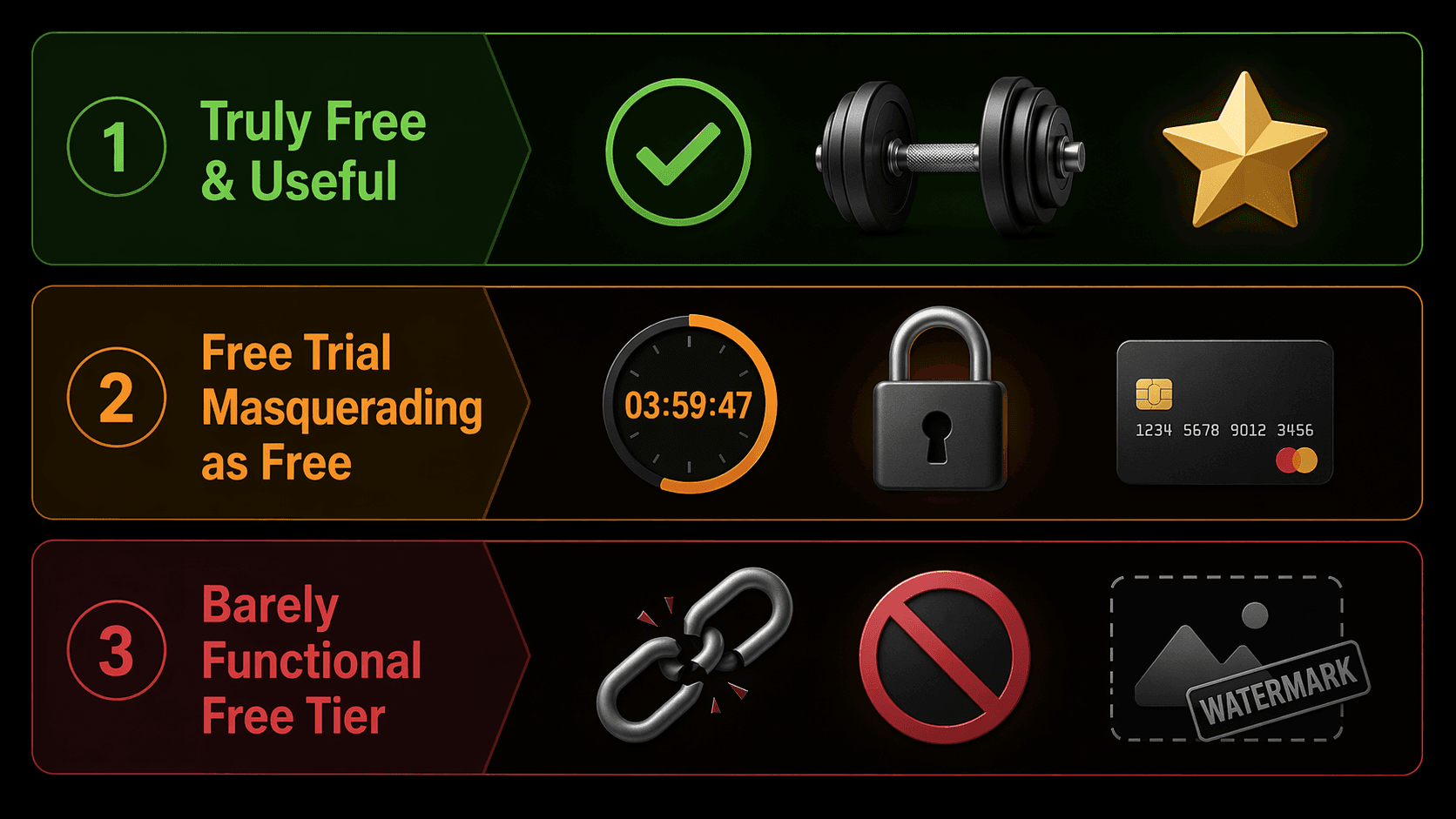
Most articles lump every app with a free option into one bucket. That's not helpful. Over the years, I've developed a simple way to sort them:
- Truly free and useful — you can use the app for a full training cycle without paying a cent. No nag screens, no hidden time bombs.
- Free trial masquerading as free — the app gives you 7 or 30 days of full access, then locks almost everything behind a subscription. The free tier is essentially a demo.
- Barely functional free tier — the free version is so stripped down (ads every screen, no custom routines, limited exercises) that it's essentially unusable for regular training.
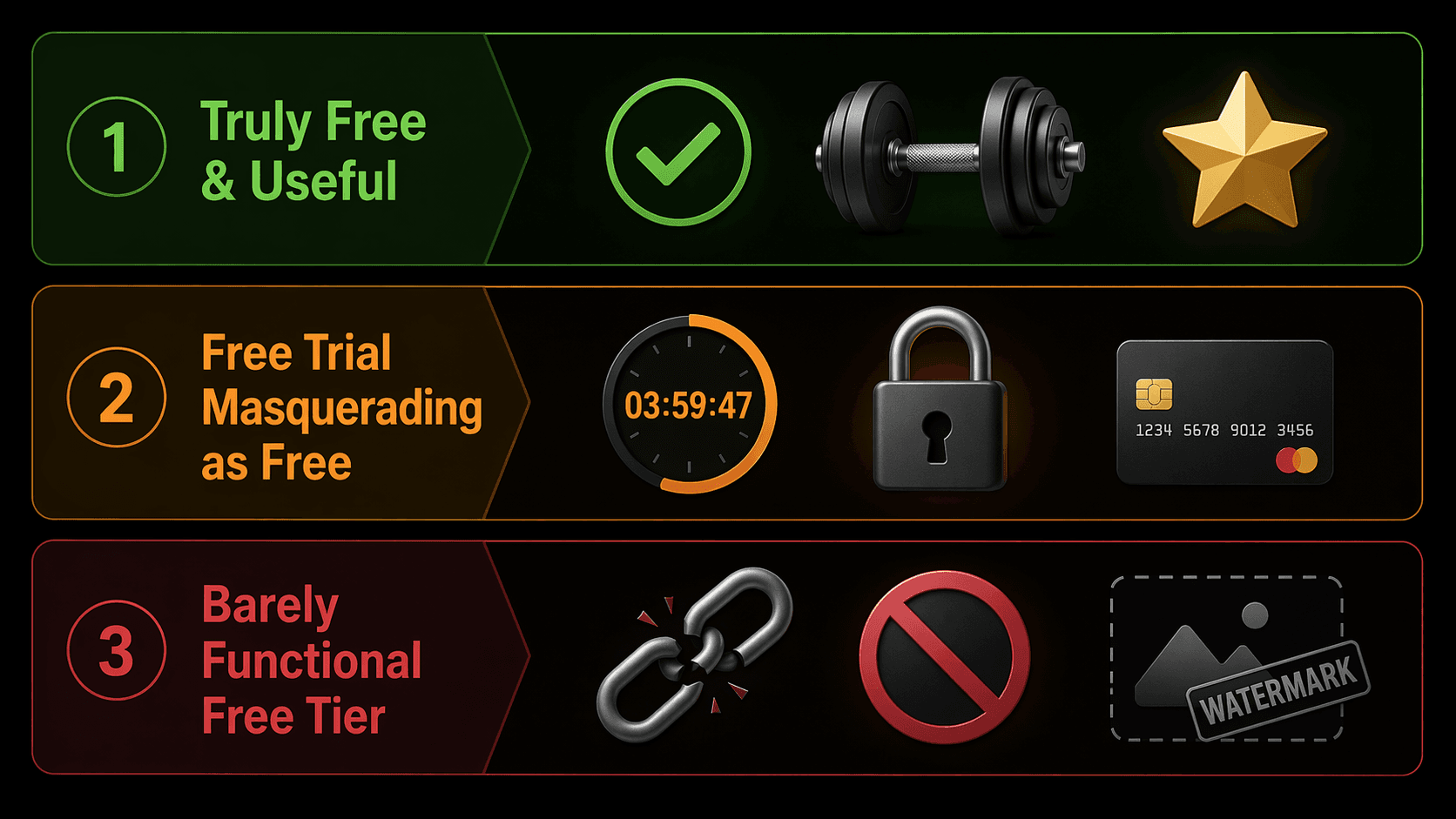
This taxonomy matters because it changes your download decision. If you grab an app that turns out to be a masquerade, you've wasted time. If you grab a truly free app, you can start training immediately and never worry about a billing date.
Four Apps That Don't Need Your Money
Nike Training Club, Caliber, Hevy, and Boostcamp prove that professional-grade functionality can cost nothing. Here's what you actually get on each free tier:
| App | Free tier highlights | What you lose if you don't pay |
|---|---|---|
| Nike Training Club | 300+ trainer-led classes, periodized programs, certified instructors | Nothing – no paid tier exists |
| Caliber | 500+ exercises with video demos, workout logging, progress charts, ad‑free | Nutrition tracking and coaching ($6/month) |
| Hevy | Workout logging, progress graphs, social features, free forever | Advanced analytics and custom routines ($2.99/month) |
| Boostcamp | 1,000+ strength programs from elite coaches including Jim Wendler's 5/3/1 | Advanced stats and program creation ($14.99/month) |
Nike Training Club doesn't just have a generous free tier — it has no paid tier at all. Nike made the app completely free in 2020 and has kept it that way. Over 300 trainer-led workouts across HIIT, strength, yoga, pilates, and mindset. Every instructor is certified. You get periodized programming that would cost you $10–$15/month in most other apps. For free. The only catch: it's a guided-class app, not a strength tracker. If you need to log sets and reps, you'll need something else. But for the vast majority of home fitness users who just want to follow a workout, NTC is the benchmark that every other free tier should be measured against.
Caliber's free tier is particularly impressive. It's completely ad‑free, which is rare even among paid apps. You can log every set, track your progress over weeks and months, and access the full exercise library with demonstration videos. The only thing locked behind the $6/month paywall is nutrition tracking and personalised coaching. For most people doing strength training at home, the free version is all you need.
Boostcamp is the weapon of choice for anyone who follows established strength programs. The free tier includes over 1,000 programs from elite coaches — including Jim Wendler's 5/3/1, which alone would cost you $20 for the book. You get the program structure, progression guidance, and logging. There's no time limit, no hidden unlock. It's a genuinely professional resource at zero cost.
Hevy is the best free strength tracker I've used. The free‑forever version gives you workout logging, progress graphs, and social features. The premium upgrade ($2.99/month) adds advanced analytics and custom routine creation — nice to have, but not essential. If you just want to record your lifts and see the line go up, stay free.
For a deeper look at tracker‑specific free tiers, see our free workout tracker apps deep dive.
The Ones That Are Just Demos
Now for the other side. Every app that calls itself free should be able to pass a simple test: can you complete a full workout session without being prompted to upgrade? If the answer is no, it's not free — it's a demo.
SHRED gives you a free 7‑day trial. After that, it's $9.99–$20/month depending on your plan (pricing varies by source — GGR says $9.99, Fortune says $14.99–19.99). The free 'basic tier' is essentially a taster. You can't build a consistent training habit on a week of access.
Fitbod offers a limited free trial, then costs roughly $15/month. Muscle Booster has no fixed free trial at all — you're hit with a paywall almost immediately, at $19.99–$29.99/month. WalkFit gives you a 30‑day tryout, then requires a subscription around $24.99–29.99/month.
These apps belong in the 'barely functional free tier' or 'masquerade' bucket. If you download them expecting a usable free experience, you'll be disappointed. The industry loves to call these 'free' because it inflates download numbers, but the actual user experience is a prolonged upsell.
If you want to know what to watch for before downloading, our guide on red flags in free workout apps breaks down the common tactics.
The $34/Month Stat — Why It's Almost Useless
You've probably seen the stat: the average workout app costs $34/month. That figure comes from Garage Gym Reviews, and it's technically correct. But it's also the most misleading number in this conversation. Why? Because it includes Future at $199/month and Peloton at $13/month in the same average. That's like saying the average car costs $80,000 because you included a Ferrari and a Toyota in the same calculation.
| App | Monthly cost | Annual cost | What you actually get for that price |
|---|---|---|---|
| Hevy Pro | $2.99 | $23.99 | Advanced analytics, custom routines |
| Strong | $4.99 | $29.99 | Unlimited routines, custom exercises, offline access |
| Caliber Premium | $6.00 | $72.00 | Nutrition tracking, coaching |
| SHRED Premium | $9.99–20.00 | $119–240 | AI-driven workout planning, full library |
| Peloton App One | $13.00 | $130.00 | All classes (strength, yoga, cardio, outdoor) |
| Apple Fitness+ | $10.00 | $80.00 | Studio‑style workouts with trainer integration |
| Strava | $8.00–12.00 | $80.00 | GPS analysis, segment leaderboards, training logs |
| Future | $199.00 | $2,388.00 | Real human coach, form reviews, daily check‑ins |
If you remove Future and Peloton from the average, the remaining apps cluster around $5–15/month. That's the real range for most people. The $34 number is useful only if you're considering a premium coaching service — but for the vast majority of home lifters who just need logging or guided classes, you can get excellent functionality for under $10/month, or even zero.
When You Should Actually Pay
I'll give you three scenarios where upgrading is worth it:
- You want a real human coach monitoring your progress. Future or a comparable service is the only option. That's $199/month well spent if you're serious about performance and have the budget.
- You need offline access because your gym has no signal. Strong Premium at $4.99/month is a small price for that peace of mind.
- You rely on AI programming because you have limited time and want a workout generated instantly. SHRED or Fitbod can save you the mental energy of planning — but only if you actually use the generated workouts.
For everyone else — and that's most home fitness users — the free tiers of NTC, Caliber, Hevy, or Boostcamp are more than enough. Don't let the 'average $34/month' scare you into paying for something you don't need.
If you're still comparing options, our free workout planner app comparison and strength‑specific free vs. paid breakdown cover more specific ground. And if you're also evaluating your overall home gym investment, check our home gym cost breakdown.
Comments
Join the discussion with an anonymous comment.