
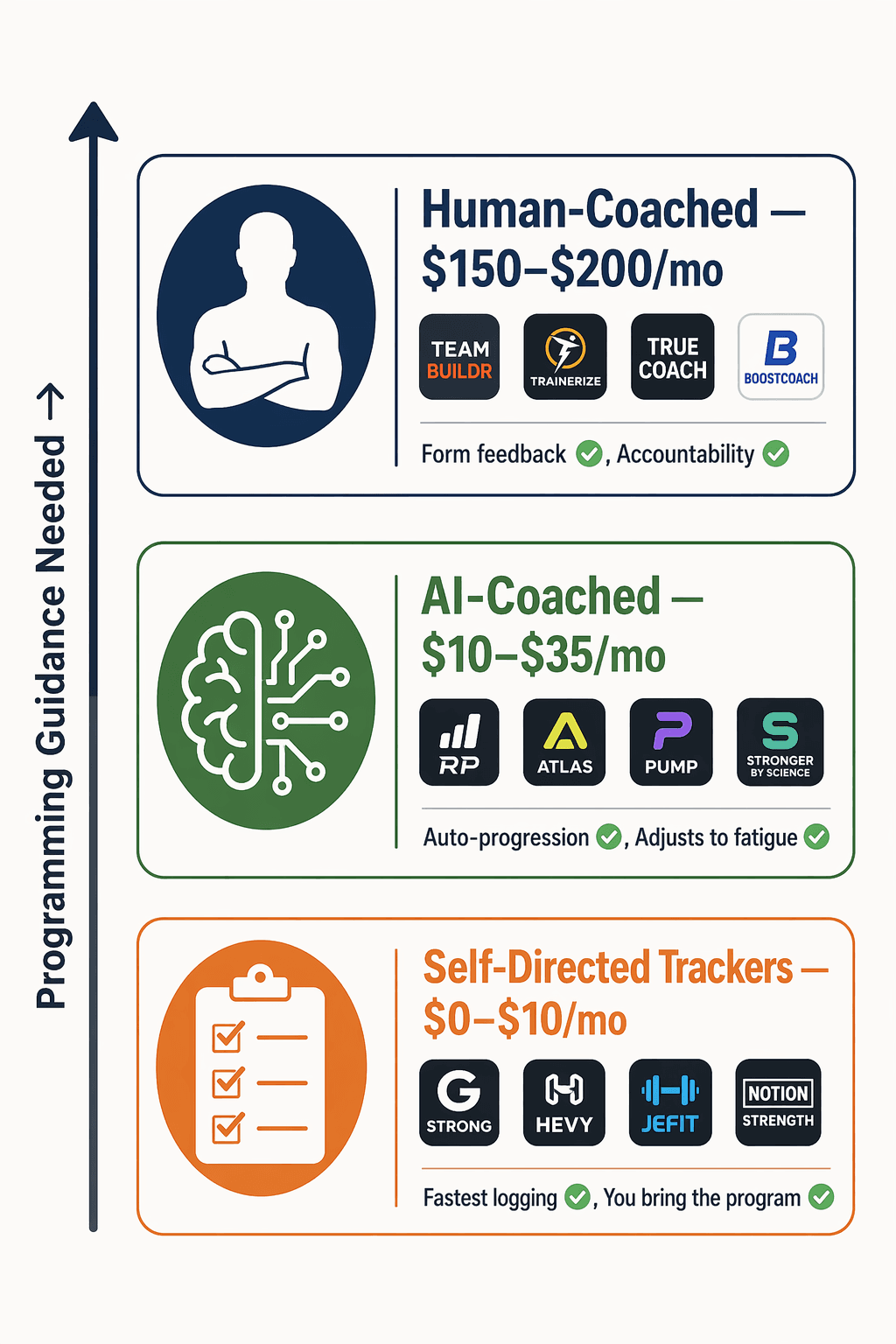
Garage Gym Reviews tested more than 70 workout apps and arrived at an average monthly cost of $34. I’ve tried apps from all three tiers myself, and that average is nearly useless. It flattens three very different pricing clusters – $0–$5 for self-directed trackers, $10–$15 for AI-coached systems, and $150–$200 for human coaching. The real question isn’t how much the average user spends; it’s what you get for the money in terms of programming judgment.
PCMag put the “good rate” at $10–$15 per month. That fits the middle cluster. But it doesn’t tell you whether you should be looking at the middle cluster at all. If you already know how to write your own program, even $10 is too much. If you need someone to watch your squat form, $199 is not unreasonable. The average is a distraction.
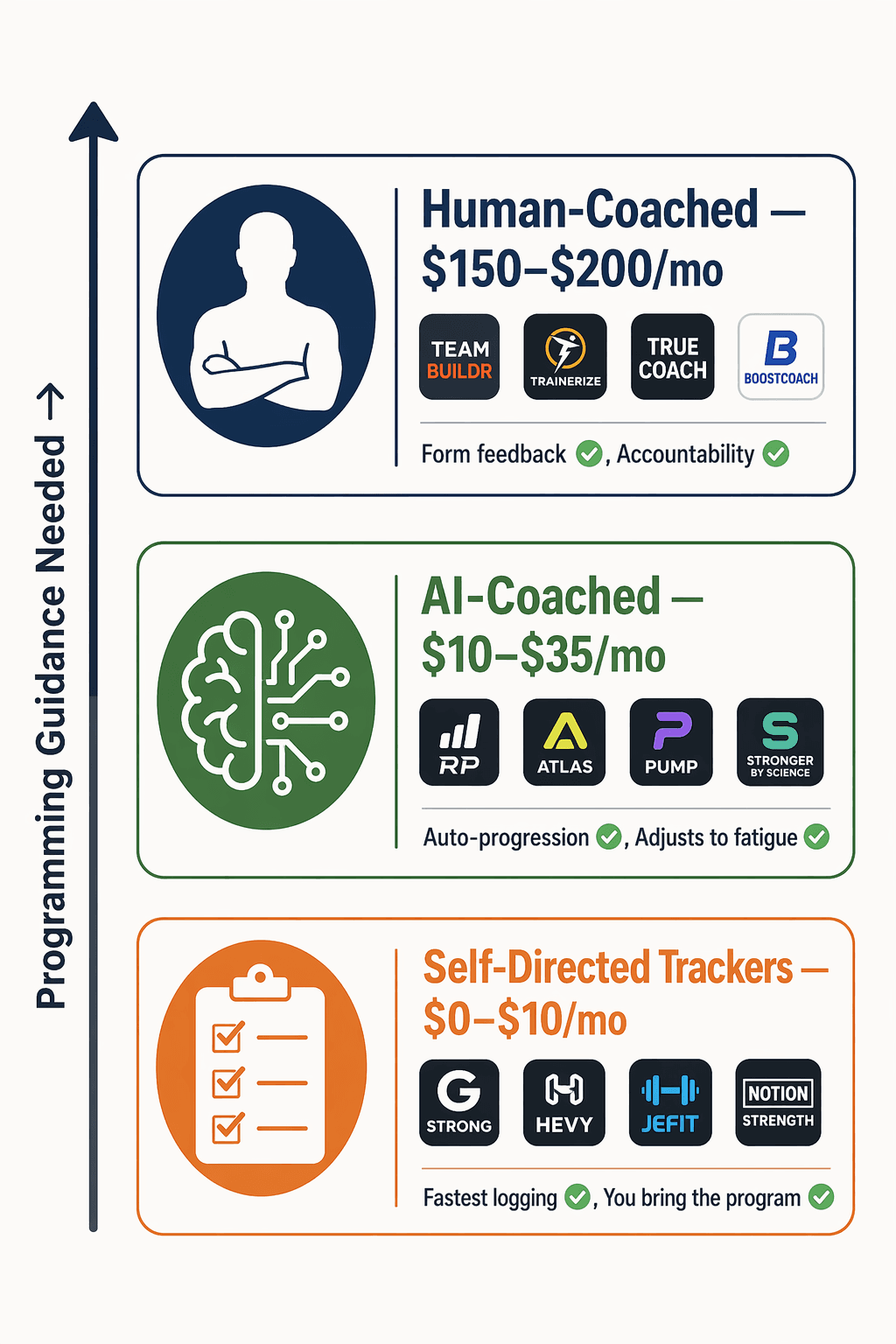
Three Tiers, One Question: Who Programs the Work?
Every strength training app comes down to this: when you walk into your home gym, who decides what you do next? The answer splits the market into three clean groups.
| Tier | Programming Source | Typical Cost/Month | Representative App |
|---|---|---|---|
| Self-Directed Tracker | You | $0–$5 | Hevy, Strong, Boostcamp |
| AI-Coached | Algorithm | $10–$35 | Fitbod, JuggernautAI, TR[Ai]NER |
| Human-Coached | Real coach | $150–$200 | Future, Caliber Premium |
That’s it. Everything else – progressive overload scores, exercise libraries, wearable sync – is either a feature of the tier or a decoration. If you don’t need the programming source, you don’t need the app.
Tier 1: You Write Your Own Program
The self-directed tracker tier is for lifters who already understand periodization, progressive overload, and how to structure a training cycle. You bring the program; the app just logs the sets. It’s the fastest way to record a workout – open, tap, lift, done.
Hevy costs $2.99 per month (free version available) and has a clean interface that serious lifters like. Strong costs about $5 per month and has more than 3 million users. Boostcamp is free with a $14.99 Pro tier. These apps excel at one thing: letting you record your workout in under 30 seconds. They do not write your program, they do not adjust for fatigue, and they do not check your form.
JEFIT, which has 13 million users and an exercise library of 1,400+ movements, claims that lifters who use systematic tracking with intelligent progression achieve 23% better strength gains over 12 weeks, citing research in the Journal of Strength and Conditioning Research. I’d treat that exact percentage with some caution – the source is JEFIT’s own blog, and I want to see the original study. But the direction is plausible: consistent, intentional tracking helps. The key point is that the app itself does not do the thinking. The intelligence comes from the program you bring.
For more on choosing the right tracker, see: What to Look for in a Workout Tracker App.
Tier 2: The Algorithm Writes Your Program (But Can It Coach?)
AI-coached apps are the middle ground: they auto-generate workouts based on your performance data, adjust weight and volume, and apply fatigue management. They cost $10–$35 per month and promise results that approach human coaching without the price tag.
But not all AI is equal. Garage Gym Reviews gave JuggernautAI a 5/5 for progressive overload and Fitbod a 3/5. That looks like a clear winner – until you understand what each app actually does. JuggernautAI is built for powerlifting periodization: it follows a multi-week block, adjusts for daily readiness, and manages fatigue across mesocycles. Fitbod is a general strength app that rotates exercises by muscle group and adjusts volume. The 5/5 for JuggernautAI reflects its strength in one specific training style, not that it's universally better. If you're not a powerlifter, a 5/5 in progressive overload is the wrong score to optimize for.
Pricing varies: Fitbod is $15.99 per month (some sources say $12.99; the Fitbod website currently shows $15.99, and I defer to the more recent source). JuggernautAI is $35 per month. TR[Ai]NER by Element 26 costs $14.99 per month or about $10 per month on an annual plan. All of these apps adjust your program based on logged data. None of them watch your form or ask you how your back feels after a heavy set. That gap matters.
For a deeper look at AI-specific features, see: Best AI Fitness Apps in 2026.
Tier 3: A Real Human in Your Corner
Future costs $199 per month. Caliber Premium $200. That's more than many gym memberships. For that money you get a real human coach – someone who designs your program, reviews form videos, and checks in daily. No algorithm can replicate the judgment of an experienced coach who sees you squatting in a video and says “your hips shoot up on rep four.” No algorithm can build accountability like a human who expects a reply.
This tier is not for everyone. But for a beginner who doesn't know how to squat safely, or a lifter returning from injury who needs careful load management, $200 is not overpaying. It's paying for a level of service that no app can automate. The mistake is signing up for human coaching when you already know the basics.
For a broader cost breakdown: Free vs Paid Strength Training Apps in 2026.
The Hardest Question: Do You Actually Know How to Program Your Training?
This is where most people get it wrong. It's easy to think you know more than you do. I've been there – I spent four months on a $199 coaching plan before I realized I could design my own routine and just needed a tracker.
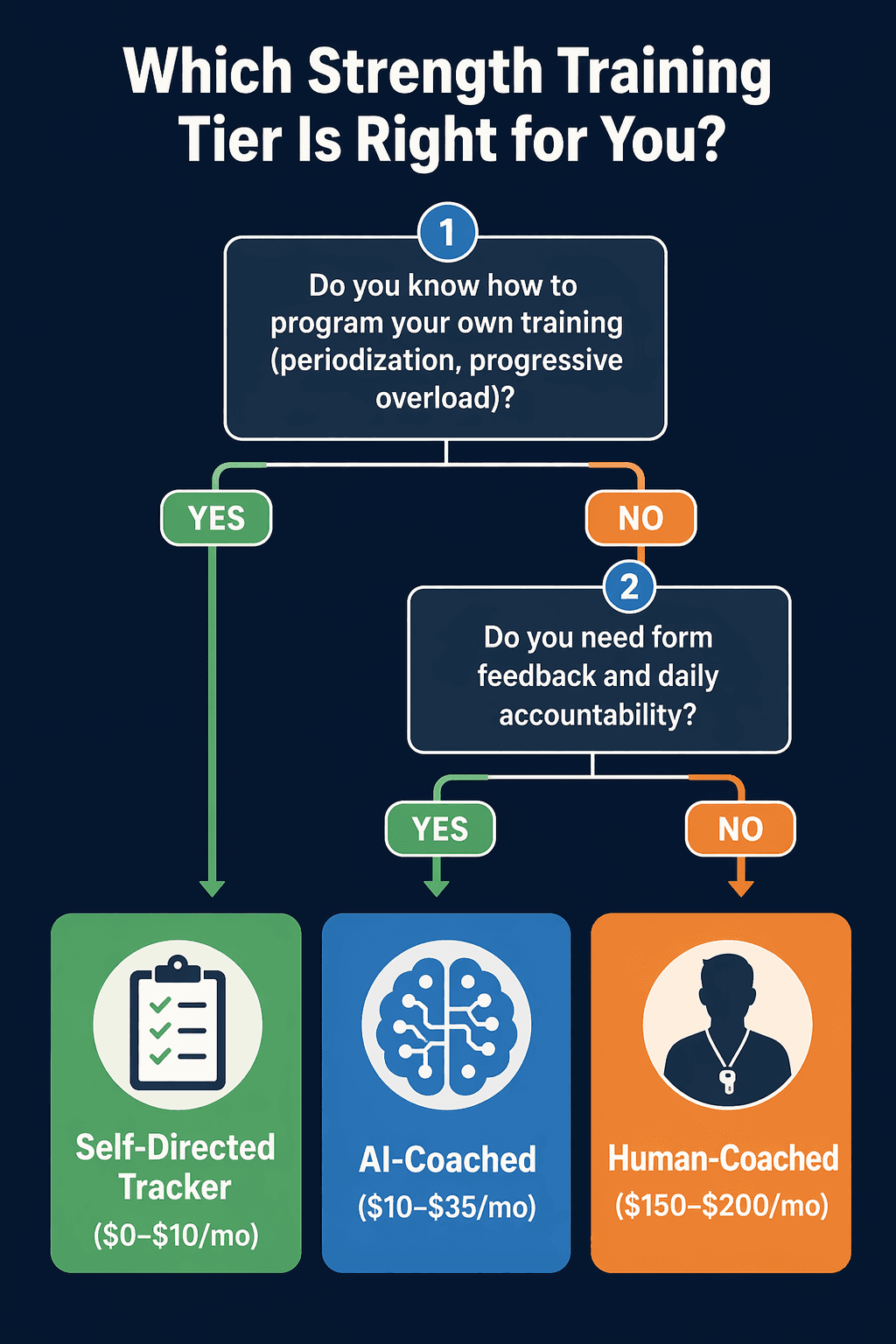
Ask yourself two questions honestly:
- Can you design a progression scheme that includes weekly load increases, volume management, and a deload week every four to six weeks?
- Do you need someone to review your form to stay safe and make progress?
If the answer to both is “yes” and “no” respectively, you need a self-directed tracker. If you can program but need form feedback, you may need a coach – or a good form-check app alongside a tracker. If you can't program and can't self-diagnose form issues, you need human coaching. Everything else falls in the AI middle.
For more on the free vs. paid debate: Are Paid Strength Training Apps Worth It?.
The Hybrid Strategy: $0 Tracker + $20 Program Book = AI-Level Results
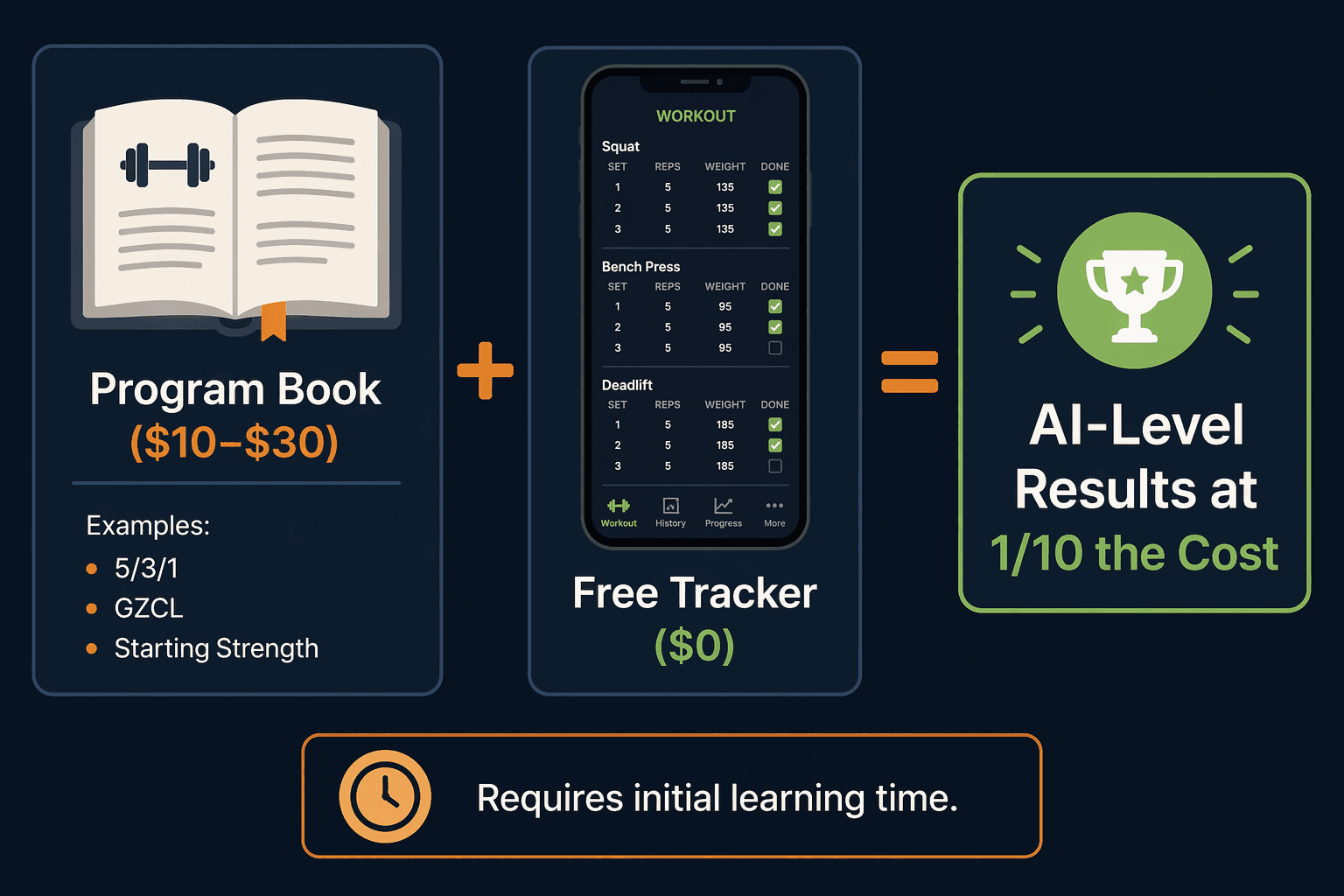
Here's a path that no app company will advertise: use a free tracker like Hevy or Strong combined with a $10–$30 program book such as 5/3/1, GZCL, or Starting Strength. The app logs the lifts. The book provides the progression scheme. The cost: around $0–$5 per month plus a one-time purchase. The result: programming quality that matches or exceeds what AI apps deliver, at a fraction of the recurring price.
There's a catch: you have to understand periodization well enough to apply the book's principles to your own training. That takes upfront learning time – maybe a few hours of reading and a few weeks of practice. It's not a mainstream solution, and it won't suit someone who just wants to open an app and follow instructions. But for the lifter who wants control and is willing to learn, it's a legitimate third option.
For more on free tracker trade-offs: Free Workout Tracker Apps: What You Actually Get vs What You Lose.
So which app should you download? None of them, until you've answered the two-question test above. The best strength training app is the one that matches your actual need for programming guidance – not the one with the most features or the highest review score. If you bring your own program, a free tracker is all you need. If you want auto-progression but can live without form feedback, an AI app in the $10–$35 range works. If you need a coach, pay the $150–$200 and get your money's worth.
The $34 average is a distraction. The three tiers are not. Choose your programming source, then pick the app.
Comments
Join the discussion with an anonymous comment.