
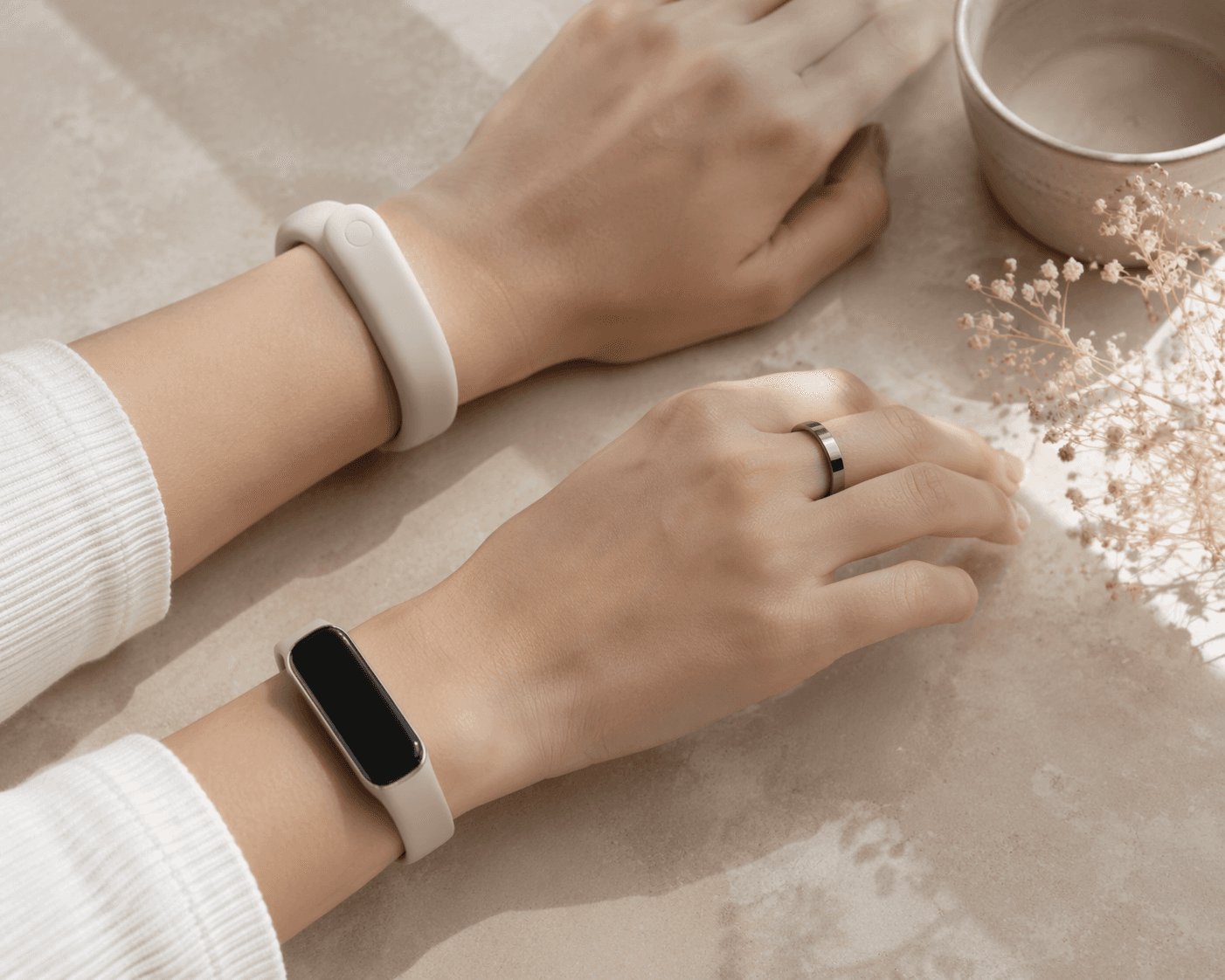
The uncomfortable part of choosing the best fitness tracker for women starts before features, apps, or sleep scores. It starts with whether the thing can stay on your body through a sweaty workout, a light-sleep night, a blouse cuff, a dinner out, and the week your fingers or wrists feel a little puffier than usual.
That is why the real first choice is not Garmin versus Fitbit versus Oura versus Whoop. It is form factor: a wrist tracker or smartwatch, a smart ring, or a screenless band. There is no universally best form factor for women. There is a best match between your body, your main use case, and the true cost of keeping the data after the novelty wears off.
| Form factor | Best fit | Likely discomfort point | Sleep practicality | Workout-data strength | Women’s-health caveat | Subscription exposure |
|---|---|---|---|---|---|---|
| Wrist tracker or smartwatch | Women who care most about workout heart rate, GPS, and glanceable stats | Case width, band pressure, sleeve catching, optical sensor sitting poorly on a small wrist | Good if the case is slim; annoying if it digs into the wrist bone | Usually strongest for workouts, especially when GPS and activity modes matter | Cycle tracking varies widely; some devices log symptoms, while others add temperature-based retrospective insights | Often low or optional: Garmin Lily 2 has no subscription; Apple Watch SE 3 has no subscription but requires an iPhone; Fitbit Charge 6 has optional Premium [2][6] |
| Smart ring | Women who want sleep tracking, discreet wear, and a device that does not look like fitness gear | Ring sizing is less forgiving; finger swelling, temperature, and cycle-related water retention can change comfort | Excellent for many light sleepers because Oura Ring 4 weighs only 3.3–5.2g [1] | Useful for background recovery and daily heart-rate trends, but not automatically best for every workout | Oura uses temperature data for cycle prediction, but irregular cycles, PCOS, and perimenopause make algorithmic claims more fragile [3] | Oura Ring 4 starts at $299–$349 plus $5.99/month for membership [1][3] |
| Screenless band | Women who want continuous tracking without a screen pulling attention all day | Still has wrist-fit problems; a wide module can feel bulky on smaller wrists | Often better than a watch if the hardware is soft and low-profile | Strong for background strain, recovery, and heart-rate trends; workout usefulness depends on model and app behavior | May offer less visible cycle interaction because the device itself has no screen | Very different by brand: Whoop 5.0 is $199–$359/year, while the reported Fitbit Air is $99.99 with no required subscription for core metrics [5][2] |
That table is the whole argument in miniature. A ring may be the easiest thing to sleep in and the least awkward thing to wear to work. A wrist tracker may still be the cleaner choice if workouts matter more than readiness scores. A screenless band can remove the tiny wrist-screen distraction without magically fixing fit or cost.
If you are still comparing the broad wearable categories, the basic watch-versus-ring-versus-band trade-off is covered in Fitness Tracker Ring vs. Smartwatch vs. Fitness Band: Which Wearable Fits Your Home Workout?. Here, the deciding layer is more specific: small wrists, sleep comfort, ring sizing, cycle-related body changes, and whether the device still makes financial sense in year three.
Fit is not a cosmetic detail
Women’s fitness trackers are too often treated as regular trackers in smaller colors. That misses the problem I see most often after the first week: the device is not technically bad, but it is physically irritating enough that it comes off. Once it comes off, the best sensor stack in the world is irrelevant.
The smart ring has the obvious comfort advantage on paper. Oura Ring 4 weighs 3.3–5.2g, depending on size, while wrist trackers in PCMag’s 2026 roundup range from roughly 12g to 37g [1][2]. A few dozen grams does not sound dramatic until it is pressing into the side of your wrist at 2:00 a.m. or catching on bedding every time you roll over. For light sleepers, the difference between a tiny ring and a hard rectangle on the wrist is not theoretical.
But rings are not a free pass. A wristband can be loosened one notch. A ring cannot. Wareable’s reporting on period-tracking wearables includes user-reported ring fit issues around cycle-related swelling, including rings that feel fine during one part of the cycle and tight during another [3]. That is not clinical proof measuring finger circumference across cycle phases; it is directional, lived-use evidence. Still, it matters because ring sizing has almost no margin for error. Temperature, salt intake, travel, strength training, weight changes, and menstrual-cycle-related water retention can all make a previously comfortable ring feel wrong at exactly the time you are supposed to wear it overnight.
This is where a smart ring purchase should slow down. Use the sizing kit. Wear the sample ring at night, during a workout, after a salty meal, and through the part of your cycle when your hands are most likely to swell. If you are between sizes, the smaller size may look better, but it may also be the size that wakes you up.
Wrist trackers have the opposite problem: they are adjustable, but the sensor housing may be too wide or too rigid for the wrist underneath it. A band can close around a small wrist and still leave the optical sensor sitting badly. The issue is not just comfort; it can affect the data. A review of wrist-worn heart-rate devices published in PMC notes that wrist optical heart-rate accuracy can be affected by device placement, movement, and the interaction between the sensor and the skin [4]. When the case spans a narrow wrist poorly, the device may shift, let in light, or fail to maintain the consistent contact optical sensors need.
Finger-based PPG has a plausible placement advantage because the arteries in the finger are closer to the skin surface than at the wrist, which can help produce more consistent pulse waveforms in some conditions [4]. That does not mean rings are more accurate for everything. It means placement can favor a ring for resting metrics, overnight trends, and background heart-rate collection. During workouts, the answer depends on the activity, movement, grip, temperature, and how the device processes noisy data.
For home strength training, I am especially cautious with rings. Dumbbells, kettlebells, pull-up bars, resistance handles, and rowing grips can make a ring uncomfortable or unsafe. Some women simply remove the ring for lifting, which is sensible, but then the device misses the session you may have most wanted to capture. A wrist tracker can also get in the way during floor work or wrist-loaded moves, but it is usually easier to shift up the arm, tighten for exercise, and loosen afterward.
The screenless band sits closer to the wrist tracker than the ring in fit terms. Whoop’s appeal is that it can be worn continuously and charged on-wrist, so you do not have to break the habit just because the battery is low [5]. That is clever, and I like it. But a screenless band still needs a stable wrist fit. Removing the display does not remove the need for good sensor contact, a band that does not chafe, and a module that does not feel oversized on a smaller wrist.
Accuracy depends on where the sensor sits, not just what the spec sheet promises
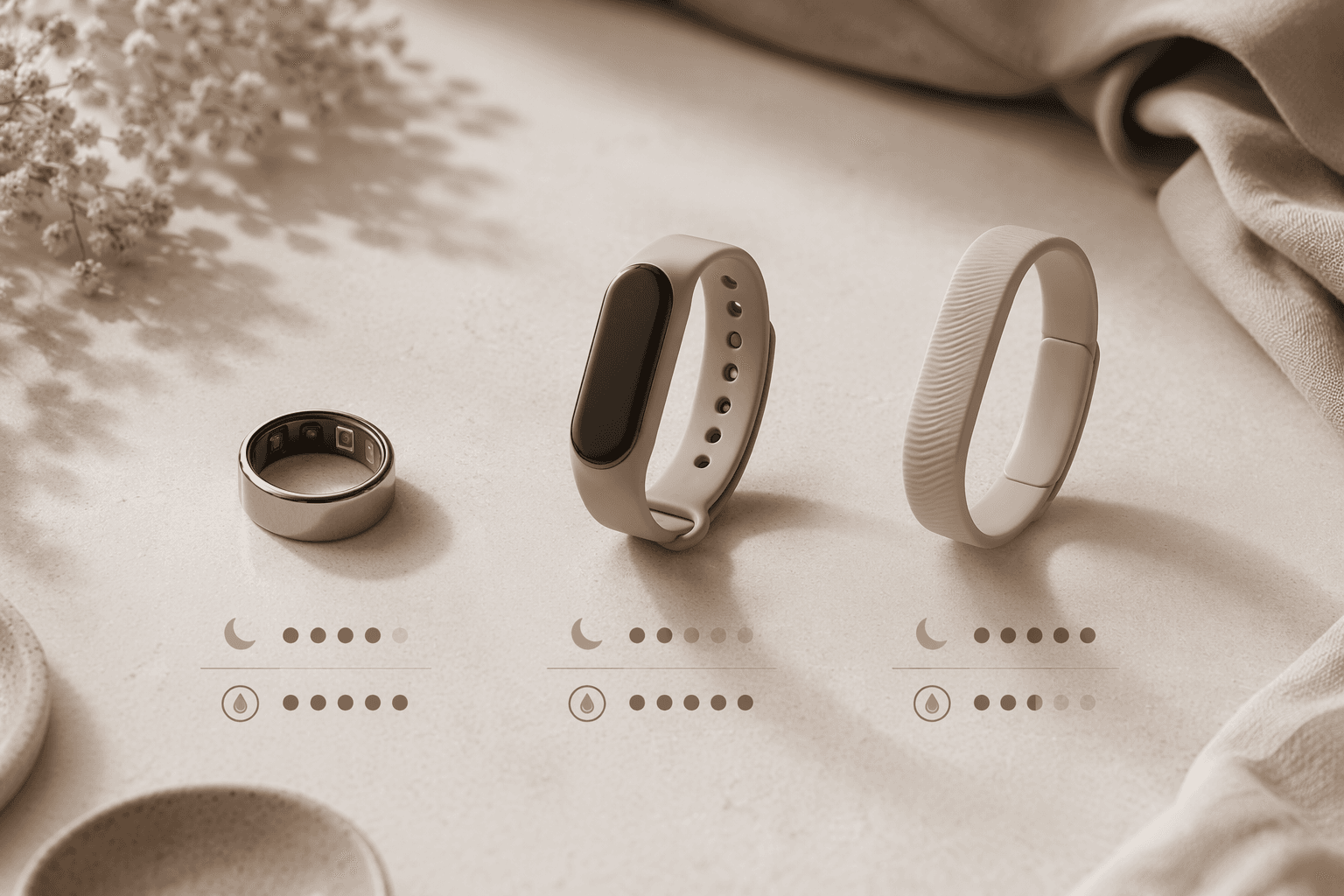
A wearable can only measure what its body position allows it to measure well. That sounds obvious, but it gets lost in product pages. Heart-rate accuracy is not one universal score. Resting heart rate during sleep, interval training, walking, cycling, strength training, and stress detection are different measurement situations.
For sleep and recovery, a ring has a strong practical case. It is light, discreet, and unlikely to flash a screen in your face when you move. Oura’s broader appeal is not just that it has recovery metrics; it is that the hardware makes overnight wear easier for people who dislike sleeping in watches. If recovery tracking is your main reason for buying a ring, How Oura Ring Tracks Recovery: Readiness Score, HRV Accuracy, and What the Science Says is the more focused deep dive.
For workouts, especially if you care about live zones, pace, GPS, and quickly checking whether your heart rate recovered between intervals, a wrist tracker or smartwatch is still easier to live with. You can see the number without opening your phone. Many models also offer workout modes that understand the difference between a walk, a run, a bike ride, and a strength session. A ring can collect useful data, but it is not as convenient when you want feedback during the session itself.
The small-wrist issue is the one I would not hand-wave. A wide case on a narrow wrist can rock during motion. A loose band can look comfortable but produce worse optical readings. A tight band can improve contact but irritate skin or leave pressure marks. That trade-off is not vanity; it is biomechanics plus sensor physics.
There is some commercial guidance suggesting average female wrist size falls around 5.7–6.2 inches, or 14.6–15.7 cm, but that figure comes from a commercial fitness site rather than a peer-reviewed anthropometric study. I would treat it as a reminder, not a standard. The useful action is simpler: measure your wrist, check the band’s stated range, and look at the sensor housing width, not only the band length.
Cycle tracking is useful, but it is not a medical promise
Women’s-health tracking is one of the areas where form factor and brand matter, but it is also where marketing gets ahead of evidence. A menstrual-cycle tile is not the same thing as reliable ovulation prediction. Temperature trends can be useful, but they do not turn a consumer wearable into a fertility clinic.
Oura leans heavily on temperature. Wareable reports that Oura uses 1,440 daily temperature readings for cycle phase prediction, while also noting user reports from people with PCOS or irregular cycles who felt the algorithm guessed ovulation dates that did not occur [3]. That is an important boundary. The same feature may be genuinely helpful for someone with fairly regular cycles and much less reliable for someone with PCOS, irregular cycles, postpartum changes, or perimenopause.
Garmin offers cycle and pregnancy tracking with temperature features on supported devices, Fitbit’s cycle tools are more basic calendar-style logging, and Apple Watch uses wrist temperature for retrospective cycle tracking rather than forward-looking medical prediction [3]. If women’s-health features are your main buying reason, compare what the device actually measures, what it only logs, and what it infers. For a watch-only comparison, see Which Fitness Tracker Watch Has the Best Women’s Health Tracking?.
The most honest way to use cycle tracking is as pattern support. It can help you notice that sleep, resting heart rate, temperature, cravings, training tolerance, or mood often shift at certain points. It should not be the only tool you use for contraception, fertility treatment decisions, or diagnosing cycle problems.
The subscription is part of the form factor
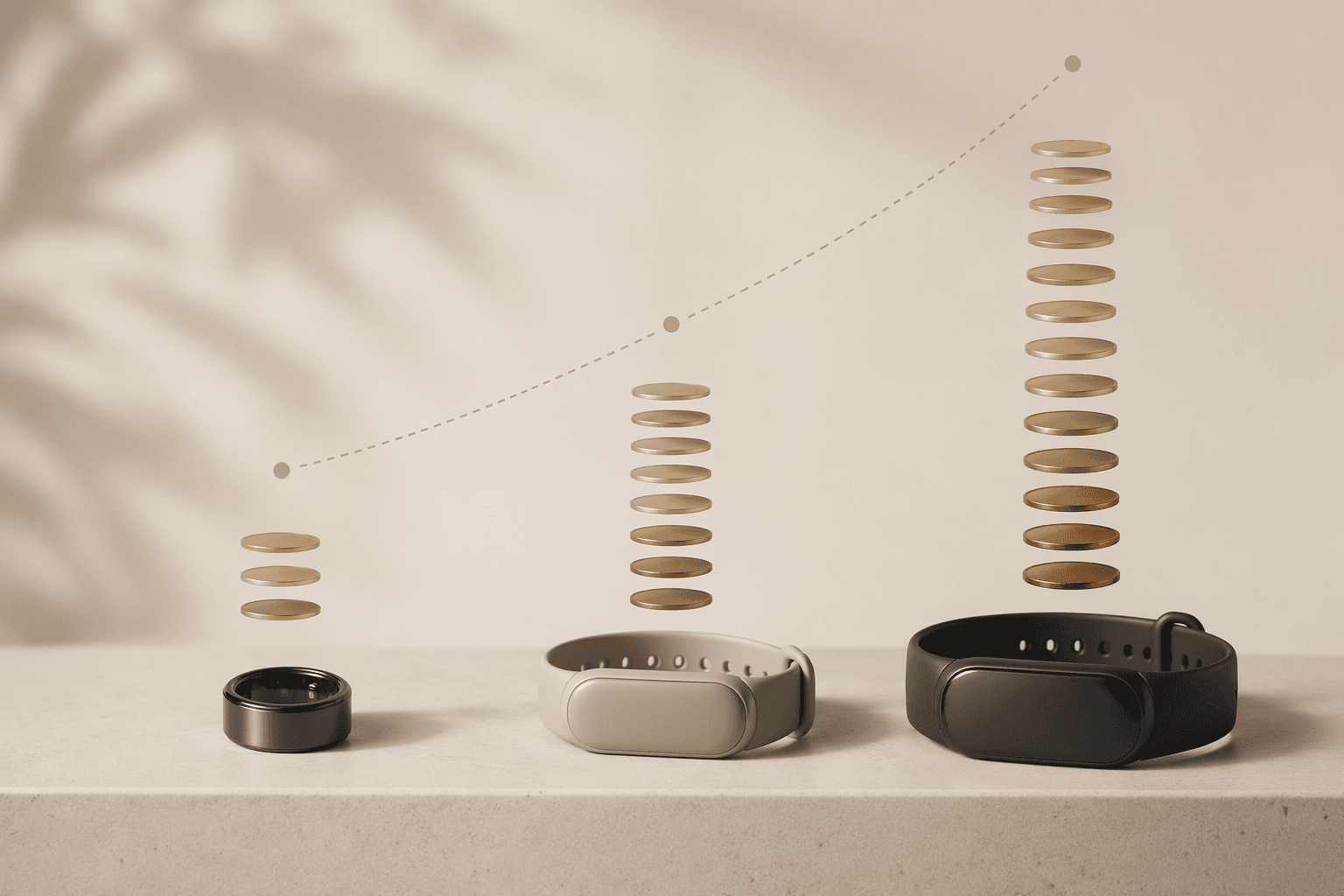
A wearable that asks you to wear it continuously is also asking for a long-term financial relationship. That matters. If the device costs $99 up front but needs a yearly membership to be useful, it is not really a $99 device. If a ring is comfortable enough to wear every night but hides the best insights behind a monthly fee, the subscription is part of the buying decision, not an afterthought.
Here is the rough ownership picture using current reported prices. These are device-and-subscription estimates only; they do not include taxes, discounts, replacement bands, warranty plans, or phone costs.
| Device | Up-front or yearly price | 2-year cost | 3-year cost | 5-year cost | What to notice |
|---|---|---|---|---|---|
| Oura Ring 4 | $299–$349 plus $5.99/month membership | $442.76–$492.76 | $514.64–$564.64 | $658.40–$708.40 | Low-profile hardware, strong sleep appeal, but the membership becomes part of the real price [1][3] |
| Whoop 5.0 | $199–$359/year | $398–$718 | $597–$1,077 | $995–$1,795 | Screenless and on-wrist charging, but the yearly model dominates long-term cost [5] |
| Fitbit Air | $99.99, no required subscription for core metrics | $99.99 | $99.99 | $99.99 | As reported in May 2026, this changes the screenless-band value equation if pricing holds [2] |
| Garmin Lily 2 | $249.99, no subscription | $249.99 | $249.99 | $249.99 | Small-watch appeal with no recurring fee, assuming the fit and feature set suit you [2] |
| Apple Watch SE 3 | $249, no subscription, iPhone required | $249 | $249 | $249 | No wearable subscription, but it only makes sense inside the iPhone ecosystem [2] |
| Fitbit Charge 6 | $99.95, Premium optional at $10/month | $99.95 without Premium; $339.95 with Premium | $99.95 without Premium; $459.95 with Premium | $99.95 without Premium; $699.95 with Premium | Bridges the gap: usable without Premium, more expensive if you keep the add-on [6] |
The long-term numbers make the screenless category much less simple. Whoop 5.0 has a 14-day battery and on-wrist charging, which is the kind of design detail that actually solves a daily-wear problem [5]. You can keep wearing it while it charges instead of losing a night of data because the puck died on the bathroom counter. But at $199–$359 per year, the question becomes whether its coaching and recovery ecosystem are worth the recurring price for you [5].
Victoria Song at The Verge makes the sharper point: for some petite-wristed users, pairing an Oura ring with a smartwatch can be more cost-effective over three to five years than paying for Whoop alone, with her estimate putting the savings at more than $1,350 in some scenarios [5]. That reframes the decision. The alternative to a screenless subscription band is not always one perfect device. It may be a ring for sleep and a watch you already own, or a no-subscription wrist tracker for workouts plus a simpler sleep setup.
The newly reported Fitbit Air is the reason I would not talk about screenless bands in 2026 as if Whoop owns the category. PCMag lists Fitbit Air at $99.99 with no required subscription for core metrics, based on May 2026 reporting and pricing at the time [2]. Prices can shift, and a cheaper device may not replace the depth of a more mature subscription platform. Still, it changes the fairness calculation for women who want background tracking without renting their own health dashboard.
If you are comparing screenless options specifically, the better companion read is Screenless Fitness Tracker Buyer’s Guide 2026: Best Options by Budget and Use Case. And if the subscription math is already making you suspicious, Best Fitness Tracker for Women: The Hidden Subscription Costs That Change Which One to Buy is where I would spend more time before buying anything.
Where each form factor makes the most sense
Choose a smart ring if sleep comfort and discreet wear come first
A ring is the cleanest choice if you mainly want overnight recovery, resting trends, and a device that disappears under normal clothes. It is especially appealing if you hate sleeping in watches, do not want a screen on your wrist, and prefer something that looks like jewelry rather than gear.
The non-negotiables are sizing and subscription tolerance. If your fingers swell noticeably, if you lift heavy with bare hands, or if you already know rings bother you at night, do not let the elegance of the form factor override that. Also decide whether Oura’s $5.99/month membership still feels reasonable after three or five years [3].
Choose a wrist tracker or smartwatch if workouts matter most
For live workout data, GPS, pace, heart-rate zones, timers, and quick glances during a session, a wrist device remains the practical default. It is also the safer choice if you do strength training with weights or equipment that makes ring wear awkward.
The fit check matters more than the colorway. Look for the smallest case that still gives you the sensors and battery life you need. Check whether the band has enough holes or adjustment range for your wrist. If the optical sensor sits on the edge of your wrist bone or the housing rocks when you move, that is not a minor annoyance; it can affect both comfort and readings.
Garmin Lily 2 is attractive in this lane because it keeps the no-subscription model and a smaller, more jewelry-like profile [2]. Fitbit Charge 6 is the bridge option: inexpensive up front, capable as a tracker, and usable without Premium, though the optional $10/month subscription can change the five-year cost if you keep it [6]. Apple Watch SE 3 makes sense if you are already an iPhone user and want a broader smartwatch, not just a tracker [2].
Choose a screenless band if distraction is the problem
A screenless band is not for someone who wants to check pace mid-run from the wrist. It is for the person who wants the device to collect background signals without turning into another tiny inbox. That can be valuable if you are trying to reduce notifications, stop checking stats compulsively, or wear something less conspicuous in professional settings.
Whoop is the established version of that idea, with serious recovery culture around it and useful hardware touches like on-wrist charging [5]. But some of its wellness language deserves a raised eyebrow. The Verge reports that Dr. Lili Barouch, a Johns Hopkins cardiologist, criticized Whoop Age as “more for entertainment than a medically valid parameter” [5]. That does not make the whole device useless. It does mean you should separate useful trend tracking from features that sound more diagnostic than they are.
Fitbit Air, if its reported $99.99 no-required-subscription position holds, is the option that makes me re-check the category before recommending a paid yearly platform by default [2]. For many women, “screenless” is the benefit. They may not need a premium coaching ecosystem to get that benefit.
A fit-first decision rule
Choose a ring if sleep comfort, discreet all-day wear, and recovery trends matter most, and only if ring sizing still feels safe and comfortable across your normal body fluctuations.
Choose a wrist tracker or smartwatch if workouts, live stats, GPS, and no-subscription practicality matter most, and only if the case and band actually fit your wrist instead of merely closing around it.
Choose a screenless band if background tracking without distraction is the priority, and only after the subscription math makes sense over the number of years you realistically plan to wear it.
References
- Oura Ring 4 specs — Oura
- The Best Fitness Trackers We've Tested for 2026 — PCMag
- The best period tracking and prediction wearables — Wareable
- Are Activity Wrist-Worn Devices Accurate for Determining Heart Rate? — PMC/NIH
- Here are the fitness trackers I actually recommend — The Verge
- Fitbit Charge 6 review and testing — Forbes Vetted
Comments
Join the discussion with an anonymous comment.