
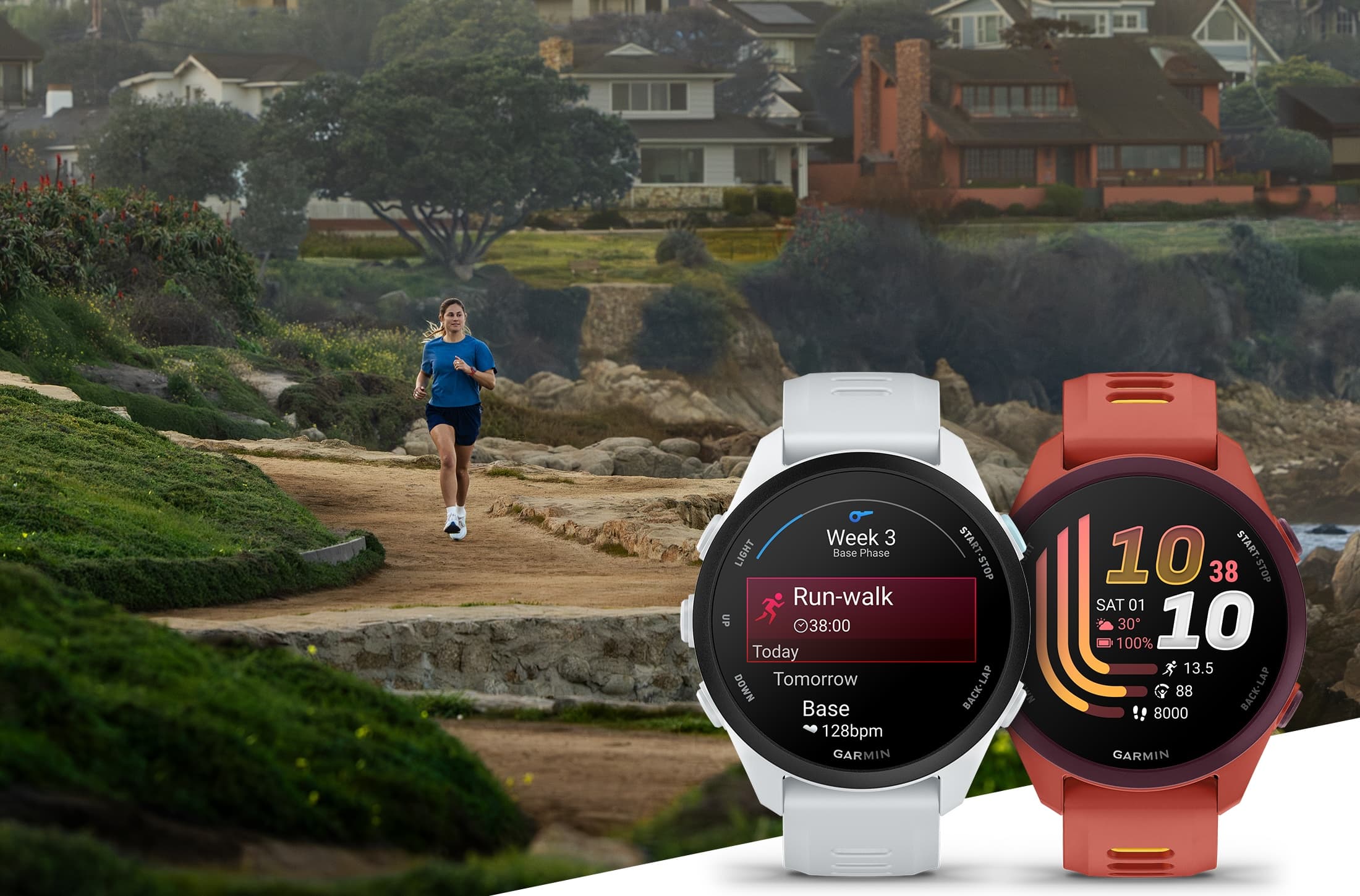
You want a capable garmin fitness tracker under $350, and you do most of your training in a spare room, not on a trail. The new Forerunner 70 ($249) and Forerunner 170 ($299) both arrived in May 2026 with premium sensors and prices that don't hurt. The question is not which is better. It's which one you actually need, and the answer, for almost everyone in a home gym, is the FR70.
What $249 Buys
The FR70 does not cut corners. It has a 1.2-inch AMOLED touchscreen, the latest Elevate Gen 4 optical heart rate sensor, 90+ sport profiles, and the same operating system as the $1,000+ Fenix 8 Pro. DC Rainmaker, the most trusted independent reviewer in the space, called it the strongest value watch Garmin has and the most feature-packed, price-focused watch they've released this decade.
"the Forerunner 70 is the strongest value watch that Garmin has now in its lineup" and "the most feature-packed and price-focused watch Garmin has released this decade" — DC Rainmaker
That's one reviewer's opinion, but the feature list backs it up. The FR70 delivers about 85% of what a $600 watch does. The fine print on battery life: Garmin says up to 13 days in smartwatch mode. Real-world usage — GPS activities, always-on display, continuous heart rate — cuts that by 30–40%. Testers from Garage Gym Reviews and Wareable consistently report 7–9 days under normal use. You will charge it weekly, not biweekly. That's still very good for an AMOLED watch, but know it before you buy. I'd rather you expect a week and be satisfied than expect two weeks and be annoyed.
Why $50 More Probably Buys Nothing
The Forerunner 170 costs $299. For that $50 you get a barometric altimeter/compass, Garmin Pay, and cycling power meter support. For a cyclist training outdoors, those are useful. For someone doing strength, HIIT, and yoga in a spare room, they are zero-use. Let me put it plainly: you do not need a barometric altimeter to track a deadlift. Garmin Pay is convenient if you forget your wallet on a run, but it is not a fitness feature. If you never cycle outdoors and don't care about tap-to-pay, that $50 buys nothing functional.
| Feature | FR70 ($249) | FR170 ($299) |
|---|---|---|
| AMOLED display | Yes | Yes |
| Elevate Gen 4 HR sensor | Yes | Yes |
| 90+ sport profiles | Yes | Yes |
| Barometric altimeter | No | Yes |
| Garmin Pay | No | Yes |
| Cycling power meter support | No | Yes |
| Openwater swimming | No | Yes |
| Music storage | No | No |
| Smartwatch battery (est.) | 13 days | 10 days |
| GPS battery (est.) | 23 hours | 20 hours |
The battery trade-off is real: the FR170's extra sensors draw power, dropping estimated smartwatch life from 13 to 10 days and GPS from 23 to 20 hours. You pay $50 and get less battery stamina. If you won't use the altimeter or contactless payments, the FR170 is simply a shorter-lived FR70.
What's Missing – And Why You Won't Care
Neither watch has multi-band GPS, ECG, offline maps, or triathlon mode. A feature-checking reviewer might flag these as missing. For a home gym athlete, they are irrelevant.
Multi-band GPS helps accuracy in dense urban canyons. DC Rainmaker tested the single-band GPS on these models and found it "not meaningfully different" from multi-band except in extreme environments like midtown Manhattan. If you take your watch on a jog around the neighborhood or use it indoors, single-band GPS is perfectly adequate. ECG on a wearable is not a training tool — it's a health screening feature with limited clinical utility for asymptomatic people. Offline maps are for trail runners and hikers. Triathlon mode is for triathletes. None of that applies to the person lifting weights in their garage.
What both watches do have is 90+ sport profiles that include every home workout mode you can name: strength training, HIIT, cardio, yoga, Pilates, treadmill, indoor cycling, rowing, stair stepper, elliptical, boxing. If your training is in a room, not on a trail, these watches cover it.
But What About the Forerunner 165?
The Forerunner 165 is discounted to around $200. It has the same Gen 4 heart rate sensor, but an older MIP display (not AMOLED) and fewer sport profiles. The display alone is worth the extra $50 — the AMOLED is significantly brighter and easier to read in daylight. I'd call the FR70 a better long-term buy. If your budget is absolutely stuck at $200, the FR165 is a valid choice. But if you can stretch, the FR70 is the smarter investment.
What about the Forerunner 265 at ~$349? It adds multi-band GPS, offline maps, training readiness, and music storage. Those are genuine upgrades, but again: for a home gym athlete who doesn't run marathons or need maps, they are overkill. The FR70 at $249 is the sweet spot.
Which One to Buy
Get the FR70. Save the $50. You won't miss the features you never needed.
If you cycle outdoors regularly and want in-ride power meter data, or if you genuinely use Garmin Pay multiple times a week, the FR170 is a fair upgrade. Otherwise, $50 buys nothing functional. And remember: Garmin Connect+ is an optional $6.99/month subscription that adds AI insights and dashboards — we have a full review — but the core features work perfectly fine without it. No subscription required.
See our full guide to Garmin trackers for home gyms for a broader lineup comparison, and the 2026 tiered buyer's guide if you want to compare across all price points.
Comments
Join the discussion with an anonymous comment.