
Home Gym Builds / $0-100 / apartment
Are Balletcore Sneakers Good for Home Workouts?
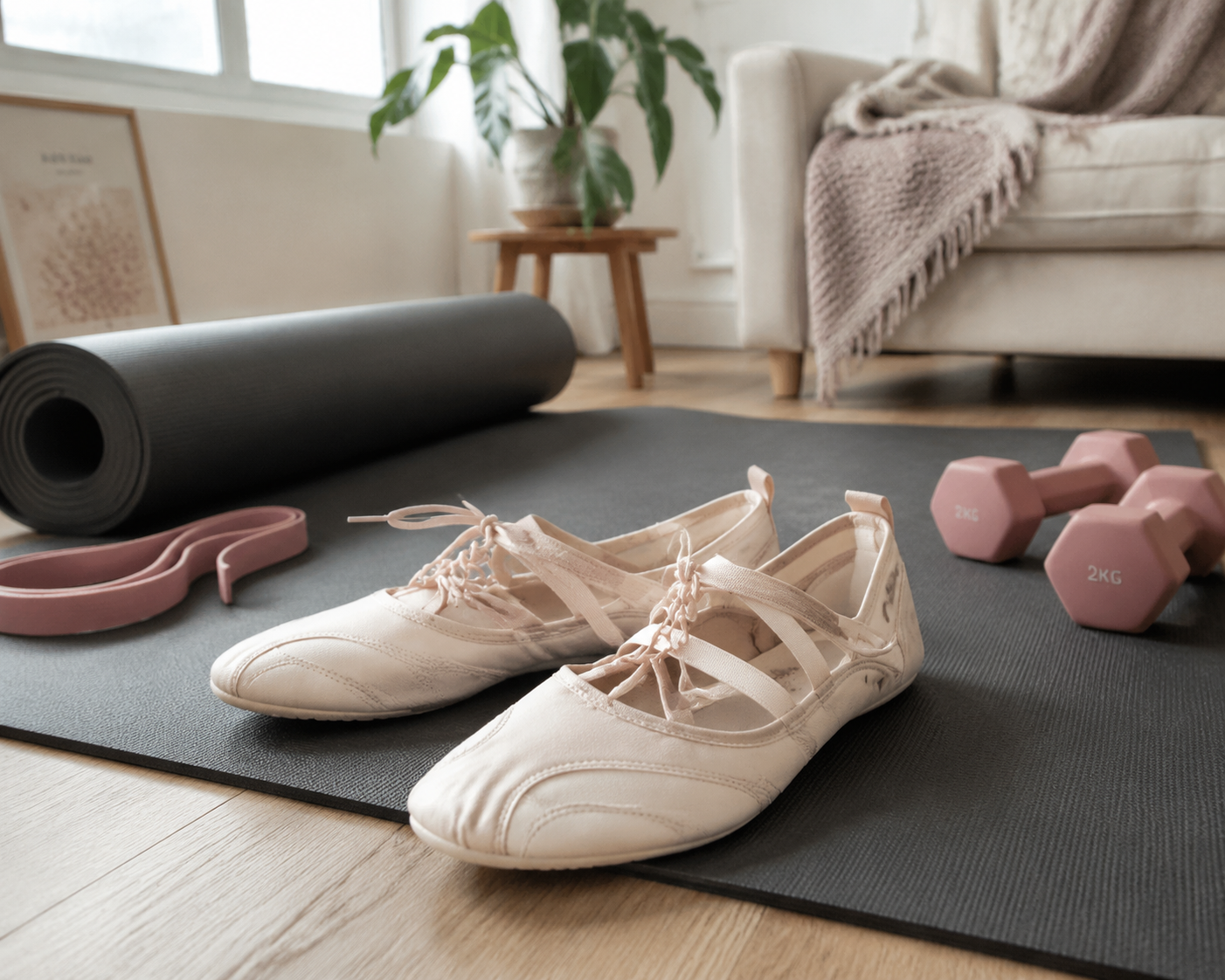
Balletcore sneakers can double as home workout shoes — but only for the right routines. This guide explains which low-impact exercises their flat soles support, and why high-impact or lateral movements call for proper training footwear.
- Budget tier
- $0-100
- Space type
- apartment
- Floor footprint
- Minimal
By Editorial Team
Itemized build and cost breakdown
- Total cost estimate
- $90
- Included equipment
- Balletcore sneakers
Prices and specs on this build are rechecked periodically — if something looks stale, flag it below.
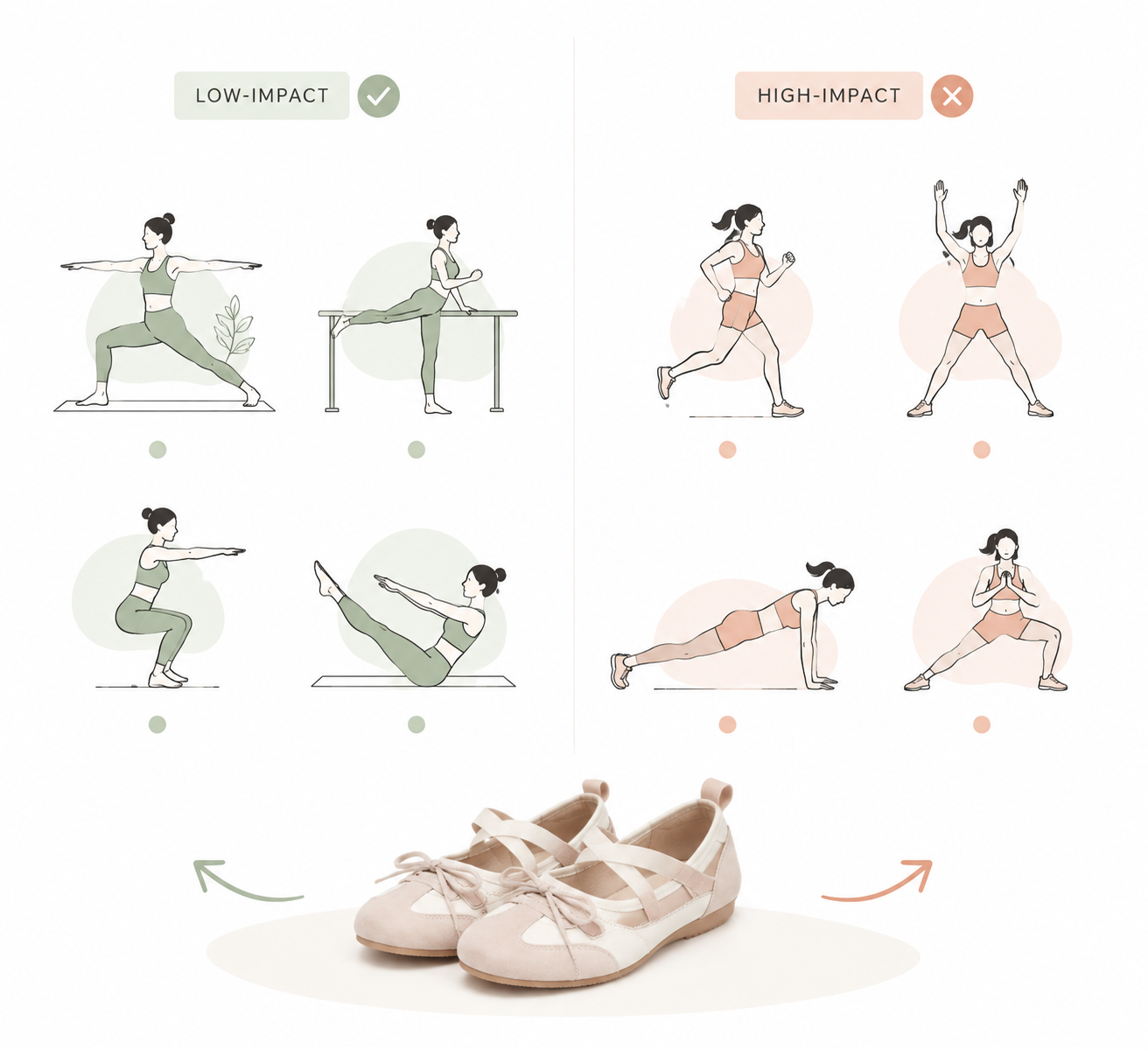
Yes, balletcore sneakers can work for home workouts — if the workout is grounded, low-impact, and controlled. Think bodyweight squats, glute bridges, slow lunges, barre-style pulses, pilates mat work, light yoga flows, mobility sessions, and short walks. They are the wrong shoe for HIIT, running, jump-heavy dance cardio, burpees, skater hops, fast pivots, or anything that asks your foot and ankle to absorb impact while changing direction quickly.
That split matters because the appeal is real. If you already own a pair, or you want one pair that looks good outside and does not eat another square foot of closet space, the question is not silly. Searches for “ballet sneakers” rose 1,300% in Lyst’s Q1 2025 Index, which says more about fashion demand than workout performance, but it explains why these shoes are suddenly sitting by so many apartment doors next to mats and resistance bands.[1]
The practical boundary is already visible in how retailers and movement specialists talk about the category. Foot Locker’s ballet sneaker FAQ says they “can be suitable for light exercise such as walking or yoga,” while adding that more intense workouts may require specialized athletic footwear for support and performance.[2] Nike’s training-shoe guidance explains why flat, stable soles can help with a greater range of movement patterns than running shoes, especially when the work is not just straight-ahead running.[3] Dr. Nancy K. Imbeau, speaking to Dance Retailer News, drew the sharper safety line: ballet sneakers generally lack the support and functionality for higher-level movement, especially enough stability around the ankle joint or midfoot for dynamic movement.[4]
The Same Sole Is the Point and the Problem
Most balletcore sneakers are low, flat, flexible, and lightly cushioned. For slow strength work, that can be useful. A flatter sole lets your foot feel the floor instead of balancing on a high, soft running-shoe stack. During a squat, hinge, split squat, calf raise, or glute bridge, that ground contact can make it easier to press evenly through the foot and notice when your weight is drifting.
That is why these shoes make more sense for a renter doing controlled strength work in six feet of living-room space than for someone launching into tuck jumps. Flatness helps when the exercise asks for stable pressure. It stops helping when the exercise asks the shoe to manage landing force, repeated shock, or side-to-side load.
Running shoes and training shoes solve different problems. Nike’s own comparison describes training shoes as flatter and more stable for varied movement patterns, while running shoes are built for forward motion.[3] Balletcore sneakers borrow one useful feature from training shoes — the low, flexible, close-to-floor feel — but they usually do not bring the full package: reinforced sidewalls, structured heel counters, grippy outsoles designed for training floors, or enough midfoot lockdown for quick direction changes.
| Home workout | Balletcore sneaker verdict | Why |
|---|---|---|
| Bodyweight strength | Usually reasonable | Flat soles can support stable squats, hinges, bridges, and controlled lunges. |
| Barre | Usually reasonable | Small-range, grounded movement matches the flexible, low-profile construction. |
| Pilates mat work | Usually reasonable | Most work is controlled, low-impact, and not dependent on lateral shoe support. |
| Light yoga or mobility | Sometimes reasonable | Useful if you want foot covering or grip, but barefoot may still feel better for some poses. |
| Short walks | Reasonable if comfortable | Walking comfort is better supported than workout safety, especially for cushioned models. |
| HIIT | No | Repeated jumping, fast transitions, and fatigue increase the need for cushioning and support. |
| Running | No | The category is not built for repeated forward impact the way running shoes are. |
| Dance cardio with jumps or pivots | No | Impact plus rotation asks for more ankle and midfoot stability than most fashion ballet sneakers provide. |
| Lateral agility or skater moves | No | Side-to-side cutting exposes the weak point: minimal lateral containment. |
Where Balletcore Sneakers Actually Make Sense
For bodyweight strength, balletcore sneakers can be a sensible compromise. A flat shoe is often better than a thick, squishy running shoe for exercises where you need to feel planted. If your home routine is built around squats, reverse lunges, Romanian deadlift patterns with light dumbbells, wall sits, step-backs, dead bugs, planks, and floor-based core work, the shoe is mostly there to give you traction, a clean surface, and a stable base.
Barre and pilates are also natural matches, with a few caveats. The movement is usually small-range, controlled, and close to the floor. A flexible sole can make calf raises, turnout-inspired positions, and foot articulation feel less clumsy than a bulky trainer. The caveat is that the shoe should stay put. If your heel lifts out, the strap loosens, or your foot slides inside the shoe during a lunge, that pair is not doing the job.
Light yoga is more personal. Foot Locker includes yoga in the “light exercise” lane for ballet sneakers,[2] but many people will still prefer bare feet on a mat because toes can spread and grip. A balletcore sneaker can make sense for a cold floor, a shared building gym, or a standing mobility session where you want a little coverage. It is less convincing for balance-heavy flows if the outsole slips or the toe box cramps your foot.
Short walks are the other reasonable use case, but walking comfort should not be confused with training safety. Business Insider reported that a tester wore JW Pei Caitlin ballet sneakers for 12 hours, including dancing, without blisters.[5] InStyle described the Puma Speedcat Ballet as blister-free and comfortable for extended wear.[6] Those are useful signals if you want a shoe for errands and a low-key mat session, not proof that the shoe can handle jump squats.
Where the Answer Turns Into No
HIIT is the cleanest no. A home HIIT class often looks simple on a screen, but your shoes are dealing with repeated landings, speed changes, sweat, fatigue, and imperfect apartment flooring. Jumping jacks, squat jumps, burpees, mountain climber switches, plank jacks, and fast alternating lunges ask for more than a cute flat sole. They ask for shock absorption, grip, and containment when your form gets tired.
Running is also out. Even if the shoe feels comfortable while walking, that does not make it a running shoe. Running repeats the same impact pattern over and over, and balletcore sneakers are not designed around that job. The issue is not whether you can physically jog to the mailbox in them. The issue is whether they are appropriate footwear for a run as exercise.
Jump-heavy dance cardio sits in the same problem zone. The aesthetic overlap with dance can be misleading here. A fashion ballet sneaker may look movement-friendly because it is soft and minimal, but quick turns, bouncing combinations, pivots, and lateral travel expose the lack of midfoot and ankle support that Dr. Imbeau warned about for dynamic movement.[4]
Side-to-side cutting is the quiet test a lot of these shoes fail. Forward and backward movement lets the shoe behave like a simple flat platform. Lateral lunges, skater hops, shuffle steps, and fast curtsy-lunge transitions push your foot into the side of the upper. If the upper is soft satin, thin leather, mesh, or a low-cut Mary Jane shape with minimal lockdown, your foot can move faster than the shoe can support.
A Fashion Ballet Sneaker Is Not a Dance Sneaker
This is where the naming gets annoying. Balletcore sneakers and dance sneakers can live in the same visual neighborhood, but they are not automatically the same tool. Dance Retailer News points to the Bloch Boost Mesh Split-Sole as a functional comparison point: it costs $97, has built-in arch support and non-marking soles, and Pamela Levy, director of ballet pedagogy at ABT and NYU, uses it instead of fashion ballet sneakers for actual teaching and movement.[4]
That comparison should make the decision simpler, not more complicated. If the shoe was designed for streetwear, judge it as streetwear that may tolerate some low-impact exercise. If it was designed as a dance or training shoe, then its movement features deserve a separate look. A ribbon, strap, split look, or ballet-adjacent silhouette does not tell you what the midsole, outsole, heel, and upper can handle.
How Specific Models Shift the Use Case
Model differences matter because “balletcore sneaker” covers shoes that feel almost barefoot and shoes that behave more like cushioned lifestyle sneakers. Current listings and seasonal releases can change, especially for models such as the Adidas Taekwondo Mei and Nike Air Rift, so verify the exact version before treating any spec as permanent.
| Model | Reported price range | Construction note | Best home-workout fit |
|---|---|---|---|
| Adidas Taekwondo Mei | $68–174 | Thin leather sole; closest to a minimalist lifting-shoe feel | Controlled strength, barre, and grounded bodyweight work |
| Puma Speedcat Ballet | $75–100 | Ortholite insole; among the more cushioned options in the category | Walking plus very low-impact circuits |
| Vivaia Cristina | $89–129 | Satin upper; barefoot feel; weakest for support | Gentle mat work, mobility, and casual wear rather than dynamic exercise |
| Nike Air Rift | $105 | Split toe; Air heel unit | Walking-first use, with light exercise as a secondary role |
| Adidas Samba Jane | $100–105 | Gum sole; medium flex; velcro adjustability | Low-impact strength or barre when the strap gives secure fit |
| Bloch Boost Mesh Split-Sole | $97 | Built-in arch support; non-marking soles; dance-oriented build | A functional dance-sneaker benchmark, not a fashion substitute |
The Adidas Taekwondo Mei is the most interesting if your workout is strength-biased. A thin leather sole and minimalist feel can be useful for squats, hinges, and grounded bodyweight sessions because there is less shoe between you and the floor.[2][5][4] That does not make it a cross-trainer. It means the shoe’s strengths line up with slow, stable movement.
The Puma Speedcat Ballet is better framed as the comfort pick. Its Ortholite insole makes it one of the more cushioned models in the category, and InStyle’s wear test found it comfortable and blister-free for extended wear.[6] That makes it more appealing for a day that includes errands, a walk, and a gentle circuit. Cushioning for comfort is still not the same as impact protection for HIIT.
The Vivaia Cristina sits closer to the “barefoot feel” side of the category, with a satin upper and the weakest support profile among the examples in the research set.[5][4] That can feel pleasant for light mat work, but it is exactly the kind of shoe where lateral movement deserves a hard stop. A soft upper that feels elegant with jeans may not control your foot during a fast side lunge.
The Nike Air Rift is more walking-first than training-first. The split toe and Air heel unit make it distinct from flatter ballet sneakers, and its best use case is short walks with light exercise around the edges.[5] If your workouts are mostly pilates, mobility, and walking, it can make sense. If your app cues sprint intervals or plyometric blocks, it does not solve that problem.
The Adidas Samba Jane is the adjustability example. A gum sole, medium flex, and velcro strap give it a better chance of staying secure than a loose slip-on, with prices reported around $100–105.[2] For apartment strength sessions, that strap matters more than the trend label. If it locks the foot down, the shoe becomes more useful; if it gaps, slides, or pinches, it becomes casual wear.
Fit Checks Before You Press Play
Before counting balletcore sneakers as workout shoes, do a boring two-minute fit check. It is less glamorous than an outfit photo, but it is the part that protects your ankles, your downstairs neighbors, and your budget.
- Stand in your workout socks and check toe room; several tester reports note that ballet sneakers can run narrow, so wide feet need extra caution.[5]
- Do ten slow squats; your heel should stay seated and your foot should not slide forward.
- Do five reverse lunges per side; the upper should hold your midfoot without twisting.
- Step side to side slowly; if your foot spills over the edge or the shoe rolls, skip lateral workouts.
- Check the outsole on your actual floor or mat; a shoe that slips on vinyl, tile, or a rug is not a workout shoe in that room.
For a broader home setup, footwear belongs in the same decision as your mat, bands, dumbbells, and storage. If a $90 pair of ballet sneakers means you cannot buy the resistance bands or mat you actually need, that is not a free two-in-one win. FitAtHome’s best home gym equipment guide and first-time home gym buying framework are useful if you are still sorting out what deserves the next purchase.
The Evidence Has a Ceiling
There is no peer-reviewed study directly testing balletcore sneakers for home workout performance. The best available evidence is narrower: a retailer’s light-exercise boundary, general training-shoe mechanics, expert caution from a dance-medicine context, and comfort tests for walking and extended wear.[2][3][4][5][6] That is enough to draw practical limits, not enough to rank every pair as safe or unsafe for every body.
So the decision should follow the workout, not the trend. If your home gym workout plan is mostly grounded strength, barre, pilates, mobility, and walking, balletcore sneakers can be a reasonable dual-purpose buy. If the session includes jumping, running, rapid pivots, or side-to-side cutting, use proper training footwear.
References
- The Lyst Index Q1 2025, Lyst
- Comfortable Ballet Sneakers, Foot Locker
- Training Shoes vs. Running Shoes, Nike
- Balletcore Sneakers Shine on Streets, but Are They Made for Movement?, Dance Retailer News
- The Best Ballet Sneakers, Business Insider, April 2026
- Puma Speedcat Ballet Sneakers Are the It Shoe for Summer, InStyle, June 2026
Best for
Before you buy
Verify an item, or start using this build
Spot a stale price or spec?
Prices and stock change. If something in this build no longer matches what you found at checkout, let us know so we can recheck it.