
What a Cargo Container Pool Really Costs vs. a Home Gym
A cargo container pool's base price hides a much larger all-in cost: $50,000–$85,000+ installed, plus $500–$7,340 a year to run. This cost reality-check benchmarks the container pool against container gyms and in-home builds so you can judge which delivers more training value per dollar.
- Budget tier
- outside-standard-tier
- Space type
- small-room
- Total cost
- $50,000-$85,000+ installed
- Floor protection required
- —
- Best for
- swim/lap training buyers, homeowners, land owners
- Last tested
Items included: Container shell, liner/coating, filtration, pump, plumbing, electrical, fencing, decking
If you searched for cargo container swimming pool installation cost home gym, the useful answer starts with the installed object, not the steel box. River Pools, a fiberglass-pool company and therefore not a neutral observer of container pools, puts a finished shipping-container pool project around $50,000–$85,000+ installed. Published operating-cost estimates then add roughly $500–$7,340 per year, depending on whose cost model you use. A container gym, by contrast, can price anywhere from about $9,570 for a 20-foot turnkey listing to $55,728 for a 40-foot model, while one UK container supplier describes DIY conversions at roughly £10,000–£15,000. [1][2][3][4][5]
That is the whole suspicion in one line: the pool may begin with the same kind of steel shell as the gym, but it becomes a permitted, wired, fenced, filled, treated, and maintained water system. The gym becomes a structure that holds equipment. Those are not the same ownership problem.
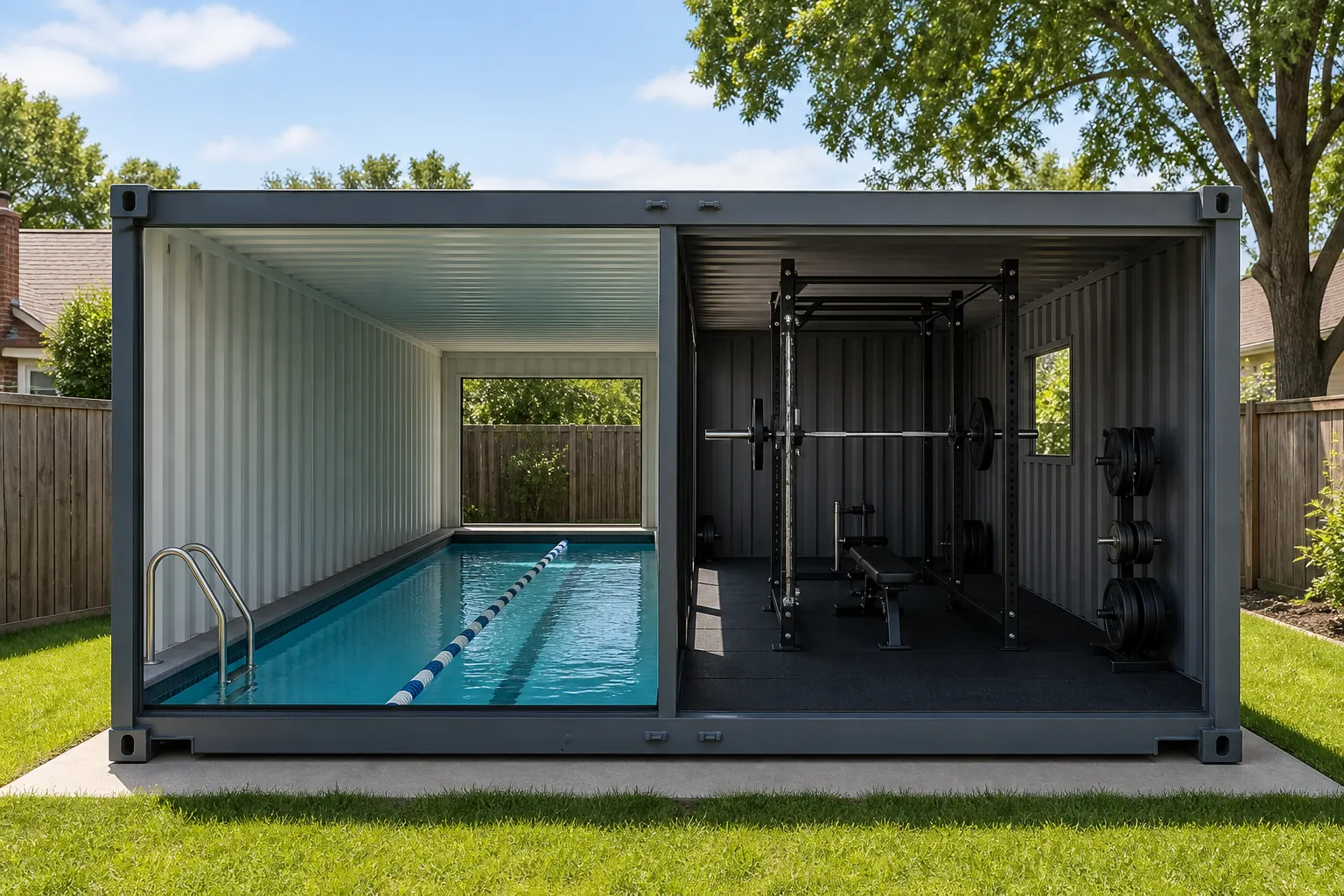
Container builds also sit far outside FitAtHome’s usual tested small-room budget tiers. A $100, $300, or $800 room setup can be phased, moved, resold, or corrected. A container pool is land work. A container gym is a detached outbuilding. The comparison is still useful, but it is a cost audit, not a first-party build plan.
The base pool price is only the first layer
The cheapest number around a container pool is usually the least helpful one. A raw shipping container can make the idea look like a clever shortcut, but a swimming pool is not a hollow box; it needs a liner or coating, filtration, plumbing, electrical work, structural support, safe access, code compliance, and the surrounding work that lets humans use it without turning the backyard into a liability.
Even before site work, the pool package itself can already be substantial. Modpools advertises units from about $36,000. Midwest Container Pools gives an example 20-foot complete package at $46,440. River Pools describes smaller units around $17,000 and 8-by-20-foot units reaching the mid-$40,000s, while Jack Cooper’s cost guide also places many shipping-container pool projects well above the raw-shell fantasy. [6][2][1][7]
| Cost layer | Published range or example | Why it matters |
|---|---|---|
| Pool package or base unit | About $17,000 to the mid-$40,000s in examples; Modpools from about $36,000; Midwest 20-foot complete package at $46,440 [1][2][6] | This is the pool product before the backyard is fully ready for it. |
| Site preparation | $500–$3,000; excavation can be $2,000–$8,000 if installed inground [2] | The pool needs a level, load-bearing placement area. |
| Delivery | $500–$3,000 [2] | Distance, access, and unloading conditions change the real bill. |
| Crane placement | $300–$800 [2] | The box still has to be lifted into position if ordinary unloading will not work. |
| Electrical | $500–$1,500 [2] | Pumps, heating, lighting, and controls do not run on enthusiasm. |
| Permits | $100–$2,000 [2] | Local rules can turn a quick backyard idea into a formal project. |
| Fencing | $1,500–$5,000 [2] | A usable pool usually has safety-code consequences. |
| Decking | $5–$50 per square foot [2] | The pool may be a rectangle; the safe walking, entry, and lounging area around it is another project. |
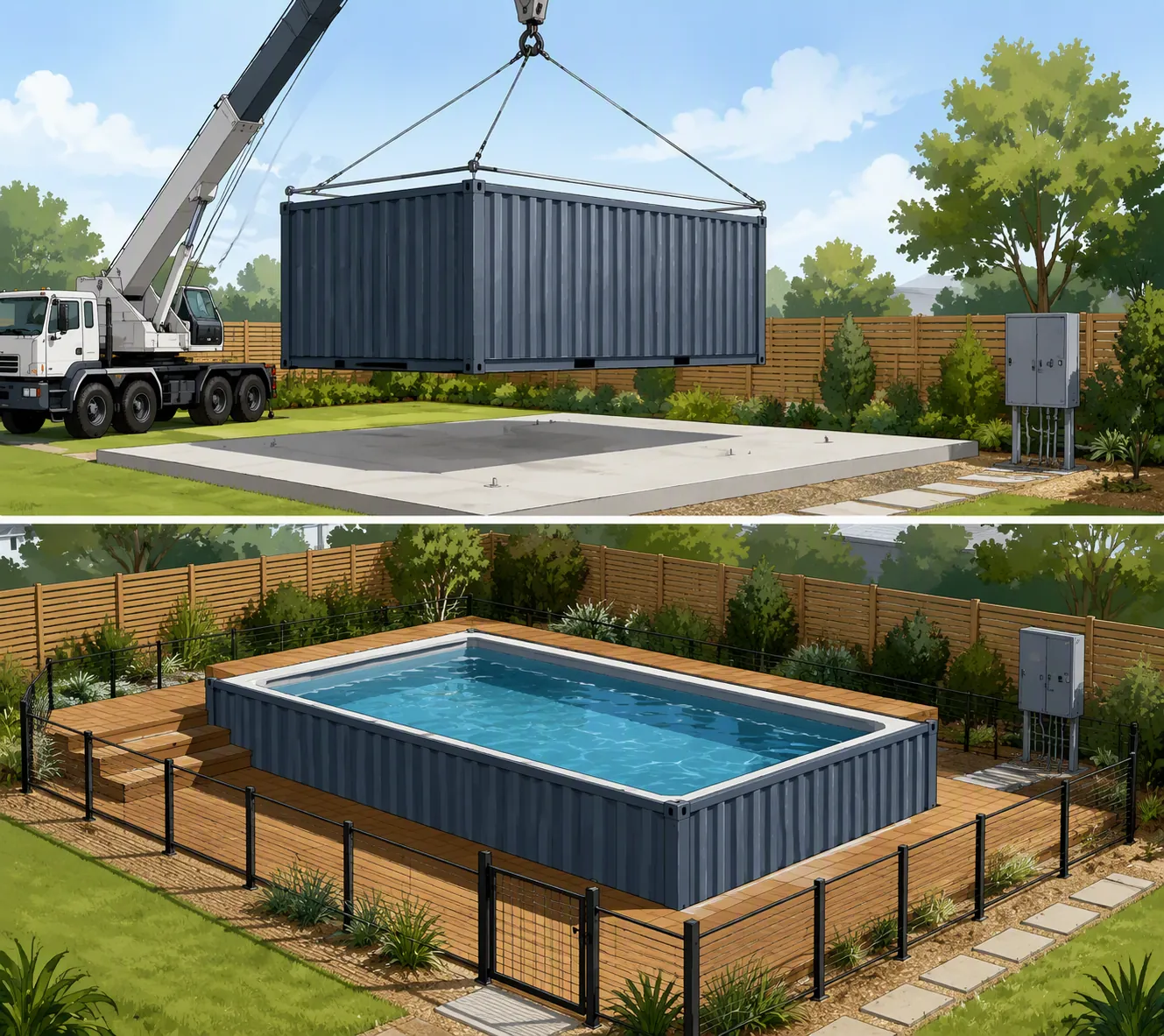
This is why the $50,000–$85,000+ installed range is more believable as a stack than as a scare number. Delivery, crane work, electrical, permits, fencing, decking, and site preparation are not decorative add-ons. They are the difference between a container sitting in a yard and a pool a homeowner can actually use.
The foundation is not supporting an empty container
A container pool’s weight changes the moment it becomes a pool. PoolSpaForum describes a 20-foot unit at about 6,000 pounds dry and about 5,000 gallons of water when filled. The foundation question is therefore not, “Can the yard hold a steel box?” It is, “Can this prepared area hold the filled pool, the people using it, and the surrounding structure safely over time?” [8]
That also explains why “installed in days” advertising can be technically true and still financially misleading. The container may arrive and be set quickly. The buying decision, however, has to include the work that happened before the truck arrived and the inspections or finishing work that follow.
Above-ground placement may reduce excavation, but it can increase the importance of stairs, decking, sightlines, fencing, and backyard access. Inground placement can look cleaner, but the excavation line item alone can erase the fantasy that the container is the cheap shortcut. Neither route should be judged from the shell price.
Annual operating cost is the second price tag
Installation is not the end of the pool budget. Midwest Container Pools estimates annual maintenance at $500–$1,500. Premier Pool Co’s container-pool cost guide gives a much wider $1,570–$7,340 annual range and says self-maintained owners commonly land around $2,000–$3,000 per year. [2][3]
Those ranges are too wide to treat as a precise forecast for every yard. Climate, heating expectations, local utility prices, cover use, water chemistry, cleaning habits, and service choices all matter. But for a home-fitness buyer, the important point is simpler: the pool keeps asking for money after the installation crew leaves.
A normal home gym does not have an equivalent recurring burden. Rubber flooring does not need chlorine. A barbell does not run a pump. A rowing machine, treadmill, or cable trainer may eventually need repair, but the ownership model is not built around water treatment, heating, filtration, and seasonal care.
What the same steel box buys as a gym
A container gym is not automatically cheap. Bob’s Containers lists a 20-foot container gym from $9,570 and a 40-foot model at $55,728. Universal Containers, writing for a UK audience, describes DIY container-gym conversions at about £10,000–£15,000, so the number needs a currency and regional-labor caveat before being compared to US pool projects. [4][5]
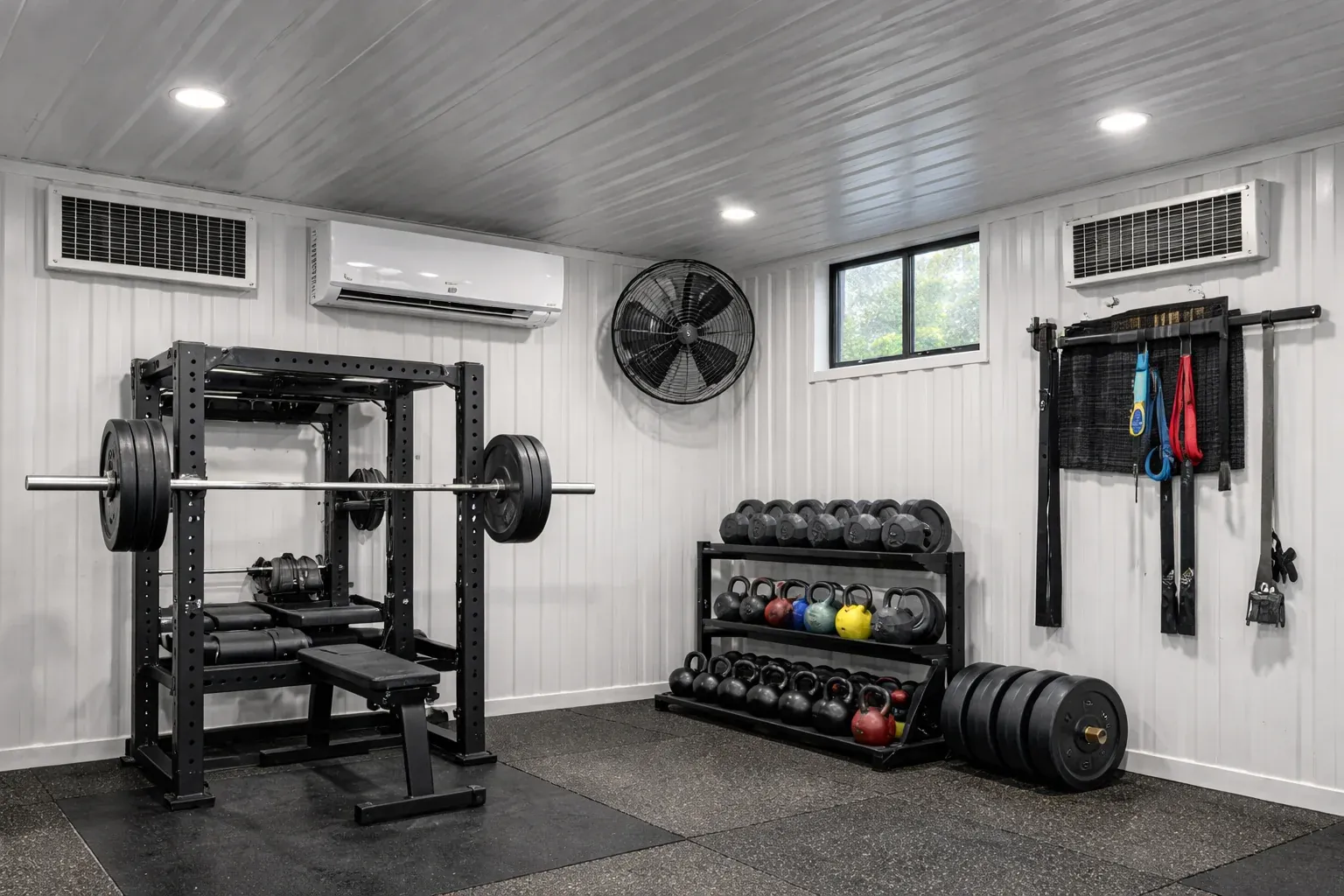
The container gym still has site requirements. Fury Company’s container-gym page describes a placement area supporting 7,500+ pounds, four concrete footings, and a 16–20 week build lead. That is not a mat-and-dumbbell weekend project. [9]
But once placed and equipped, the gym spend converts into more exercise categories. Strength training, hypertrophy work, mobility, conditioning intervals, loaded carries if the exterior space allows, suspension training, dumbbell work, barbell work, bands, and cardio equipment can all live in the same structure. The pool can be excellent for the person who wants swimming. The gym is more forgiving for the person whose training goals change over five years.
This is where a detached container only makes sense if the detached structure solves a real problem: no spare room, no garage bay, noise concerns, ceiling-height needs, or a household boundary that makes training inside the home impractical. If the goal is simply more training per dollar, a normal room build deserves to be priced first. FitAtHome’s small-apartment home gym tour and apartment budget phases show how far the usual tiered approach can go before a buyer needs a backyard structure.
The pool’s fitness value is narrower than its lifestyle value
A container pool is a fitness tool only if the buyer wants swimming, lap work, aquatic intervals, water walking, or low-impact conditioning enough to pay pool prices. If the real goal is “I should work out more,” a pool is a risky way to buy motivation.
The layout also matters. Endless Pools, a swim-spa competitor with an obvious incentive to frame shipping-container pools unfavorably, criticizes them for a roughly 4.5-foot single-depth water column across common 20-to-40-foot lengths. That does not make every container pool useless for training, but it does narrow the use case: compact swim practice, water exercise, and backyard cooling are different from a deep, varied aquatic-training environment. [10]
River Pools makes related critiques about steel corrosion and coating lifespan, and those should be read as competitor claims rather than neutral engineering law. Still, they point to a fair buyer question: if the shell is the selling point, what protects that shell from the water system it is holding, and who is responsible if the coating, liner, or structure fails? [1]
The gym comparison is not that swimming is inferior. Swimming is valuable precisely because it is specific: low-impact conditioning, skill practice, breathing rhythm, shoulder endurance, and aquatic recovery. The problem is paying for that specificity when the buyer actually needs general training capacity.
Swim spas and pool-plus-hot-tub packages sit in the middle, not outside the math
A swim spa can look like the compromise: smaller than a pool, more aquatic-training oriented than a decorative backyard basin, and often easier to place than a full pool project. PoolSpaForum’s 2021 guide placed swim spas around $15,000–$55,000, so the figure is useful as a dated baseline rather than a 2026 quote. [8]
Container-pool vendors may also offer pool-plus-hot-tub configurations. Midwest Container Pools lists hot-tub add-ons at roughly $5,000–$15,000. That may improve year-round appeal for some households, but from a training-value view it is another added cost, not a discount on the core pool decision. [2]
A cleaner way to compare the three options
| Option | Likely cost posture | Best fitness argument | Weak point |
|---|---|---|---|
| Cargo container swimming pool | $50,000–$85,000+ installed, plus about $500–$7,340 per year to run [1][2][3] | Dedicated swim, lap, and aquatic conditioning at home | High installation stack, continuing maintenance, narrower training menu |
| Container gym | About $9,570–$55,728 in listed turnkey examples; DIY conversion examples around £10,000–£15,000 in a UK source [4][5] | Detached strength and conditioning space with broad exercise variety | Still needs land, placement work, footings, lead time, and a reason to exist outside the house |
| Ordinary in-home gym | Fits the normal phased-budget model rather than a container-project model | Most training utility per dollar for strength, mobility, and general conditioning | Limited by room size, noise, ceiling height, neighbors, and household tolerance |
For a buyer trying to keep the decision grounded, the five-year view is often more honest than the installation quote. FitAtHome’s all-in-one gym vs. modular cost comparison uses that same ownership lens: what gets used, what sits idle, what can be upgraded, and what keeps charging you after purchase. The same logic applies here, just at a much larger scale.
The ordinary in-home build wins the utility-per-dollar test for most people because it can start small and expand only when training behavior proves the need. A pair of adjustable dumbbells, bands, a bench, a pull-up option, a mat, and one well-chosen cardio tool can cover a large share of general fitness without creating a new structure in the yard. If the big-purchase temptation is really about buying a single elegant machine, FitAtHome’s home Pilates machine cost comparison is the closer cousin than a pool quote.
The decision frame
- Choose the cargo container pool only if swim or lap training is the point, you own the land, local permitting works, and the yearly operating cost is acceptable before the first crane quote arrives.
- Choose the container gym only if a detached structure solves a real space problem that an indoor room, garage bay, shed, or smaller phased build cannot solve.
- Choose the ordinary in-home build if the goal is maximum training utility per dollar, broad exercise variety, low recurring cost, and the ability to expand without committing to a construction project.
The container pool is not a bad idea because it is expensive. It is a bad fit when the buyer wants general fitness and is being sold a backyard amenity as if it were the most efficient training infrastructure. If swimming is the goal, price the whole pool. If training is the goal, price the workouts first.
References
- Shipping Container Pools: The Essential Pros and Cons, River Pools and Spas, updated Feb. 2026
- How Much Are Container Ship Pools? Cost Breakdown, Midwest Container Pools
- Shipping Container Swimming Pool Cost, The Premier Pool Co
- 40′ Container Gym, Bob’s Containers
- Shipping Container Gym Ideas, Universal Containers
- Modpools, Modpools
- How Much Does a Shipping Container Pool Cost?, Jack Cooper
- Shipping Container Pools, PoolSpaForum, Aug. 2, 2021
- Container Gyms, Fury Company
- Endless Pools v Shipping Container Pool, Endless Pools
Some links on this page are affiliate links — they may earn us a commission at no extra cost to you. Our tier and tests are decided before we ever check which links pay; see our full affiliate disclosure.
Spot something off?
Noise and floor-damage claims carry real deposit-risk consequences if we get them wrong — tell us if your experience with this build didn't match what's above.