
Cool Down Fast After a Home Workout Without AC
Standard cool-down advice like walking or stretching doesn't actually lower your core body temperature. This article explains specific, evidence-backed cooling techniques—neck cooling, forearm immersion, fan-mist evaporative cooling, and pulse-point ice packs—to safely and rapidly cool down after a home workout when you don't have air conditioning.
- Citation source
- CDC
- Evidence level
- general guideline
You finish the last set in a hot apartment, peel yourself off the mat, and do the thing you are supposed to do: walk around, breathe slowly, maybe stretch your calves. Your heart rate drops. Your legs stop buzzing. And yet 20 minutes later you are still cooking inside your own shirt.
That is the part most generic cool-down advice does not handle. Walking and stretching can help you transition out of exercise, but they are not the same as cooling the body. A narrative review by Van Hooren and Peake found that active cool-downs such as walking or light jogging do not significantly lower core temperature compared with passive rest, and core temperature can stay elevated for up to 90 minutes after exercise.[1]
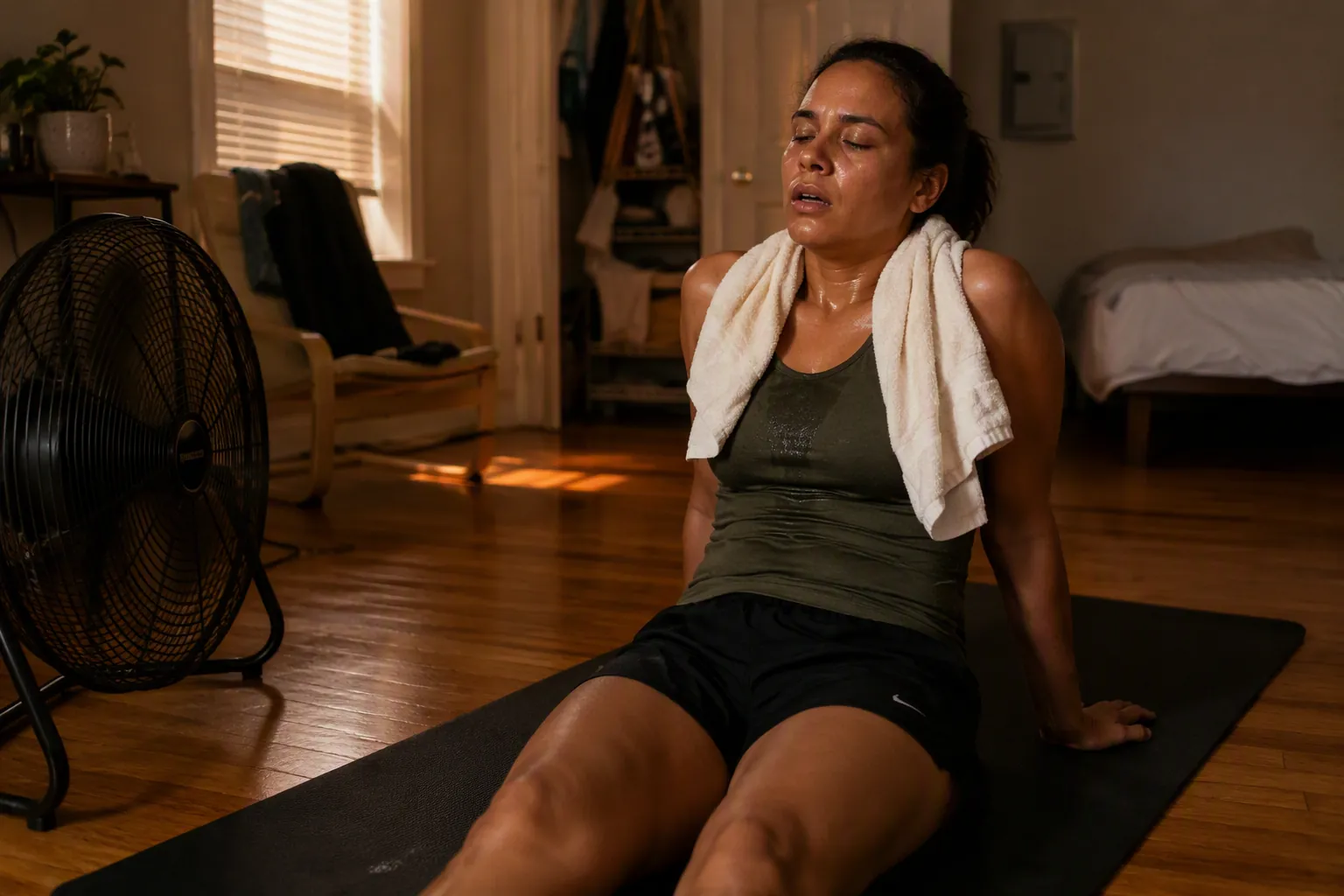
So if you came here looking for workout cooling tips without AC at home, the useful question is not “What is the perfect recovery ritual?” It is: how do you move heat out of the body quickly with the stuff already in your apartment?
Do this first: the no-AC post-workout cooling sequence
If you are hot, sweaty, and irritated, do not start with a long stretch on a soaked mat. Start by removing the things that are keeping heat and sweat against your skin, then cool the places where blood and thermal sensation give you the most return.
| What to do | How to do it at home | Why it helps |
|---|---|---|
| Get out of heat-trapping clothes | Change into a dry, loose shirt or go shirtless if you are comfortable. Remove socks, compression layers, and tight waistbands. | Wet fabric can hold warmth and sweat against the skin, making evaporation less effective.[2] |
| Put a cold damp towel on the neck | Run a towel under cold water, wring it out, and wrap it across the back and sides of the neck. | Neck cooling improves thermal perception in heat and can make the body feel cooler quickly.[3] |
| Immerse forearms and elbows | Fill a sink or bowl with cold water and ice if available. Submerge forearms and elbows for about 5 minutes. | The forearm and elbow region gives cooled blood a direct route back toward the core through large superficial vessels. |
| Mist or wet skin, then use a fan | Spray water on arms, chest, shoulders, neck, or legs, then sit in front of a fan. | Wet skin plus airflow increases evaporative heat loss; a fan alone in a hot room may only move warm air around.[4][5] |
| Add ice packs to pulse points | Wrap ice packs or frozen bags in a thin towel and place them on the neck, wrists, underarms, or inner groin. | These areas bring blood closer to the skin surface, which makes heat transfer more efficient.[4] |
| Shower after targeted cooling starts | Use cool or tepid water. Avoid turning the shower into an ice-bath contest. | Very cold water can feel dramatic, but colder is not automatically better for core cooling. |
That order matters. The shower is not useless, but it should not be the only plan. If you jump straight into a very cold shower while still overheated and then step back into a stagnant room, you may feel shocked cold for a few minutes and then start radiating heat again.
Change clothes before you try to “recover”
The fastest upgrade is not glamorous: strip off the soaked layer. A damp shirt plastered to your torso can keep heat and moisture sitting against the skin. RinseKit’s summer cool-down guidance puts the clothing change near the start of the sequence for that reason: damp fabric traps heat and interferes with evaporation.[2]
In a small apartment, this also keeps you from turning the next 30 minutes into a slow steam bath. Put the wet clothes somewhere they can dry, towel off excess sweat, and expose more skin to moving air if privacy allows. Loose dry clothing is better than compression gear when the job is heat loss.
Neck cooling is the best low-effort move
A cold towel on the neck looks almost too simple to take seriously, which is exactly why it is useful after a hot home workout. You do not need a recovery gadget. You need cold water, a towel, and enough patience to leave it in place instead of pacing around your apartment pretending that movement is helping.
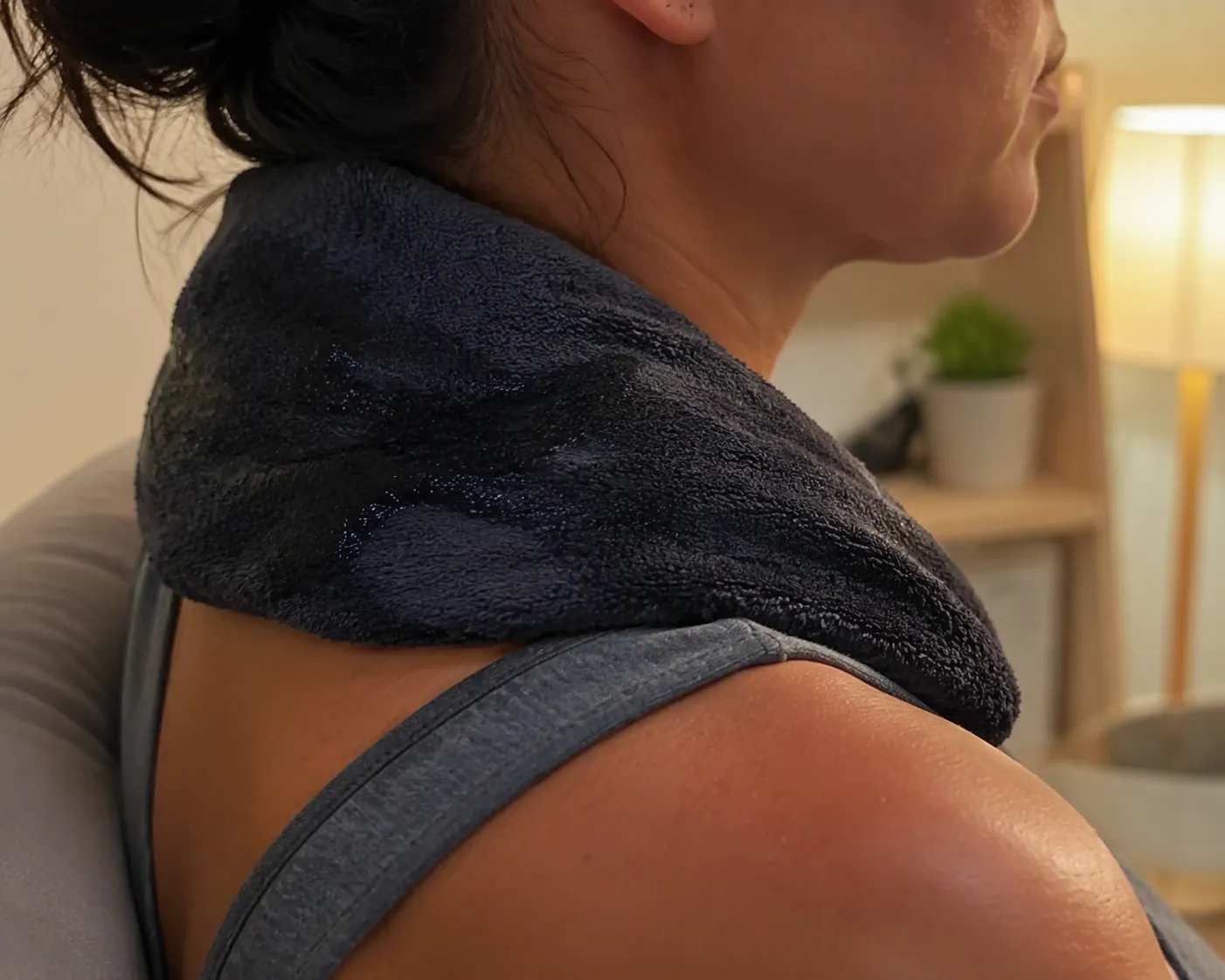
Neck cooling gets special attention in sports-medicine research because the neck is highly sensitive to temperature and sits near major blood vessels and thermoregulatory signaling pathways. A 2022 Sports Medicine - Open review found that neck cooling improves endurance performance and thermal perception in hot conditions.[3]
For post-workout cooling, the performance angle is less important than the sensation angle. When your neck cools, the whole situation often becomes more tolerable within minutes. That can keep you from making bad choices, like standing under painfully cold water, lying motionless in a closed bathroom, or deciding something must be wrong because you still feel hot after a normal cool-down.
Use the towel across the back and sides of the neck, not just draped politely over your shoulders. Re-wet it when it warms up. If you have ice, put a few cubes in the towel or chill the towel in a bowl of cold water first. Keep a dry towel nearby so the rest of your skin can still evaporate sweat instead of staying swampy.
Forearm-and-elbow immersion works better than it looks
Forearm immersion is the move people skip because it looks like something you would do only if you had no shower. That is backwards. It is one of the most apartment-compatible ways to cool blood moving through the arms without needing a tub, an ice bath, or a climate-controlled room.
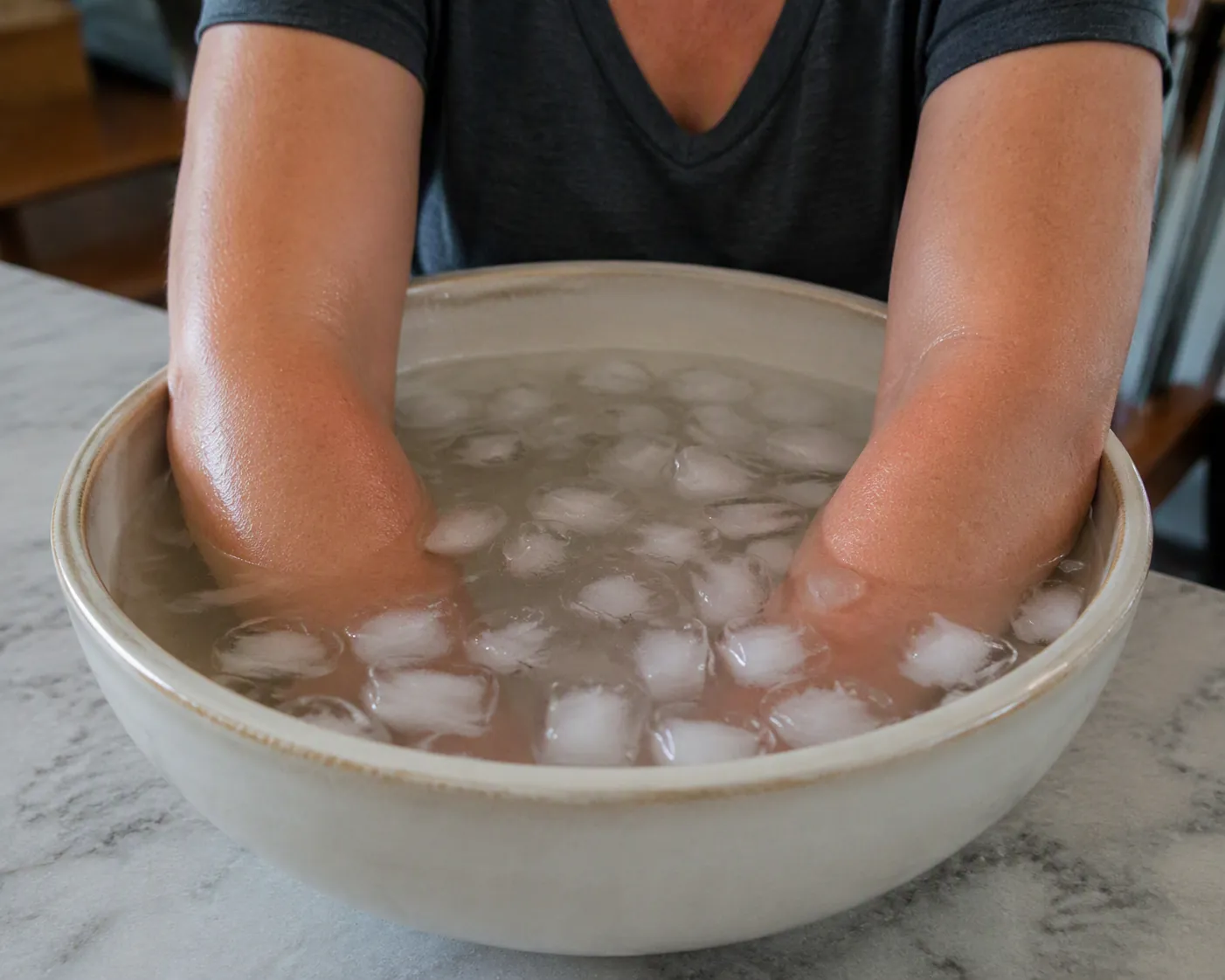
Fill a sink, mixing bowl, storage bin, or deep pot with cold water. Add ice if you have it. Submerge both forearms and elbows for about 5 minutes. The elbow matters because the brachial vein network runs through that area; cooling there can send cooler blood back toward the core instead of only chilling your hands.
This is also easier to control than a full cold shower. If the water feels painfully cold, pull your arms out briefly, stir in a little warmer water, then continue. You are trying to reduce heat load, not prove pain tolerance.
A fan needs wet skin to do real work in a hot room
A fan can be disappointing after a hard workout in a hot apartment. If the room air is warm and your skin is already drying unevenly, the fan may feel like it is just pushing heat from one corner to another. The fix is to give the air something to evaporate.
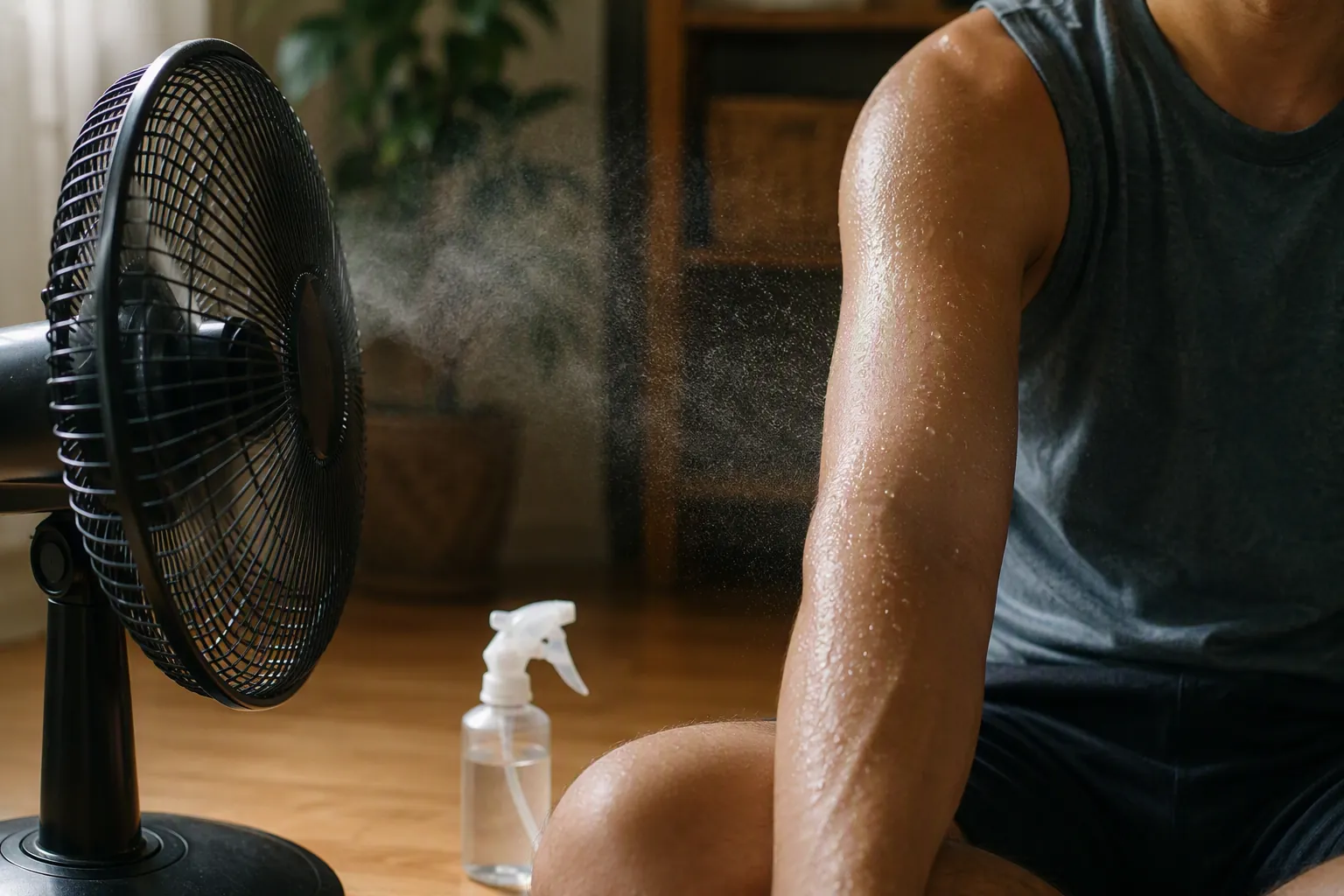
Harvard Health recommends wetting the skin first, then using a fan to cool down.[4] TrainerRoad makes the same practical point for indoor training: airflow matters, but in a hot indoor setup, simply moving warm air is limited unless evaporation is part of the system.[5]
Use a spray bottle, a wet washcloth, or your hand dipped in cool water. Wet the arms, legs, chest, shoulders, and neck. Then sit where the fan crosses as much skin as possible. If the room is humid, evaporation will be slower, but wet skin plus airflow still gives you more cooling potential than sitting in soaked clothes and hoping.
Use ice packs where blood is close to the surface
Ice packs are an add-on, not the whole protocol. They work best on high-heat-transfer areas: the neck, wrists, underarms, and inner groin. Harvard Health includes these pulse-point areas in its cooling advice because blood runs closer to the surface there.[4]
Wrap the ice pack in a thin towel. Do not put hard frozen packs directly on skin and leave them there while you scroll your phone. Move them around or use short intervals. The point is steady heat transfer, not giving yourself an ice burn after surviving a workout.
About that cold shower
A shower is tempting because it feels decisive. You are drenched, annoyed, and standing near a bathroom anyway. A cool or tepid shower can help, especially after you have already started neck cooling, forearm immersion, or fan-and-mist cooling.
The mistake is assuming ice-cold water is automatically better. Very cold water can trigger peripheral vasoconstriction, narrowing blood vessels near the skin. That may make the skin feel intensely cold while slowing some heat transfer from the core. Healthline’s cold-versus-hot shower guide notes the circulation trade-offs around cold showers and post-workout use.[6]
Start cool, not punishing. Let your breathing settle. If you feel lightheaded, nauseated, confused, or worse when you get in, get out, sit or lie down in a cooler spot if possible, and treat that as a safety signal rather than a willpower problem.
What not to overthink
Do not lose time searching for a perfect water temperature. The research and guidance around cooling do not point to one universal number for every situation, and recommendations for drinking fluids do not translate neatly into skin cooling, towel cooling, or forearm immersion. Use water that is cold enough to feel clearly cooling but not so cold that it causes pain, panic breathing, or numbness.
A product claim is not a cooling measurement. A cooling towel, wrap, or vest can be useful if it helps you keep cold water against the neck or skin, but “feels colder” is not the same as “lowers core temperature fastest.” The mechanism still matters: contact with cooler material, evaporation, airflow, and blood flow near the surface.
A traditional active cool-down is also optional once it stops helping. If walking helps your breathing and coordination come down, fine. If it keeps you generating heat in a room with no AC, stop moving and start cooling.
When cooling is not working
Most overheated post-workout misery improves once you get out of wet clothes, cool the neck and forearms, wet the skin, and sit in moving air. If symptoms are escalating instead of easing, stop treating it like normal recovery.
The CDC’s heat guidance for athletes flags emergency warning signs such as confusion, altered mental status, loss of consciousness, seizures, very high body temperature, or symptoms that worsen despite cooling.[7] If those show up, seek emergency help. If someone else is with you, have them help with cooling while help is on the way.
Heat also changes the decision before the workout starts. If your home gym is already hot before you begin, use a heat-aware setup, shorten the session, or move the hard work. FitAtHome’s guide to home workouts during extreme heat without AC covers the during-workout side, while hot home gym safety tips can help you decide when the room itself is the problem.
After the immediate heat load is down, the next issue is sleep. A hot room can keep recovery miserable long after the workout is over, so pair this protocol with a plan for sleeping without AC after workouts if nighttime heat is part of the pattern.
After a hot home workout without AC, walking and stretching are not enough if the real problem is body heat. Strip the wet layer, cool the neck, immerse the forearms and elbows, use wet skin with a fan, add pulse-point ice packs, and keep an eye on symptoms. Then deal with the room you have to recover in.
References
- Do We Need a Cool-Down After Exercise? A Narrative Review of the Psychophysiological Effects and the Effects on Performance, Injuries and the Long-Term Adaptive Response, Sports Medicine, 2018.
- How to Cool Down After a Workout: The Best Ways to Recover in Summer Heat, RinseKit.
- Neck Cooling and Exercise Performance in the Heat: A Narrative Review, Sports Medicine - Open, 2022.
- Want to cool down? 14 ideas to try, Harvard Health Publishing, 2024.
- Does Your Indoor Training Setup Have Enough Cooling?, TrainerRoad.
- Cold Shower vs. Hot Shower: Which One Is Better?, Healthline.
- Heat and Athletes, Centers for Disease Control and Prevention.
This is general fitness education, not medical advice. For diagnosis or treatment of pain or injury, consult a qualified clinician.
Pick your next session
Browse all routines to find an appropriately-spaced next session.
Spot something off?
This content sits adjacent to health guidance — tell us if a citation or figure needs a correction.