
How to Sleep Without AC and Recover Faster From Workouts
Learn how to sleep cool without air conditioning using a proven sequence of pre-bed rituals, fan placement, and bedding swaps that support muscle repair and recovery after hard workouts.
- Citation source
- HealthPartners
- Evidence level
- general guideline
The hard part about learning how to sleep without AC for better workout recovery is not knowing that a cool room helps. It is coming home from a late lift or bodyweight session, eating dinner in a small apartment, and realizing the room is still holding the day’s heat. The fan is moving air, but not really removing heat. The sheets feel sticky. Your legs are tired, but your body is still running warm.
For recovery sleep, the useful target is roughly 60–67°F. Rooms above 75°F can interfere with deep sleep and REM sleep, the stages tied to muscle repair, hormone release, motor learning, and next-day training readiness.[1][2][3] Sleep also depends on a drop in core body temperature of about 1–2°F; if your room, bedding, humidity, and workout timing keep that drop from happening, discipline during the day can get undercut at midnight.[2][4]
That does not mean everyone without a 65°F bedroom is doomed. Some athletes sleep acceptably at 68–72°F, and tolerance varies. The better question for a renter is more practical: how much of the gap can you close tonight without installing an AC unit, violating a lease, or buying your way out of the problem?
The no-AC recovery sequence
The sequence matters because each step removes a different obstacle. Blinds keep heat from entering. Workout timing reduces internal heat. A warm shower moves heat to the skin before bedtime. Fan placement removes hot air instead of stirring it. Bedding and humidity decide whether sweat can actually evaporate. Pulse-point cooling and ice-supported airflow help you get through the narrow sleep-onset window.
| When | Action | What it changes |
|---|---|---|
| Daytime | Close blinds or curtains before direct sun hits the room | Reduces heat gain before the room becomes a storage box |
| Workout planning | Avoid hard training in the final 2–3 hours before bed when possible | Gives core temperature more time to fall |
| 60–90 minutes before bed | Take a warm shower, then get out into a ventilated room | Encourages skin blood flow and a later core-temperature drop |
| After outdoor air cools | Use a window fan as exhaust and open another window or door crack for intake | Pulls cooler night air through the room |
| Bed setup | Use breathable sheets and reduce synthetic layers | Improves sweat evaporation and perceived coolness |
| Sleep onset | Cool neck, wrists, or ankles; optionally use ice in front of a fan briefly | Targets the first hour when falling asleep is most fragile |
If you already have a broader recovery routine, treat this as the temperature piece inside it, not a replacement for food, hydration, mobility, or sensible programming. The same logic applies whether your training is a barbell session in a spare room or a bodyweight workout squeezed into a living room; sleep temperature is one of the quiet variables that decides whether recovery work actually lands. For a wider recovery structure, see Your Complete Post-Workout Recovery Routine at Home.
Start before the room gets hot
The cheapest cooling move happens hours before bedtime: block sunlight before it loads the room with heat. Closing blinds or curtains can reduce indoor temperature by up to 10°F, which is a bigger swing than most last-minute fan tricks can produce once the walls, floor, and mattress are already warm.[5]
In a small apartment, this is not decorative advice. A bedroom that faces afternoon sun can keep radiating heat long after the outdoor temperature starts dropping. Close blinds before the sun hits the glass, not after the room already feels bad. If you work from home and need daylight, prioritize the bedroom first and borrow light from another room. Recovery sleep is more sensitive to the bedroom than the hallway.
If you can create shade outside the glass without breaking lease rules, that helps too. But even plain blinds, closed early, change the night. The goal is not to create a perfect sleep lab. It is to avoid starting your evening routine from a room that has spent eight hours baking.
Move the workout earlier when the room will not cool
Late training is sometimes the only training. But when there is no AC, a hard session in the last 2–3 hours before bed creates a predictable problem: exercise raises core temperature, and the body still needs to cool before sleep onset.[1] If the room is also above the comfortable sleep range, the body is trying to dump heat into an environment that does not want to take it.
On hot weeks, the adjustment does not have to be heroic. Move the hardest work earlier when possible. If evenings are fixed, shift the late session toward lower heat cost: technique work, easy zone work, mobility, or shorter strength work with longer rests. Save high-rep circuits, heavy conditioning, and dense lower-body sessions for days when you have more cooling time afterward.
This is especially relevant for home bodyweight training, where the workout often happens in the same room where sleep is supposed to happen later. If the room is already hot, a dense session can turn the bedroom into both gym and sauna. For more on matching training stress to recovery, see How to Recover From a Bodyweight Workout at Home.
Use the warm-shower paradox instead of chasing a cold shock
A cold shower right before bed feels obvious after a hot workout. It can feel good on the skin, and sometimes that is worth something. But for sleep onset, the better-supported move is often a warm shower 60–90 minutes before bed. Warm water increases blood flow to the skin; once you get out, that surface heat can dissipate, helping core temperature fall afterward.[6][7]
The timing is the whole trick. A hot shower immediately before getting under covers can leave you flushed and damp. A cold shower immediately before bed may cool the skin while also creating a short-term alerting effect, and it does not necessarily solve the deeper cooling problem as reliably. The useful version is boring: shower warm, not scalding; finish early enough; dry fully; then sit or move lightly in the coolest airflow you can create.
If you train late, shower as soon as you can after dinner or cleanup rather than saving it as the last thing before bed. The shower is not just hygiene. It is part of the temperature schedule.
Turn the fan into an exhaust system
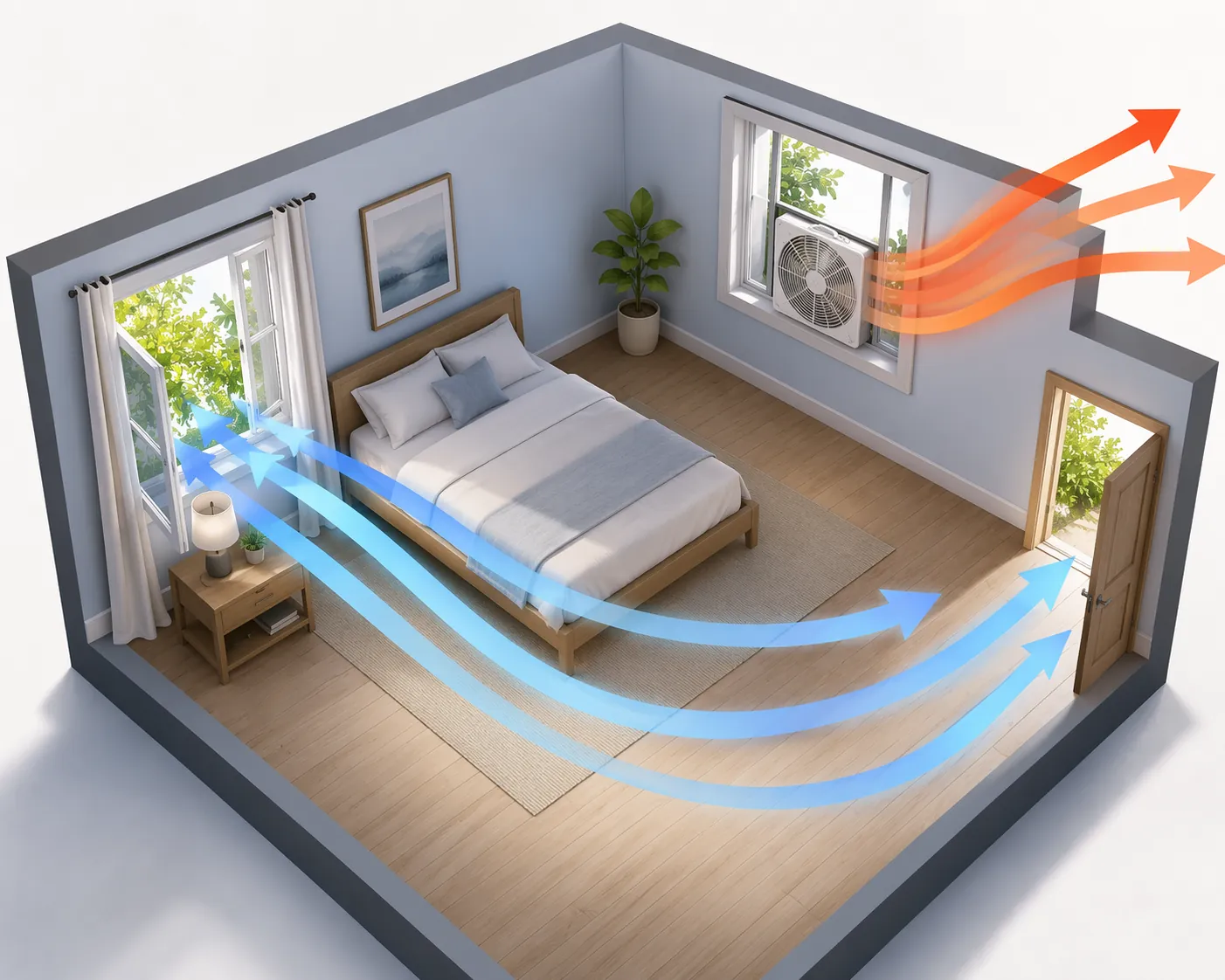
A fan pointed at the bed can make skin feel cooler, but if the room is hot and humid, it may only be pushing warm air around. The stronger apartment setup is a box fan in a window facing outward. Used as exhaust, it pushes warm indoor air outside and creates negative pressure that pulls cooler nighttime air in from another opening.[1][5]
The setup is simple, but the details matter:
- Put the fan in the warmest window or the window closest to the sleeping area, facing out.
- Open a second window, door, or safe hallway-facing gap on the opposite side of the room or apartment.
- Keep the path between intake and exhaust as open as possible so air moves through the room, not just around the fan.
- Start the exhaust setup when outdoor air is cooler than indoor air; before that point, keep blinds closed and avoid pulling heat inside.
- If you have two fans, use one as exhaust and one to move incoming cooler air across the room, not both randomly pointed at the bed.
This is where many no-AC nights are won or lost. A fan is not a tiny air conditioner. It helps by increasing evaporation and by moving air from one place to another. If the only thing it does is blast hot air at your torso, you may feel briefly less miserable while the room temperature barely changes.
Noise is the renter’s tax on this method. A rattling fan in an old window can be fixed more often than people think: wedge folded cardboard or a towel around the frame, set the fan on a stable sill or stool, and keep the blades clean. The goal is steady airflow, not a machine that keeps waking you up every time it vibrates against the frame.
Change the bed, not just the air
Bedding decides whether your body can use the airflow you worked to create. Cotton and linen sheets breathe and wick moisture better than microfiber or polyester blends, improving perceived thermal comfort even when the room temperature has not changed dramatically.[1]
The apartment version is blunt: remove the synthetic comforter, skip the heavy mattress topper if it traps heat, and sleep under a light cotton or linen sheet. If you share a bed with someone who runs cold, use separate layers instead of one shared blanket that turns into a compromise nobody likes.
This is also where laundry timing matters. Slightly damp towels, sweaty workout clothes, and wet gear drying in the bedroom all add moisture to the air. Dry them elsewhere if you can. A small room with wet fabric and closed windows will feel worse than the thermometer suggests.
Do not ignore humidity
Heat and humidity are different problems. A fan can help sweat evaporate, but when humidity climbs above 60%, evaporation becomes less effective and the same room can feel much hotter.[1] That is why a fan alone often disappoints in a sticky apartment even when it seemed useful in spring.
If you already own a dehumidifier, run it earlier in the evening rather than waiting until bed. If you do not, low-cost moisture absorbers can help in closets or small rooms, though they will not perform like a real dehumidifier. The point is not to turn a humid bedroom into a desert. It is to make evaporation possible enough that airflow and lighter bedding can do their jobs.
There is a tradeoff: some dehumidifiers add heat while they run. In a small bedroom, that means you may want to run one before sleep, then switch back to the exhaust fan setup once outdoor air cools. The best sequence depends on whether your main enemy that night is wet air or stored heat.
Use pulse-point cooling for the first hour
Pulse-point cooling is not magic, but it is useful at the exact moment a hot athlete needs help: sleep onset. A cold cloth or wrapped cold pack on the neck, wrists, or ankles targets areas where blood vessels sit close to the skin, which can speed heat loss and improve perceived coolness.[1][8]
Keep it short and dry. A wet towel that soaks the pillow can make the bed humid and uncomfortable later. A thin cloth between skin and cold pack avoids skin irritation. Ten to twenty minutes is often enough to get past the restless stage without turning the whole bed into a damp project.
The ice-and-fan hack has a place, but not a halo
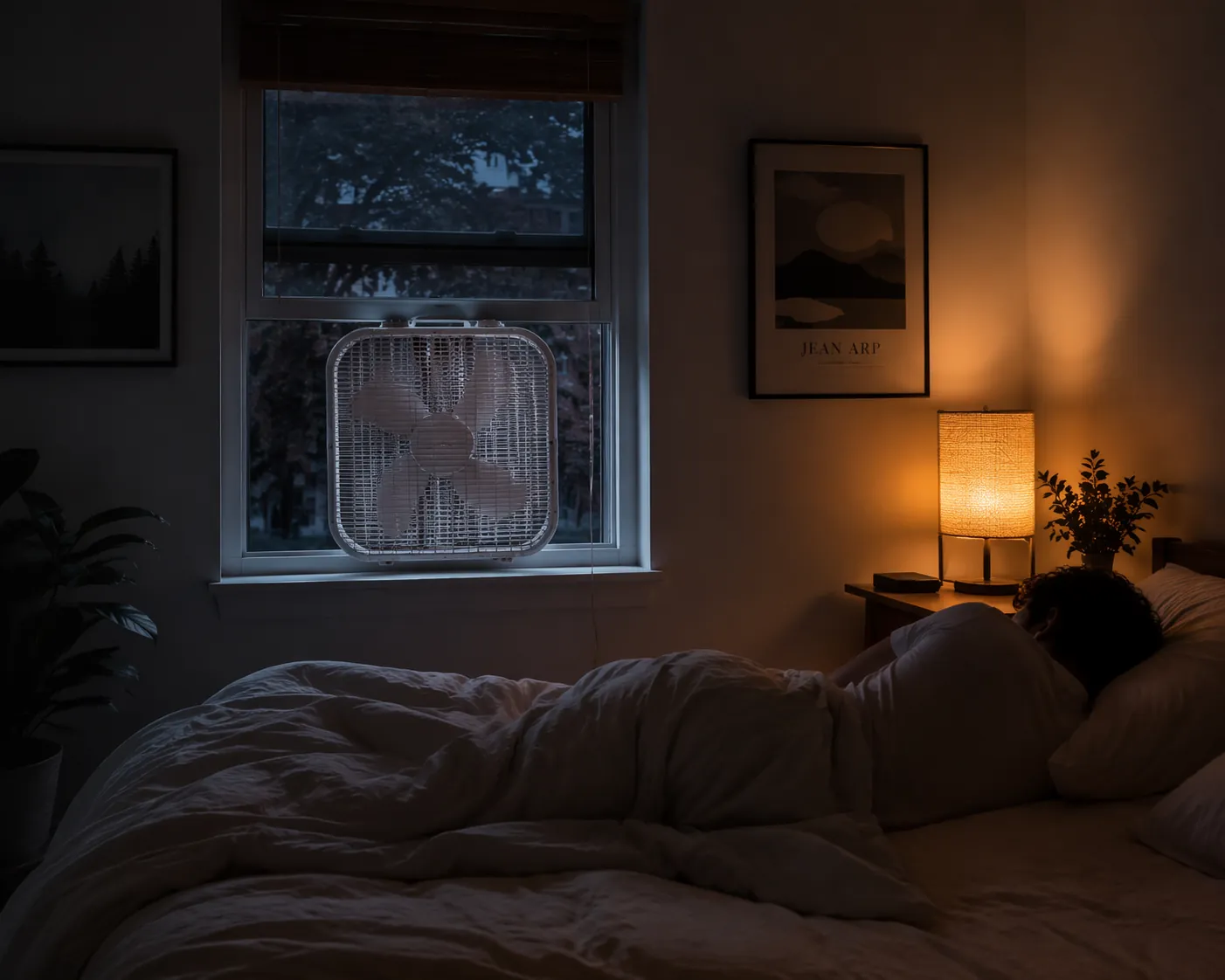
A bowl of ice in front of a fan can help for the first part of the night. Reader-reported tests collected by NPR found output-air drops of about 5–10°F for 1–2 hours, which is long enough to help some people fall asleep.[8] That is useful. It is also not the same as controlled lab evidence, and it will not overcome every hot room.
The result depends on room size, humidity, fan strength, and how much ice you use. In a tiny room, it may briefly improve the air moving across the bed. In a large room, the effect can disappear fast. In humid air, adding meltwater near the bed may make the room feel clammy if ventilation is poor.
Use it as a sleep-onset assist, not the foundation of the plan. Freeze a larger block of ice or several bottles during the day, place them in a bowl or tray that will not spill, put the setup where the fan can move air across the cold surface, and keep cords away from water. If the room has no airflow path and the humidity is already high, fix those first.
A realistic hot-night routine
On a hot training day, the whole routine can look like this:
- Morning or early afternoon: close bedroom blinds before direct sun hits the window.
- Training window: move hard work earlier if possible; if not, reduce late-night heat load by avoiding dense conditioning right before bed.
- After training: eat, hydrate, and start cooling the room rather than sitting in the hottest airflow path.
- 60–90 minutes before bed: take a warm shower, dry fully, and switch into loose, breathable sleep clothes.
- When outdoor air drops: place the box fan facing outward in the window and open a second intake point.
- At bed: use cotton or linen layers, cool pulse points briefly, and use ice-supported fan airflow only if it helps the first hour.
This routine also leaves room for other sleep disruptors. Late caffeine can keep a hot night from recovering even if the room setup is decent; if that is part of your pattern, see Coffee's Role in Post-Workout Recovery and Heart Health. If snoring, choking awakenings, or daytime sleepiness are present regardless of temperature, the issue may be bigger than heat; How Sleep Apnea Sabotages Home Workout Recovery covers that separate problem.
When no-AC recovery is not enough
There are nights when the weather beats the plan. Extreme heat, poor ventilation, high humidity, illness, dehydration, certain medications, or an apartment that never cools can make no-AC sleep more than a comfort problem. In those conditions, recovery is not the priority over safety. Reduce training load, relocate for sleep if you can, or treat the day as a rest day. For heat-specific training decisions, see When an Excessive Heat Warning Means It's Time to Rest.
No-AC sleep is not a purity test. If the room only gets to 70°F but you fall asleep faster, wake less often, and train better the next day, that is a win. If all you can do tonight is close the blinds earlier, set the fan as exhaust, strip the bed down to breathable layers, and cool your neck for twenty minutes, that is still better than improvising with a rattling fan after the room is already hot.
The stacked protocol works because it respects the real bottleneck: your body needs to shed heat before it can protect the deep and REM sleep that support repair. Without AC, you are not creating winter indoors. You are giving your body enough of a temperature drop, airflow path, evaporation, and sleep-onset support to recover better than it would by fighting the room all night.
References
- Tips for sleeping in hot weather without AC, HealthPartners
- What You're Forgetting When It Comes to Your Sleep, Outside Online
- How Sleep Affects Athletic Performance, Sleep Foundation
- Sleep Hygiene for Optimizing Recovery in Athletes: Review and Recommendations, International Journal of Sports Medicine, 2019
- Summer Guide to Energy Savings & Comfort, Efficiency Vermont
- What Is Sleep Hygiene?, Nike
- Sleep for Athletes: How to Optimize Sleep to Improve Performance, TrainRight
- No AC? These hacks can help you stay cool in a heat wave, NPR, 2024
This is general fitness education, not medical advice. For diagnosis or treatment of pain or injury, consult a qualified clinician.
Pick your next session
Replicate Adrien Broner's 45-Day Transformation at Home
Adrien Broner's Locked-In-A-Thon shows that a boxing-style regimen with 2-3 daily sessions can produce visible results in 7 days. This article breaks down his actual routine and shows how to replicate it at home in a small space with minimal or no equipment.
5 Strength Exercises Noah Lyles and Sha'Carri Richardson Both Use
Discover the five strength movements that elite sprinters Noah Lyles and Sha'Carri Richardson both rely on, and get practical substitutions to perform them in a small home gym with basic equipment.
Your Weekly Home Workout Plan Inspired by 2026 USATF Results
Turn the energy of the 2026 USATF Outdoor Championships into a structured weekly home workout plan. This 6-day rotation, inspired by actual athletes and their performances, requires only bodyweight or minimal gear and fits in a small apartment.
Spot something off?
This content sits adjacent to health guidance — tell us if a citation or figure needs a correction.