
Your Weekly Home Workout Plan Inspired by 2026 USATF Results
Turn the energy of the 2026 USATF Outdoor Championships into a structured weekly home workout plan. This 6-day rotation, inspired by actual athletes and their performances, requires only bodyweight or minimal gear and fits in a small apartment.
- Equipment tier required
- none
- Duration
- 30 min
- Difficulty
- beginner
- Target area
- full body
- Space footprint needed
- 6x6 ft
- Noise level
- quiet
As of July 24, 2026, the USATF Outdoor Championships are in progress in New York City, running July 23–26. That timing matters: this is not a final meet recap. It is a home-training translation of confirmed early championship results and performance anchors available now, including Aaliyah Butler’s 48.84 in the 400m, Noah Lyles’ 9.88 in a 100m heat, Cooper Lutkenhaus’ 1:42.08 in the 800m, Jamal Britt’s 12.86 in the 110m hurdles, Woody Kincaid’s 30:13.66 and Sydney Vaught’s 33:30.60 in the 10,000m, and Isaac Grimes’ 8.18m long jump.[1]
The useful question is not how to copy a championship athlete. It is how to borrow the structure underneath the performance: acceleration, elastic power, strength, rhythm, recovery, repeatability, and the ability to come back the next day without turning the living room into a crash zone.
The 6-Day USATF-Inspired Home Rotation
This weekly plan uses a 6x6-foot training space, bodyweight, one pair of dumbbells if you have them, and a resistance band if available. The week is periodized rather than random: high-output days are separated by strength, recovery, and conditioning so the intensity has somewhere to go. That is the same broad idea behind athlete-style training and a periodized weekly structure, even when the exercises are scaled for home.
| Day | Training Focus | 2026 USATF Anchor | Home Goal |
|---|---|---|---|
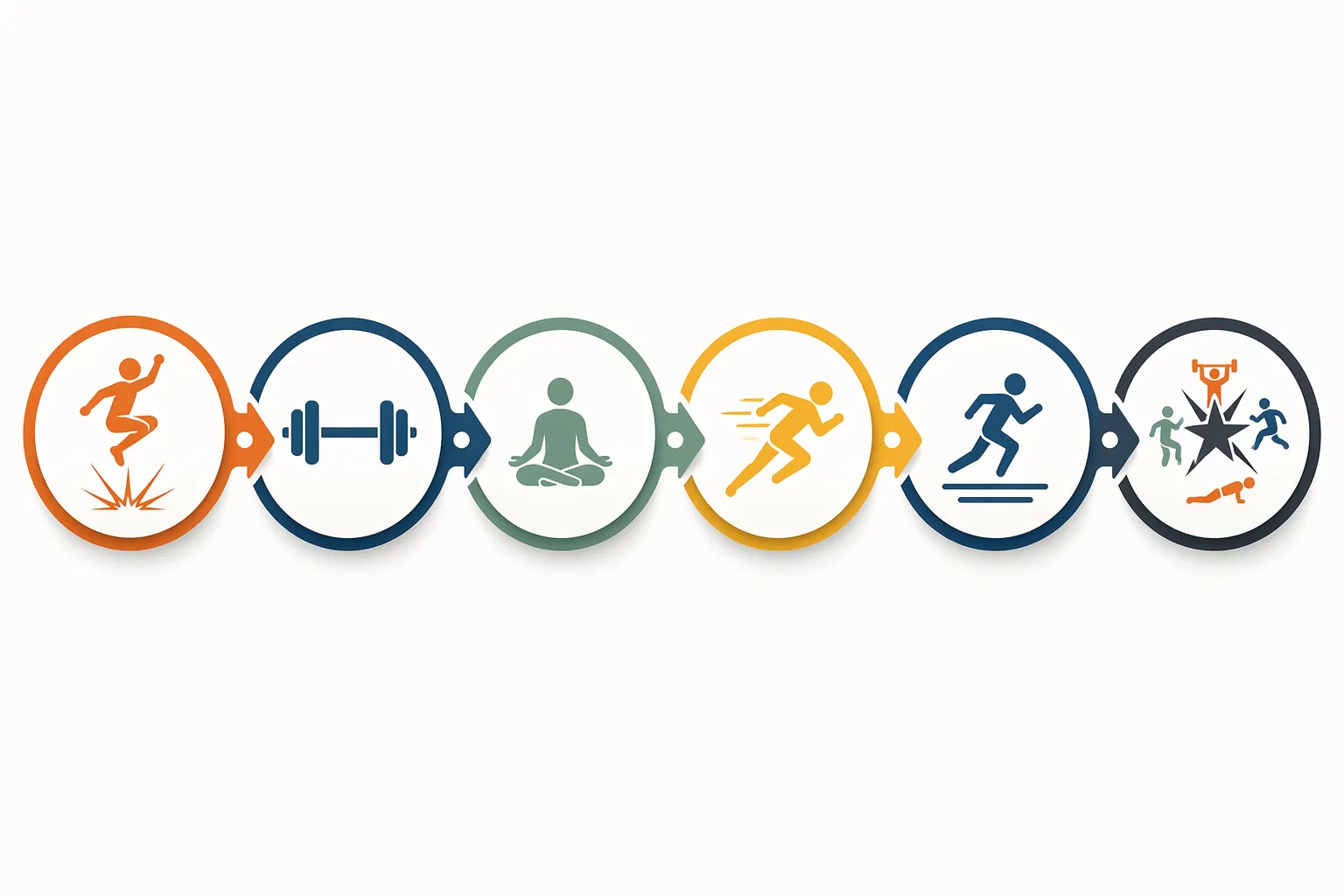
| Day 1 | Power and explosiveness | Aaliyah Butler 48.84 400m; Isaac Grimes 8.18m long jump | Produce force quickly without needing a runway |
| Day 2 | Full-body strength | Cooper Lutkenhaus 1:42.08 800m | Build strength and coordination without chasing fatigue |
| Day 3 | Active recovery | Championship-week recovery logic | Restore range, breathing, and tissue tolerance |
| Day 4 | Speed and agility | Noah Lyles 9.88 100m heat; Jamal Britt 12.86 110m hurdles | Train rhythm, reaction, and mechanics without indoor sprinting |
| Day 5 | Endurance and conditioning | Woody Kincaid 30:13.66; Sydney Vaught 33:30.60 | Sustain effort with low-impact intervals |
| Day 6 | Athletic circuit | Anna Hall and Kyle Garland | Integrate strength, power, mobility, and control |
Day 1: Power Without a Runway
Aaliyah Butler’s 48.84 gives this day its 400m edge: fast power that still has to survive the back half of the lap. Isaac Grimes’ 8.18m long jump adds the second cue: force must be organized, not scattered. In a small apartment, that means short explosive efforts, clean landings, and enough rest to keep each rep sharp.[1]
- Warm-up: 60 seconds marching in place, 10 hip hinges, 10 bodyweight squats, 10 alternating reverse lunges, 20 seconds of ankle bounces or heel raises.
- Block 1: 4 rounds of 6 squat-to-calf-raise reps, 6 push-up shoulder taps per side, and 20 seconds rest.
- Block 2: 3 rounds of 8 dumbbell or bodyweight split squats per side, 8 band rows or towel rows, and 30 seconds rest.
- Power finisher: 6 rounds of 10 seconds fast high-knee march or quiet skater step, followed by 50 seconds easy walking.
If your floor can handle jumping, use low pogo hops or small squat jumps in Block 1. If not, keep the feet connected to the floor and make the intent explosive through the hips: drive up fast, pause, then lower under control. The quiet version is not the easy version; it simply moves the intensity from noise to tension.
Day 2: Strength That Respects Recovery
Cooper Lutkenhaus’ 1:42.08 at age 17 is the kind of result that tempts people into the wrong lesson. The home lesson is not to add more suffering. For an 800m athlete, strength has to support coordination, posture, and repeatable mechanics; it cannot leave the legs so wrecked that the next session collapses.[1]
- Warm-up: 2 rounds of 8 glute bridges, 8 dead bugs per side, 8 slow squats, and 20 seconds of easy marching.
- Main lift pair: 4 rounds of 8 dumbbell Romanian deadlifts or hip hinges and 8 floor presses or push-ups.
- Single-leg pair: 3 rounds of 8 reverse lunges per side and 10 single-leg glute bridges per side.
- Core pair: 3 rounds of 30-second side plank per side and 8 slow bird dogs per side.
- Finish: 3 minutes of relaxed nasal breathing while lying on your back with feet on the floor.
Keep two reps in reserve on every strength set. If you are grinding, you have drifted away from the point of the day. The better home version is smooth, braced, and repeatable, especially if Day 4 speed work is still ahead.
Day 3: Active Recovery Is a Training Day
Championship meets are not built from maximal effort stacked on maximal effort. Athletes warm down, treat recovery as part of the job, and protect the next performance. At home, active recovery should leave you moving better than when you started.
- 5 minutes: easy walk around the room or step-touch pattern.
- 6 minutes: mobility flow of cat-cow, thoracic rotations, hip flexor rocks, hamstring sweeps, and ankle circles.
- 6 minutes: light band work with pull-aparts, lateral walks, and standing rows.
- 3 minutes: slow breathing, longer exhales, shoulders down.
This is also the best day to use zero-equipment alternatives if your week is busy, your knees are annoyed, or the apartment below you has already heard enough. Do not turn recovery into a secret conditioning session. Stop while you still feel fresh.
Day 4: Speed and Hurdle Rhythm Without Sprinting Indoors
Noah Lyles’ 9.88 in a 100m heat and 19.63-level 200m speed belong to a different universe than a hallway workout. Jamal Britt’s 12.86 in the 110m hurdles, listed as No. 5 all-time, adds another layer: speed under rhythm constraints.[1][2] The home version should not ask you to sprint across tile. It should sharpen positions, cadence, and reaction.
- Warm-up: 3 rounds of 20 seconds marching A-skips, 20 seconds rest, 20 seconds lateral shuffle steps, 20 seconds rest.
- Acceleration drill: 6 rounds of 8 seconds wall-drive switches, followed by 40 seconds rest.
- Hurdle rhythm substitute: 4 rounds of 20 seconds step-over march using an imaginary low hurdle line, followed by 30 seconds rest.
- Agility block: 5 rounds of 15 seconds quick feet in place or quiet in-in-out-out steps, followed by 45 seconds rest.
- Cooldown: calf stretch, hip flexor stretch, and slow hamstring walkouts.
The rest periods are not decoration. Speed training falls apart when fatigue takes over, even if the movement looks busy. If you want another athlete-inspired home format with skill emphasis rather than track mechanics, see this Caitlin Clark home workout. The shared idea is precision before volume.
Day 5: Endurance for a Small Room
Woody Kincaid’s 30:13.66 and Sydney Vaught’s 33:30.60 in the 10,000m are not invitations to run circles around a coffee table. They are reminders that endurance is controlled output: rhythm, patience, and the ability to keep working after the first comfortable minutes have passed.[1]
| Segment | Work | Effort |
|---|---|---|
| Warm-up | 4 minutes easy march, step-touch, or low step-up | Very easy |
| Interval 1 | 3 minutes brisk march or low-impact shadow run | Moderate |
| Recovery 1 | 1 minute easy walk | Easy |
| Interval 2 | 3 minutes alternating reverse lunge to knee drive | Moderate |
| Recovery 2 | 1 minute easy walk | Easy |
| Interval 3 | 3 minutes squat-to-reach, step jack, or quiet skater step | Moderate |
| Recovery 3 | 1 minute easy walk | Easy |
| Interval 4 | 3 minutes mixed low-impact cardio of your choice | Moderate |
| Cooldown | 4 minutes easy movement and breathing | Easy |
Use the talk test here. You should be able to speak in short phrases during the work intervals, not hold a casual conversation and not gasp. If your joints dislike lunges, replace them with sit-to-stand squats, marching, or step-touches.
Day 6: The Multi-Event Circuit
Anna Hall and Kyle Garland make sense as the final anchors because the heptathlon and decathlon reward range. USATF preview material identified Hall and Garland among the multi-event athletes to watch at the 2026 championships, which is enough for this training purpose: use the last day to blend qualities rather than specialize.[3][4]
Set a timer for 30 seconds of work and 30 seconds of transition. Move through the circuit three to five times depending on your week.
- Squat or dumbbell goblet squat for lower-body strength.
- Push-up, elevated push-up, or dumbbell floor press for upper-body force.
- Band row, towel row, or dumbbell row for posture and pulling strength.
- Reverse lunge to knee drive for single-leg control.
- Dead bug or plank shoulder tap for trunk stability.
- Low-impact fast feet, marching sprint, or small skater step for athletic finish.
This circuit should feel athletic, not chaotic. If your form starts changing just to keep pace with the timer, cut the round count. Multi-event training rewards competence across movements; it does not reward making every station look like the final seconds of a bootcamp class.
Apartment Rules That Keep the Intent Intact
The home constraint is not a flaw in the plan. It forces cleaner decisions. A track session can hide sloppy intent behind distance; a living-room session cannot. Every movement has to earn its space.
- For quiet power, replace jumps with fast concentric reps: squat to calf raise, split squat drive, hip hinge to tall stand.
- For sprint mechanics, use wall drives, marching A-skips, and fast arm action instead of hallway sprints.
- For endurance, extend time under control rather than adding impact.
- For intensity, manipulate tempo, rest, and range before adding noise.
- For recovery, stop early enough that tomorrow’s session improves instead of survives.
A general athletic-training framework supports this distinction between structured performance work and random exercise selection, and USATF coaching education material also treats strength training as a planned support system rather than a pile-on after endurance work.[5][6] For a home exerciser, the practical version is simple: know the day’s purpose before choosing the hardest variation.
How to Repeat the Week
Run the six days in order if your body is handling the load well. If not, insert a full rest day after Day 2 or Day 4. Keep the athlete anchor even when you scale the movement: Butler and Grimes still mean crisp power, Lutkenhaus still means strength with restraint, Lyles and Britt still mean speed mechanics, Kincaid and Vaught still mean sustained rhythm, and Hall and Garland still mean integrated athleticism.
That is the useful transfer from the 2026 USATF schedule and results into workout inspiration: not pretending a mat and dumbbells reproduce a championship meet, but letting championship structure make a small-space week more focused.
References
- 2026 USATF Outdoor Championships full results, Olympics.com, https://www.olympics.com/
- 2026 USA Outdoor Track and Field Championships, Wikipedia, https://en.wikipedia.org/
- Women’s Preview, USATF, https://www.usatf.org/
- Men’s Preview, USATF, https://www.usatf.org/
- Train Like An Athlete, Nourish Move Love, https://www.nourishmovelove.com/train-like-an-athlete/
- Strength Training for Distance Runners, USATF Campus, https://www.usatf.org/
What a small equipment investment adds
We don't have a build tagged to this exact tier yet. Browse all builds.
How often should you repeat this?
See our recovery and rest reference for citation-anchored rest-interval guidance.
Spot something off?
Tell us if a movement, tier assumption, or duration didn't match your experience.