
GLP-1 Diet and Exercise Plan for Fat Loss, Not Muscle Loss
A practical, evidence-anchored weekly plan for adults taking GLP-1 weight-loss medications: protein-first meals, scheduled hydration, and a CDC-aligned exercise skeleton that protects muscle, manages nausea and fatigue, and builds the habits that determine whether the weight stays off after the prescription ends.
- Citation source
- ACSM, CDC, AJCN
- Evidence level
- Formal position stand / general guideline
- Recommended frequency
- 150 min/week moderate aerobic; 2-3 strength sessions/week
The cleanest answer to “what should I eat and how should I train on a GLP-1?” starts with the trial contrast. In STEP-3, semaglutide plus intensive lifestyle coaching produced about 16% weight reduction, compared with 5.7% with lifestyle intervention alone; in STEP-1, semaglutide with general lifestyle instructions produced about 14.9% weight reduction, compared with 2.4% in the placebo group receiving lifestyle instructions [1][2]. That does not make diet and exercise look irrelevant. It makes them look like the part of the plan that has to catch everything the drug does not do by itself: protect muscle, keep meals tolerable, keep bowels moving, and build routines that still exist if the prescription stops.
That last part matters. The AJCN joint advisory notes that people who stop GLP-1 therapy typically regain up to two-thirds of lost weight within a year [1]. So the goal is not a perfect seven-day menu. It is a weekly operating system: enough protein to support lean tissue, enough fluids to offset muted thirst and GI symptoms, enough walking to meet a real aerobic dose, and enough strength work to tell the body that muscle is still needed.
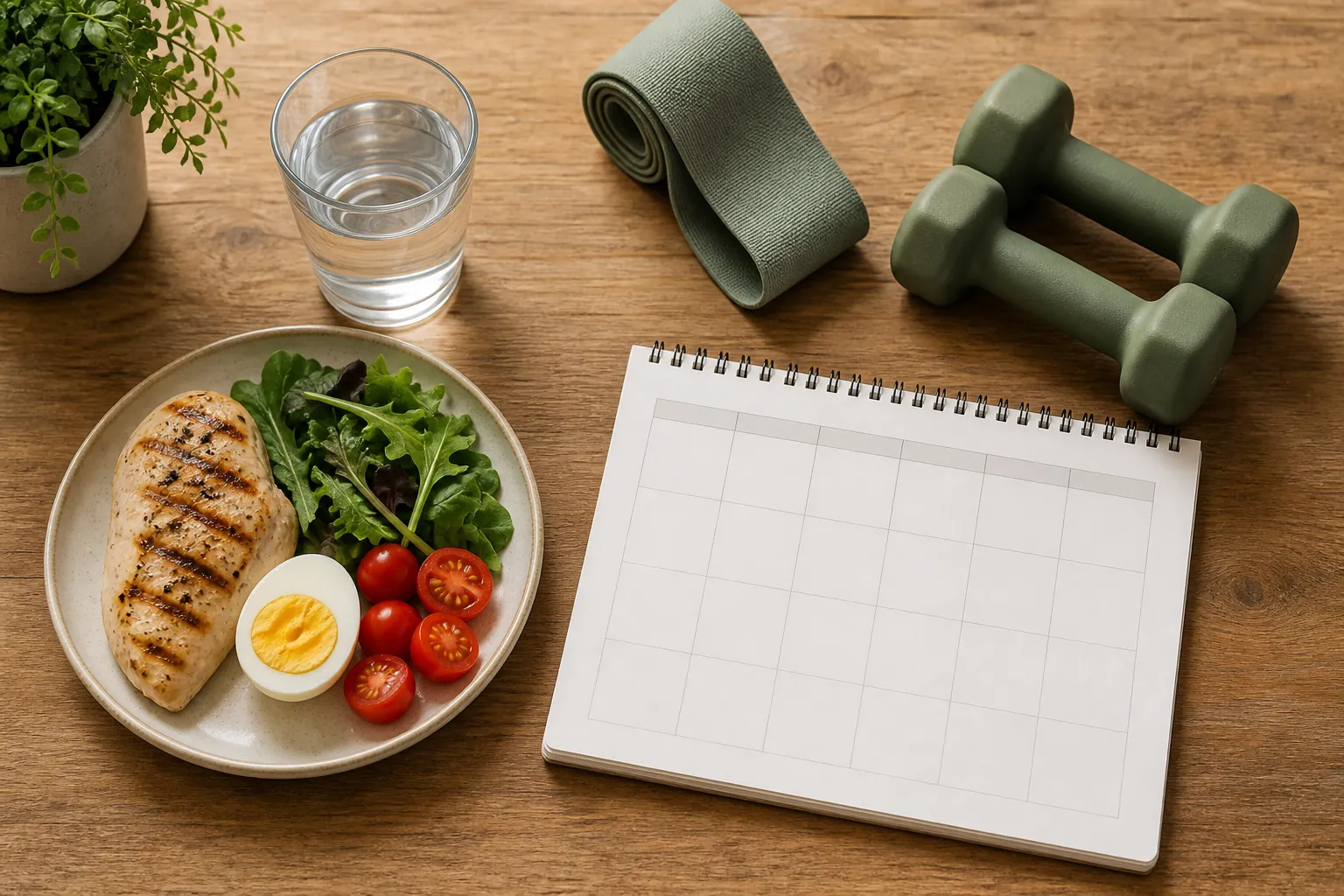
The week has two jobs: fat loss and function
Weight loss on semaglutide, tirzepatide, or liraglutide can be fast enough that the scale becomes a distraction. The better question is what the scale is giving up. In STEP-1 body-composition data, semaglutide was associated with about 9.7% lean-mass loss and about 19.3% fat-mass loss; in SURMOUNT-1, tirzepatide body-composition findings have been summarized as roughly 25% lean mass and 75% fat mass among weight lost; broader reviews put lean-mass loss during GLP-1-associated weight reduction in a wide 15% to 40% range, depending on the population, medication, dose, diet, and training context [1][4]. Those are not interchangeable numbers, and they should not be averaged into a fake certainty. They are enough to justify strength training.
The baseline exercise frame is the CDC adult guideline: at least 150 minutes per week of moderate-intensity aerobic activity, plus 2 days per week of muscle-strengthening activity that works all major muscle groups [3]. For adults on a GLP-1, a useful home target is roughly 60 to 90 minutes of resistance training per week, usually spread over 2 to 3 sessions with bands, body weight, or dumbbells [4].
If that sounds too neat for a week with nausea, fatigue, constipation, or low appetite, it should. The AJCN advisory reports nausea in 25% to 44%, diarrhea in 19% to 30%, vomiting in 8% to 24%, and constipation in 17% to 24% of trial participants, depending on medication and context [1]. Early training cannot pretend those symptoms are character flaws. The first win may be 10 to 15 minutes of light walking after a small meal, repeated most days.
The repeatable weekly skeleton
Use this as the default week, not as a punishment grid. The Cleveland Clinic’s GLP-1 exercise example uses the same basic idea: distribute aerobic work through the week, place strength on nonconsecutive or well-spaced days, and leave room for recovery [5]. The version below assumes home workouts, no gym membership, and symptoms that may change day to day.
| Day | Movement plan | Food and recovery emphasis |
|---|---|---|
| Monday | 30-minute moderate walk. If symptoms are high, split into three 10-minute walks. | Protein-first meals; schedule fluids in the morning and afternoon. |
| Tuesday | Strength session A, 25 to 35 minutes: squat or sit-to-stand, hip hinge, push, pull, carry or core. | Small meal 1 to 2 hours before if tolerated; stop before nausea escalates. |
| Wednesday | 30-minute moderate walk or low-impact cardio at home. | Fiber from easy foods: fruit, cooked vegetables, oats, beans if tolerated. |
| Thursday | Strength session B, 25 to 35 minutes: lunge or step-back, glute bridge, row, press, core. | Protein first again; do not wait for strong hunger cues. |
| Friday | 30-minute moderate walk, preferably after a meal. | Hydration check; keep portions small if fullness is lingering. |
| Saturday | Optional strength session C, 15 to 25 minutes, or mobility plus an easy walk. | Use this as the flexible day, not the make-up-punishment day. |
| Sunday | 30-minute easy-to-moderate walk, gentle mobility, or full rest if recovery is poor. | Plan protein options and water cues for the next 3 days. |
The aerobic math is simple: five 30-minute moderate sessions gives you 150 minutes. Moderate means you can talk in short sentences but would not want to sing. If fatigue is high, the same daily target can become 10 minutes after breakfast, 10 after lunch, and 10 after dinner. That is not a downgrade. For many GLP-1 users, shorter post-meal walks are the difference between a plan that survives nausea and a plan that gets abandoned by Wednesday.
What the strength sessions should include
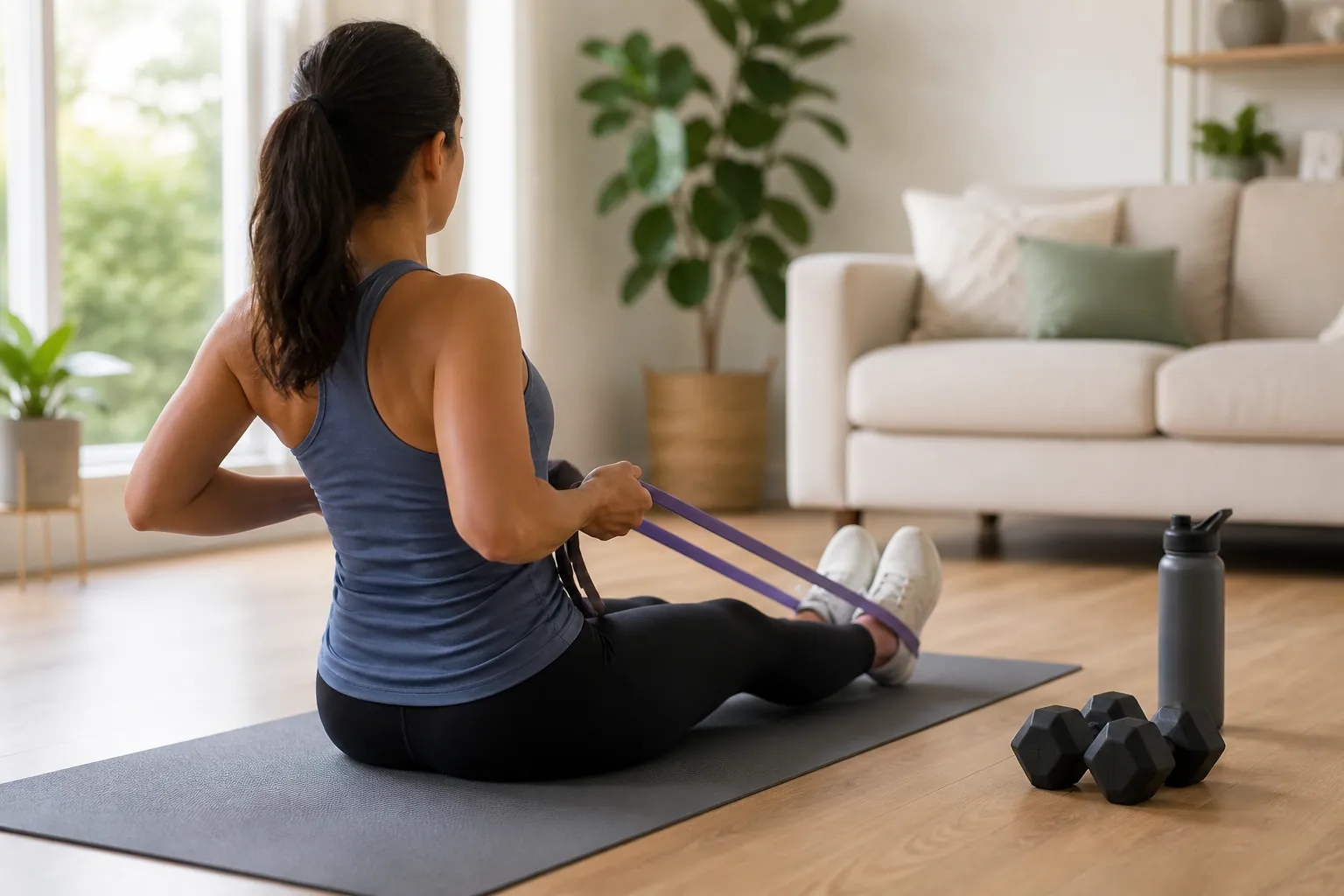
Each strength day should cover the major patterns, not just the body parts that feel familiar. At home, that can look like this:
- Squat pattern: chair sit-to-stand, bodyweight squat, goblet squat.
- Hinge pattern: hip hinge drill, glute bridge, dumbbell Romanian deadlift.
- Push pattern: wall push-up, incline push-up, floor push-up, dumbbell press.
- Pull pattern: resistance band row, towel row variation, one-arm dumbbell row.
- Core or carry: dead bug, side plank, suitcase carry, slow marching hold.
Keep the first two weeks boring on purpose: 1 to 2 sets per movement, 6 to 12 controlled reps, with plenty of rest. Add a set, a slightly harder variation, or a little load only when you finish the session without nausea, dizziness, or unusual fatigue. For a deeper progression, use Preserve Muscle After GLP-1s With This Home Workout Plan instead of trying to turn this weekly overview into a full strength program.
Eat in a rhythm that supports training, not in a recipe slideshow
A GLP-1 can make hunger quieter, but quieter hunger does not automatically mean adequate protein, fluids, or fiber. The JAMA patient page cites a protein range of 1.0 to 1.5 grams per kilogram per day, while the AJCN advisory cites 1.2 to 1.6 grams per kilogram per day, or about 80 to 120 grams per day as an absolute range for many adults [6][1]. Those ranges are not identical, and neither settles the practical question of actual body weight versus ideal body weight for every person. If your prescriber or dietitian gives you a target, use that. If not, start with the meal-level behavior that fits both sources: put protein first.
Aim for roughly 20 to 30 grams of protein at meals, using smaller meals every 3 to 4 hours if full-size meals are uncomfortable [6][1]. The point is not to force food through nausea. It is to stop the common pattern where breakfast becomes coffee, lunch becomes two bites of crackers, and dinner becomes the only real protein of the day.
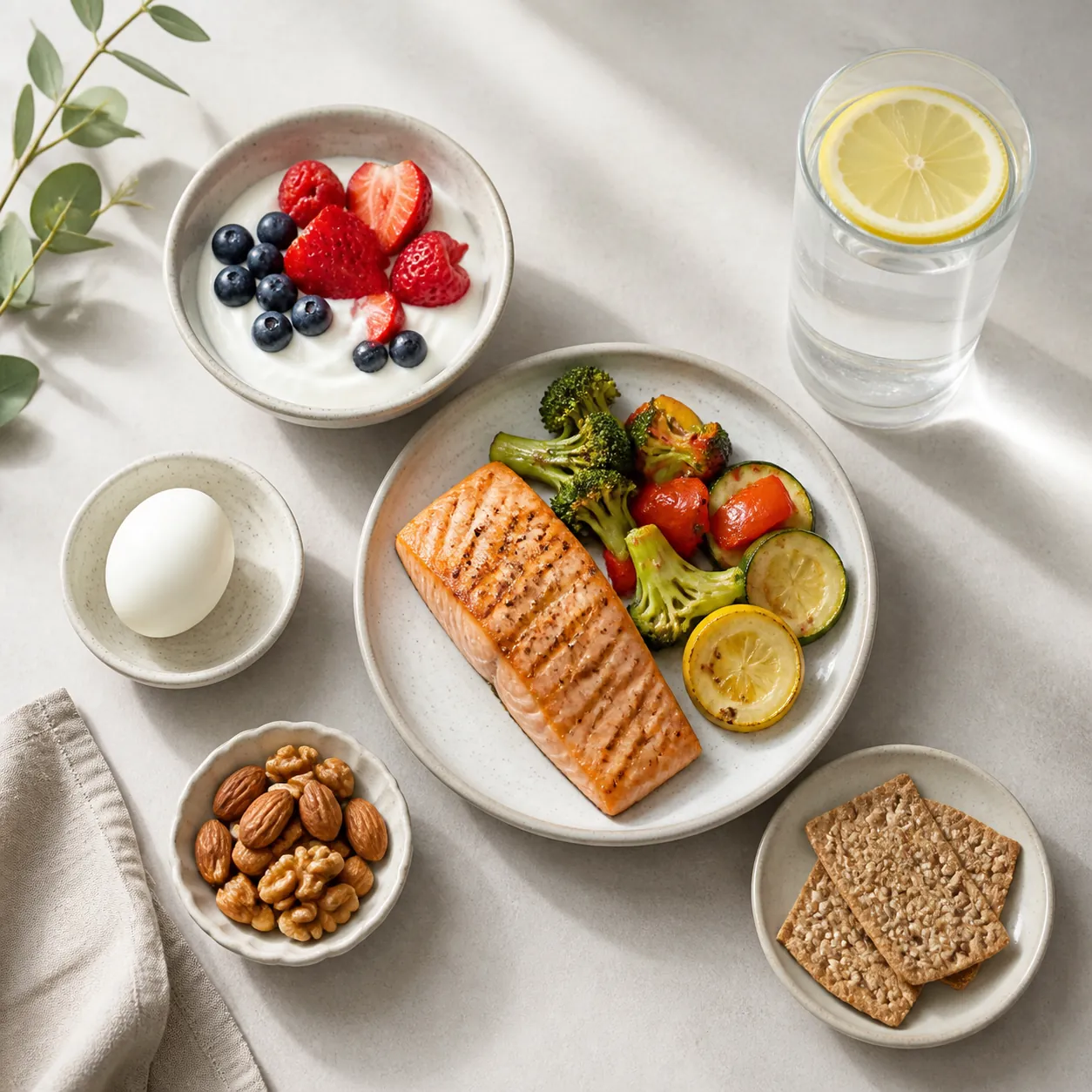
| Meal moment | What to do first | Simple options |
|---|---|---|
| Breakfast | Protein before sweet or starchy foods. | Greek yogurt with berries; eggs with toast; cottage cheese; protein smoothie if solids are difficult. |
| Lunch | Build a small plate, not a huge bowl. | Chicken or tofu with rice and cooked vegetables; tuna on whole-grain crackers; turkey and avocado wrap. |
| Pre-workout snack, if needed | Keep it small and familiar. | Half a yogurt, a boiled egg, a few crackers with cheese, or a small smoothie. |
| Dinner | Protein first, then vegetables, then starch if there is room. | Salmon with roasted vegetables; lean meat or beans with potatoes; tofu stir-fry with rice. |
| Low-appetite backup | Choose easy protein and fluids. | Soup with shredded chicken, kefir, yogurt, cottage cheese, or a shake recommended by your clinician. |
Hydration also needs a schedule. GLP-1 users may not feel thirst normally, and nausea can make large drinks unpleasant [1][6]. Put water where the day already has anchors: after waking, with your morning routine, between meals, before a walk, after a walk, and with an evening constipation check. Sipping usually works better than trying to make up a whole day of fluids at night.
Foods to prioritize, and foods to be careful with
Prioritize lean proteins, Greek yogurt or cottage cheese if tolerated, eggs, fish, poultry, tofu, beans or lentils if they do not worsen GI symptoms, cooked vegetables, fruit, oats, potatoes, rice, whole-grain crackers, soups, and simple meals with recognizable portions. Cooked vegetables may be easier than large raw salads during high-nausea weeks.
Be careful with large high-fat meals, fried foods, very spicy foods, alcohol, oversized raw salads, and carbonated drinks if they increase fullness, reflux, belching, nausea, or diarrhea. This is not a permanent morality list. It is symptom management. The meal that technically “fits your macros” can still be the wrong meal if it makes the next walk impossible.
How to modify the week when symptoms are loud
The plan should flex before it breaks. Keep the weekly targets in view, then adjust the day’s version based on what your body is doing.
- Nausea day: skip intense intervals and heavy lifting. Walk 10 minutes after a small protein-forward meal if tolerated. Choose bland, lower-fat foods and sip fluids.
- Vomiting or severe nausea: do not train through it. Prioritize fluids as advised by your clinician and contact your provider if symptoms are severe, persistent, or worsening.
- Constipation week: keep walking daily, schedule fluids, and use fiber foods you tolerate. A hard strength session without hydration is not the smart fix.
- Fatigue day: reduce the workout to one round of strength patterns or a 10- to 15-minute easy walk. Preserve the habit without pretending energy is unlimited.
- Low-appetite day: use smaller protein doses more often. A few workable meals beat one ambitious meal that you cannot finish.
- Dizziness, chest discomfort, faintness, or unusual shortness of breath during exercise: stop the session and consult your provider.
This article does not give dosing advice, medication-starting advice, stopping advice, or diabetes-medication management. If you use insulin, sulfonylureas, blood-pressure medication, or any medication affected by food intake and weight loss, your prescriber needs to be involved in exercise and meal changes.
If you need a quieter or more structured version
Apartment noise, joint sensitivity, and low equipment are solvable problems. For quiet strength work, use Build Muscle Without Making Noise — A Small Space Workout Plan. For upper-body progression without equipment, use How to Progress Your Upper Body Workout With No Equipment. If the aerobic target feels abstract, How Much Home Exercise Does It Take to Lose 100 Pounds? gives more context on exercise dose across a longer weight-loss arc.
Equipment can stay minimal: a long resistance band, a loop band, one or two dumbbells, or a stable chair can cover the first phase. If you want help choosing gear, start with the Builds group rather than buying a room full of equipment before you know which movements feel best.
For this week, the plan is enough: protein first at each meal, small meals every 3 to 4 hours if needed, scheduled fluids, five moderate walks or their 10-minute pieces, and two full-body strength sessions. If symptoms are high, start with 10 to 15 minutes of light activity per day and protect the rhythm. If symptoms are severe or exercise brings dizziness, chest discomfort, or unusual shortness of breath, stop and call your provider.
References
- Nutritional priorities to support GLP-1 therapy for obesity: a joint Advisory, The American Journal of Clinical Nutrition
- Anti-Obesity Medications, American College of Sports Medicine
- Physical Activity Guidelines for Adults, Centers for Disease Control and Prevention
- Exercise and nutrition considerations for adults using GLP-1 receptor agonists for weight management, Frontiers
- Exercise for GLP-1 Use, Cleveland Clinic
- What to Eat When Taking a GLP-1 Medication, JAMA Internal Medicine
This is general fitness education, not medical advice. For diagnosis or treatment of pain or injury, consult a qualified clinician.
Pick your next session
Browse all routines to find an appropriately-spaced next session.
Spot something off?
This content sits adjacent to health guidance — tell us if a citation or figure needs a correction.