Preserve Muscle After GLP-1s With This Home Workout Plan
Explains why muscle loss (up to 39% of weight lost on GLP-1s) sets the stage for rapid regain once appetite returns, and provides a practical home strength plan using compound bodyweight and resistance-band movements to preserve muscle, support metabolic rate, and minimize post-medication weight recovery.
- Duration
- 25 min
The scary part after GLP-1 weight loss is not that the medication “did the work.” That argument is tired and not very useful. The scary part is more practical: after losing a meaningful amount of weight on Ozempic, Wegovy, Mounjaro, Zepbound, or another GLP-1 medication, part of that loss may have come from lean mass, not just fat.
That matters because smaller does not automatically mean stronger. UC Davis Health has described lean-mass loss during GLP-1-based weight loss in the 15% to 25% range, while Hinge Health summarizes a higher-end figure of 39% from body-composition research discussed in The Lancet Diabetes & Endocrinology.[1][2] Individual results vary, and those numbers should not be used to panic anyone. They do explain why a person can reach a lower weight and still feel less stable, less powerful, or nervous about regain once appetite starts sounding louder again.
Lean mass is one of the tissues that helps support resting metabolic rate. Lose enough of it, and the body has less metabolically active tissue to maintain. Add returning hunger, looser routines, and fewer medical appetite signals, and the post-medication phase can feel fragile fast. In the STEP 1 trial extension, participants regained a substantial portion of weight after semaglutide withdrawal, which is one reason this phase deserves its own plan rather than a vague instruction to “stay active.”[3]
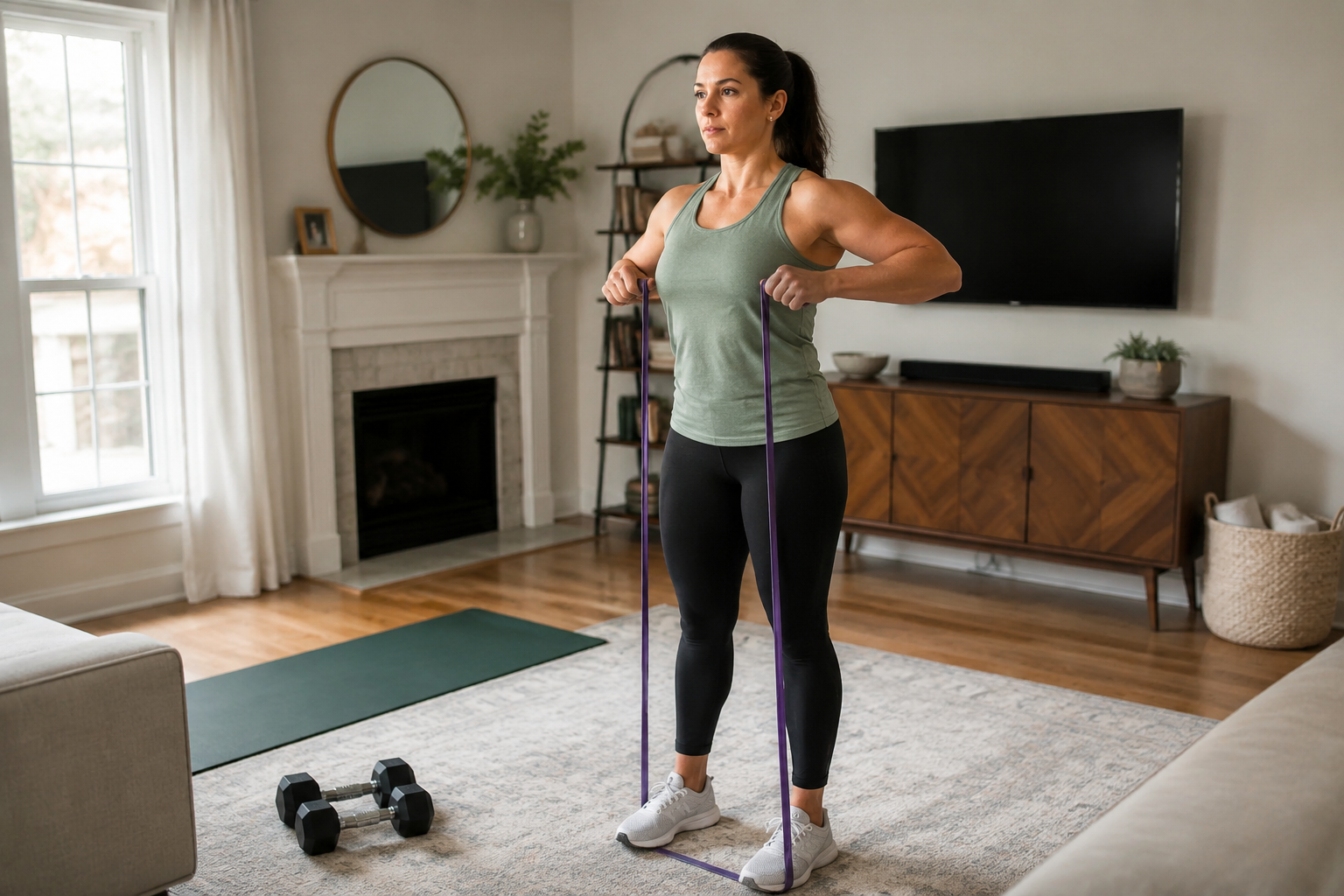
The strongest behavioral clue we have comes from the Copenhagen S-LiTE post-treatment analysis. In the year after stopping liraglutide, the medication-only group regained about 9.6 kg, while the exercise group regained about 3.6 kg — roughly a 6 kg difference.[4] That is not proof that a living-room band routine produces the same result. The trial used supervised indoor cycling and circuit training, not a home workout plan after weight loss medication. Still, the direction is hard to ignore: exercise changed the after-stop trajectory.
So the goal here is not to copy a clinical protocol. The goal is to translate the useful part into something repeatable at home: train the major movement patterns, give muscle a reason to stay, walk enough to keep daily energy output from collapsing, and progress slowly enough that the plan survives ordinary weeks.
The Home Plan at a Glance
Before the details, here is the whole flow. This is the minimum effective structure, not a punishment plan.
| Piece | Target |
|---|---|
| Strength frequency | 2-4 sessions per week |
| Session length | 20-30 minutes |
| Warm-up | 3-5 minutes of easy mobility and light movement |
| Main patterns | Squat, hinge, push, pull, carry/core |
| Working sets | 3 sets per movement |
| Reps | 8-12 controlled reps |
| Effort | RPE 5-6: challenging, but not grinding |
| Rest | 45-90 seconds between sets |
| Daily movement | 7,000-10,000 steps or equivalent low-intensity movement |
| Progression | Add reps, then sets, then reduce rest, then choose a harder variation |
If 20 minutes sounds too short to matter, that is usually because fitness content has trained people to confuse exhaustion with effectiveness. Short home sessions can work when the exercises are compound, repeated consistently, and progressed instead of constantly replaced. For a broader beginner explanation, this 20-minute home workout guide is a useful companion.
If you are still taking medication, recently changed dose, have dizziness, gallbladder symptoms, uncontrolled blood pressure, chest pain, fainting, or known cardiovascular concerns, get medical clearance before starting or changing training. Mass General’s GLP-1 fitness guidance also emphasizes pairing movement with appropriate medical context rather than treating exercise as separate from care.[5]
Use Five Movement Patterns, Not Random “Toning” Exercises
The body does not need a complicated split right now. It needs repeated practice in the movement patterns that cover most daily strength: squatting, hinging, pushing, pulling, and carrying or bracing. That gives you a simple way to train legs, hips, chest, back, shoulders, trunk, and grip without needing a gym.
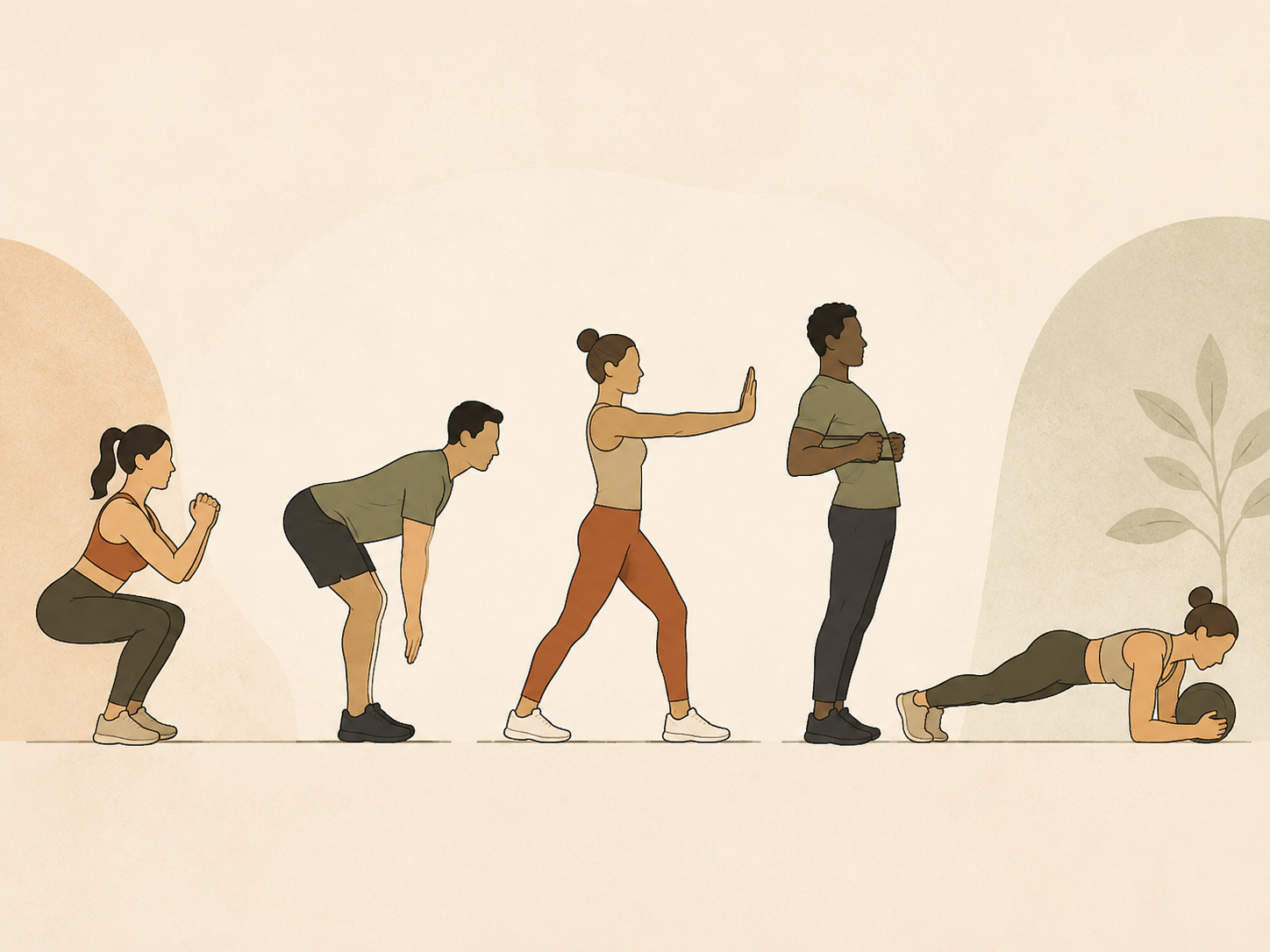
Squat: Rebuild leg strength for stairs, chairs, and joints that feel different
Start with a sit-to-stand from a chair if your knees, hips, or balance feel uncertain. Stand with feet about hip-width, sit back until your hips touch the chair, then stand without bouncing. If that is easy, move to a bodyweight squat. If that is easy, hold one dumbbell at your chest or loop a resistance band under your feet and hold the ends at shoulder height.
- Easier: chair sit-to-stand
- Standard: bodyweight squat
- Harder: goblet squat with one dumbbell
- Band option: banded squat with the band under both feet
Aim for 3 sets of 8-12 reps. Stop each set with a few good reps still available. The goal is controlled leg work, not proving that your knees can tolerate a bad last rep.
Hinge: Train hips and hamstrings without turning it into a back exercise
The hinge is the pattern people often skip at home because it feels less obvious than a squat. It is worth learning. A hinge trains the glutes and hamstrings, helps with lifting things from the floor, and balances all the sitting most people do while their weight is changing.
Practice by standing a foot or so in front of a wall, softening your knees, and pushing your hips back until your glutes lightly touch the wall. Your spine stays long. Your ribs do not flare. Once that pattern makes sense, use a dumbbell Romanian deadlift, a banded deadlift, or a hip bridge on the floor.
- Easier: wall hip-hinge drill
- Floor option: glute bridge
- Dumbbell option: Romanian deadlift with one or two dumbbells
- Band option: banded deadlift
Push: Keep the shoulders honest
Push work can be a wall push-up, an incline push-up with hands on a counter, a floor push-up, a dumbbell floor press, or a band chest press. Pick the version that lets you move through a clean range without your shoulders shrugging toward your ears.
A good starting version for many post-weight-loss beginners is the incline push-up. It is easier to control than the floor version, and it gives you room to progress by lowering the surface over time.
- Easier: wall push-up
- Standard: incline push-up
- Floor option: knee or full push-up
- Equipment option: dumbbell floor press or band chest press
Pull: Do not let the back disappear
Pulling is where resistance bands earn their space. Anchor a band safely in a door, loop it around a sturdy post, or use a seated band row with the band around your feet. Pull the elbows back, pause briefly, and control the return. If you have dumbbells, use a one-arm row with one hand supported on a chair or couch.
This pattern matters because rapid weight loss often changes posture, clothing fit, and how people carry themselves. Back training will not magically tighten skin, but it can help the upper body look and feel more supported.
- Band option: seated band row
- Anchor option: standing band row
- Dumbbell option: supported one-arm row
- No-equipment fallback: prone W raise, done slowly
Carry or core: Brace without making every workout an ab circuit
Core work here means resisting motion, not doing endless crunches. If you own a dumbbell, use a suitcase carry: hold the weight in one hand, walk slowly for 20-40 seconds, then switch sides. If you have no load, use a dead bug, bird dog, side plank, or slow marching bridge.
The test is simple: can you breathe, keep your ribs and pelvis controlled, and avoid twisting or collapsing? If yes, the exercise is doing its job.
A Sample 3-Day Home Routine
Two days per week is a valid start. Three days is the sweet spot for many people. Four days can work if sessions stay short and recovery is good. This sample uses three full-body sessions because it repeats the important patterns often enough without asking you to become a different person overnight.
| Day | Workout |
|---|---|
| Day 1 | Chair squat or goblet squat; dumbbell or band Romanian deadlift; incline push-up; band row; suitcase carry or dead bug |
| Day 2 | Bodyweight squat; glute bridge; dumbbell floor press or band chest press; one-arm row; side plank |
| Day 3 | Goblet squat or slow sit-to-stand; banded deadlift; incline push-up; seated band row; bird dog or carry |
For each movement, do 3 sets of 8-12 reps at RPE 5-6. RPE means rate of perceived exertion. A 5 or 6 should feel like real work, but you could still do several more reps if you had to. That matters after GLP-1 weight loss because the task is to rebuild a training signal, not create soreness that makes you skip the next session.
If you want a more general beginner template using the same basic movement logic, the 4-week no-equipment home workout plan can sit alongside this plan. The difference here is the post-medication emphasis: preserve lean mass, avoid burnout, and make the routine boring enough to repeat.
Progress Without Burning Yourself Down
The most common mistake is jumping from “I should lift” to a plan that feels like a debt repayment program. That usually lasts a week or two. Muscle preservation responds better to steady, repeated loading than to occasional dramatic workouts.
Use this progression order:
- Add reps first. If you are doing 8 reps with good form, build toward 12 before changing the exercise.
- Add a set only when recovery is easy. Move from 2 to 3 sets if you started lower, or add a fourth set to one pattern, not everything.
- Reduce rest slightly. Move from 90 seconds toward 60 seconds only if form stays clean.
- Choose a harder variation. Lower the push-up surface, use a heavier dumbbell, slow the lowering phase, or move from a chair squat to a goblet squat.
Do not change all four variables at once. If you add reps, keep the weight and rest the same. If you choose a harder variation, let the reps drop back down. The body reads consistent tension very well; it does not need chaos to understand that muscle is still required.
After the first month, you can continue with the same pattern and make the exercises gradually harder. If you need a longer runway, this 12-week at-home bodyweight workout plan gives you a way to keep progressing without inventing a new routine every Monday.
Walking Is the Quiet Part of the Plan
Strength training tells the body to keep muscle. Daily movement helps keep energy expenditure from shrinking into the smallest possible version of your day. That is why the practical target here is 7,000-10,000 steps per day, or the closest equivalent you can repeat: short walks, errands on foot, pacing during calls, light chores, or easy cycling.
Some maintenance guidance points toward roughly 250 minutes per week of moderate activity as a long-term target. Treat that as a ceiling to build toward, not a rule you have already failed. The operational plan is simpler: strength train 2-4 times per week and keep daily movement from disappearing.
This is especially important when appetite is unpredictable. On some days, food noise may be low and training may feel flat. On other days, hunger may rebound and sitting still may make the whole day feel harder to manage. Walking is not glamorous, but it is adjustable. Ten minutes after a meal counts. A slow loop around the block counts. The repeatable version counts more than the ideal version.
Protein Supports the Workout; It Does Not Replace It
Protein deserves a place in this plan because lifting without enough building material is frustrating. Mayo Clinic Store guidance discusses 60-75 grams per day as a practical minimum range for many people using GLP-1 medications, while higher recomposition-oriented targets are often discussed around 1.2-1.6 grams per kilogram per day.[6] Those numbers should be individualized with a clinician or dietitian, especially if you have kidney disease, digestive issues, or other medical constraints.
On low-appetite days, make protein easier rather than more virtuous. Put it early in the day if evenings are hard. Use foods you can tolerate. Pair a protein source with meals you already eat. If a shake helps you meet a clinician-approved target, that is a tool, not a character flaw.
The workout is still the signal. Protein supports muscle repair and retention, but the body also needs a reason to use it. That reason is repeated resistance training.
What to Watch During the First Four Weeks
The first month should feel almost underwhelming. That is a good sign. You are learning how the new body moves, how your joints respond, how hunger behaves around training, and how much recovery you actually have.
- Good soreness: mild muscle tenderness that fades within a day or two.
- Too much: joint pain, dizziness, nausea that worsens with training, chest symptoms, or soreness that changes how you walk.
- Good effort: breathing harder while still controlling the movement.
- Too much effort: grinding reps, holding your breath, or needing several days to feel normal again.
- Good progress: more reps with the same form, steadier balance, easier stairs, and better confidence picking things up.
If you miss a session, do the next scheduled one. Do not double it. If you are exhausted, do one set of each pattern and walk. The plan works because it stays attached to real life.
The Honest Limit
No home workout can guarantee permanent weight maintenance after GLP-1 medication. The evidence is also not as tidy as social media makes it sound. The S-LiTE result is encouraging, but it came from supervised exercise. Cambridge researchers reviewing post-drug weight regain patterns have also emphasized that many patients regain weight rapidly after stopping, while still keeping off a portion of the original loss.[7] That is a more realistic picture than either panic or denial.
What you can control is the signal you send next. Train squat, hinge, push, pull, and carry or core 2-4 times per week. Keep most sets at 8-12 reps and RPE 5-6. Walk enough that daily movement does not vanish. Eat enough protein to support the work, with medical guidance where needed. Progress slowly. The post-medication body may not be effortless to maintain, but it can become harder to regain from.
References
- UC Davis Health examines systemic impact of GLP-1-based therapies, UC Davis Health, 2025.
- Ozempic and Exercise: What You Need to Know, Hinge Health.
- Weight regain and cardiometabolic effects after withdrawal of semaglutide: The STEP 1 trial extension, PMC.
- Healthy weight loss maintenance with exercise, liraglutide, or both combined: post-treatment results from a randomized placebo-controlled trial, PMC.
- Fitness for People Taking GLP-1 Agonists, Massachusetts General Hospital.
- GLP-1 Medications and Muscle Loss: What to Know About Nutrition and Supplements, Mayo Clinic Store.
- Patients regain weight rapidly after stopping weight-loss drugs but still keep off a quarter of lost weight, University of Cambridge, 2026.
What a small equipment investment adds
We don't have a build tagged to this exact tier yet. Browse all builds.
How often should you repeat this?
How Whoop and Oura Ring track recovery for home workouts
For home exercisers deciding between WHOOP and Oura Ring, the better sleep and recovery tracker depends on training style: WHOOP's strength-aware tracking fits dumbbell and grip-heavy sessions, while Oura's sleep-first scoring suits yoga and indoor cycling. The verdict hinges on how each builds its daily recovery score, their home-workout tracking gaps, and who pays for hardware versus subscription.
Spot something off?
Tell us if a movement, tier assumption, or duration didn't match your experience.