
6 Evidence-Backed Knee Rehab Exercises for At-Home Recovery
Recovering from knee pain at home? This guide cross-references AAOS, HSS, NHS, and ACSM clinical guidelines to identify the six most evidence-backed exercises you can perform with nothing more than a chair, wall, and yoga mat in any small space.
- Citation source
- AAOS, HSS, NHS, ACSM
- Evidence level
- general guideline
- Recommended frequency
- 2 to 3 times per week
The useful thing about knee injury rehab exercises for home is that the serious sources are less creative than the internet. Cross-reference the AAOS Knee Conditioning Program, the HSS physical therapy routine published by Mohammad Saad, DPT, the NHS inform knee exercise guide, and ACSM's strength-training guidance, and the same small group of movements keeps showing up: quad sets, straight leg raises, seated knee extensions, hamstring curls, mini squats or wall sits, and calf raises.[1][2][3][4]
That repetition matters. It means the defensible at-home starting point is not a long menu of clever variations. It is a short routine you can do with a chair, a wall, a yoga mat, and roughly 4 by 6 feet of clear floor.
The boundary comes first: this is for mild-to-moderate knee issues, onset pain, stiffness, strains, or recovery that a clinician has already cleared for home exercise. Do not self-manage fresh trauma, an open or fresh surgical wound, a knee that locks, gives way, swells without explanation, or feels unstable. Those are not signs that you need a tougher home routine; they are reasons to be evaluated before loading the joint.
The Six Exercises That Survive the Cross-Check
| Exercise | Why it stays in the routine | Home setup |
|---|---|---|
| Quad sets | Rebuilds quadriceps activation without moving the knee much | Yoga mat or firm floor |
| Straight leg raises | Loads the quadriceps while the knee stays straight | Yoga mat and enough room to lie down |
| Seated knee extensions | Trains controlled knee straightening from a chair | Chair |
| Hamstring curls | Restores the knee-bending side of the strength balance | Chair, wall, or countertop for balance |
| Mini squats or wall sits | Introduces controlled weight-bearing through a small range | Chair, wall, or both |
| Calf raises | Strengthens lower-leg support used in walking and stairs | Chair or wall for balance |
AAOS includes strengthening work such as half squats, hamstring curls, and leg extensions with examples like 3 sets of 10, and notes that its knee conditioning program can be used 2 to 3 days per week for maintenance.[1] HSS recommends knee strengthening exercises 2 to 3 times per week, with stretches 3 to 5 times per week and 30 to 60 second holds.[2] NHS inform gives a more conservative pain-managed progression: start with 2 to 3 repetitions, add 1 to 2 reps every few days, and work up to 2 sets of 15.[3]
Those numbers are not all trying to describe the same person on the same day after the same injury. The practical reading is simpler: start at the low end if the knee is irritable, use repeated exposure rather than one heroic session, and let next-day symptoms decide whether the routine was too much.
Use Pain Rules Before You Use Progressions
The NHS pain rule is one of the most useful pieces of home rehab guidance because it gives you a decision in the moment. During exercise, pain from 0 to 5 out of 10 can remain in play. If the pain is worse the next morning, reduce the volume next time.[3]
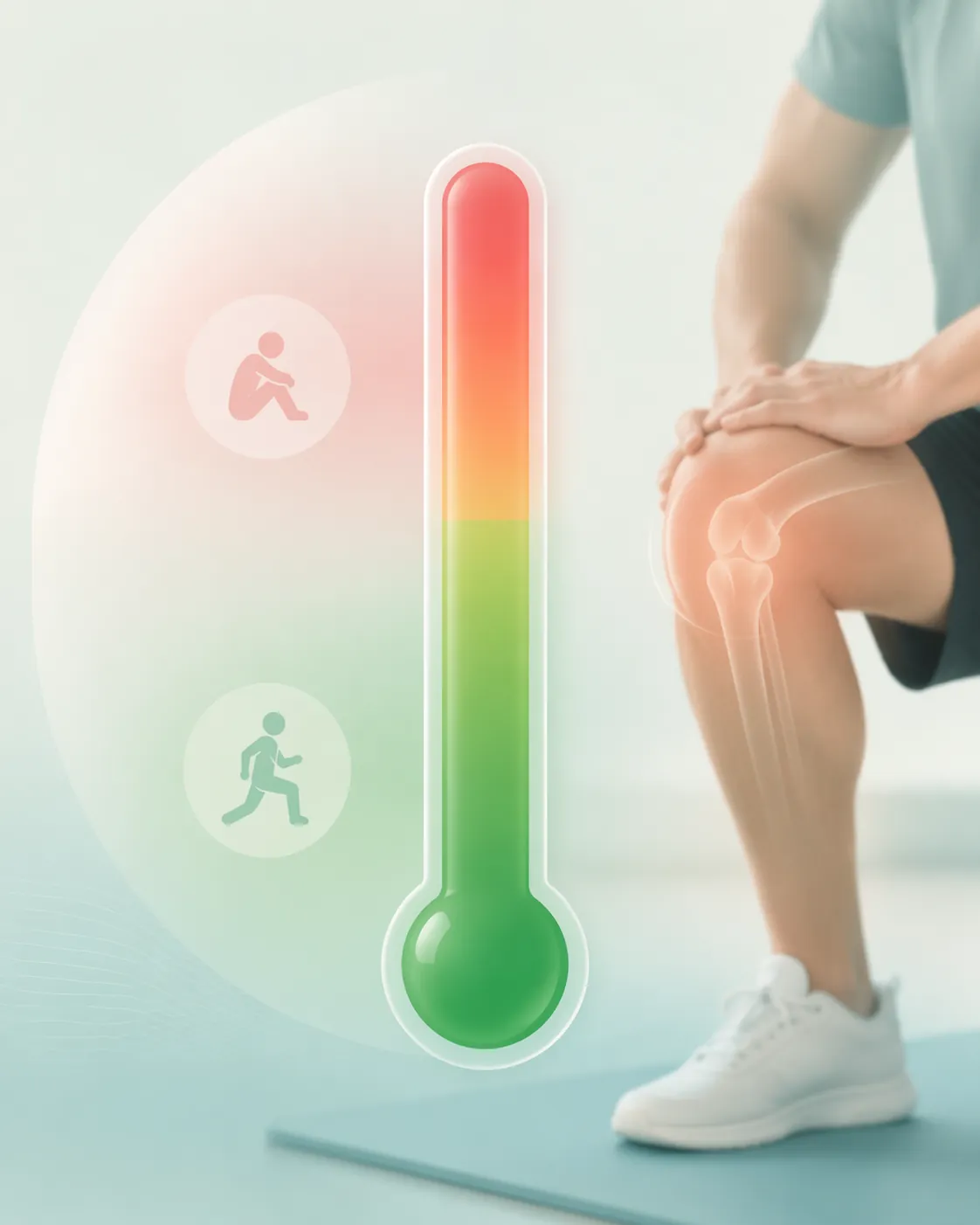
That rule protects against two common mistakes. One is stopping at the first mild sensation and never giving the tissues enough repeated practice to adapt. The other is treating pain as proof that the exercise is working and pushing until tomorrow becomes worse. Neither is a reliable rehab strategy.
ACSM's osteoarthritis-focused material is also worth reading carefully rather than stretching beyond what it says. In that OA context, ACSM reports that strength training throughout life can lower osteoarthritis risk by 18 to 23 percent, and that at least 12 sessions are needed for sustained pain reduction.[4] That does not prove that every knee injury follows the same timeline. It does support the boring but important idea that one or two careful sessions are not enough evidence to declare a home routine useless.
For a broader look at how ACSM frames home-based strength work during recovery, see What the 2026 ACSM Guidelines Say About Home Injury Recovery. The point for this routine is narrower: repeat the same safe movements often enough to learn what your knee tolerates.
1. Quad Sets
A quad set looks almost too simple to count. You sit or lie with the leg straight, tighten the thigh muscle, press the back of the knee gently toward the floor or mat, hold briefly, then relax. For someone who expects rehab to look like a workout, this can feel like underperforming. It is not. It is a way to practice quadriceps contraction when bending, squatting, or stairs may still be too provocative.
Its place in the routine is earned by how often clinical knee programs begin with controlled quadriceps activation. The quadriceps help straighten the knee and manage force during walking, standing from a chair, and stair descent. If the thigh muscle is not turning on cleanly, more advanced exercises often become compensation drills.
Set up on a yoga mat with the working leg straight. A small towel under the knee can make the feedback clearer, but it is optional. Tighten the front of the thigh without lifting the heel. Hold for a comfortable count, then fully relax before the next rep. The mistake to avoid is driving the knee down aggressively or holding your breath. This should feel like a deliberate muscle contraction, not a battle with the joint.
2. Straight Leg Raises
The straight leg raise takes the quad set and asks it to do more. You tighten the thigh first, keep the knee straight, then lift the leg a short distance from the floor. AAOS includes straight leg raises in its knee conditioning program, and HSS also places them in a home strengthening sequence.[1][2]
For a small apartment, this is one of the cleanest exercises available. Lie on the mat with one knee bent and the working leg straight. Tighten the thigh of the straight leg, lift it only as high as you can without losing the locked-in position, pause, then lower slowly. The non-working bent leg gives your back a more comfortable position and helps keep the movement controlled.
The usual failure point is letting the knee bend as the leg rises. Once that happens, the exercise stops being a clean quadriceps drill and becomes a workaround. If you cannot lift the leg without the knee softening, return to quad sets for a few sessions or reduce the height of the lift.
3. Seated Knee Extensions
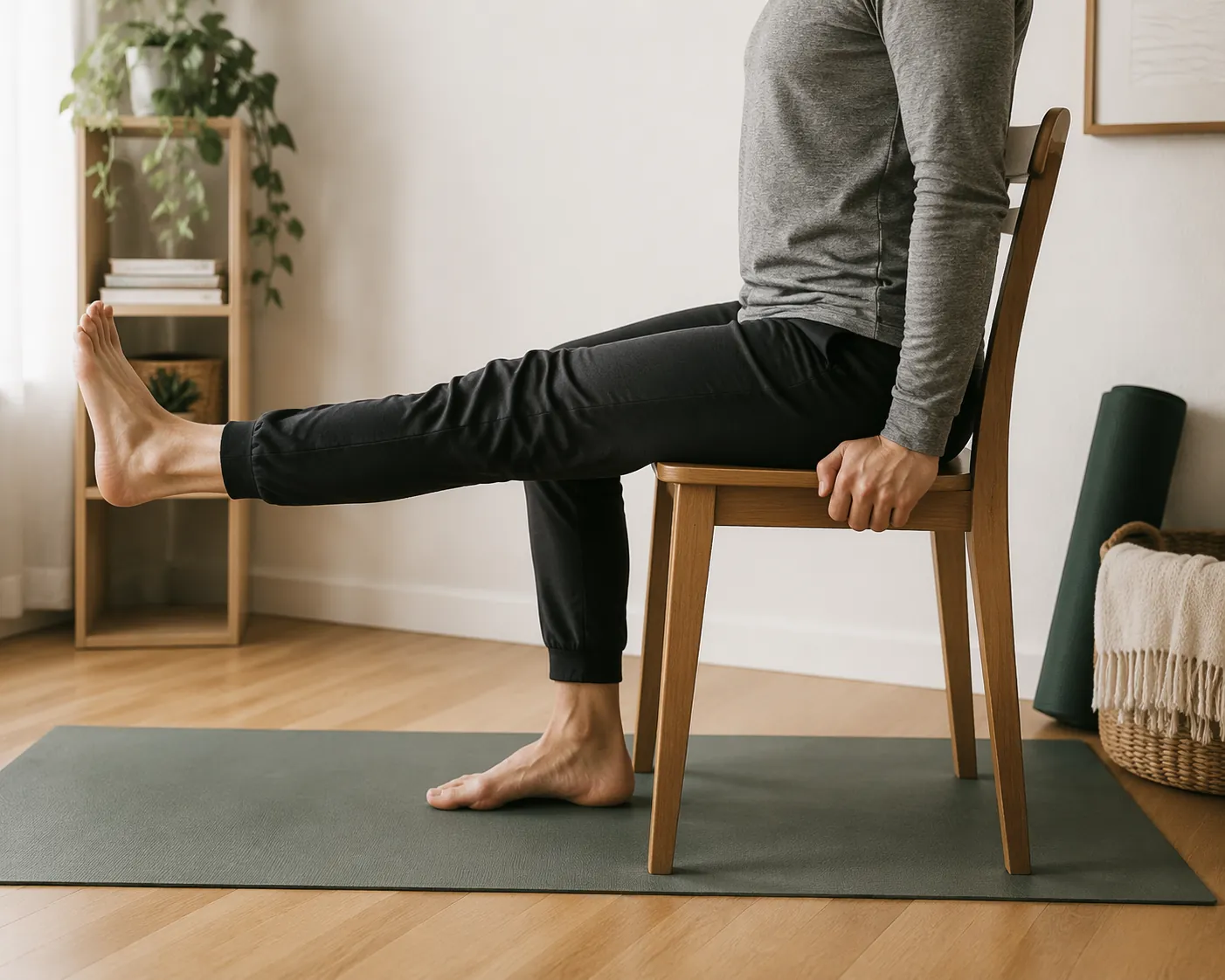
Seated knee extensions are the chair version of controlled knee straightening. Sit tall, place both feet on the floor, then slowly straighten one knee until the lower leg lifts in front of you. Pause briefly, lower with control, and reset before the next repetition.
This movement appears in the AAOS knee conditioning material as leg extensions, with a sample prescription of 3 sets of 10.[1] The chair setup is useful because it removes the excuse that rehab requires floor access at every session. It also gives a cautious exerciser a clear range to observe: Can the knee straighten smoothly? Does the kneecap area feel irritated? Is the lowering phase controlled, or does the foot drop?
Do not turn the first week into a test of how many extensions you can tolerate. If the knee is sensitive, use the NHS-style entry point: 2 to 3 reps, then add 1 to 2 reps every few days if symptoms remain acceptable.[3] If you are considering ankle weights or bands later, that belongs after pain and control are predictable; the equipment question is covered separately in Do You Need Equipment for Knee Rehab at Home?.
4. Hamstring Curls
Knee rehab cannot be only a quadriceps project. The hamstrings help bend the knee and support control around the joint, especially during walking and changes of direction. AAOS includes hamstring curls in its conditioning program, again with a sample of 3 sets of 10.[1]
At home, stand behind a chair or near a wall. Keep the thighs roughly in line, bend one knee, and bring the heel toward the buttock only as far as comfortable. Lower slowly. The movement should come from the knee, not from arching the low back or swinging the thigh forward and back.
This is a good place to be modest. A small, clean curl is more useful than a high heel lift that turns into hip motion. If balance is the limiting factor, use both hands on the chair and make the range smaller. The goal is not to prove that you can stand on one leg; it is to train the bending side of the knee without irritating it.
5. Mini Squats or Wall Sits
Mini squats and wall sits introduce weight-bearing. That is why they are useful, and also why they need restraint. AAOS includes half squats with a sample of 3 sets of 10, while HSS includes squat-based strengthening in its knee routine.[1][2] The version that belongs in early home rehab is not a deep squat. It is a small, controlled bend.
For a mini squat, stand facing the back of a chair with your feet about hip-width apart. Hold the chair lightly, bend the knees a short distance, keep the heels down, then return to standing. For a wall sit, place your back against a wall and slide down only a little, staying well above a deep knee angle. Hold briefly, then come back up.
The most common mistake is chasing depth. In rehab, depth is not automatically progress. Better signs are even weight through both feet, knees tracking comfortably, no sharp pain, and no next-morning flare. If the wall sit feels more provocative than the mini squat, use the chair version. If both are too much, keep the routine to non-weight-bearing work until symptoms settle or a clinician gives you a clearer plan.
6. Calf Raises
Calf raises are easy to dismiss because the sore area is the knee, not the ankle. But walking, stair climbing, and standing all ask the lower leg to help manage load. HSS includes calf raises in its knee strengthening recommendations, which is enough reason not to leave them out of a small-space plan.[2]
Stand behind a chair or near a wall. Rise onto the balls of both feet, pause briefly, then lower slowly. Keep the movement vertical rather than rocking forward. If both-leg calf raises are easy and symptom-free, the next step is not necessarily single-leg work right away; first make the lowering phase slower and more controlled.
This exercise also gives you a simple daily-life check. If calf raises are painful, wobbly, or uneven, stairs and longer walks may still be asking more of the leg than the rehab routine can support. That does not mean you should avoid walking entirely; it means your total daily load counts alongside the formal exercises.
A Conservative Home Plan
If you need a starting structure, use the clinical ranges as guardrails rather than commands. HSS places strengthening work at 2 to 3 times per week.[2] NHS inform allows a very low entry point of 2 to 3 repetitions per movement, adding 1 to 2 repetitions every few days and capping progression at 2 sets of 15.[3] AAOS examples often use 3 sets of 10 for strengthening movements such as half squats, hamstring curls, and leg extensions.[1]
| If your knee is... | Start with... | Progress when... |
|---|---|---|
| Irritable or newly painful | 2 to 3 reps of each tolerated exercise | Pain stays 0 to 5 during exercise and is not worse the next morning |
| Settled but weak | 1 set of 8 to 10 reps | You can control the motion without swelling or next-day increase |
| Consistently tolerant | 2 sets of 10 to 15 reps | Daily activities and rehab both remain predictable |
A simple session can run in this order: quad sets, straight leg raises, seated knee extensions, hamstring curls, mini squats or wall sits, then calf raises. That order moves from low joint motion and supported positions toward standing work. It is not sacred. If the standing movements are the only ones that flare symptoms, keep the earlier exercises and get advice before forcing the later ones.
Strengthening the muscles around the knee is not just a comforting ritual. AARP quotes Cleveland Clinic physical therapist Kari Orlandi, DPT, explaining that each extra pound of body weight exerts about 3 pounds of pressure across the knee.[5] That clinical framing is not a reason to turn this article into a weight-loss lecture. It is a reminder that the knee sits inside a load-sharing system: quadriceps, hamstrings, calves, hips, walking volume, stairs, and body weight all affect what the joint experiences.
What Counts As Enough?
A quad set can be enough on a day when the knee is reactive. Two sets of 15 can be too much on a day when the joint is swollen or worse the next morning. Home rehab works best when the unit of judgment is not exercise difficulty, but response: during the session, later that day, and the next morning.
Use the same six movements long enough to learn their signal. If knee extensions are calm but mini squats flare symptoms, you have useful information. If straight leg raises are clean but hamstring curls cause cramping or pain, reduce range or reps. Constantly changing exercises makes it harder to know whether the knee is improving, irritated, or simply confused by new inputs.
Once these movements are boring, repeatable, and no longer producing next-day setbacks, a broader low-impact routine may make sense. At that point, Low-Impact Workout for Knee Pain You Can Do at Home is a more appropriate next step than adding random harder variations to a rehab plan.
These six exercises are the defensible at-home core because they recur across the strongest available guidance, require almost no space, and can be progressed under clear pain rules. They are not a diagnosis, a complete surgical protocol, or a promise that every knee will respond the same way. They are the place to start when the responsible choice is to do something measured, repeatable, and small enough to fit beside a chair.
References
- Knee Conditioning Program — AAOS OrthoInfo.
- Stretches and Exercises to Strengthen Your Knees from an HSS PT — HSS, April 2026.
- Exercises for knee muscle and joint problems — NHS inform.
- Hot Topic | Strength & Power Exercise for Osteoarthritis — ACSM.
- 8 Knee Exercises for Strength and to Reduce Pain — AARP.
This is general fitness education, not medical advice. For diagnosis or treatment of pain or injury, consult a qualified clinician.
Pick your next session
Browse all routines to find an appropriately-spaced next session.
Spot something off?
This content sits adjacent to health guidance — tell us if a citation or figure needs a correction.