
A 10-Minute Quiet Yoga Routine for Stress Relief at Home
An evidence-anchored, apartment-safe 10-minute yoga routine for stress relief at home — breath work, gentle floor postures, and lying relaxation — plus a realistic look at how much a short daily practice can help.
- Citation source
- Harvard Health and CDC
- Evidence level
- Restrained inference
- Recommended frequency
- 10 minutes daily
Here is the useful version first: this is a 10-minute, no-jumping, floor-based quiet at-home yoga routine for stress relief. It fits beside a couch, uses no special props, and should not sound like a workout to the person below you. The goal is not to leave the room transformed. The goal is smaller and more trustworthy: lower the volume on the workday enough that you can repeat the same routine tomorrow.
That smaller claim is also the better-supported one. Harvard Health describes yoga as a way to reduce the burden of mental stress and improve sleep quality, with the most benefit coming from regular practice rather than the occasional heroic session. The CDC’s broader physical-activity guidance is similarly modest: a single session can reduce short-term feelings of anxiety, while regular activity is associated with lower risk of depression and anxiety over time.[1][2]
So this routine is built for repeatability: slow breathing, gentle floor positions, and a short lying relaxation. No flows that make your heels knock the floor. No chair scraping. No “reset your nervous system” promise that gives you one more thing to fail at.
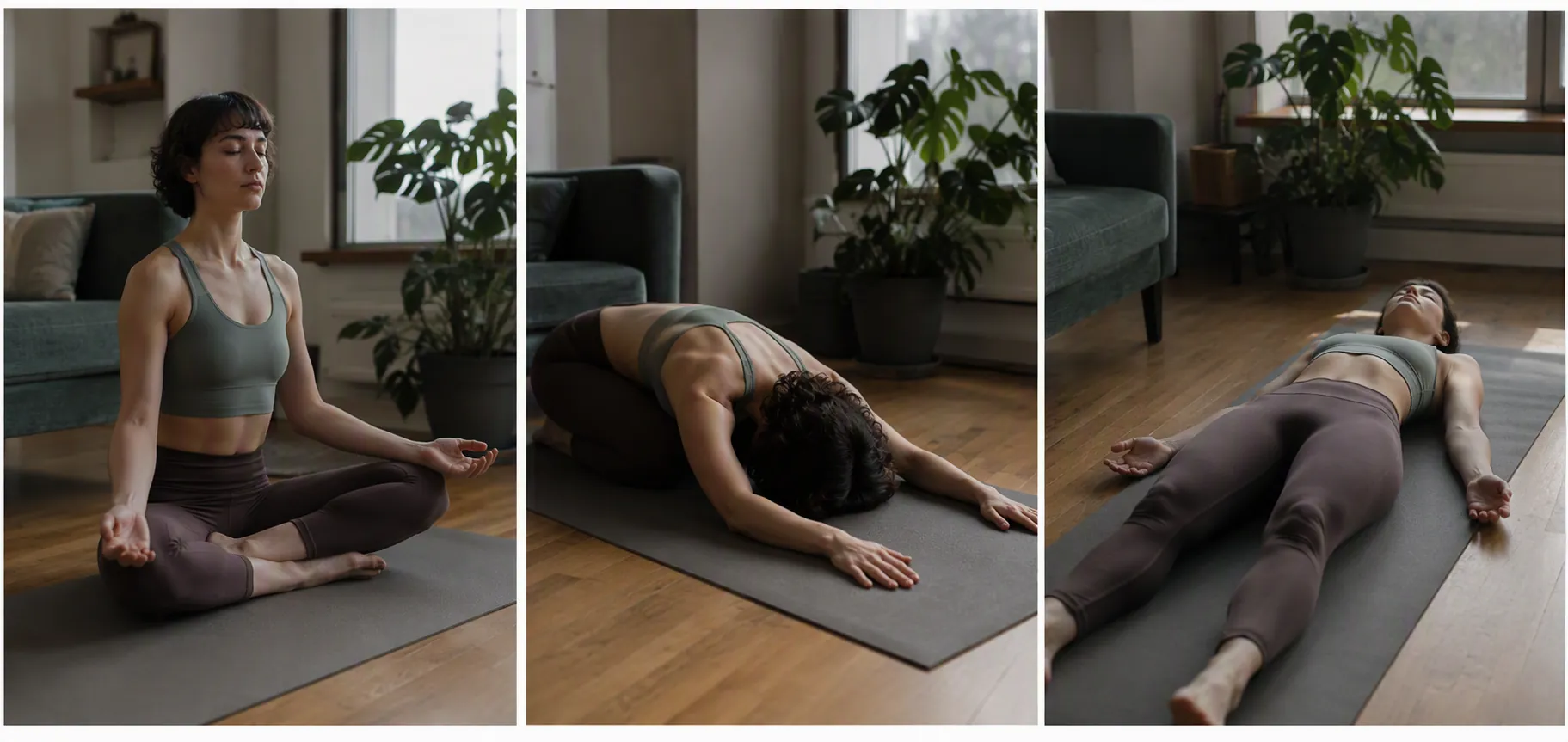
The 10-minute quiet yoga routine
Use a mat if you have one. If you do not, choose a carpeted spot or place a folded blanket where your knees and hips will rest. Keep the routine low to the ground. The quietest transition is usually the one where one hand, one knee, or one hip touches down before the rest of you follows.
| Time | What to do | Quiet cue |
|---|---|---|
| 0:00–1:30 | Seated breathing | Sit down once, stay there, and let the breath do the work. |
| 1:30–2:30 | Neck, jaw, and shoulder release | Move only your head, shoulders, and hands. |
| 2:30–4:00 | Hands-and-knees cat-cow into child’s pose | Lower one knee at a time; pad the knees if needed. |
| 4:00–5:30 | Seated side bend and soft forward fold | Keep hips planted; avoid rocking back and forth. |
| 5:30–7:00 | Reclined knees-to-chest and windshield wipers | Roll down through your side instead of dropping onto your back. |
| 7:00–8:30 | Reclined figure-four stretch | Switch sides slowly; keep the lifted foot controlled. |
| 8:30–10:00 | Lying relaxation | Do less. Let the floor hold you. |
0:00–1:30 — Seated breathing
Sit cross-legged, sit with your legs straight, or sit with your back against the couch. Pick the position that makes your hips complain the least. Rest your hands on your thighs. Let your shoulders drop without making a project of perfect posture.
Breathe in through your nose for about five counts. Pause for about two counts if that feels easy, then exhale slowly through your nose or mouth. Harvard’s breathing guidance includes a five-count inhale and a short hold; for this routine, the important part is that the breath becomes slower without becoming strained.[1]
If counting irritates you, drop the count and use a simpler rule: make the exhale slightly longer than the inhale. Nothing has to look meditative. You are just giving the first minute and a half to breathing instead of checking the phone again.
1:30–2:30 — Neck, jaw, and shoulder release
Keep your seat. Let your chin dip slightly toward your chest, then bring your head back to neutral. Turn your head a little to the right, then to the left. Stay out of the big dramatic neck circles; small range is quieter in the body and kinder to a tense neck.
Now shrug your shoulders toward your ears on an inhale. Exhale and let them drop. Do that three or four times. Unclench your jaw. Press your tongue lightly to the roof of your mouth, then let it soften. If your workday lives in your shoulders and face, this minute earns its place.
2:30–4:00 — Cat-cow into child’s pose
Place both hands on the floor in front of you. Shift forward onto hands and knees slowly, setting one knee down and then the other. If your knees make hard contact with the floor, double the mat under them or slide the folded edge of a blanket underneath.
On an inhale, gently tip your pelvis forward and let your chest move slightly through your arms. On an exhale, round your back and let your head relax. Repeat for five or six slow breaths. This should feel like oiling a hinge, not performing a backbend.
Then bring your big toes toward each other, widen your knees only as much as comfortable, and sit your hips back toward your heels. Your forehead can rest on the mat, on stacked hands, or not at all. Stay for three slow breaths. If child’s pose bothers your knees or ankles, skip it and stay in hands-and-knees breathing.
4:00–5:30 — Seated side bend and soft forward fold
Walk your hands back and return to a seated position. Keep the transition boring: hand down, hip down, legs around. Reach your right hand to the floor beside you and arc your left arm overhead. Take two slow breaths into the left side of your ribs. Switch sides.
Then sit with your legs crossed or extended and fold forward only until your back and hips say, “fine, this is enough.” Rest your hands wherever they land. The quiet cue here is to stop before you start fidgeting. A smaller fold held calmly usually does more for stress than a deeper fold you have to negotiate every three seconds.
5:30–7:00 — Reclined knees-to-chest and windshield wipers
Come onto your side first, then roll onto your back. This is the apartment version of lying down: no thud, no dropped elbows, no heel crash. Draw both knees toward your chest and hold behind your thighs or over your shins. Rocking is optional, but if your floor carries sound, skip it. Stillness is fine.
Set both feet on the floor wider than hip-width. Let both knees drift a few inches to the right, back to center, then a few inches to the left. Keep the range small enough that your feet do not slide or smack down. Move with the exhale.
7:00–8:30 — Reclined figure-four stretch
Keep lying on your back. Cross your right ankle over your left thigh, making a loose figure-four shape. If that is already enough, stay there. If you want more, lift the left foot and hold behind the left thigh. Take three slow breaths. Lower the left foot with control, uncross, and switch sides.
The point is not to win a hip-opening contest. Keep your face soft, your breath unforced, and your foot from dropping to the floor when you change sides.
8:30–10:00 — Lying relaxation
Stretch your legs out or keep your knees bent with feet on the floor. If your low back prefers support, place your calves on the couch seat. Let your hands rest on your belly, ribs, or the floor.
Scan down the body once: forehead, jaw, shoulders, hands, belly, hips, thighs, feet. At each stop, release about ten percent of the effort. Not all of it. Ten percent is believable. When the timer ends, roll to one side and press yourself up slowly instead of jackknifing upright.
How much can a short routine actually help?
The cleanest answer is: probably a little, especially if you do it often. That may sound underwhelming, but it is a much better promise than pretending ten minutes of floor yoga will erase a hard job, a loud building, or a month of poor sleep.
The most directly relevant dose study followed 54 home-office workers during the COVID-19 period. Participants assigned to one month of daily 10-minute beginner yoga — built from mindfulness, breathing, postures, and relaxation — had significant reductions in musculoskeletal discomfort and total mood disturbance, while the control group showed no change. That is useful evidence for the basic shape of this routine, but it is still one study in a specific pandemic-era home-office context, so it should not be treated as proof that every 10-minute routine works for every stressed person.[3]
A separate 2025 randomized controlled trial tested an 11-minute daily yoga nidra practice in 362 participants. Compared with a waitlist group, the practice significantly reduced stress, anxiety, depression, and rumination, with small effects reported in the d = 0.08–0.16 range. More frequent practice was also associated with lower total cortisol. Again, the useful takeaway is not that yoga nidra is magic; it is that a short, repeatable downshift can measurably help some people, and frequency appears to matter.[4]
The body-mechanism story also fits the routine’s shape. A systematic review of biosignal research described yoga-related shifts toward parasympathetic activity, including lower heart rate, higher heart-rate variability, decreased cortisol, and reduced sympathetic activation. Slow breathing and lying relaxation are not filler at the end of the workout; they are part of why the routine is aimed at settling rather than stimulating.[5]
Larger yoga-and-anxiety research points in the same general direction, but not toward huge effects. A 2018 meta-analysis of randomized controlled trials reported small short-term effects of yoga on anxiety compared with no treatment. That supports yoga as a plausible aid, not as a guaranteed replacement for care, sleep, medication, therapy, or changes to the stressor itself.[6]
This is why the routine stays quiet and simple. If the evidence favors regular practice and small consistent relief, the best home version is the one you can do on a Tuesday night without rearranging furniture, irritating your knees, or apologizing to the downstairs neighbor.
Make it apartment-safe without turning setup into a hobby
A standard yoga mat is enough for most people. If your floor is hard and echoey, more cushioning under knees and hips helps. SELF’s quiet-workout guidance points to yoga and Pilates as among the quieter home workout options and notes that a thicker mat and socks can help absorb and muffle floor contact.[7]
Use socks only if you are staying on the floor and not doing standing balance work. Slipping is louder than breathing. For this routine, socks are usually fine because you are seated, on hands and knees, or lying down. If your mat bunches, slides, or squeaks, bare feet may be the quieter choice.
- Lower yourself in stages: hand, hip, shoulder, then back.
- Keep heels from dropping when you switch sides.
- Skip any pose that makes you adjust loudly more than once.
- Use the couch as a boundary, not a prop you have to arrange.
- Set the timer before you start so the routine does not become phone time.
This is also why the routine belongs in the no-gear, $0 end of home training. The floor space is roughly a mat footprint. If you already use quiet routines for weather, air quality, or small-space days, it can sit beside pieces like this quiet apartment workout for bad air quality days or a storm-day apartment workout without asking for another setup ritual.
Repeat it without making it another obligation
The trap with stress-relief routines is that they start calm and become homework. Avoid that. Attach the routine to a moment that already exists: after closing the laptop, after brushing your teeth, after the last meeting, before the show you were going to watch anyway. Do not wait for the perfect quiet mood. The routine is what helps create the quieter mood.
Keep the same sequence for at least a week before changing anything. Novelty feels productive, but it also costs decisions. If ten minutes is your protected dose, spend as little of it as possible deciding what to do next. The same dose-over-novelty idea shows up in home workouts designed to improve focus: the repeatable routine is usually more useful than the impressive one you rarely start.
If you miss a day, do not compensate with a 30-minute session unless you actually want one. Just return to the 10 minutes. The evidence here does not point to intensity as the main prize. It points to a small practice done often enough that your body recognizes the pattern.
- If you are too wired to lie still, make the seated breathing two minutes and shorten the final relaxation.
- If your back feels cranky, keep your knees bent during the lying section.
- If child’s pose bothers your knees, stay in hands-and-knees breathing instead.
- If counting the breath makes you tense, stop counting and simply slow the exhale.
When yoga should not be the whole plan
A quiet routine can be useful and still have a clear boundary. If anxiety is persistent, severe, worsening, or interfering with work, relationships, sleep, or basic daily life, yoga should not be treated as a substitute for evidence-based care.
NYU Langone’s coverage of a generalized anxiety disorder trial makes that boundary plain: yoga improved anxiety in the short term, but cognitive behavioral therapy outperformed yoga at six months. That does not make yoga pointless. It means the home routine belongs in the support category, not the replacement-treatment category.[8]
For ordinary end-of-day tension, ten quiet minutes can be a reasonable place to start. If ten minutes is all you can protect, the best use of it is not harder yoga. It is quieter, slower, more repeatable yoga done often enough to matter.
References
- How to reduce stress and anxiety through movement and mindfulness, Harvard Health
- Benefits of Physical Activity, Centers for Disease Control and Prevention
- Impact of 10-Min Daily Yoga Exercises on Physical and Mental Discomfort of Home-Office Workers During COVID-19, Human Factors
- Effects of an 11-Minute Yoga Nidra Meditation on Stress, Well-Being, Sleep, and Biological Markers, Stress and Health, 2025
- A Systematic Review of the Impact of Yoga on Biosignals, International Journal of Yoga
- Yoga for anxiety: A systematic review and meta-analysis of randomized controlled trials, PubMed
- Quiet Workout Tips, SELF
- Yoga Shown to Improve Anxiety, Study Finds, NYU Langone
This is general fitness education, not medical advice. For diagnosis or treatment of pain or injury, consult a qualified clinician.
Pick your next session
Browse all routines to find an appropriately-spaced next session.
Spot something off?
This content sits adjacent to health guidance — tell us if a citation or figure needs a correction.