
Can TB-500 Speed Up Muscle Recovery at Home?
Curious about TB-500 for muscle recovery at home? This article examines the available evidence — from animal studies to the July 2026 FDA advisory review — and explains why the science behind TB-500 doesn't yet match the community claims.
- Citation source
- FDA
- Evidence level
- restrained inference
TB-500 is being reviewed by the FDA Pharmacy Compounding Advisory Committee on July 23–24, 2026, which makes this a live regulatory story rather than another recycled peptide explainer. As of July 24, the final committee recommendation may not yet be public, but FDA scientists had already recommended against changing TB-500’s compounding status because of unresolved safety concerns.[1][2]
That timing matters for anyone searching for TB-500 for muscle recovery at home. The short answer is still the most important one: no human clinical trial has shown that TB-500 speeds muscle recovery or improves sports performance in healthy people. The popular claim is ahead of the evidence.

That does not mean the idea came from nowhere. TB-500 has a plausible biological story behind it. The problem is the way that story gets stretched: from cell behavior and animal injury models, to wound-care research involving a related but different compound, and then to confident online claims about faster recovery from lifting, running, CrossFit, or home-gym strains.
What TB-500 actually is
TB-500 is commonly described as a synthetic peptide fragment derived from thymosin beta-4. More specifically, it is a synthetic heptapeptide, Ac-LKKTETQ, based on a short sequence within the 43-amino-acid thymosin beta-4 molecule.[3]
That distinction is not cosmetic. Full-length thymosin beta-4 and TB-500 are not interchangeable just because one is derived from the other. When a promotional article cites thymosin beta-4 research and then slides into TB-500 dosing claims, it is borrowing evidence from a related molecule and applying it to a different product, route, and use.
The proposed mechanism centers on actin. Thymosin beta-4 is involved in binding or sequestering G-actin, a process linked to cell migration and tissue repair biology.[3] In plain terms, the appeal is that a compound connected to cell movement, blood-vessel formation, and repair signaling might help damaged tissue recover. That is a reasonable hypothesis. It is not the same thing as proof that an injectable research peptide helps a healthy lifter’s hamstring, shoulder, or quad recover faster at home.
The evidence ladder has a missing top step
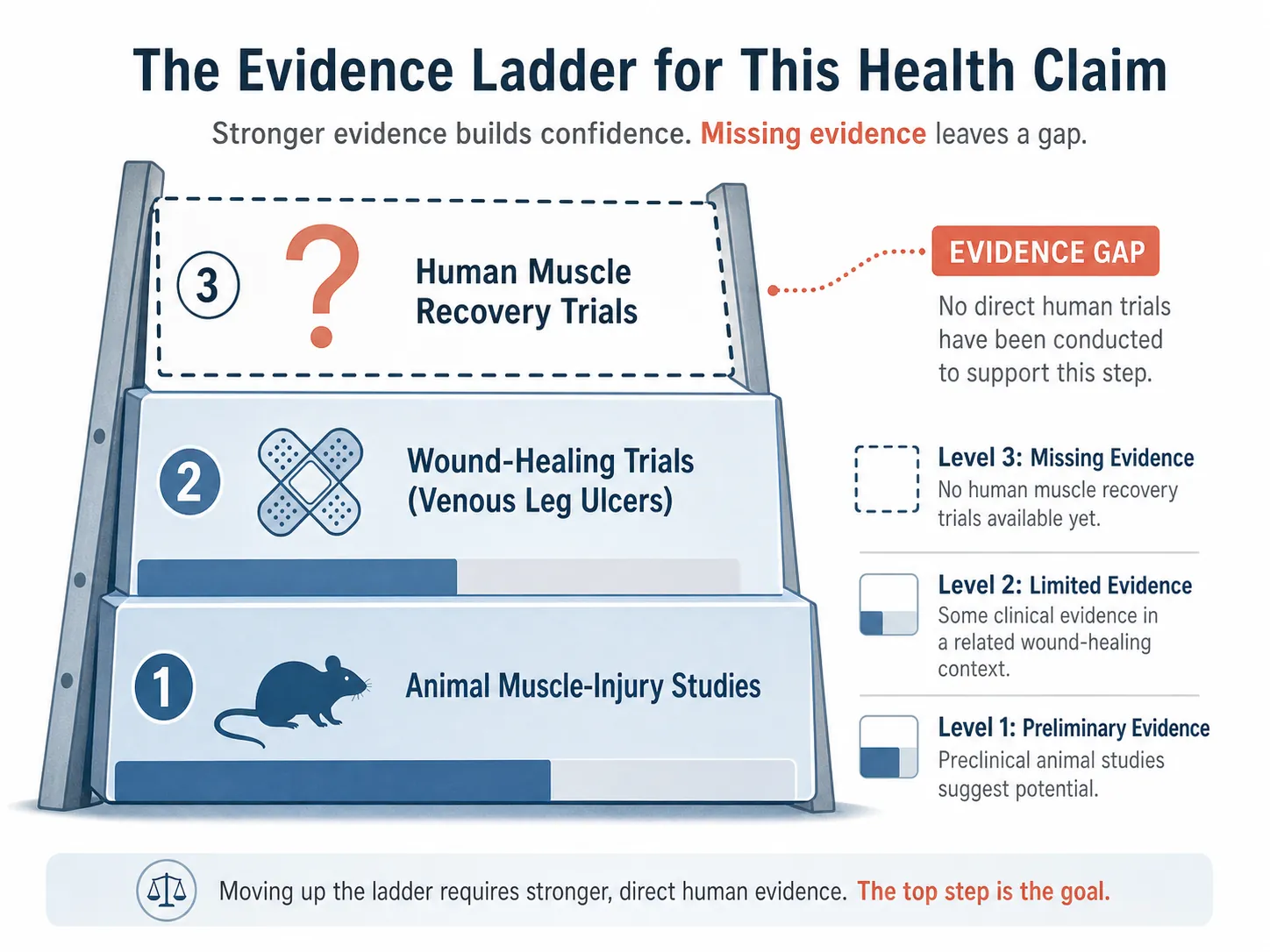
The fairest way to read the evidence is as a ladder. The lower steps are not useless; they explain why people became interested. But the top step — controlled human evidence for muscle recovery or performance — is the one that would matter most for the home-gym reader deciding whether to inject something bought online.
| Claim being made | What the evidence actually supports | How much it applies to at-home muscle recovery |
|---|---|---|
| TB-500 may affect repair biology | Mechanistic and preclinical work links thymosin beta-4-related activity with actin regulation, cell migration, and angiogenesis.[3] | Biologically plausible, but indirect |
| Peptides related to thymosin beta-4 can help tissue healing | Human phase 2 data discussed in peptide reviews involve thymosin beta-4 gel for venous leg ulcers, not injectable TB-500 for sports recovery.[4][5] | Relevant to wound biology, not proof for muscle recovery |
| TB-500 speeds recovery after training or injury | No human clinical trial has demonstrated faster muscle recovery or improved sports performance in healthy people. | Unsupported as a clinical claim |
Animal muscle-injury findings are often where the enthusiasm starts. Rodent injury models can show whether a compound affects repair-related markers or healing behavior under controlled conditions. They cannot answer the home-use question by themselves. A lab animal with a standardized injury, controlled environment, and known compound exposure is not the same as a person training around a sore tendon or strained muscle while guessing at product quality and dose.
The closest human material often cited is not TB-500 muscle recovery research. It is thymosin beta-4 gel research in venous leg ulcers. Those phase 2 trials looked at wound healing in people with chronic skin ulcers, using a topical gel form of the full-length peptide, not self-administered injectable TB-500 for exercise recovery.[4][5]
That matters because each part of the claim changes the question. A venous leg ulcer is not delayed-onset muscle soreness. A topical gel is not an injection. Full-length thymosin beta-4 is not necessarily TB-500. A clinical wound-care setting is not a home gym. The evidence does not travel cleanly across those gaps.
There is also a newer wrinkle: a 2024 study cited in mainstream health coverage suggested that TB-500’s wound-healing activity may come from its metabolite Ac-LKKTE rather than the parent compound itself.[6] That does not settle the question for athletes, but it does make the simple marketing version — “TB-500 heals tissue” — look too neat.
Why forum protocols are not dosing evidence
If you have already looked around online, you have probably seen TB-500 “loading” and “maintenance” schedules. Commonly repeated examples include 4–6 mg per week for 4–6 weeks, followed by maintenance patterns such as 2–4 mg per week or 2–6 mg per month, usually described as subcutaneous injection.[3]
Those numbers should be read as community practice, not clinically validated guidance. There is no FDA-approved TB-500 dosing protocol for muscle recovery, no approved at-home recovery indication, and no controlled trial establishing that one schedule improves outcomes more safely than another.
This is where peptide marketing often sounds cleaner than real life. “Research peptide” can look technical and sterile on a label. At home, it can mean buying an unapproved product, trusting a vial’s identity and purity, reconstituting it correctly, injecting it correctly, storing it correctly, and then interpreting your own pain, swelling, training readiness, and side effects without a clinician watching the pattern.
The home-use problem is bigger than “does it work?”
Even if a compound has a plausible mechanism, the at-home version adds risks that do not show up in a tidy mechanism diagram. Online TB-500 products are often sold as research-grade materials rather than regulated medicines. Pharmacist and medical reviews have warned about quality-control concerns such as endotoxins, truncated peptide sequences, heavy metals, mislabeling, and uncertain purity in products sold through online channels.[7][8]
That uncertainty changes the practical decision. A person is not only deciding whether the TB-500 hypothesis is interesting. They are deciding whether the actual vial in their hand is what the seller says it is, whether the dose is accurate, whether contaminants are present, and whether an injection-related complication would be recognized early.
Long-term human safety data are also missing. Reviews discussing TB-500 and thymosin beta-4-related compounds commonly flag theoretical concern around angiogenesis — the formation of new blood vessels — including the possibility that a repair-promoting pathway could be undesirable in some cancer-related contexts.[6][7] The point is not that TB-500 has been proven to cause cancer in home users. The point is that the safety question has not been closed.
That uncertainty is part of why the July 2026 FDA review is important. TB-500 has been classified in a compounding context as raising safety concerns, and FDA warning-letter activity has targeted online sellers making problematic claims around unapproved products.[1][8] This is not merely a paperwork issue. It is a signal that regulators are looking at real-world availability, claims, and safety gaps.
For competitive athletes, “everyone is doing it” can become a four-year problem
TB-500 also sits in a different risk category for tested athletes. The World Anti-Doping Agency treats substances like TB-500 under Category S0, which covers non-approved substances. In 2024, a Canadian athlete received a four-year ban after a case involving BPC-157 and TB-500 use.[9]
That case does not prove widespread use, and it does not tell us whether TB-500 improves performance. It does show that the casual online tone around peptides can collide with formal anti-doping consequences. If your sport, federation, employer, or event uses drug testing rules, “recovery peptide” is not a protective label.
What the evidence would need to show
A useful TB-500 muscle-recovery trial would not just measure whether people felt better after using it. It would need a defined population, a verified compound, a controlled dose, a comparison group, prespecified recovery outcomes, adverse-event tracking, and enough follow-up to catch more than short-term reactions.
For a home-gym reader, the outcomes would need to be practical: time to return to training, strength restoration, pain during specific movements, re-injury rates, imaging or functional measures when appropriate, and side effects. A study in chronic venous leg ulcers cannot substitute for that. Neither can animal data, seller testimonials, or a before-and-after post from someone whose injury may have improved with time, deloading, sleep, nutrition, physical therapy, or a changed training plan.
This is the difference between a plausible experiment and an evidence-based recovery tool. Plausibility earns research interest. It does not earn an at-home recommendation.
Where that leaves TB-500 for muscle recovery at home
TB-500 cannot be recommended as an evidence-based at-home muscle-recovery tool. The strongest available case is that thymosin beta-4-related biology is interesting and that some preclinical or wound-healing findings justify further research. The missing evidence is the evidence people are usually buying it for: human muscle recovery, return-to-training, and performance outcomes in healthy or athletic populations.
The July 2026 FDA advisory review makes that gap harder to ignore. Regulators are not treating TB-500 as a settled, low-friction recovery aid. They are actively reviewing compounding eligibility while FDA scientists have raised unresolved safety concerns.[1][2]
If you are dealing with a strain, flare-up, or stubborn overuse injury at home, the less exciting options still have the stronger footing: reduce the aggravating load, keep pain-limited movement in, rebuild capacity progressively, and get evaluated when pain, weakness, bruising, numbness, swelling, or loss of function does not behave like a routine training tweak. FitAtHome’s guides to foot injury recovery at home and wrist rehab exercises at home are better places to start than an unapproved injectable peptide.
References
- FDA Advisory Committee Calendar — U.S. Food and Drug Administration.
- Omer Awan coverage of FDA review of TB-500 compounding eligibility — Forbes, July 21, 2026.
- TB-500 — Moonshot Medical.
- TB-500 review — Innerbody Research.
- TB-500 and thymosin beta-4 evidence review — Sports Injury Physio.
- TB-500 health and safety coverage — Men's Health.
- TB-500 and peptide safety review — Ortho & Wellness.
- Warning Letters — U.S. Food and Drug Administration.
- TB-500 WADA status and Canadian athlete case — BSCG.
This is general fitness education, not medical advice. For diagnosis or treatment of pain or injury, consult a qualified clinician.
Pick your next session
Browse all routines to find an appropriately-spaced next session.
Spot something off?
This content sits adjacent to health guidance — tell us if a citation or figure needs a correction.