
The run is over. Shoes are off, heart rate is coming down, and the disciplined part of the day feels complete. That is usually where advice about poor air quality and outdoor exercise stops: check the air before you train, shorten the session if needed, move indoors when the air is bad.
Recovery does not stop there. For the next hour or two, your body is still paying back the oxygen cost of the workout through excess post-exercise oxygen consumption, or EPOC. Breathing remains elevated while temperature, heart rate, oxygen demand, and metabolic processes settle back toward baseline. If the air around you is smoky, stale, poorly filtered, or loaded with fine particles, that recovery window is still an exposure window.

The Exposure Does Not End When the Workout Ends
At rest, ventilation is often described around 12 liters of air per minute. During hard exercise, it can rise toward 100 liters per minute, depending on intensity, fitness, and body size.[1][2] That jump is why poor outdoor air gets so much attention during running, cycling, and hiking: a working body pulls far more air deep into the lungs than a resting one.
The neglected part is what happens afterward. EPOC can keep breathing above baseline for roughly 60 to 120 minutes after exercise, especially after harder or longer sessions.[1][2] Your breathing is no longer dramatic enough to notice, but it is not back to a quiet resting state either. If you finish a smoky trail run and then sit near an open window, or drive home through traffic with the fan pulling outside air, your lungs are still moving more air than they would on an ordinary evening.
That does not mean one polluted cooldown ruins a training block. The available research does not give a clean number like “PM2.5 adds 37 minutes to recovery” for healthy exercisers. The safer conclusion is narrower and more useful: the same physiology that makes exercise increase pollutant intake can continue into early recovery, when the body is also trying to repair.
PM2.5 Adds Inflammatory Stress to an Already Busy Repair Process
Exercise itself creates inflammation. That is not a flaw in the system. Training stress produces signals that help the body adapt: muscle tissue repairs, mitochondria respond, and the immune system participates in cleanup. A good recovery routine gives that process enough oxygen, fluids, nutrients, sleep, and time to resolve.
Fine particulate matter complicates that process because PM2.5 is small enough to penetrate deep into the lungs. Reviews of particulate pollution describe particles smaller than 2.5 micrometers crossing biological barriers, entering circulation, and contributing to oxidative stress and proinflammatory cytokine activity.[3][4] In plain terms, poor air can add a second inflammatory load while the body is already managing the controlled inflammatory load created by training.
That distinction matters. The concern is not only that polluted air irritates the lungs during a workout. It is that inhaled particles can become a systemic stressor during the period when recovery is supposed to be moving in the other direction: toward lower stress, tissue repair, and a return to baseline.
For the person who tracks recovery carefully, this can look confusing. The workout was normal. The pace was controlled. Protein, stretching, and sleep were handled. Then the next morning’s readiness score or HRV looks worse than expected. Wearables cannot diagnose air-pollution effects, and a low score can come from many places, but poor air is one plausible stressor to consider when a hard training day overlaps with smoke, heavy traffic exposure, or a stale indoor cooldown. If you use recovery metrics, it helps to read them as context rather than verdicts; our guide to sleep and recovery wearable data explains how to avoid over-reading a single number.
Moving Indoors Helps Only If the Indoor Air Is Cleaner
“Go inside” is good advice when outdoor smoke or pollution is high, but it is incomplete. The U.S. Environmental Protection Agency has reported that indoor air can contain 2 to 5 times more pollutants than outdoor air under typical conditions, with large variation by building type, ventilation, indoor sources, and outdoor conditions.[5] That finding does not mean indoors is usually worse for every person on every day. It means the wall between “outside risk” and “inside safety” is thinner than fitness advice often pretends.
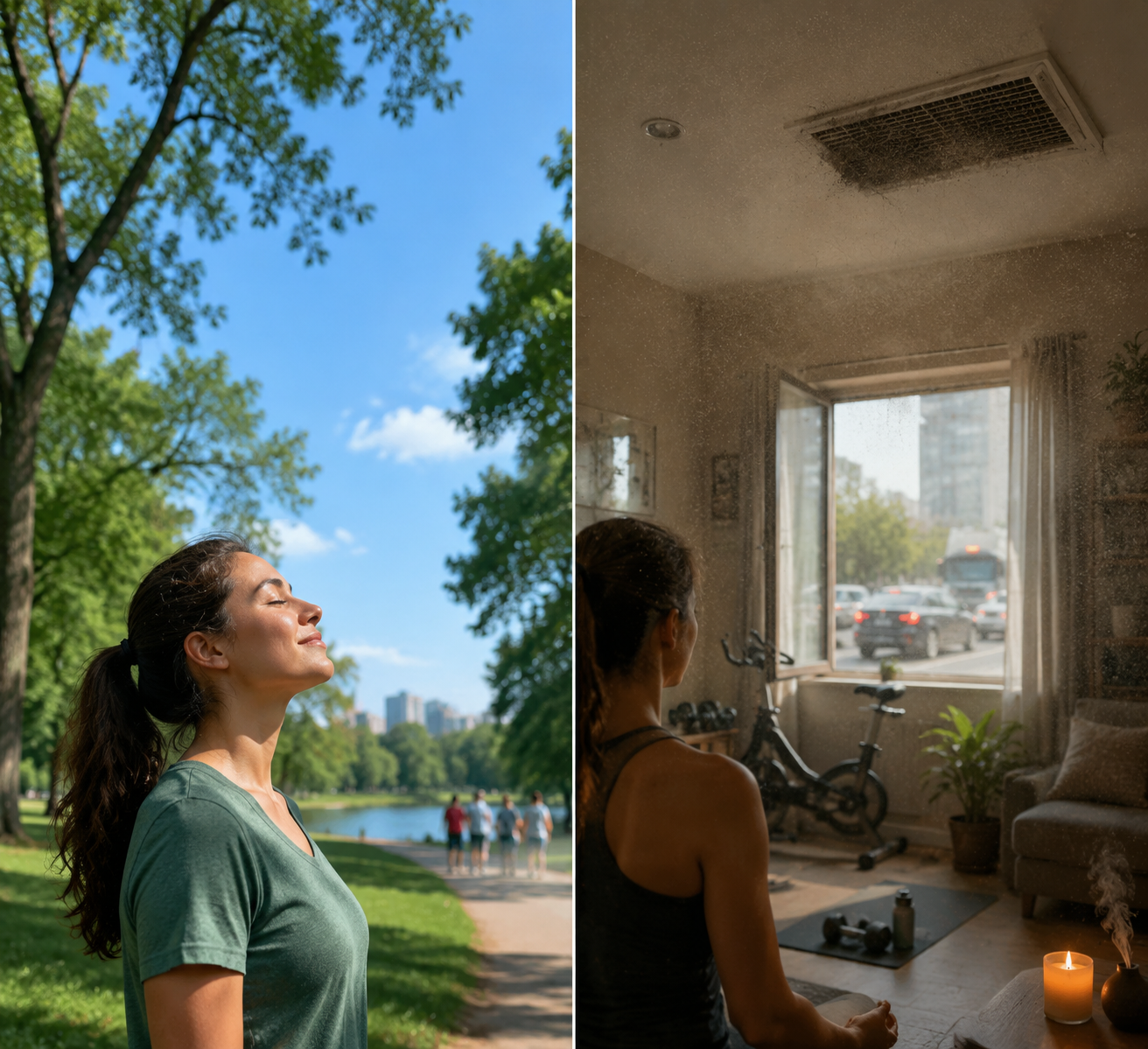
A home gym can hold dust from vents, particles from cooking, candle smoke, cleaning products, pet dander, and outdoor pollution that leaked in earlier. A garage gym may add vehicle-related contaminants or poor ventilation. An apartment near traffic may stay exposed even after the windows close. The room can feel comfortable and still be a poor recovery environment.
Commercial gyms are not automatically exempt. Reports citing a 2018 multi-country gym study describe carbon dioxide levels above 1,000 ppm in some gym environments, a threshold often used as a sign of inadequate ventilation and associated with fatigue and cognitive performance concerns.[2][6] That evidence should be treated as context rather than a verdict on every gym, especially because CO2 is not the same pollutant as PM2.5. Still, it widens the recovery question: air quality is not only wildfire smoke or an AQI color on a weather app. Ventilation matters.
This is why a person can make the right upstream decision—cut the outdoor session short, move the next workout inside, avoid the worst AQI hour—and still recover in a room that keeps exposure going. If you need help deciding when to shift training indoors in the first place, start with how to work out indoors when the air quality is bad. Once the workout is done, the next decision is where you spend the first recovery hour.
What to Change in the First Hour After Training
The practical move is not to become afraid of outdoor exercise. It is to stop treating air as irrelevant the moment the watch says “workout complete.” During the first 60 to 120 minutes, choose the recovery space as deliberately as you choose the route, pace, or post-workout meal.
- Cool down away from obvious sources: smoke, idling cars, dusty garages, busy roads, open windows during wildfire events, and rooms with recent cooking smoke or strong cleaning fumes.
- Use ventilation when outdoor air is actually better, and close windows when outdoor air is the problem. The right choice depends on the source.
- If you use filtration, place it where you actually recover, not only where you sleep or work.
- Change out of smoky or dusty clothing before settling into a small room, especially after wildfire smoke, trail dust, or heavy traffic exposure.
- Watch patterns rather than one-off feelings: repeated headaches, unusual chest tightness, coughing, wheezing, or recovery scores that dip after poor-air workouts deserve attention.
This air-quality layer does not replace the basics. A complete recovery plan still needs a gradual cooldown, fluids, food, mobility work when useful, and sleep. If you want that broader sequence, use a complete post-workout recovery routine at home as the foundation. Then add the missing environmental question: is the air in this room helping recovery settle down, or keeping the stress response active?

When Poor-Air Recovery Is More Than a Training Problem
Most healthy exercisers do not need to medicalize every bad-air workout. But symptoms change the decision. Chest pain, shortness of breath that feels disproportionate, wheezing, dizziness, faintness, or symptoms that persist after leaving the polluted environment should not be treated as normal soreness or a low-readiness day.
People with asthma, cardiovascular disease, respiratory conditions, pregnancy, or other medical concerns should be more conservative and ask a healthcare provider how to adjust training during poor air-quality periods. The recovery window is exactly when it is easy to underreact, because the hard part appears to be finished.
Poor air quality can sabotage recovery because recovery is not just what you eat, stretch, or track. It is also where your elevated breathing continues, what particles that air carries, and whether “indoors” actually means cleaner air. The next post-workout hour deserves a better plan than sitting wherever happens to be convenient.
References
- Exercise and Air Pollution, American College of Sports Medicine
- Exercise, Breathing Rate, and Air Pollution, AtmoTube
- Exercise and Air Pollution, Molekule
- Comprehensive Review of Particulate Matter and Inflammation, PMC
- Indoor Air Quality and Pollutant Levels, U.S. Environmental Protection Agency
- 2018 Gym Carbon Dioxide Study, cited by Molekule and AtmoTube

Comments
Join the discussion with an anonymous comment.