Most common musculoskeletal injuries keep recreational athletes out for weeks to months, not days. A mild ankle sprain or grade 1 hamstring strain may return in about 1 to 3 weeks, while tendon problems often need 4 to 12 weeks, fractures commonly need 6 to 12 weeks, shoulder injuries may take 3 to 6 months, and ACL reconstruction usually belongs in the 6- to 12-month category rather than the “I feel good this week” category.[1][2]
That answers the anxious calendar question. It does not answer the return-to-sport question. The better test is what the injured tissue can tolerate now: walking, range of motion, loaded strength, cutting, sprinting, landing, or the awkward half-speed version of sport where many re-injuries happen because the athlete is technically “back” but not ready.
| Injury | Typical return-to-sport range | What changes the timeline |
|---|---|---|
| Ankle sprain, grade 1 | About 1-2 weeks | Pain, swelling, balance, and ability to hop or change direction without guarding |
| Ankle sprain, grade 2 | About 2-6 weeks | Ligament laxity, swelling response after activity, and single-leg control |
| Ankle sprain, grade 3 | About 6-12+ weeks | Instability, bracing needs, sport demands, and whether medical evaluation changes the plan |
| Hamstring strain, grade 1 | About 1-3 weeks | Pain with sprinting, stride length, and eccentric hamstring strength |
| Hamstring strain, grade 2 | About 4-8 weeks | Bruising, strength loss, sprint exposure, and re-strain history |
| Hamstring strain, grade 3 | About 3+ months | Tendon involvement, major strength deficit, and whether surgical or specialist care is needed |
| Tendonitis or overuse tendinopathy | About 4-12 weeks | Load management, morning stiffness, pain response 24 hours after training, and recurrence |
| Fracture or stress fracture | About 6-12 weeks | Bone healing, location, imaging or medical clearance, and impact progression |
| Shoulder injury | About 3-6 months | Tissue involved, overhead demands, strength, and end-range control |
| ACL reconstruction | About 6-12 months | Graft maturation, strength and hop symmetry, psychological readiness, and sport type |
The ranges are useful because they stop magical thinking. If a grade 2 hamstring strain is still painful at week 3, that is not automatically a disaster. If a grade 3 ankle sprain feels “pretty okay” after 10 days, that does not make cutting drills sensible. A timeline is a planning tool; it is not a permission slip.
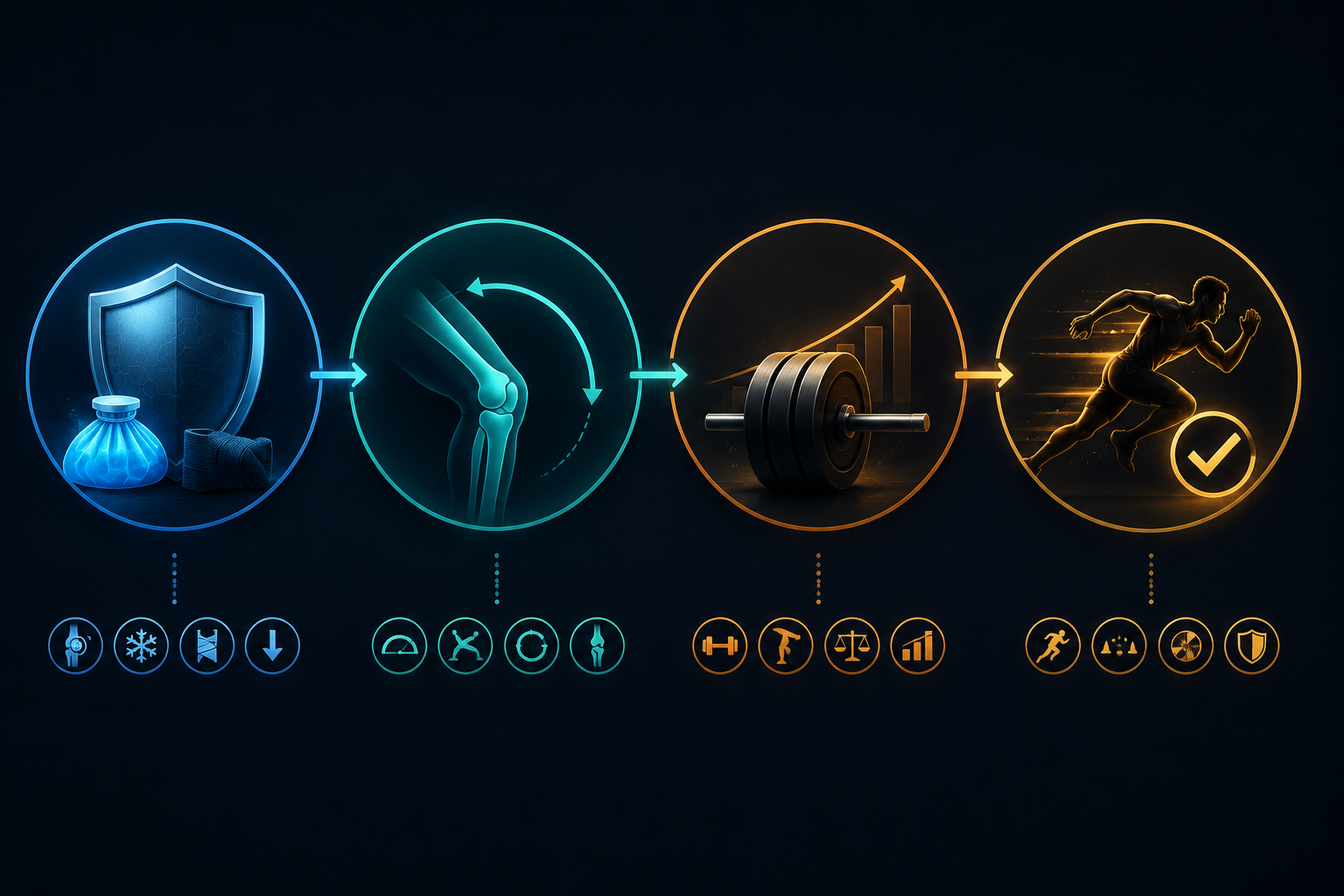
The Four Phases Behind Most Injury Recovery Timelines
Most return-to-sport plans move through the same broad workflow: protect the injury, restore motion, rebuild strength and conditioning, then reintroduce sport. Some clinical guides place those phases roughly at 0-6 weeks, 6-12 weeks, 12-20 weeks, and 20-24+ weeks for longer recoveries, especially surgical or major injuries.[3][4] Shorter injuries compress the same sequence. A mild ankle sprain may pass through protection and motion in days; an ACL reconstruction stretches the same logic across months.
| Phase | Main job | Progression signs |
|---|---|---|
| Protection and pain control | Calm symptoms, protect healing tissue, avoid making the injury louder | Pain and swelling trend down; walking or basic daily movement improves; no sense of giving way |
| Range of motion | Regain comfortable movement before heavy loading | Motion is close to the uninjured side or good enough for the next task; stiffness does not spike after gentle work |
| Strength and conditioning | Reload the tissue and rebuild capacity | Strength, balance, and repeated efforts improve without next-day flare-ups |
| Return to activity | Add sport-like speed, impact, fatigue, and decision-making | The athlete can progress exposure while symptoms, movement quality, and confidence stay stable |
The order matters. Pain and swelling control before aggressive motion. Motion before heavy loading. Loading before sport-like chaos. Sport-like work before full return. When a rehab plan goes wrong at home, it often skips one of those transitions rather than choosing the wrong exercise.
Phase 1: Protection Is Not Just Rest
Protection means giving the tissue a quieter environment so healing can start. For an ankle sprain, that might mean reducing painful walking volume and using support. For a hamstring strain, it means not testing sprint speed every morning. For tendon pain, it usually means cutting the irritating load rather than doing nothing at all. For a suspected fracture or stress fracture, it means getting medical guidance before deciding that soreness is just something to train through.
The home check here is boring but valuable: does the injury settle after ordinary life, or does it get warmer, puffier, sharper, or less trustworthy as the day goes on? A tendon that is quiet during warm-up but cranky the next morning is not necessarily improving. An ankle that tolerates straight walking but swells after errands is giving different information than one that stays calm.
Phase 2: Motion Comes Before Ambition
Range of motion is where many home athletes get impatient because it feels too small to count as training. It counts. A knee that cannot bend and straighten well will borrow motion somewhere else. A shoulder that cannot move comfortably overhead will turn a simple press into a compensation project. An ankle that lacks dorsiflexion will make squats, running, and landings messier than they need to be.
The standard is not perfect symmetry on day one. The standard is useful, improving motion without a symptom penalty. A gentle mobility session that leaves the joint looser and no more swollen later is different from a stretching session that wins five minutes of range and costs two days of irritation.
Phase 3: Strength Has to Look Like the Job
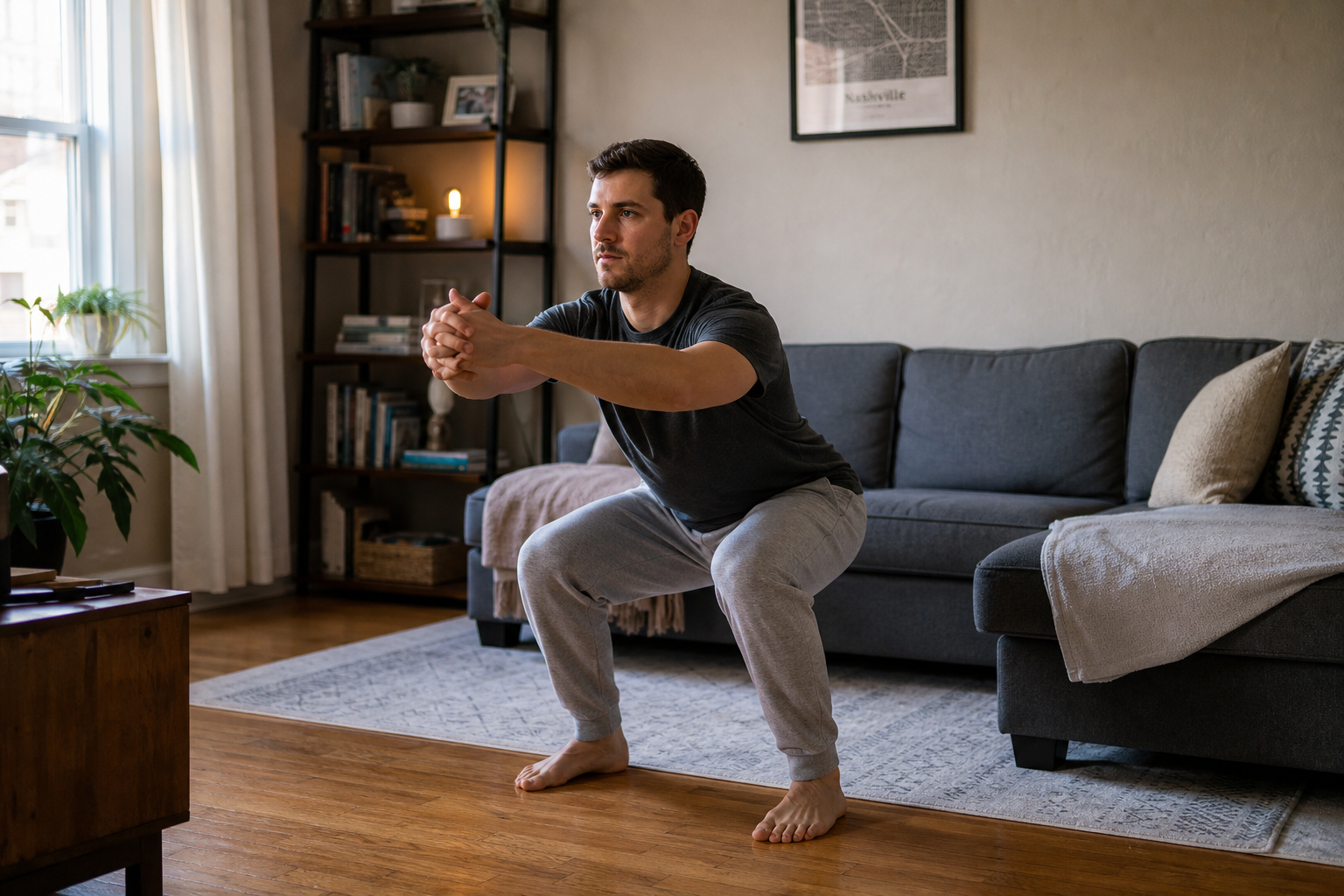
Strength work is not only about making the injured area less weak. It is where the tissue learns to accept load again. Calf raises in a hallway, split squats beside a kitchen counter, slow hamstring bridges, banded shoulder work, and step-downs can be legitimate pieces of the rebuild when they are matched to the injury and progressed honestly.
This is also where recovery habits start to matter again. Sleep, nutrition, and controlled activity do not clear an athlete for sport, but they affect whether training stress is absorbed or just piled onto a sensitized area. A simple post-workout recovery routine at home can be useful during this phase because it keeps easy days easy and makes hard days easier to interpret.
Soft-tissue tools have a place if they help someone tolerate movement, but they should not become the whole plan. Foam rolling may make surrounding tissue feel better during reconditioning; it does not prove a tendon, ligament, graft, or bone is ready for impact. For that distinction, use it as one small recovery tool, not as a readiness test. A practical guide to foam rolling and active recovery for home gym training fits best here, after symptoms are controlled and loading has resumed.
Phase 4: Return Is a Progression, Not a Doorway
The last phase is where “I can exercise” and “I can return to sport” separate. A runner may tolerate easy mileage but not hills or intervals. A recreational soccer player may jog pain-free but still flinch when cutting off the injured leg. A lifter may press light dumbbells but lose shoulder control near fatigue. Sport adds speed, impact, reaction, and ego; rehab has to meet those demands before the first full session back.

How the Timeline Changes by Injury
Different tissues heal and fail differently. Ligaments, muscles, tendons, and bones do not respond to the same calendar pressure. The useful question is not “Can I handle one workout?” It is “Can this tissue handle the next several exposures without swelling, limping, guarding, or losing quality?”
Ankle Sprains: Balance and Swelling Decide More Than Bravery
Mild ankle sprains can return quickly, often around 1 to 2 weeks, while moderate sprains commonly take 2 to 6 weeks and severe sprains may need 6 to 12 weeks or longer.[1][2] The trap is that straight-line walking can look normal long before the ankle is ready for side cuts, uneven ground, or landing on someone else’s foot.
A practical home sequence is: walk without limping, regain enough ankle motion for squatting and stairs, restore single-leg balance, then add hopping, jogging, and direction changes. Painter’s tape on the floor can help make hop distance or balance reaches more consistent from week to week, but it is still a screen. If the ankle feels unstable, repeatedly swells, or gives way, that is not a home-testing problem; it is a medical or PT problem.
Hamstring Strains: Jogging Is Not the Same as Sprinting
Grade 1 hamstring strains are often listed around 1 to 3 weeks, grade 2 strains around 4 to 8 weeks, and grade 3 injuries at roughly 3 months or more.[1][2] The return decision should respect the task that usually exposes the hamstring: fast running, acceleration, deceleration, or a long stride under fatigue.
Pain-free jogging is a useful milestone, not the finish line. The athlete still needs progressive speed exposure: brisk walking, easy jogging, relaxed strides, faster strides, then sport-specific sprinting or cutting. If the first fast stride produces a grabby sensation, the tissue has answered the question.
Tendonitis and Overuse Injuries: Quiet Is Not Always Recovered
Tendonitis and other overuse tendon problems are commonly placed in the 4- to 12-week recovery range.[1][2] They can feel deceptively manageable because pain often warms up during exercise. The more useful data point is the 24-hour response: morning stiffness, pain on stairs, tenderness, or a return of symptoms after a session.
Tendons usually need a calmer load pattern, then a deliberate rebuild. That may mean reducing jumping, hills, heavy gripping, overhead volume, or speed work while keeping enough activity to maintain general fitness. A wearable recovery score can add context about sleep and overall strain, but it cannot tell whether a tendon is ready for plyometrics. If you use one, treat what your fitness tracker’s recovery score actually measures as background information, not clearance.
Fractures and Stress Fractures: Bone Sets the Pace
Fractures are often listed around 6 to 12 weeks before return, depending on location and severity.[1][2] Stress fractures deserve particular caution because the early symptom can look like ordinary training soreness until impact keeps repeating the same mistake. This is one category where home athletes should be slower to self-clear. Bone healing, imaging decisions, and weight-bearing rules are not best guessed from a pain scale.
Once a clinician clears loading, the return still needs steps: walking volume, low-impact conditioning, short impact exposures, then sport-specific work. Skipping from “no pain at rest” to running every other day is how a calendar turns into a loop.
Shoulder Injuries: The End Range Has to Be Trustworthy
Shoulder injuries are often grouped around 3 to 6 months in broad sports recovery timelines.[1][2] That range is too wide to mean much without knowing whether the issue is irritation, instability, a rotator cuff injury, a labral injury, or a post-surgical case. For the home athlete, the useful checkpoint is whether the shoulder can control the positions the sport actually uses: overhead reach, loaded pressing, hanging, catching, throwing, or bracing on the floor.
Pain-free range is not enough if the shoulder feels loose, apprehensive, or weak at the top of the motion. That is especially true for overhead sports and lifts, where a small loss of control at end range can carry more consequence than a little mid-range soreness.
Criteria That Matter More Than the Date
Home checks are not clinical clearance. They are a way to stop guessing. If they reveal pain, swelling, asymmetry, instability, or fear, the next move is not to negotiate with the calendar; it is to reduce the exposure and, when needed, get medical or PT input.
- Symptoms: pain stays mild and predictable during activity, then returns to baseline afterward.
- Swelling or stiffness: the joint or tendon does not puff up, stiffen, or feel worse the next morning.
- Range of motion: the injured side moves well enough for the task without compensation.
- Strength: the injured side can handle repeated loading without shaking, collapsing, or shifting the work elsewhere.
- Balance or landing control: single-leg tasks look controlled, not lucky.
- Confidence: the athlete can perform the movement without bracing, hesitation, or protective avoidance.
For lower-body injuries, limb symmetry is often used as one return-to-sport benchmark. A common minimum is about 90% symmetry between limbs for strength and hop testing, though some research discussed in criterion-based testing resources suggests that closer to 96% may better predict successful return in certain contexts.[5] That does not mean a living room hop test has the precision of a lab. It means a big side-to-side gap is useful evidence that the athlete is not ready for full exposure.
A simple home version is to compare sides on controlled tasks: single-leg calf raises, single-leg balance, step-downs, broad hops, or repeated submaximal hops if impact is already appropriate for the injury. The goal is not to chase a heroic number. The goal is to notice whether one side is clearly weaker, shorter, slower, shakier, or more guarded.
A Graduated Return Beats One Big Comeback Session
After clearance for sport progression, one clinical return protocol uses a 4-week ramp from 25% to 50% to 75% to 100% participation.[3] The exact percentages are less important than the principle: the body gets repeated chances to show whether it can absorb the next dose.
| Week | Participation target | What to watch |
|---|---|---|
| Week 1 | About 25% | Technique, light drills, short exposure, no symptom spike |
| Week 2 | About 50% | More volume, controlled speed, stable next-day response |
| Week 3 | About 75% | Higher intensity, more sport-like fatigue, still no swelling or guarding |
| Week 4 | About 100% | Full participation only if symptoms, strength, movement quality, and confidence hold |
This progression is especially helpful for recreational athletes because adult schedules create false tests. One pickup game on Saturday may feel fine because adrenaline, social pressure, and a week of rest hide the cost. The real test is whether the body can tolerate repeated exposure: practice, errands, stairs, work, sleep, and another session without the injury getting louder.
Wearables can help track general recovery during this ramp, especially sleep, resting heart rate, and overnight strain trends. They are supporting signals, not tissue-specific clearance. If you like data, a fitness tracker ring recovery guide or a comparison of the best fitness trackers for recovery can help you interpret the background noise. A green score still cannot see a weak landing.
ACL Reconstruction Is the Timeline You Should Not Rush
ACL reconstruction deserves its own caution because feeling athletic can arrive before the graft is mature. Return timelines commonly sit around 6 to 12 months, while graft maturation is often discussed in the 9- to 12-month range.[2][4][5] The athlete who can jog, squat, and look confident at month 6 may still be dealing with biology that has not finished adapting.
The re-injury warning is not subtle. Returning before 9 months after ACL reconstruction is associated with a 6-times higher second ACL injury rate in the literature cited by return-to-sport clinical resources.[4][5] More broadly, returning too soon after injury is described as increasing re-injury risk by 2 to 6 times.[4] Those figures are exactly why “six months” can mean either “ready for a controlled phase” or “ready to tear it again,” depending on what was rebuilt during those months.
Objective testing matters here, but access is uneven. Criterion-based ACL resources discuss strength testing, hop testing, limb symmetry, and movement-quality assessment, while also noting that only 9% of clinicians in one literature review of 209 ACL studies used objective testing criteria.[5] That is frustrating for athletes, but it also means home athletes should not treat the absence of testing as proof that testing is unnecessary.
A home athlete cannot reproduce isokinetic strength testing or force-plate landing analysis with painter’s tape and a phone video. Still, obvious asymmetry matters. If the reconstructed side lands stiff, collapses inward, hops shorter, tires earlier, or makes the athlete hesitate, that is useful information. It is not a verdict by itself; it is a reason to slow down and seek better assessment.
Psychological Readiness Is Part of Recovery, Not a Bonus
Fear after injury is not weakness. HSS describes how the brain can continue to associate a movement with danger even after physical healing, and kinesiophobia has been reported to affect up to 50% of athletes.[6][4] That matters because hesitation changes mechanics. A cautious cut, a protected landing, or a late deceleration can load the body in ways the athlete did not practice.
ACL return-to-sport research often uses the ACL-RSI scale to assess psychological readiness, with a threshold of 56 out of 100 discussed in clinical return-to-sport resources.[5] The number should not be treated as magic. It is a reminder that confidence, emotions, and risk appraisal belong in the clearance conversation, not outside it.
At home, the practical version is to watch behavior. Does the athlete avoid planting on one side? Do they slow down before the movement they claim is fine? Do they need to talk themselves into every rep? Do they trust the joint only when fresh? Those signs do not mean the athlete is doomed or dramatic. They mean the return exposure may need to be smaller, more rehearsed, and more measurable.
When the Calendar Is Too Optimistic
A timeline is too optimistic when symptoms keep reappearing at the same step. The ankle swells every time jogging starts. The hamstring tolerates easy running but grabs during strides. The tendon is fine during workouts and stiff every morning. The fracture site aches when impact returns. The reconstructed knee passes casual gym work but fails confidence, hop control, or symmetry checks.
- Get medical guidance promptly for suspected fracture, major swelling, deformity, numbness, inability to bear weight, repeated giving way, or severe loss of motion.
- Seek PT or sports medicine input when pain persists, swelling returns after each progression, strength stays clearly asymmetric, or the injury changes how you move.
- Do not self-clear ACL reconstruction, major ligament injury, dislocation, post-surgical recovery, or suspected stress fracture based only on home tests.
- Scale back when the next-day response is worse, even if the session itself felt manageable.
The safest return-to-sport decision lines up several signals at once: symptoms stay quiet, swelling does not rebound, range of motion supports the task, strength is close enough to the other side for the demand, sport exposure has progressed gradually, movement quality holds under fatigue, and the athlete trusts the movement. If pain, swelling, instability, fear, or obvious asymmetry is still present, the calendar is not enough.
References
- Getting Back in the Game: Sports Injury Recovery Timelines — Moriarty PT
- Sports Injury Recovery Timeline: What to Expect — ProTouch PT
- Return to Sports After Injury: Complete Rehabilitation Timeline & Training Protocol — OSSO Orthopaedics
- Return to Sport After Injury: Complete Guide for Athletes — Physioactif
- Return-to-Sport Testing: Complete Guide to Criterion-Based Clearance — True Sports PT
- Returning to Sports after Injury: How to Overcome Your Fear — HSS

Comments
Join the discussion with an anonymous comment.