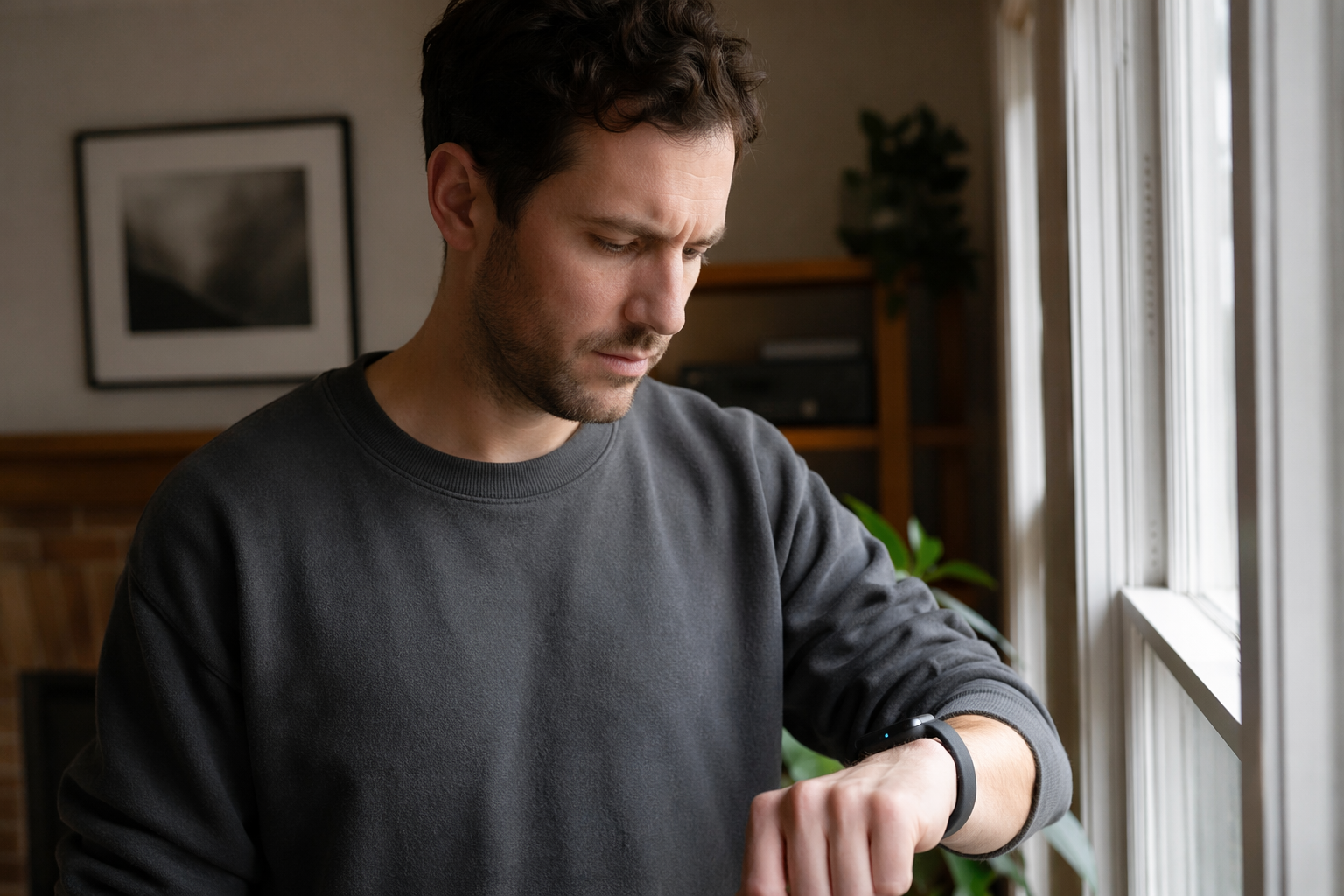
The awkward moment with a health and fitness tracker usually happens before the workout, not after it. You planned a normal dumbbell session. The coffee is made, the mat is out, and your watch, ring, or strap says your recovery is 37%, or “low,” or red. The question is no longer whether the device measured something. It probably did. The question is whether that final readiness number deserves the authority it is asking for.
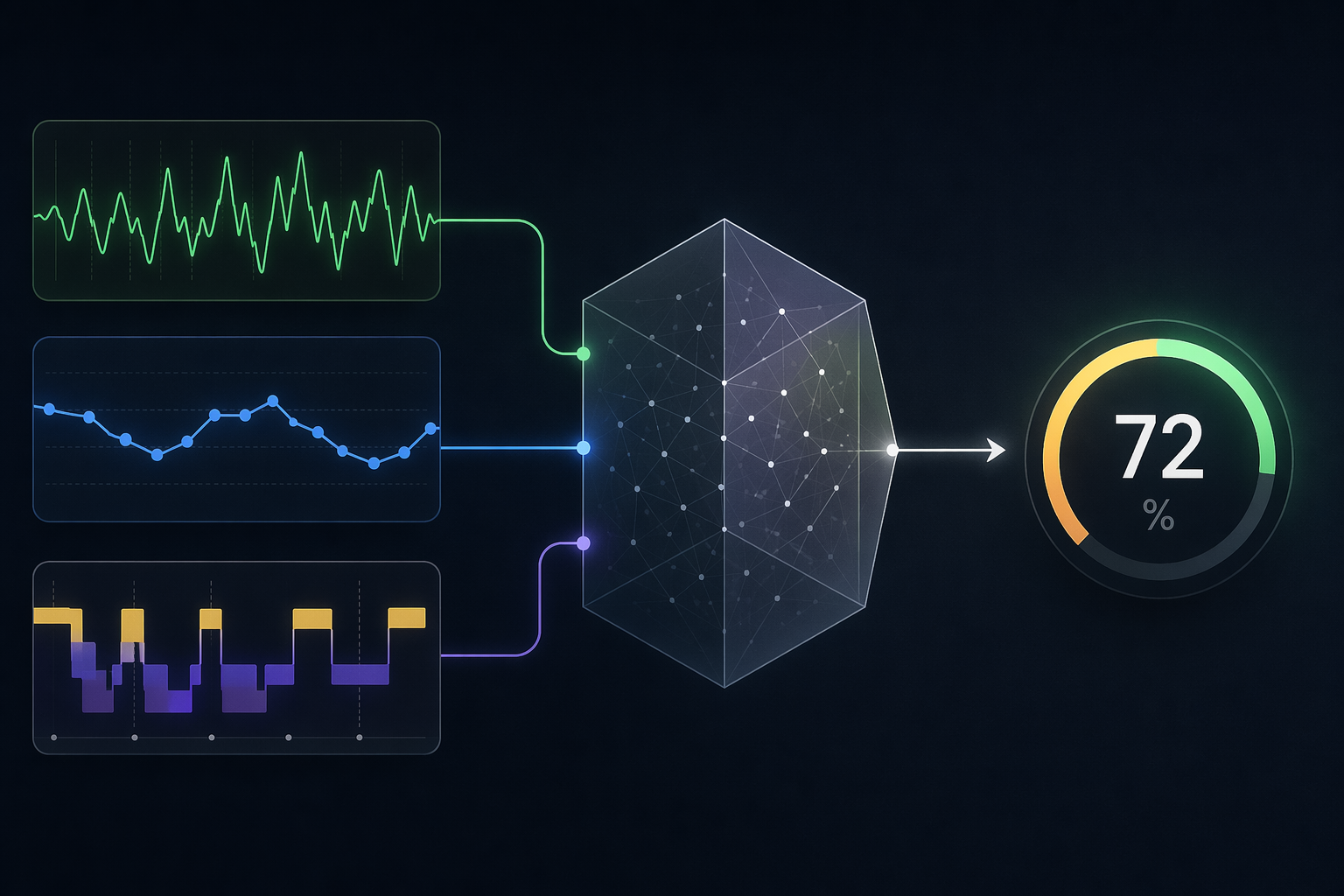
That distinction matters. Most recovery scores are built from real signals: heart rate variability, resting heart rate, sleep duration, respiratory rate, temperature, recent training load, or some version of activity balance. Those inputs can be useful. The problem is the finished score, because each company blends those inputs differently, usually without showing the formula or proving that the composite number predicts training readiness better than the raw measurements underneath it.
The score is a blend, not a lab result
The most important thing to know about a recovery score is that it is not the same thing as HRV. HRV is one input. Resting heart rate may be another. Sleep and recent training may be folded in. Then the platform turns those inputs into a single number or label that feels cleaner than the body it is trying to summarize.
That cleanliness is the appeal. It is also the weak point. A 2025 paper in Translational Exercise Biomedicine, as summarized by Rachele Pojednic, PhD, reported that major wearable manufacturers do not disclose exactly how their composite recovery scores are calculated, and that few provide peer-reviewed validation for those scores.[1] KYGO’s 2026 Recovery Score Explorer reached a similarly uncomfortable finding: only 2 of 12 wearable recovery scores it reviewed had published peer-reviewed validation.[2]
That does not mean every number on the screen is useless. It means the most polished number is often the least inspectable one. You can usually see your HRV, resting heart rate, sleep time, and sometimes training load. You usually cannot see why today’s HRV drop counted more than last night’s sleep, why a hard session two days ago still matters, or why one device thinks you are ready while another thinks you should back off.
Why WHOOP, Oura, Garmin, and Fitbit can disagree
Put three devices on the same body overnight and you should not expect one shared truth in the morning. WHOOP, Oura, Garmin, and Fitbit are not simply displaying the same measurement with different graphics. They are making different editorial decisions about which signals matter and how much weight each signal gets.
| Platform | What the recovery score uses | How it appears to the user |
|---|---|---|
| WHOOP Recovery | Overnight HRV, resting heart rate, sleep, and respiratory rate | A 0–100% recovery score |
| Oura Readiness | HRV, resting heart rate, body temperature, sleep, activity balance, and daytime updates | A 0–100 readiness score |
| Garmin Training Readiness | HRV, sleep, acute load, and recovery time | A 0–100 training readiness score |
| Fitbit Daily Readiness | HRV, sleep, and recent activity | A low, moderate, or high readiness band |
This is why cross-device comparison is mostly a trap. If WHOOP gives you a yellow score, Oura gives you an 82, and Garmin says your training readiness is low, the disagreement may not be because one device has discovered a hidden crisis. It may be because each platform is answering a slightly different question.
The business model adds another layer to the trust problem. As of mid-2026 reporting, Garmin’s Training Readiness is included with device purchase, while WHOOP requires a $239/year membership, Oura Readiness requires a $70/year membership, and Fitbit’s fuller readiness insights sit behind Premium at $10/month.[2] A subscription does not automatically make a metric worse. It does, however, raise the stakes for how confidently the app packages uncertainty. If a platform is selling recovery guidance as a premium feature, it should be clear about what has been validated and what is interpretation.
The swimmer study is the warning label
The clearest case against treating a daily composite score as a training command comes from NCAA Division 1 swimmers. In that study, WHOOP’s Recovery Score showed zero correlation with validated physiological and psychological stress measures, while raw HRV did correlate significantly.[1]
That is a narrow finding, not a universal takedown of WHOOP or every recovery score. It involved a specific population, a specific device ecosystem, and a specific comparison. But it lands because it tests the exact promise people care about: does the readiness score line up with meaningful stress measures? In that case, the polished score did not. The raw signal underneath it performed better.
For a home exerciser, the practical consequence is simple: if the app and the underlying data disagree, do not automatically believe the app. A low score with a normal HRV trend, normal resting heart rate, decent sleep time, and no unusual fatigue deserves a different response from a low score that appears alongside a clear HRV drop, elevated resting heart rate, poor sleep, and a sore throat.
Sleep data helps, until it starts pretending to know too much
Sleep belongs in recovery tracking, but not all sleep metrics deserve the same weight. Johns Hopkins Medicine notes that consumer sleep trackers tend to be more useful for estimating total sleep time than for identifying sleep stages, and that they can overestimate sleep and misclassify stages.[3] That matters because many readiness scores give sleep a central role, while the most confident-looking sleep-stage chart may be the least reliable part of the night.
For training decisions, total sleep time and sleep consistency are more useful than treating a device’s REM or deep-sleep estimate as a hard instruction. If you slept five hours, woke up repeatedly, and feel flat, that is enough information to adjust the session. You do not need a perfect hypnogram to justify taking squats down a notch.
There is also a behavioral cost to over-monitoring. Orthosomnia research describes people whose pursuit of ideal sleep-tracker numbers worsens their sleep experience and anxiety around sleep.[4] A tracker that helps you notice a pattern is useful. A tracker that makes you lie awake worrying about tomorrow’s score has crossed into the problem it was supposed to solve.
Raw HRV trends are more defensible than daily verdicts
HRV is not magic, but it is one of the better wearable recovery inputs when it is measured under calm, repeatable conditions. Wrist and ring sensors that use optical PPG are generally more vulnerable during movement than at rest, which is why overnight resting HRV is the better use case. The device is not trying to chase a wrist bouncing through burpees. It is measuring while you are still, asleep, and repeatedly sampled.
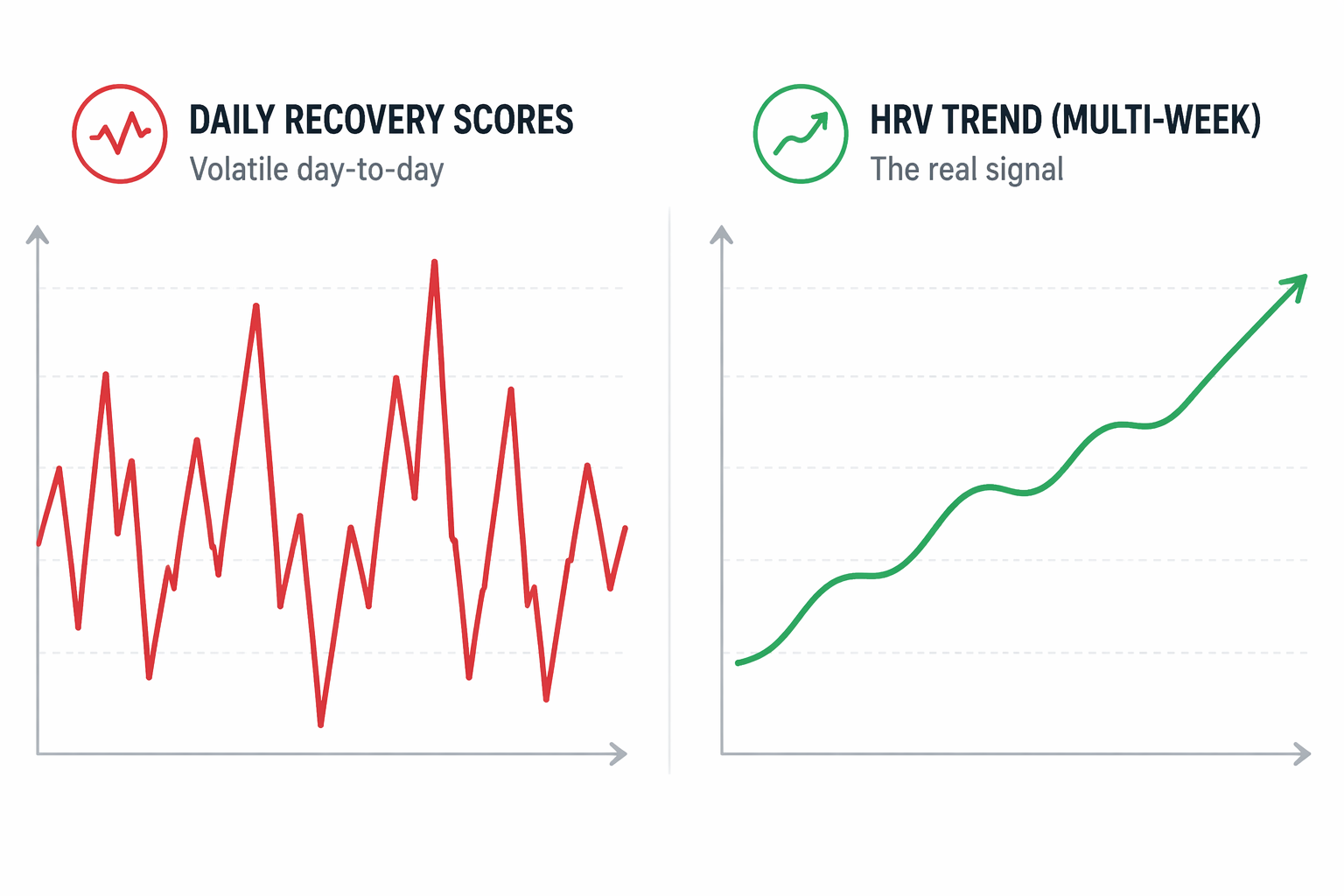
The word “trend” is doing a lot of work here. A single low HRV reading can happen after alcohol, a late meal, travel, illness, stress, a hard workout, poor sleep, or random measurement noise. A multi-week pattern is harder to dismiss. If your usual overnight HRV has been sliding for several days while resting heart rate is climbing and training feels worse, that is a stronger signal than one dramatic red morning.
It is also why comparing your HRV to someone else’s is pointless. HSS gives broad reference ranges showing how much HRV varies by age: people in their 20s may commonly fall around 55–105 ms, while people in their 60s may fall around 25–45 ms.[5] Those ranges are orientation, not a leaderboard. Your useful comparison is usually you against your own baseline, measured with the same device, under similar conditions.
The best evidence does not say to ignore HRV. It says to stop asking one day’s composite score to do too much. In a Finnish HIIT study, people who performed high-intensity interval training when HRV was high experienced greater fitness gains. In a Spanish cycling study, cyclists who tailored training to HRV improved performance up to 14% more than controls.[1] Those findings support HRV-guided training as a pattern-based tool, not a demand that every Tuesday morning number should rewrite your plan.
How to use the score without obeying it
A recovery score is most useful as a prompt to inspect the inputs. If the number is low, open the underlying data before canceling the workout. Look at overnight HRV compared with your own recent baseline, resting heart rate, sleep time, recent training load, and whether anything obvious happened: alcohol, illness, travel, a stressful workday, or a harder-than-usual session.
- If HRV is near your normal range, resting heart rate is normal, and you feel good, keep the workout but warm up honestly.
- If HRV is down for several days, resting heart rate is up, and sleep has been short, reduce intensity or volume.
- If you have illness symptoms, unusual fatigue, dizziness, or sharp pain, override the app and skip or modify training.
- If the score is high but your body feels awful, treat your body as the better source.
That last point is not anti-data. It is good data hygiene. A composite score can miss life stress, soreness from a new movement, the way a joint feels under load, or the difference between being under-recovered and being anxious about a number. Expert commentary from Marco Altini, Christie Aschwanden, and Dr. Eamon Duffy converges on the same practical view: subjective readiness is at least as important as wearable recovery scores when deciding how hard to train.[1][5]
For a broader way to place wearables inside recovery instead of letting them run the whole show, the home fitness recovery pyramid is a better starting point than any brand dashboard. If you want to turn the numbers into a weekly rhythm, use a weekly recovery system rather than reacting to one morning’s color. For ring-specific caveats, the fitness tracker ring accuracy guide goes deeper on sensor limits.
The home-training rule
Do not throw away the tracker. Do not hand it the keys either. Use the composite recovery score as a notification that says, “Check the underlying signals.” Use raw overnight HRV as a trend over weeks. Treat sleep duration as more useful than sleep-stage certainty. Compare your HRV to your own baseline, not to a friend’s number or an age chart.
Then make the training decision with the information the app cannot fully know: perceived readiness, soreness, illness symptoms, unusual fatigue, life stress, and how the warm-up actually feels. Recovery scores are not fake. They are overconfident containers for partly useful data. For home workouts, that makes them worth checking and risky to obey.
References
- Should You Trust Your Wearable? What, Rachele Pojednic, PhD
- Recovery Scores Compared: WHOOP, Oura, Garmin, KYGO, 2026
- Do Sleep Trackers Really Work?, Johns Hopkins Medicine
- Orthosomnia: Are Some Patients Taking the Quantified Self Too Far?, Nature and Science of Sleep
- Heart Rate Variability, Hospital for Special Surgery

Comments
Join the discussion with an anonymous comment.