
A fitness tracker ring is accurate enough to trust for some quiet, overnight patterns and not accurate enough to replace a sports watch, chest strap, GPS watch, or medical device. That sounds like hedging, but it is the most honest reading of the evidence: rings do very well when your body is still, especially for nocturnal heart rate, HRV, sleep/wake detection, and temperature trends. They get much less convincing once your hand starts swinging, gripping, lifting, or bouncing.
The strongest single source here is a 2025 systematic review of 107 smart-ring studies involving about 100,000 participants. In that review, nocturnal heart rate tracked ECG extremely closely at r²=0.996, HRV reached r²=0.980, and sleep detection sensitivity against polysomnography generally landed in the 93–96% range. The same review also found weaker performance for steps, active heart rate, sleep stages, and anything that depends on GPS, which most rings simply do not have. [1]
| Metric | How much to trust it | Best use |
|---|---|---|
| Nocturnal heart rate | High: r²=0.996 vs. ECG in reported validation | Resting baseline, recovery trend, illness signal |
| HRV | High at rest: r²=0.980 vs. ECG in reported validation | Long-term recovery pattern, not a one-day verdict |
| Sleep/wake detection | High: 93–96% sensitivity vs. polysomnography | Bedtime consistency, sleep duration trend |
| Sleep stages | Limited: one validation reported about 53% staging accuracy | Loose context only; do not over-read REM/deep splits |
| Temperature trends | Useful for baseline shifts | Cycle, illness, and recovery context |
| Steps | Moderate to weak: 82–92% in free-living conditions, below wrist devices at 94–98% | Rough daily movement estimate |
| Active heart rate | Weakest during higher-motion exercise | Not ideal for interval intensity or zone training |
| GPS pace/distance | Not directly measured on most rings | Use a phone or GPS watch instead |
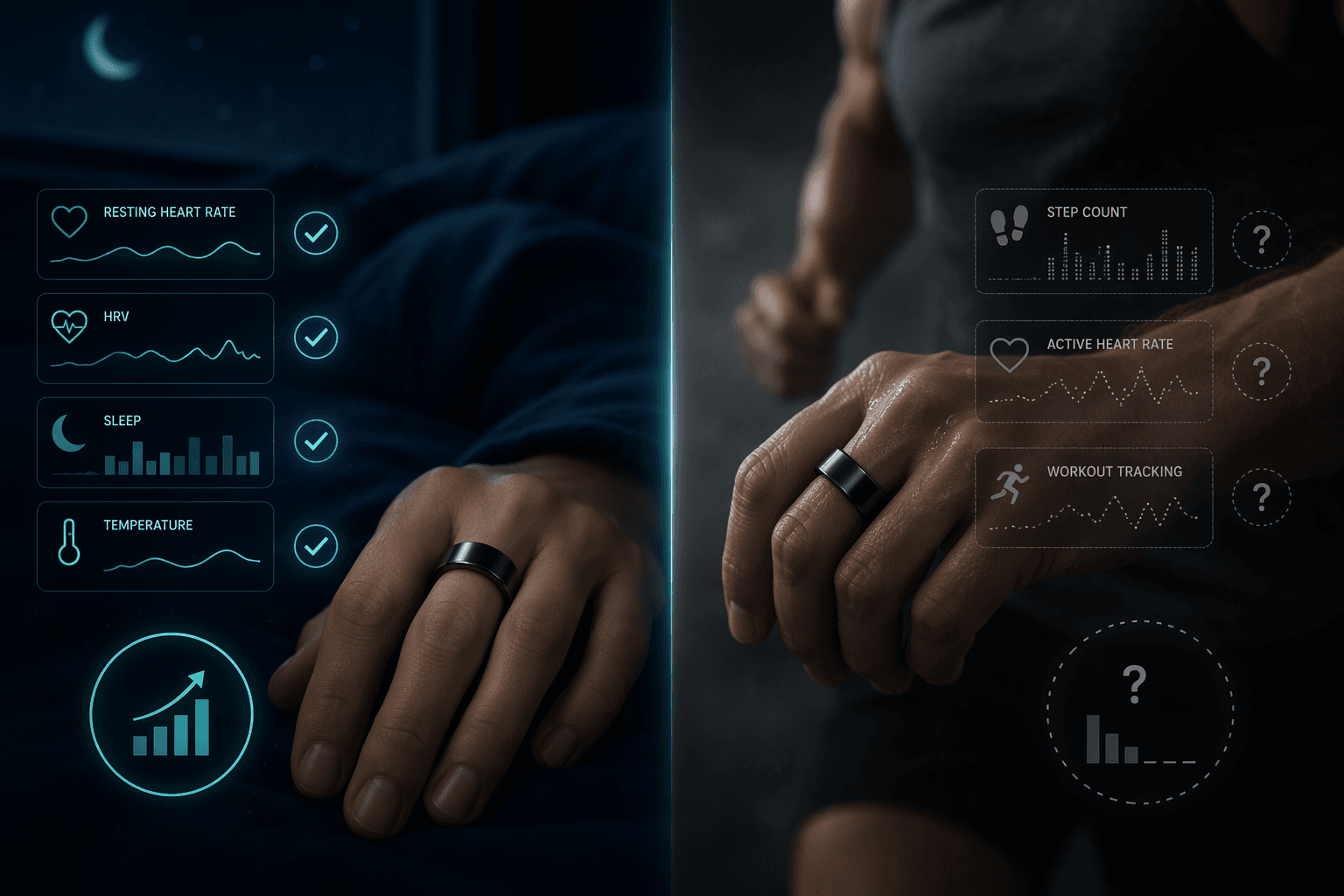
The useful answer is metric by metric, not “accurate” or “inaccurate”
Most arguments about smart ring accuracy get mushy because they treat every number in the app as if it came from the same measurement problem. It did not. A ring estimating your resting heart rate at 3:17 a.m. is doing a very different job from a ring estimating your heart rate while you are gripping dumbbells, cycling over rough pavement, or doing burpees.
At night, the ring has a major advantage: the finger is relatively still, blood flow at the finger is often easier to sample than at the wrist, and the device can collect repeated readings over hours. That is why the resting physiology numbers in the clinical literature look strong. The 2025 review reports excellent nocturnal heart rate and HRV correlations against ECG, plus high sleep/wake sensitivity compared with polysomnography. [1]
During exercise, the measurement environment gets messier. The ring can shift on the finger. The hand changes shape slightly with grip. Light-based sensors have to contend with motion artifacts. Step estimates can be fooled by hand movement or suppressed by activities where the hand stays fixed. A wrist tracker has its own problems, but it usually has more room for sensors, a display, better exercise modes, and often connected or built-in GPS. For the broader ring-versus-wrist tradeoff, see Fitness Tracker Rings vs. Wrist Trackers.
Resting heart rate and HRV are the strongest case for wearing a ring
If a buyer asks which numbers in a fitness tracker ring deserve the most trust, I start with nocturnal heart rate and HRV. In the systematic review, Kinnunen et al. reported r²=0.996 for nocturnal heart rate and r²=0.980 for HRV compared with ECG. Those are not casual app-store claims; they are the kind of validation numbers that make a ring genuinely useful for tracking recovery patterns over time. [1]
The catch is that HRV is easy to misuse even when the sensor is doing a good job. A low HRV reading after poor sleep, alcohol, a hard training day, travel, or stress may be meaningful. A single low HRV reading on a random Tuesday is not a diagnosis and not necessarily a command to cancel a workout. The value is in the baseline: what is normal for you, how far today deviates from it, and whether the deviation persists.
That is why rings can be helpful for recovery without being magical recovery judges. They are good at collecting the quiet overnight inputs that many people would never measure otherwise. Whether the app’s readiness score interprets those inputs sensibly is a separate question. For a deeper look at Oura’s HRV and readiness interpretation, see How Oura Ring Tracks Recovery.
Sleep duration is more trustworthy than sleep stages
Sleep is where many ring owners either become loyalists or start quietly panicking. The useful distinction is simple: rings are much better at detecting sleep versus wake than they are at naming the exact sleep stage.
In published validation summarized by the 2025 review, Oura Ring Gen 3 showed 94.4–94.5% sleep sensitivity across 421,045 epochs. That supports using a ring to track whether your sleep window is consistent, whether you are getting roughly more or less sleep, and whether your nights are being disrupted. But the same body of evidence reported sleep staging accuracy of only about 53%, which is a very different level of confidence. [1]
So if your ring says you slept six hours instead of seven and your bedtime shifted late, that is worth noticing. If it says your REM was “bad” by a few minutes, that is not worth reorganizing your day around. Consumer sleep staging is an estimate built from movement, heart rate, HRV, temperature, and breathing-related signals. It is not the same thing as polysomnography, where brain activity, eye movement, muscle tone, and other signals are measured directly.
Trend accuracy is not the same as medical accuracy
This is the line that keeps people out of trouble: a ring can be good at noticing a personal baseline shift without being a medical monitor. Those are different promises.
The clinical literature contains some genuinely interesting signal-detection findings. In the systematic review, smart-ring data detected COVID-19 about 2.75 days before symptoms at 82% sensitivity. The same review reports findings on inflammatory bowel disease flare prediction weeks ahead, depressive episode detection in bipolar disorder with 79% sensitivity seven days early, and 96.4% ovulation detection accuracy for menstrual cycle tracking. [1]
Those findings do not mean a ring diagnoses COVID-19, IBD flares, depression, or ovulation with clinical certainty for every user. They mean that continuous, low-friction measurements can reveal patterns that may be useful when interpreted in context. Temperature rising above your own baseline, HRV dropping below your usual range, and resting heart rate drifting upward together may be a meaningful signal. It still needs judgment, symptoms, and when appropriate, medical testing.
That distinction matters because app language often makes estimates feel more final than they are. “Readiness,” “recovery,” and “resilience” are interpretations layered on top of sensor data. Some are useful; some are overconfident. The sensor can be accurate enough to show that something changed without proving exactly why it changed.
Where rings start to break down: workouts, steps, and movement
The active-tracking weakness is not a tiny footnote. It is the main reason a person can love a ring for recovery and still be disappointed by it in the gym.
Step counting is a good example. The review found ring step accuracy around 82–92% in free-living conditions, while wrist devices were reported around 94–98%. Kristiansson et al. found a much stronger lab relationship than free-living relationship, and Niela-Vilen et al. found Oura overestimated steps by an average of 1,416 daily compared with a research-grade ActiGraph. [1]
That gap between lab and daily life is exactly where buyers get burned. In a controlled walking test, the movement pattern is clean. In real life, you carry groceries, type, push a stroller, grip a barbell, cook dinner, gesture while talking, and hold a bike handlebar. A ring has to infer locomotion from a finger that is not always moving like the rest of the body.
Active heart rate has the same problem in a different form. Photoplethysmography needs a stable optical signal. Exercise adds sweat, pressure changes, rapid arm motion, grip tension, and shifting contact. A ring can still produce useful post-workout context, but it is not the tool I would choose for interval targets, zone-2 precision, or comparing heart-rate response across workout types. For a workout-by-workout ring assessment, see Oura Ring for Fitness Tracking: Workout-by-Workout Assessment.
GPS-dependent exercise is even more straightforward. Most fitness tracker rings do not contain built-in GPS, so pace, distance, and route either come from a paired phone or are estimated indirectly. If you care about running pace, cycling distance, hiking routes, or outdoor interval structure, a GPS watch or phone-based tracker is the cleaner instrument. For broader metric-by-metric workout accuracy comparisons, see Best Workout Tracker Accuracy.
This is also where screenless design matters. Rings are elegant partly because they disappear. That same disappearing act means no glanceable workout screen, no easy lap button, and less direct feedback during training. If you are comparing ring-style tracking with other low-distraction devices, the Screenless Fitness Tracker Accuracy Showdown is the more useful comparison than a general smart ring buyer list.
Brand reviews tell the same practical story
Mainstream smart-ring reviews tend to like the form factor, sleep tracking, comfort, battery life, and recovery-style dashboards. They also keep circling back to the same weak point: activity tracking is less convincing than passive health tracking. Wareable’s 2026 smart ring testing, PCMag’s 2026 picks, ZDNET’s 2026 comparison, WIRED’s 2026 smart ring guide, and CNET’s 2026 expert-tested list all treat rings primarily as health and recovery wearables rather than complete workout instruments. [2][3][4][5][6]
That does not prove clinical accuracy by itself. Reviews are secondary context, not validation studies. But they are useful because they match the pattern in the research: the ring is most comfortable when it is watching your body settle down, not when it is trying to decode a chaotic training session from your finger.
The Oura problem: most of the evidence is not really “all rings” evidence
The phrase “fitness tracker ring accuracy” sounds brand-neutral. The evidence base is not. In the 2025 review, 72% of the included studies used Oura. That makes Oura the center of the research literature, not merely one example among many. [1]
This matters if you are comparing Oura, RingConn, Samsung Galaxy Ring, Ultrahuman, or another newer ring. You cannot automatically transfer Oura validation results to every ring with a similar shape. Sensors differ. Fit differs. Sampling choices differ. Algorithms differ. App interpretations differ. Even when two rings report the same kind of metric, they may not be measuring, cleaning, weighting, or scoring it the same way.
Availability can also shift the comparison. Oura’s patent enforcement actions have affected U.S. availability for some competitors, including Ultrahuman Ring Air and Circular Ring 2, so a neat accuracy comparison may not match what a buyer can actually purchase.
The review’s limitations make that caution stronger: 65% of the 107 studies had moderate-to-high risk of bias, 89% involved proprietary algorithms, race and ethnicity reporting was poor, and adherence declined from 80% at 3 months to 43% at 12 months. A device can be accurate in a validation study and still become less useful if the population is narrow, the algorithm is opaque, or people stop wearing it consistently. [1]
RingConn’s own accuracy discussion also frames smart rings as stronger for passive health tracking than high-precision exercise tracking, which is consistent with the broader pattern, but manufacturer material should not be treated the same way as independent validation. [7]
For readers specifically evaluating Oura as a fitness device, Oura Ring as a Fitness Tracker is the better companion piece. For recovery-device comparisons that include non-ring platforms, see Whoop vs Oura vs Garmin.
How to use a ring without letting the dashboard boss you around
The best use of a fitness tracker ring is not to obey every morning score. It is to build a personal baseline and notice when several signals move together.
- Trust resting heart rate and HRV more as trends than as single-day commands.
- Use sleep duration and sleep/wake timing more than exact sleep-stage minutes.
- Treat temperature shifts as context, especially when paired with symptoms, cycle timing, travel, or hard training.
- Use step counts as rough movement estimates, not precise activity totals.
- Use a chest strap, sports watch, or GPS device when workout intensity, pace, route, or distance matters.
- Do not treat a readiness score as a diagnosis, a training plan, or a medical clearance.
A ring is often most useful when it quietly confirms what your body has already been hinting at: you slept poorly, your resting heart rate is elevated, your HRV is suppressed, and today probably should not be a maximal training day. It is less useful when it tries to reduce your entire state of readiness to a tidy number that feels more certain than the underlying evidence allows.
The practical trust rule
Use a fitness tracker ring for recovery trends, sleep/wake consistency, resting heart rate and HRV patterns, temperature shifts, and long-term baseline changes. Do not use it as a replacement for a sports watch, chest strap, GPS tracker, polysomnography, ECG, or medical evaluation.
That leaves rings in a more useful place than either marketing hype or blanket skepticism. They are not inaccurate toys. They are also not all-purpose fitness instruments. They are strongest when your body is still and weakest when your workout gets complicated.
If you want to act on the recovery side of the data, start with Fitness Tracker Rings: A Practical Guide to Using Them for Home Fitness Recovery. If you are deciding whether the ring form factor makes sense at all, use the ring-vs-wrist comparison before trusting any “best smart ring” ranking.
References
- Smart Ring in Clinical Medicine: A Systematic Review — PMC (NIH)
- Best smart rings 2026: Oura and top alternatives tested — Wareable
- The Best Smart Rings We've Tested for 2026 — PCMag
- The best smart rings of 2026: I found an obvious winner — ZDNET
- 3 Best Smart Ring Brands: Oura, RingConn, and Samsung (2026) — WIRED
- Best Smart Rings for 2026: Expert Tested and Reviewed — CNET
- Are Smart Rings Accurate Enough for Health Tracking? — RingConn
Comments
Join the discussion with an anonymous comment.