
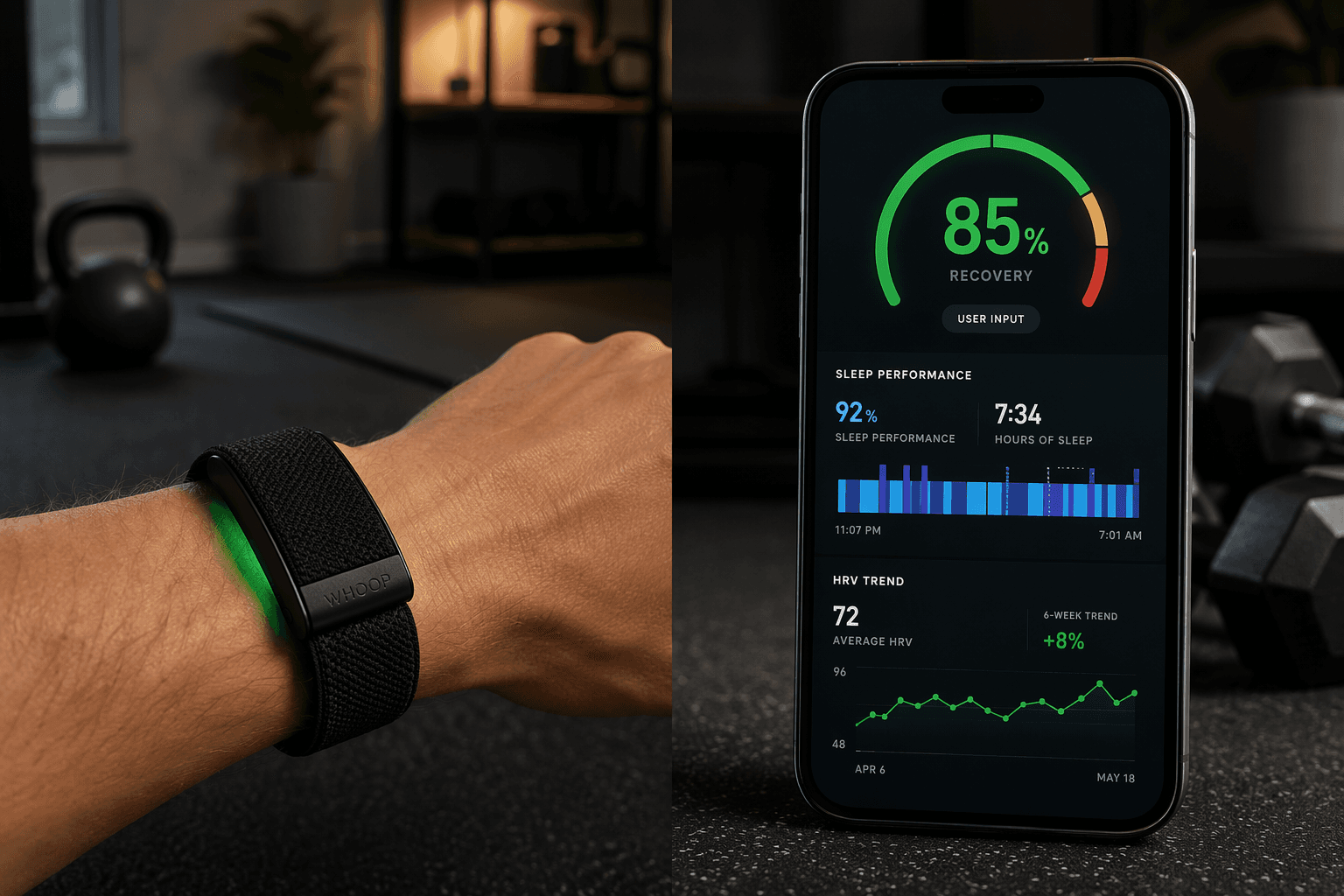
You have probably read that one of these devices tracks recovery better than the others. I have seen the marketing copy: “gold standard for HRV,” “most accurate sleep tracker,” “the only one that truly understands your body.” I have also seen the peer-reviewed data, and the first thing that stands out is not which device wins. It is that all three can reliably detect a 15% drop in heart rate variability from your baseline. That is the threshold that actually matters for deciding whether to push or rest. And they all clear it.
The numbers that usually get thrown around come from a 2025 peer-reviewed study published in The Physiological Society. Over 536 nights with 13 participants, they compared five wearables against a gold-standard ECG. HRV concordance (CCC): Oura Gen 4 hit 0.99, WHOOP 4.0 hit 0.94, and Garmin Fenix 6 hit 0.87. That looks like a clear ranking — until you ask what the difference means in a real training week. The 0.99 vs 0.94 looks like a chasm on paper, but it’s not the gap that matters. All three catch the 15% drop. The differences show up at marginal fluctuations — a few milliseconds here and there — not at the kind of swing that changes a training decision.
Does that mean you should ignore the CCC values entirely? No. But if the top priority is deciding between a green and a yellow recovery score, the gap is not big enough to be the deciding factor. The deciding factor is something else entirely: how each device integrates recovery into your training loop.
The Real Difference: How Each Device Defines Recovery
The three devices measure HRV with similar overall accuracy, but they define “recovery” differently. That difference has a bigger impact on your daily training decisions than any decimal point in a concordance coefficient.
| Dimension | WHOOP 5.0 | Oura Ring 4 | Garmin Fenix 8 / Forerunner 965 |
|---|---|---|---|
| HRV method | Deep-sleep HRV (last slow-wave cycle) – eliminates daytime confounders | Continuous overnight sampling – broader autonomic picture | 7-day rolling HRV Status – more stable, less reactive |
| Recovery score basis | Strain Score + Recovery (HRV, RHR, sleep, respiratory rate) – integrated loop | Readiness Score – emphasizes sleep and HRV baseline | Training Readiness – combines sleep, recovery time, HRV Status, stress, load, Body Battery |
| Strain tracking | Velocity-based training for strength strain – unique | No native strain estimation | Training load and acute/chronic ratio (via third-party apps for strength) |
| Behavioral consequence | Reactive: single-night HRV changes shift your daily strain target | Smooth: nightly HRV trends guide readiness, but less tied to training load | Stable: rolling average makes week-to-week trends clear, less day-to-day noise |
WHOOP’s method is the most focused: it captures HRV during the last deep-sleep cycle, which isolates the reading from daytime stress and activity. Then it feeds that value directly into a strain target for the next day. You wake up, see a red recovery, and WHOOP tells you to take it easy. That loop is unique.
Oura samples HRV continuously throughout the night, giving a broader picture of how your autonomic nervous system behaved over the whole sleep period. Its Readiness score leans heavily on sleep quality and HRV baseline, but it does not offer a corresponding strain target. You get the data; you have to decide what to do with it.
Garmin’s approach is the most complex and the most stable. Training Readiness combines six inputs: sleep quality, recovery time, a 7-day rolling HRV Status, stress history, short-term training load, and Body Battery. Because the HRV component is a rolling average, day-to-day scores fluctuate less. You get fewer false alarms but also less sensitivity to an acute issue. For an athlete who wants steady long-term trends without being jerked around by one bad night, Garmin’s method suits them. For someone who wants a daily “should I go hard or go easy?” signal, WHOOP’s reactivity is actually a feature.
The Cost: Upfront vs. Subscription
Garmin looks cheaper because the upfront price is the only price. But a $1,000 Fenix 8 is a different purchase decision than a $349 ring or a $30-a-month band. The two-year total tells a more useful story.
| Device | Upfront cost | Annual subscription | 2-year total | 3-year total |
|---|---|---|---|---|
| WHOOP Peak (5.0 + PowerPack) | $0 (included) | $239/yr | $478 | $717 |
| Oura Ring 4 + membership | $349 | $69.99/yr | $488.98 | $558.97 |
| Garmin Forerunner 965 | $599 | $0 | $599 | $599 |
After two years, WHOOP Peak and Oura Ring 4 are nearly identical: $478 vs $488.98. After three years, Oura becomes cheaper by about $160 because the subscription is lower. Garmin chews up a bigger upfront chunk but never asks for another dollar. For someone who keeps a watch for four or five years, the Garmin is the long-term value winner. For someone who wants to spread out the cost and get a new device every couple of years, Oura or WHOOP may make more sense.
I have a longer breakdown of WHOOP’s subscription tiers here, including the cheaper WHOOP One tier ($149 first year, ~$199 renewal) and the premium Life tier with the MG device. The table above uses the mid-tier Peak because it is the most common choice. Just note that official WHOOP pricing now lists One at $199/yr, Peak at $239/yr, and Life at $359/yr — some older reviews quote $30/month, which no longer reflects the current structure.
Everyday Usability That Affects Your Training Week
Beyond cost and recovery methodology, the everyday experience differs significantly. Battery life, form factor, and sleep tracking accuracy all affect whether you will actually wear the device consistently.
| Feature | WHOOP 5.0 | Oura Ring 4 | Garmin Forerunner 965 / Fenix 8 |
|---|---|---|---|
| Battery life | 14+ days (16.5 in PCMag test) | ~7 days | Up to 16 days (smartwatch mode) |
| Form factor | Screenless band – no distraction, but need phone to see data | Ring – unobtrusive, comfortable for sleep | Watch – screen shows data, but may be swapped for sleep if preferred |
| Sleep accuracy (vs. polysomnography) | ~91% (older study, 4.0 – likely similar or better on 5.0) | 91.7–91.8% (Gen 3 – Gen 4 maintains comparable) | ~90% (varies by model – Garmin focuses more on GPS than sleep research) |
| GPS for outdoor runs | None – needs phone | None – needs phone | Built-in multiband GPS |
| Subscription required for full features | Yes – all features require membership | Yes – membership unlocks readiness, trends, and insights | No – all features included in purchase |
Battery life is objective. WHOOP’s two-week battery is a real advantage for someone who hates charging. Oura’s week is fine — you charge while showering and it lasts. Garmin’s smartwatch battery (up to 16 days in Forerunner 965, but less with GPS) is competitive, but you have to take it off to charge, and if you use GPS regularly, you will charge more often.
Sleep tracking accuracy is similar across all three — Oura and WHOOP have the strongest validation. Garmin’s sleep tracking has improved but still lags slightly. If sleep is your primary focus, Oura has the edge. If you also need GPS for outdoor runs, Garmin is the only one that does it well without a phone. If you want a screenless device that you can wear 24/7 without distraction, WHOOP is the obvious pick.
Who Should Buy Which — and Why
No device wins universally. The right one depends on which half of the recovery equation you prioritize: the strain-to-recovery loop, the raw sleep and HRV accuracy, or the all-in-one no-subscription value.
| Athlete type | Best fit | Reason |
|---|---|---|
| Home gym lifter who wants daily guidance on effort level | WHOOP | Unique strain-to-recovery loop; velocity-based strength strain; tells you exactly how hard to train based on your recovery |
| Data obsessive who wants the most accurate HRV and sleep metrics | Oura Ring 4 | Best-in-class CCC (0.99), top-tier sleep accuracy (91.7–91.8%), and continuous HRV sampling for a broad picture |
| Runners, cyclists, or triathletes who need GPS and want one device | Garmin Forerunner 965 or Fenix 8 | No subscription, built-in GPS, training readiness combines multiple inputs; excellent for outdoor training |
| Budget-conscious buyer planning to keep device 3+ years | Garmin (or Oura if ring form is essential) | Garmin: no recurring cost; Oura: total cost after 3 years is $559, cheaper than WHOOP |
| Team or community athlete (CrossFit, rowing, etc.) | WHOOP | Team features, adoption by professional orgs, competitive social element |
| Someone who wants to wear two devices for specific use cases | Garmin + Oura (or Garmin + WHOOP) | Garmin for GPS and outdoor runs, Oura/WHOOP for sleep and recovery data without sleeping in a watch |
The two-device option is not for everyone, and I would not recommend it unless you specifically need GPS for outdoor activities and also want a screenless sleep tracker. But if that describes you, a Garmin watch for the day and an Oura ring at night is a practical combination. Just be aware that you are doubling the cost and the charging hassle.
Bottom Line
The accuracy gap between WHOOP, Oura, and Garmin is smaller than most comparison articles would have you believe. All three catch a 15% HRV drop. All three give you a useful signal for recovery decisions. The real choice is about which half of the recovery equation you value more: the integrated strain-to-recovery loop (WHOOP), the best-in-class sleep and HRV accuracy (Oura), or the all-in-one durability with no subscription (Garmin).
Stop worrying about which device is 0.05 more concordant with an ECG and start thinking about which one actually fits into your training week. That is where the difference lives.
Comments
Join the discussion with an anonymous comment.