
You add an extra set on squat day. You push your cardio intervals from six to eight. You train six days a week because more is better, right? Then your five-rep max stalls for the third week in a row, your legs feel heavy before you even start, and you wonder what you're doing wrong.
The answer is probably not that you need more work.
Your next plateau isn't fixed by more sets
Exercise creates microscopic tears in muscle tissue. Recovery repairs those tears and builds the tissue back stronger. That’s not a controversial claim—it’s basic physiology everyone who trains already accepts. What’s less obvious is that most intermediate home gym enthusiasts spend more time deciding which lift to do than they do planning how to recover from it.
The industry is starting to catch up. NASM’s 2026 survey of 625 fitness professionals ranked "Recovery as Programming" as a top-5 trend. I’d take that as directional—it shows momentum among the people who write programs, not a controlled study—but sleep optimization and intentional deload weeks are moving from optional extras to expected components of periodization. If you’ve been training four to six days a week for more than six months and your progress has stalled, the bottleneck is likely recovery, not training volume.
The four pillars that cost nothing and work
Before we talk about schedules and tools, let’s get the foundation in place. These four areas cover recovery work that doesn’t require a single purchase.
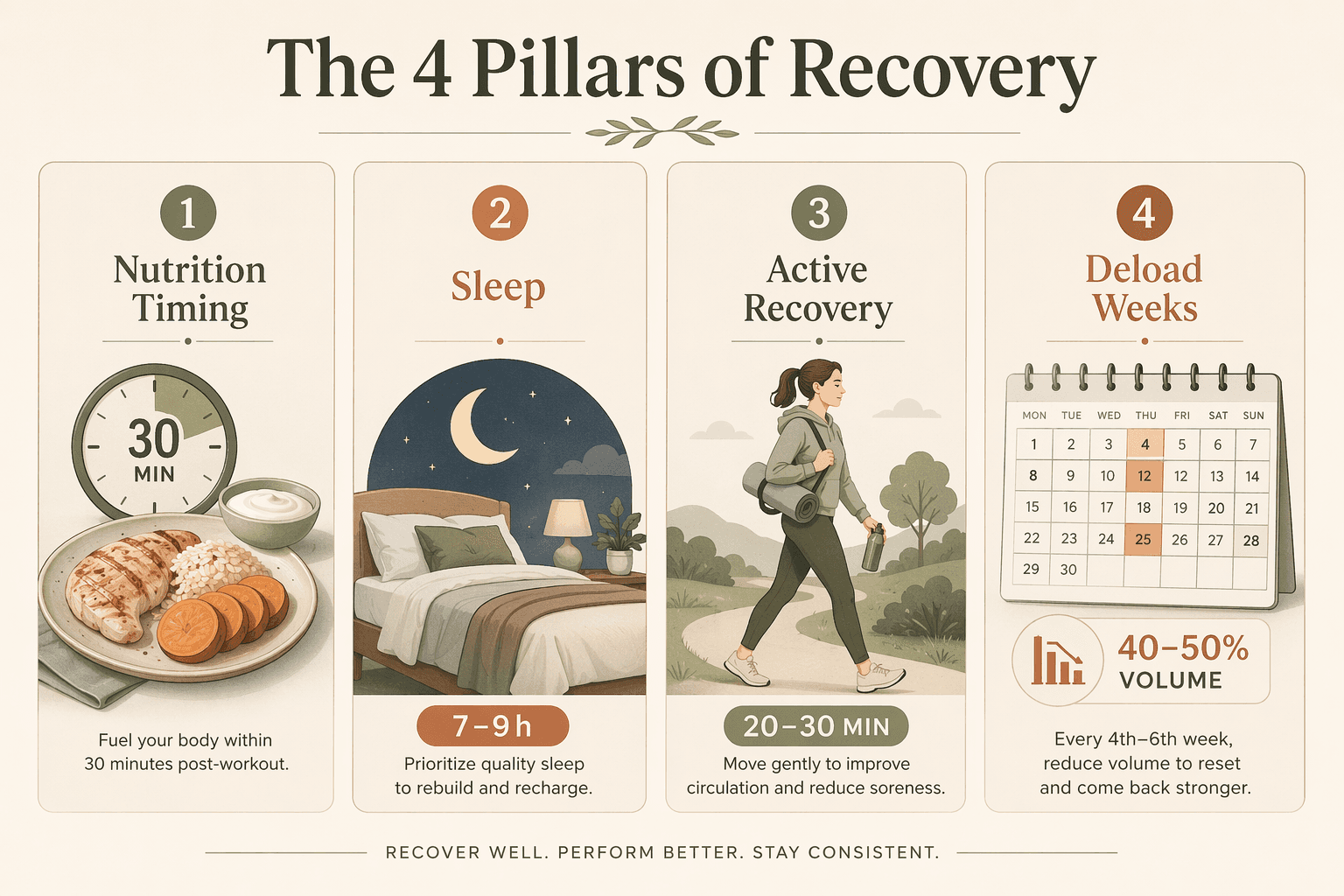
Nutrition timing (with a reality check)
The 30-minute post-workout window is the most cited piece of recovery advice. Eat protein and carbs within half an hour of finishing your last set. The evidence for a narrow anabolic window is mixed for non-professional athletes. What matters more is your total daily protein intake. If you’re getting enough protein spread across the day, missing the 30-minute mark by an hour won’t tank your gains. I’d add: if you already have your post-workout meal or shake ready, there’s no harm in timing it. But don’t treat the window as a hard deadline that makes or breaks your progress.
Sleep
More than one-third of U.S. adults get less than seven hours of sleep per night, according to the Sleep Foundation. That directly impairs muscle repair and hormone production. Seven to nine hours is the target. Consistency matters as much as duration—going to bed and waking up at roughly the same time stabilizes your circadian rhythm. No wearable needed to track that.
Active recovery
Twenty to thirty minutes of low-intensity activity on your rest days—walking, easy mobility drills, gentle yoga. The goal isn’t to burn calories or build anything. It’s to increase blood flow to muscles without adding fatigue. This is the pillar that most people skip because they think rest means sitting on the couch.
Deload weeks
Every four to six weeks, reduce training volume by 40 to 50 percent. Keep the intensity (weights should still feel heavy) but cut sets and reps. This gives your central nervous system a break while maintaining neuromuscular patterns. It’s not a week off—it’s a structured reduction that allows supercompensation. If you’ve never taken a deload, start with the 40 percent end of the range.
Don’t buy a foam roller and call it recovery. These four pillars are the system. Everything else is optional.
Your weekly recovery schedule: 3, 4, or 5 training days
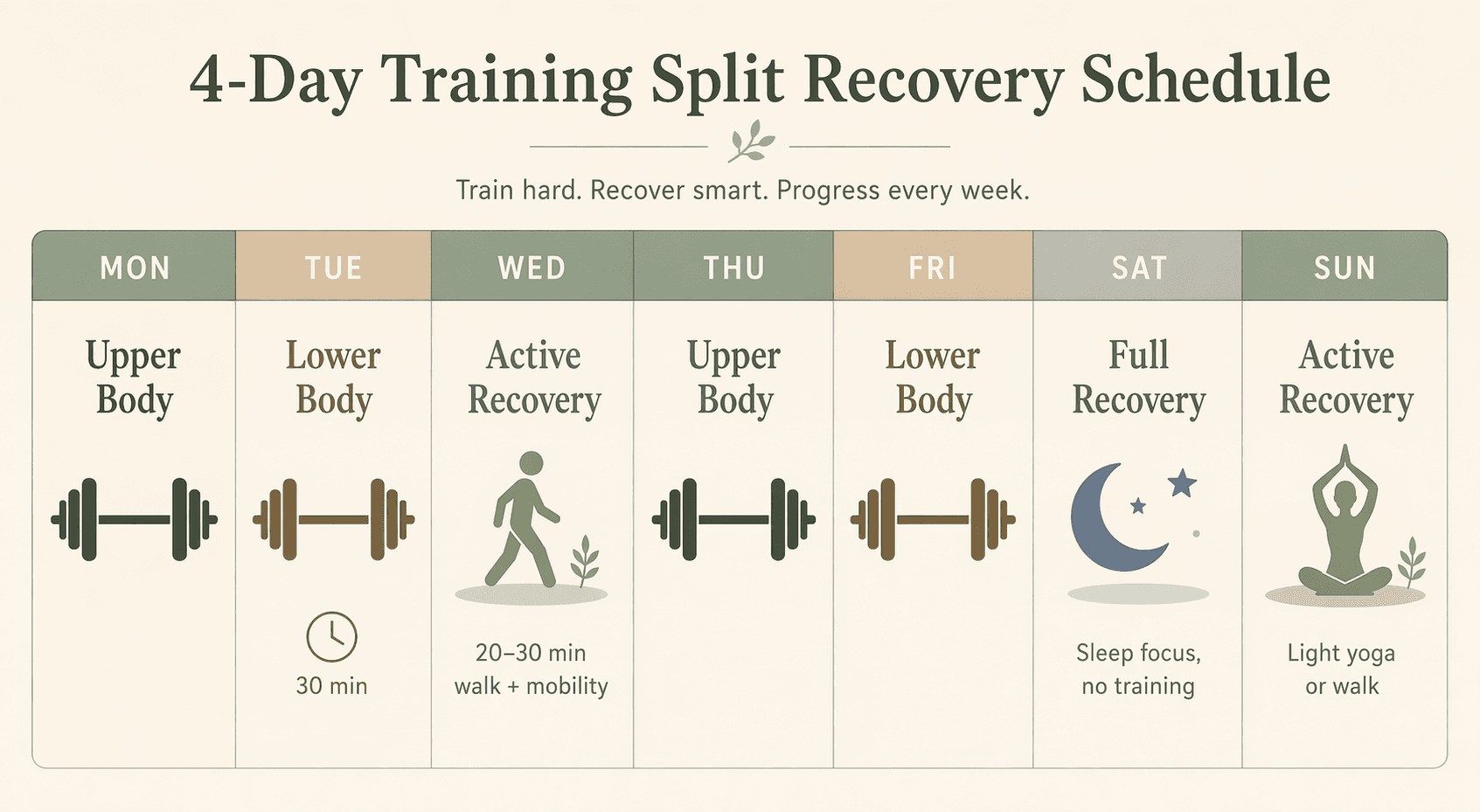
Here is where the article earns its keep. Below are three templates for common training frequencies. Each one shows your training days, your active recovery days, your full rest days, and when the deload falls. These are not aspirational—they are built from standard periodization principles and assume you have a job, a life, and limited time.
3-day split (Monday, Wednesday, Friday)
- Training days: Mon, Wed, Fri — full body or push/pull/legs rotation.
- Active recovery: Tue, Thu, Sat — 20–30 min walk, mobility, or light yoga.
- Full rest day: Sunday — no planned activity.
- Deload week: Every 5th week — reduce volume by 40–50%, keep intensity.
4-day split (Monday, Tuesday, Thursday, Friday)
- Training days: Mon (Upper), Tue (Lower), Thu (Upper), Fri (Lower) — or similar push/pull arrangement.
- Active recovery: Wednesday — 20–30 min walk or mobility. Saturday — 20–30 min easy hiking or cycling.
- Full rest day: Sunday.
- Deload week: Every 4th to 5th week — reduce volume by 40–50%.
5-day split (Monday through Friday)
- Training days: Mon–Fri — body part split or upper/lower with an extra accessory day.
- Active recovery: Saturday — 20–30 min walking or mobility. Sunday is full rest.
- Full rest day: Sunday.
- Deload week: Every 4th week. With five training days, cumulative fatigue builds faster, so deload more frequently.
Adjust the active recovery days based on how you feel. If Wednesday’s walk turns into a jog, you’ve left active recovery territory. Keep it easy.
How to spot under-recovery without a wearable
You don’t need an Oura ring or a Whoop strap to know you’re under-recovered. The signs are obvious if you stop ignoring them.
- Excessive soreness that doesn’t fade after 48 hours. If your legs still ache from Tuesday’s workout on Friday, something is off.
- Performance dip across multiple sessions. Your bench press weight feels heavier than it did two weeks ago, or your run pace drops noticeably. That’s not a bad day; that’s cumulative fatigue.
- Irritability or mood changes. When training stress spills into your non-training life, you’re not recovering well.
- Lack of motivation to train. If you dread sessions you used to look forward to, your central nervous system is asking for a break.
If you notice one or more of these, take an extra rest day or move up your deload by a week. The workout you skip today might save the progress of the next month.
What gear is worth it (and what isn’t)
After you’ve built the four-pillar system, you can consider tools. But tools without a system are just clutter.
The Theragun Prime ($300, 16mm amplitude) is a legitimate deep-tissue massage device. It can help reduce perceived soreness and improve mobility before a session. That’s a "nice to have" within a recovery system—not a requirement. Most home fitness buyers spend under $500 on a single piece of equipment (38.6% of U.S. buyers, per PTPioneer data). A massage gun at that price point is a luxury, not a necessity.
Foam rollers work fine for self-myofascial release. A $15 foam roller is as good as a $60 one for most people. Compression gear, contrast baths, and hyperbaric chambers are well beyond what an intermediate home gym enthusiast needs. Spend your money on a better training log or a set of adjustable dumbbells before you buy recovery gadgets.
The system costs nothing. The gear is optional. Prioritize sleep and active recovery before you spend a dollar.
The recovery audit: where to start this week
You don’t need a new training cycle to start. Do this now.
- Check your sleep. Are you averaging seven to nine hours? If not, pick one sleep hygiene change—no screens 30 minutes before bed, same bedtime every night—and commit to it for two weeks.
- Schedule your active recovery days for the coming week. Write them into your calendar like you would a training session. 20 minutes, easy pace, no excuses.
- Plan your next deload. Count weeks since your last reduction. If it’s been five or more, make next week a deload week.
- Scan the under-recovery signs above. If any apply, take an extra rest day tomorrow before you train again.
Start this week. Don’t wait for a new training block. The system is free, it’s concrete, and it will do more for your progress than the next set you were planning to add.


Comments
Join the discussion with an anonymous comment.