
Best Fitness Tracker for Recovery 2026: Accuracy Data You Can Trust
Most fitness tracker roundups rely on editorial opinion, not peer-reviewed data. This article examines Oura, Whoop, Garmin, and Apple Watch across HRV, sleep staging, and heart rate accuracy using independent studies—with funding sources flagged—so you can decide which device fits your recovery tracking needs.
Why the “best fitness tracker” lists you’ve read are worse than useless
You’ve seen the roundups. “Best fitness tracker for recovery” – five devices, a paragraph each, one winner. What those lists don’t tell you is which claims come from an industry-funded study and which from an independent lab. They treat accuracy as a single rankable attribute and ignore that no device wins every metric.
It matters. A 2026 Sahha survey found that 42% of purchase decisions are now influenced by validation or certification data, up from 18% in 2021. The fitness tracker market hit $70.3 billion this year. Yet most articles still rank devices based on editorial opinion, not peer-reviewed accuracy.
Here is the problem I keep seeing: no single device leads every accuracy metric, and study funding heavily influences reported rankings. If you want to buy a tracker for recovery – HRV, sleep staging, resting heart rate – you need to see the raw data, the sample sizes, and who paid for each study. That is what this article does.
The Dial et al. study: the closest thing to a gold standard we have
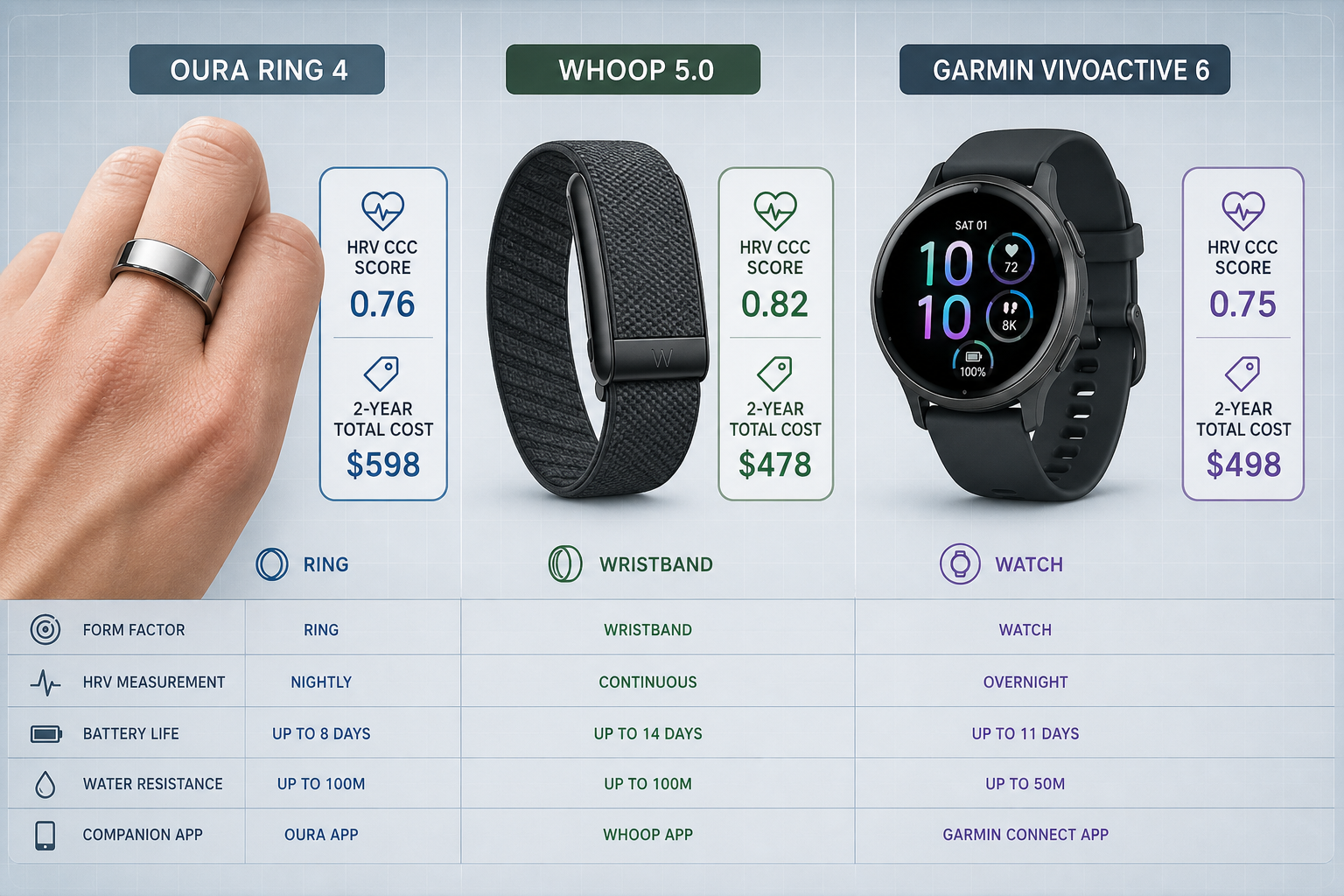
The strongest independent validation of nocturnal HRV and resting heart rate across consumer wearables comes from Dial et al. (2025), published in PMC. The study used 536 nights of data from 13 healthy adults, compared each device against a Polar H10 ECG chest strap, and was funded by the Air Force Research Laboratory – no industry money. That funding source alone makes this study stand out.
Before I give you the numbers, you need to understand two metrics they rely on. Concordance correlation coefficient (CCC) measures agreement with the reference – 1.0 is perfect, above 0.99 is “nearly perfect,” 0.95–0.99 is “substantial,” 0.90–0.95 is “moderate,” and below 0.90 is “poor.” Mean absolute percentage error (MAPE) tells you the average error as a percentage of the true value. Lower is better.
| Device | HRV (CCC) | HRV (MAPE) | RHR (CCC) | RHR (MAPE) |
|---|---|---|---|---|
| Oura Ring 4 | 0.99 | 5.96% ± 5.12% | 0.98 | 1.94% ± 2.51% |
| WHOOP 4.0 | 0.94 | 8.17% ± 10.49% | 0.91 | – |
| Garmin Fenix 6 | 0.87 | 10.52% ± 8.63% | 0.86 | – |
| Polar Grit X Pro | 0.82 | – | 0.86 | – |
Sleep staging: who wins depends on who paid for the study
If you read only Oura’s marketing materials, you would think Oura Ring is the undisputed sleep staging champion. And a study from Brigham and Women’s Hospital (2024) does show Oura Ring 3 with κ=0.65 – “substantial agreement” – ahead of Apple Watch (κ=0.60) and Fitbit (κ=0.55). That study was funded by Oura Ring Inc.
Now look at the independent University of Antwerp study (Schyvens et al., 2025), funded by VLAIO (Flanders Innovation & Entrepreneurship). There, Apple Watch 8 leads with κ=0.53, Oura is not included, WHOOP 4.0 scored highest deep sleep sensitivity (69.6%), and Garmin Vivosmart 4 scored lowest (κ=0.21). Different sponsor, different winner.
| Study | Sponsor | Best device | Second | Key metric |
|---|---|---|---|---|
| Brigham (2024) | Oura Ring Inc. | Oura Ring 3 (κ=0.65) | Apple Watch 8 (κ=0.60) | Four-stage sleep classification |
| Antwerp (2025) | VLAIO (independent) | Apple Watch 8 (κ=0.53) | WHOOP 4.0 (deep sleep 69.6%) | Sleep staging (κ), deep sleep sensitivity |
Active heart rate, steps, and VO₂ max: the rest of the picture
Recovery tracking does not end at sleep and HRV. If you train with a heart rate strap or care about step counts and VO₂ max, the leaders shift again.
According to aggregated peer-reviewed data (via Kygo.app), Apple Watch leads active heart rate accuracy at 86.31%, while Garmin trails at 67.73%. But that Garmin number reflects older optical sensors – newer Garmin models (Vivoactive 6, Forerunner 965) use the updated Elevate v5 sensor, and no independent validation of those sensors was available at the time of this research.
For step count, Garmin leads (82.58%), followed closely by Apple Watch (81.07%) and Fitbit (77.29%). For VO₂ max estimation, Garmin Forerunner 245 posts a MAPE of 5.7%, while Apple Watch 7 is at 15.79% – a wide gap.
The form factor also matters for recovery metrics: the finger has denser vasculature than the wrist, giving smart rings a structural advantage for overnight PPG signals. That is why Oura’s HRV numbers are so clean. For a deeper look at how each metric compares across devices, see our metric-by-metric accuracy deep dive. And for the full form-factor breakdown, read our guide to wrist vs. chest strap vs. armband vs. smart ring.
The caveats most roundups skip
At this point you might be tempted to pick a winner based on the table above. Do not. The evidence has holes – and I want you to see them before you decide.
- Skin tone bias: Nearly every validation study, including Dial et al., has a predominantly Caucasian participant pool. PPG sensor accuracy is known to be affected by skin pigmentation. This is a critical research gap that makes current accuracy claims unreliable for large portions of the population. No roundup mentions it.
- Tiny sample sizes: Dial et al. had only 13 adults. That is enough to show strong correlations, but not enough to guarantee the same results in a broader population. The confidence intervals are wider than most articles admit.
- Outdated hardware: The Garmin tested in the Dial study is a Fenix 6 – two generations old. If you buy a current Garmin (Fenix 8, Vivoactive 6, Forerunner 965), the HRV accuracy may be better or worse. We simply do not have independent data on the current generation.
- Subscription costs: Prices captured as of Q2 2026. WHOOP runs $600–960 over two years (hardware included in the subscription). Oura Ring 4 costs $493–643 (hardware $349–499 plus $5.99/month). Garmin is a one-time purchase of $400–1,000 – no subscription.
What actually matters for recovery: trend consistency, not point accuracy
After all those caveats, you might wonder whether any of this data is useful. It is – as long as you understand that day-to-day trends matter more than a single night’s absolute number.
A device that consistently underestimates your HRV by 5% every night still gives you a reliable trend line. You will see when your HRV drops from baseline after a hard workout or a poor night of sleep. That is the actionable signal – the direction and magnitude of change, not the raw value.
Most validated wearables need a roughly two-week baseline calibration before daily scores become interpretable for trend tracking. After that, you can use the readiness scores from Oura, WHOOP, or Garmin to guide training load and rest decisions. For a detailed look at how Oura handles this, see our deep dive into Oura's recovery tracking.
Your decision framework: match your priority to the device
Here is a concise summary of where each device stands based on the best available evidence. No single winner, but a clear match for specific priorities.
| Priority | Best device | Strength | Trade-off |
|---|---|---|---|
| HRV accuracy (nocturnal) | Oura Ring 4 | CCC 0.99, independent study | Small validation sample, subscription required |
| Sleep staging (independent data) | Apple Watch 8 | κ=0.53 in Antwerp study | Short battery life, iPhone only |
| Deep sleep detection | WHOOP 4.0 | 69.6% sensitivity in Antwerp study | Highest subscription cost ($600–960/2yr) |
| Step count & VO₂ max | Garmin Forerunner 245 (tested) | Step 82.6%, VO₂ max MAPE 5.7% | Older HR sensor tested; current gen unvalidated |
| No ongoing subscription | Garmin (various) | One-time purchase $400–1,000 | HRV accuracy data only for older models |
If you want the best form factor for overnight recovery tracking, smart rings are the fastest-growing category (32.5% CAGR) for a reason: they are more comfortable to sleep in and the finger-PPG signal is cleaner. For a head-to-head comparison of rings vs. wrist trackers for home gym use, read our guide on rings vs. wrist trackers.
The core judgment I want you to walk away with: trust the data, not the list. No single device is best for everything. Decide which recovery metric matters most to you – HRV trend, sleep staging, or cost – and pick the device that scores highest on that dimension in studies you can verify the funding source of. That is the closest thing to a real “best” we have.
This is general fitness education, not medical advice. For diagnosis or treatment of pain or injury, consult a qualified clinician.
Pick your next session
Browse all routines to find an appropriately-spaced next session.
Spot something off?
This content sits adjacent to health guidance — tell us if a citation or figure needs a correction.