
Ben Askren's Comeback Training After Lung Transplant
Ben Askren's remarkable recovery from a double lung transplant reveals a structured progression from walker-dependent to wrestling-ready. This article maps his phased training into a home-based plan you can adapt with minimal equipment.
Before you start
- Equipment required
- no equipment
- Assumes build tier
- No specific tier required
- Duration
- 10 minutes
- Difficulty
- beginner
The useful part of Ben Askren's comeback training after lung transplant is not that everyone should expect a seven-month climb from walker to wrestling mat. They should not. Askren was a former Olympic wrestler and UFC fighter, with decades of athletic skill already stored in his body, access to training partners, and doctors watching the process. The useful part is the order: first he became mobile, then he rebuilt control with bodyweight work and breathing, then he added light resistance, and only much later did he return to live wrestling.
That distinction matters because the headline version is almost too powerful. Askren was discharged on Sept. 1, 2025, after a 45-day hospital stay, needing a walker and weighing about 147 pounds after previously being around 197. By late March 2026, he had wrestled a six-minute live trial match; on July 18, 2026, he returned for a final wrestling match in Milwaukee.[1][2] Those dates make a clean comeback arc. They do not make a template.
For someone at home after surgery, serious illness, an extended hospital stay, or a transplant, the first question is not "What was Ben Askren's workout?" No published source gives his complete daily programming, exact sets, reps, rest intervals, or exercise menu. The better question is: what has to be true before the next kind of training becomes reasonable?
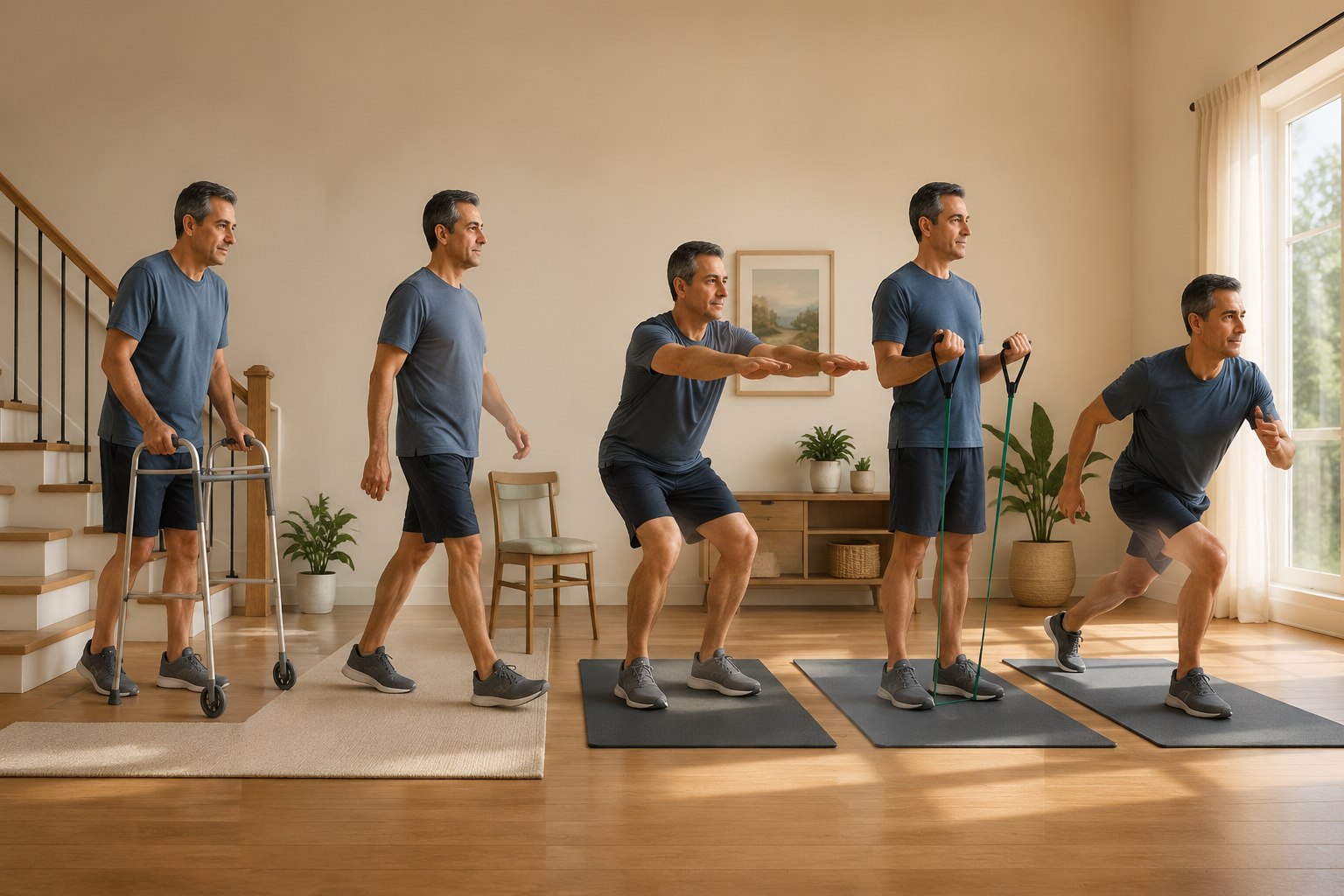
The Progression, Not the Pace
Askren described his physical capacity after the transplant as having gone "pretty much to zero," and later said he was training "pretty much every single day, in some way, shape, or form" to build himself back.[3] That sentence sounds motivational until you remember who is saying it. Daily training for a former elite wrestler can include tiny sessions, skill work, partner drilling, and supervised intensity that would be inappropriate for a deconditioned beginner.
The transferable structure is simpler and more conservative:
| Phase | Askren's documented marker | Home-training translation | Equipment priority |
|---|---|---|---|
| Phase 0: Hospital to home | Walker-dependent after discharge; short walking circuits at home | Turn safe ambulation into repeatable practice | $0: handrail, wall, chair, cleared walking space |
| Phase 1: Bodyweight and breath | Mat-based wrestling return with bodyweight only in the early months | Practice controlled floor, chair, and standing movements without external load | $0-$30: optional mat |
| Phase 2: Light resistance | Resistance bands used during later match preparation | Add gentle pulling, pushing, and posture work only after tolerance is consistent | $10-$30: light resistance bands |
| Phase 3: Specific return | Live wrestling only after he had already shown training capacity | Return to a personal sport, job task, or hobby under medical guidance | Depends on the activity |
If you are reading this from the starting edge of recovery, Phase 0 and Phase 1 deserve most of your attention. They are less dramatic than bands, weights, or sport drills. They are also where the body learns whether movement is safe enough to repeat tomorrow.
Phase 0: Training Before Workouts
The most instructive scene in Askren's recovery was not a wrestling exchange. It was a 100-foot circuit around a staircase landing at home. He described walking that loop for sets, using what the house already offered: a landing, a handrail, and a chair for rest.[3]
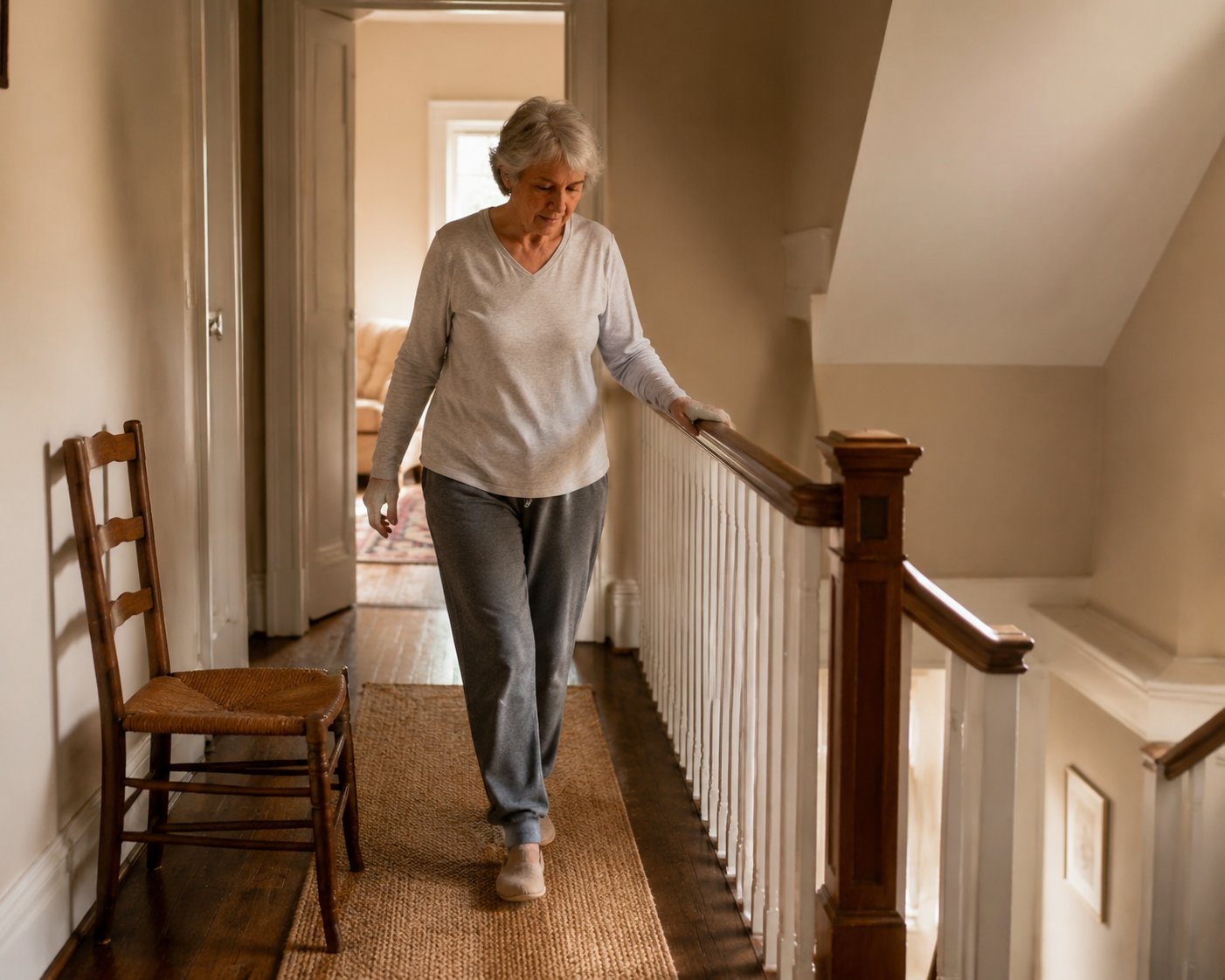
That is training before it looks like a workout. There is no performance language to hide behind. No calorie target. No complicated equipment. The task is to make a small, medically cleared movement repeatable: stand, walk a short distance, use stable support when needed, sit before form collapses, and do it again only if the body is still responding appropriately.
A home version does not need to copy the distance. It needs to copy the design. Choose a route where the floor is clear, the lighting is good, and support is available without reaching awkwardly. A hallway, kitchen loop, bedroom-to-doorway path, or landing can work. The chair is not a failure point; it is part of the plan. So is stopping early.
- Start only after the clinician who understands your surgery, transplant protocol, medications, or illness history has cleared this kind of movement.
- Keep the first route boring: flat surface, no pets underfoot, no loose rugs, no stairs unless your medical team has specifically cleared stairs.
- Place rest before you need it. A stable chair along the route changes the session from a test of willpower into a repeatable practice.
- Use support honestly. A handrail, countertop, walker, cane, or caregiver assist is not a downgrade if it keeps the movement safe.
- Track tolerance, not toughness: how you felt during the walk, how long recovery took, and whether symptoms changed later.
The decision point is not whether the route feels impressive. It is whether you can repeat it without the next day being hijacked by avoidable fatigue, dizziness, pain, breathlessness beyond your medical team's limits, or fear. For many people, structured walking is the first bridge between being discharged and being trainable.
Phase 1: Bodyweight, Breath, and the Return of Control
Askren's return to the wrestling room was not immediately a return to heavy training. Reports from November 2025 described him back in wrestling training just months after the transplant, and the later account of his early room work emphasized mat and bodyweight activity rather than external resistance for roughly the first two months.[4]
For a non-athlete at home, this phase is where walking turns into controlled movement. The body has to relearn positions: getting up and down, shifting weight, bracing gently, reaching, sitting, standing, and breathing while doing more than simply moving from one place to another. A yoga mat can make the floor more comfortable, but it is optional. A firm bed, stable chair, wall, or cleared carpeted area may be enough at the start if the movement has been cleared.
This is also where restraint is useful. Bodyweight does not mean easy. After hospitalization or major surgery, standing from a chair may be strength work. A wall push-up may be enough upper-body loading. A slow heel raise at the counter may challenge balance. A few minutes of gentle mobility can be more productive than a longer session that leaves the person guarded for the rest of the day.
| Capacity to rebuild | Home movement examples | What progress may look like |
|---|---|---|
| Standing tolerance | Supported standing, weight shifts, sit-to-stand practice from an appropriate surface | Less need to brace, smoother transitions, steadier breathing |
| Floor or mat confidence | Seated mobility, hands-and-knees positioning only if cleared, gentle rolling or positional changes | Less fear around changing levels |
| Upper-body control | Wall push-ups, table-supported reaching, gentle scapular movement | Better posture and easier daily tasks |
| Breath with movement | Slow walking, controlled arm movement, easy mobility paired with calm breathing | Movement no longer feels like a breath-holding event |
Breath work in this context should not be treated as a hack or a substitute for pulmonary rehabilitation. It is the practical skill of not panicking or bracing through every movement. If you have had a lung transplant, chest surgery, respiratory illness, or medication changes that affect heart rate, blood pressure, or breathing, your transplant team or clinician's instructions override any general fitness article.
The decision point for leaving this phase is consistency. Can you walk your short route on more than one day? Can you stand from a chair with control? Can you do a small menu of cleared movements without symptoms escalating? If the answer is still uncertain, bodyweight work is not a lesser phase. It is the phase that keeps the rebuild honest.
Phase 2: Bands Come Later Than People Want
Resistance bands entered Askren's story late, during the final preparation period before the July 18 match. The Milwaukee Journal Sentinel reported that, in the roughly 12 weeks before the match, he trained daily and used resistance bands to rebuild pushing and pulling strength without heavy compressive loading on a chest that had been surgically opened for transplant.[2]
That timing is the lesson. Bands are inexpensive and useful, but they are not magic starter equipment for a body that cannot yet tolerate walking and bodyweight control. They become appropriate when the person can already position the body safely, anchor the band without strain or fall risk, and stop well before a movement becomes a fight.
- Good early band uses are usually light: rows, gentle presses, pull-aparts, supported hip work, or posture drills approved by a clinician or therapist.
- The band should never force a surgical area, healing incision, joint, or balance system to solve a problem it is not ready for.
- The anchor matters as much as the exercise. A slipping door anchor or unstable furniture can turn a low-load movement into a fall risk.
- More resistance is not automatically better. In recovery training, the first win is tolerating repeatable movement without a setback.
Askren reportedly lost about 50 pounds during his 45-day hospital stay, moving from about 197 to 147 pounds, and later regained roughly 20 to 28 pounds through consistent training before entering the match range around 165 to 175 pounds.[5] Those numbers show the scale of his deconditioning and rebuild. They are not a body-composition target for anyone else.
Phase 3: The Least Transferable Part
Live wrestling is where Askren's story becomes least useful as a direct model. His doctor initially opposed the match and approved it only after Askren demonstrated that he was already training live in the room regularly.[3] That is a very different standard from wanting to feel normal again or missing a favorite activity.
For a home exerciser, the equivalent of sport-specific return may be gardening, carrying groceries, hiking, pickleball, kneeling to play with a child, returning to a physical job, or taking a longer walk outside. The specific task changes. The gatekeeping question stays the same: have the lower phases become stable enough that this next demand is a progression rather than a gamble?
Askren also said his chest incision had healed enough after about nine months that wrestling was no more dangerous to the surgical site than sitting at a dinner table.[2] That is a useful reminder of how long tissue healing and medical confidence can take. It is not a universal nine-month rule. Surgical approach, complications, medications, rejection risk, infection risk, bone health, and individual transplant protocols can all change the timeline.
How Much Training Is Enough?
Askren's daily training makes sense inside Askren's life. It should not become the expectation for a person rebuilding at home. A review discussing exercise around lung transplantation cites familiar public-health targets of 150 to 300 minutes per week of moderate aerobic activity and muscle-strengthening work two to three days per week, while the Lung Transplant Foundation notes exercise as part of pre- and post-transplant care and emphasizes following the transplant team's guidance.[6][7]
Those references are guardrails, not a prescription. Many people early in recovery will be below those ranges. Others may have formal pulmonary rehab, physical therapy, or transplant-center instructions that are more specific. The immediate goal is to find the lowest dose that can be repeated safely, then build only when the body has earned the next layer.
| If this is true | The next move is usually |
|---|---|
| You are not medically cleared for exercise | Do not start a fitness progression; ask your clinician what movement is allowed |
| Walking across a room is still uncertain | Stay with supported short-route walking and rest planning |
| Short walks are repeatable and symptoms are stable | Add gentle bodyweight control and mobility if cleared |
| Bodyweight movement feels controlled over time | Consider very light resistance bands with safe anchoring and professional input |
| Daily tasks are easier and specific goals are returning | Plan a gradual return to that task with your medical team or therapist |
What You Actually Need to Buy
At the beginning, possibly nothing. The first equipment list is a safe route, a stable support, a rest point, appropriate shoes or footwear guidance, and medical clearance. If that sounds too small, it is worth remembering that Askren's earliest documented home training was a walking circuit, not a garage gym.[3]
Later, a mat can make floor or seated work more comfortable. Resistance bands can add low-cost pulling and pushing options. Adjustable dumbbells, weighted vests, and heavy strength tools are not first purchases for this kind of comeback unless a clinician or therapist has already built that bridge with you.
- $0 phase: cleared walking space, handrail or wall support, stable chair, simple tracking notes.
- Optional mat phase: a comfortable surface for seated, kneeling, or floor-based work only if getting down and up is safe.
- Band phase: light resistance bands and a safe anchor after bodyweight control is reliable.
- Later equipment: only after your medical team, therapist, or coach can explain why the added load is appropriate now.
The hard part is not finding equipment. The hard part is respecting the phase you are actually in.
The Takeaway From Askren's Comeback
Askren's comeback is encouraging because it shows a devastated body being organized back into training: walker, home circuit, mat work, bands, live wrestling. It is risky only when the speed of the story is mistaken for the lesson of the story.
If your body feels like zero, your first program may be a cleared walk between two safe points. Your first purchase may be nothing. Your next tool may be a mat or a light band, but only when the earlier layer is steady enough to support it. Askren's volume, pace, and wrestling endpoint belong to him. The progression logic is the part worth taking home.
References
- Ben Askren to make miraculous return to combat sports year after near-fatal illness, double lung transplant, Yahoo Sports, link
- Ben Askren final wrestling match after lung transplant in Milwaukee Real American Freestyle, Milwaukee Journal Sentinel, July 18, 2026, link
- Ben Askren admits double lung transplant almost feels like a bad dream now that he's wrestling again just one year later, MMA Fighting, link
- Ben Askren returns to wrestling training just months after life-saving double lung transplant, Bloody Elbow, Nov. 7, 2025, link
- Ben Askren wrestling return RAF11 Belal Muhammad, The Athletic, June 1, 2026, link
- Exercise training in lung transplant candidates and recipients, Frontiers in Sports and Active Living, 2024, link
- Exercise Pre & Post Lung Transplant, Lung Transplant Foundation, link
Don't have the gear this routine assumes? Find the build that covers it.
Wondering how much rest you need after this? Read our ACSM-cited recovery reference.
Questions about form, substitutions, or a correction? Leave it below.
Comments
Join the discussion with an anonymous comment.