
Bogdan Guskov's Short Notice Training for Small Spaces
Bogdan Guskov's 14-day preparation for a UFC main event reveals a minimalist conditioning protocol that requires only a jump rope and 4 m² of floor space. This article adapts that approach into a space-efficient workout routine for home athletes with limited equipment and budget.
Before you start
- Equipment required
- jump rope
- Assumes build tier
- No specific tier required
- Duration
- 25 minutes
- Difficulty
- intermediate
Bogdan Guskov’s short-notice UFC training preparation starts with the part that matters most: he reportedly accepted a fight with Magomed Ankalaev in under 30 seconds, with 14 days to prepare for a July 25, 2026 main event that is still forthcoming as of July 20, 2026.[1] That is not a movie montage. That is a calendar problem.
Two weeks is not enough time to build a new fighter. It is barely enough time to sharpen the one already there. The useful question is not whether a home athlete can “train like Guskov,” because his exact daily camp is not publicly documented. The useful question is what survives when the camp gets cut down to the frame: conditioning, striking volume, explosive bodyweight work, and enough trunk stability to keep the rest from falling apart.
That stripped-down version is also the part that transfers cleanly to a small apartment. A jump rope costs about $10, takes almost no storage, and can sit next to a marked square of floor instead of pretending a spare bedroom is a performance center.[3][5] The often-cited 4 m² floor-space minimum belongs to 369MMAFIT’s home MMA conditioning model, not to Guskov’s personal camp, so it should be treated as a practical adaptation rather than a biographical claim.[5]
What a 14-Day Fight Camp Stops Trying to Do
A normal camp has room for layers: opponent-specific drills, heavier sparring blocks, strength cycles, technical adjustments, weight management, and recovery windows. A short-notice camp has to decide what can be improved quickly and what can only be maintained. Reporting on short-notice UFC fights points to the same hard tradeoffs: big weight cuts, poor sleep, compressed preparation, and less room for the normal rhythm of camp.[2]
The first thing that shrinks is game-plan specificity. You can still watch tape and build a few tactical reminders, but two weeks does not give a fighter endless rounds to rehearse every exchange. For a home athlete, that matters because it kills the fantasy of copying a secret plan. The transferable piece is not a hidden Ankalaev-specific drill. It is the way the training narrows when there is no time to waste.
Heavy sparring also becomes harder to justify. The closer the fight gets, the more a cut, concussion, tweaked knee, or swollen hand matters. The Athletic’s short-notice framework is useful here because it treats the problem as logistics and risk, not bravery theater.[2] If you have 14 days, the session that leaves you exhausted but intact beats the session that proves you are tough and then costs you three recovery days.
Maximal strength work belongs in the same pile. Heavy lifting can be valuable in a full training year, but the adaptation timeline is wrong for a two-week deadline. FightCamp’s fighter-style programming emphasizes repeatable conditioning, round structure, striking volume, and bodyweight work rather than pretending last-minute maximal strength is the main lever.[3] The closer the date gets, the more the gym starts looking less like a place to build new capacity and more like a place to express the capacity already there.
| Usually reduced in a 14-day camp | Usually kept because it transfers fast |
|---|---|
| New opponent-specific layers | Simple tactical reminders and repeatable striking rounds |
| Heavy sparring volume | Shadow boxing, pads, bag work, or low-impact striking volume |
| Maximal strength blocks | Explosive bodyweight circuits |
| Complicated equipment rotations | Jump rope, floor work, core training, timed rounds |
The Transferable Core: Rope, Rounds, Floor
The cleanest home version is built around three 5-minute rounds with 1-minute rests, because that mirrors UFC round pacing rather than generic interval-cardio formatting.[3] It does not make an apartment session equal to a professional fight camp. It does force the work to live inside the same clock: long enough to expose breathing problems, short enough to keep intensity honest, and structured enough that the rest periods do not turn into wandering around the room.
The jump rope earns its place because it solves several problems at once. It raises heart rate quickly, trains foot rhythm, gives the calves and ankles repeated low-amplitude contacts, and does not require a machine. FightCamp uses rope work inside fighter-style preparation, Verywell Fit’s Chris Camozzi MMA workout uses no-equipment conditioning logic, and 369MMAFIT treats rope work as a high-value home-conditioning tool.[3][4][5]
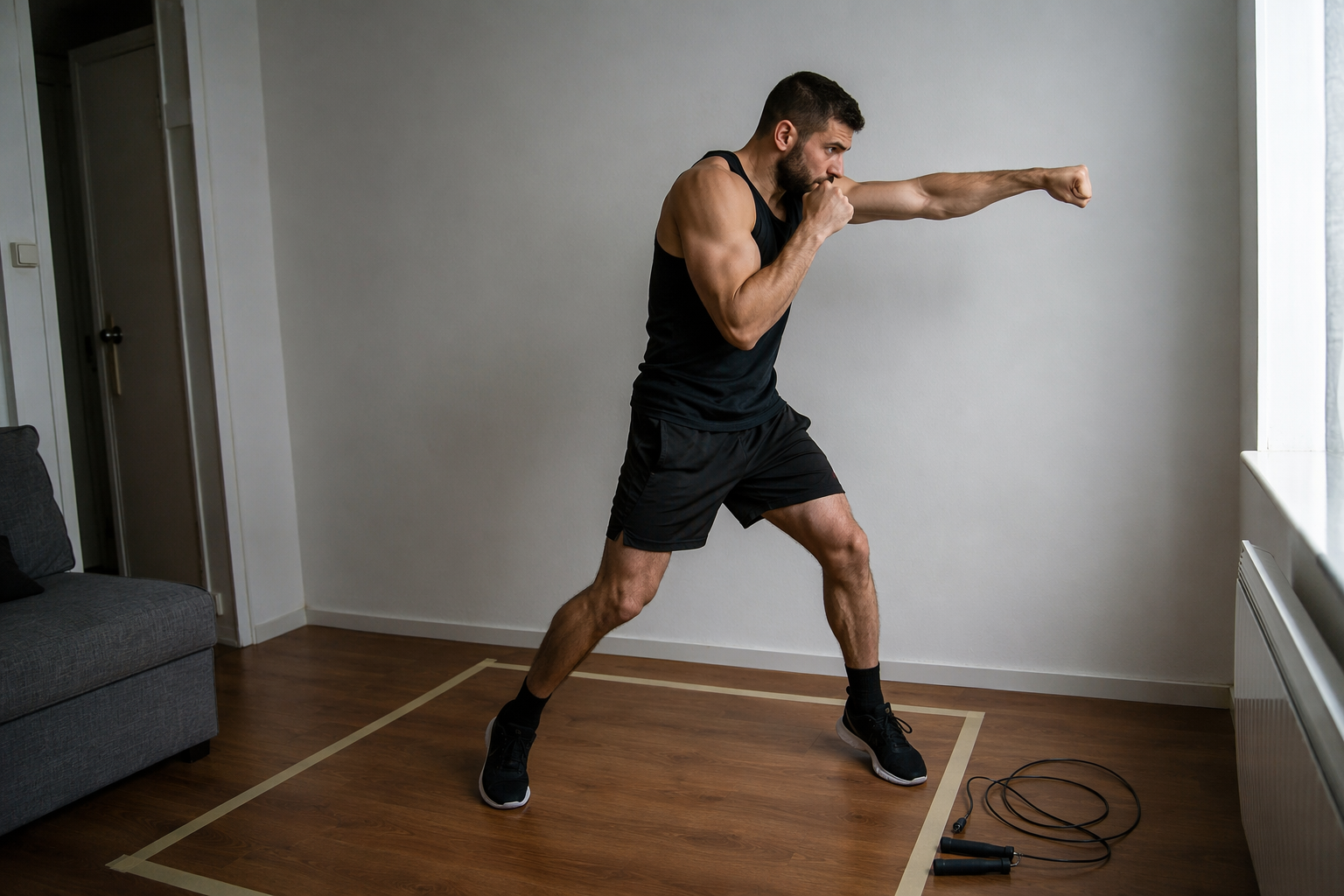
Shadow boxing is the other obvious survivor. It needs almost no space, but it punishes sloppy attention. A useful round is not flailing in front of a wall. It is stance, guard, jab return, hip turn, exit step, reset. If the room is truly small, tape a square on the floor and make the boundary part of the work. Step out of it by accident and you have learned something about your balance.
Bodyweight power circuits fill the gap left by heavy lifting. Burpees, squat jumps, mountain climbers, sprawls, and explosive push-ups can produce aerobic and anaerobic adaptations in non-elite athletes without equipment, according to the 369MMAFIT program’s evidence-based model, which cites conditioning research by Turner and Bogdanis.[5] Verywell Fit’s no-equipment MMA circuit from UFC veteran Chris Camozzi supports the same basic direction: simple movements, hard output, very little gear.[4]
A 4 m² Home Version That Does Not Pretend to Be Guskov’s Logbook
Here is the honest adaptation: this is not Guskov’s private daily schedule. It is a small-space protocol built from the publicly supported pieces of short-notice fight preparation and published MMA-style home conditioning. The floor-space claim comes from 369MMAFIT’s model, the round structure comes from FightCamp’s fighter-style pacing, and the movement choices line up with the no-equipment circuits described by Verywell Fit and 369MMAFIT.[3][4][5]
| Block | Time | Work |
|---|---|---|
| Warm-up | 5 minutes | Easy jump rope, joint circles, light shadow boxing |
| Round 1 | 5 minutes | Jump rope with short bursts every 30 to 60 seconds |
| Rest | 1 minute | Walk, breathe, keep hands high, do not sit |
| Round 2 | 5 minutes | Shadow boxing with footwork inside the marked square |
| Rest | 1 minute | Recover enough to keep movement clean |
| Round 3 | 5 minutes | Bodyweight circuit: sprawls, squat jumps, mountain climbers, explosive push-ups |
| Core finish | 3 to 6 minutes | Plank variations, hollow holds, dead bugs, slow mountain climbers |
The warm-up should feel boring. That is a compliment. Five minutes of easy rope and light shadow boxing is enough to check the floor, the ceiling, the rope length, and the joints before the hard work starts. In a cramped room, the warm-up is also a safety inspection. If the rope clips a lamp or your rear foot keeps catching a rug, fix that before you start chasing intensity.
Round 1 is rope conditioning. Keep most of it sustainable, then add short bursts. The mistake is turning the first minute into a calf-taxing sprint and spending the next four minutes tripping. If the rope is new, alternate regular bounce, boxer step, high knees, and brief fast turns. If the ceiling is too low or downstairs neighbors are a real constraint, use a ropeless rhythm drill and keep the same timing, but understand that the load will change.
Round 2 is shadow boxing. Work in combinations that return to stance: jab-cross, jab-cross-hook, jab to exit, cross-hook-reset. Add level changes, pivots, and defensive moves only if they stay controlled. A small room does not forgive theatrical footwork. It rewards clean steps, short exits, and knowing exactly where the wall is without staring at it.
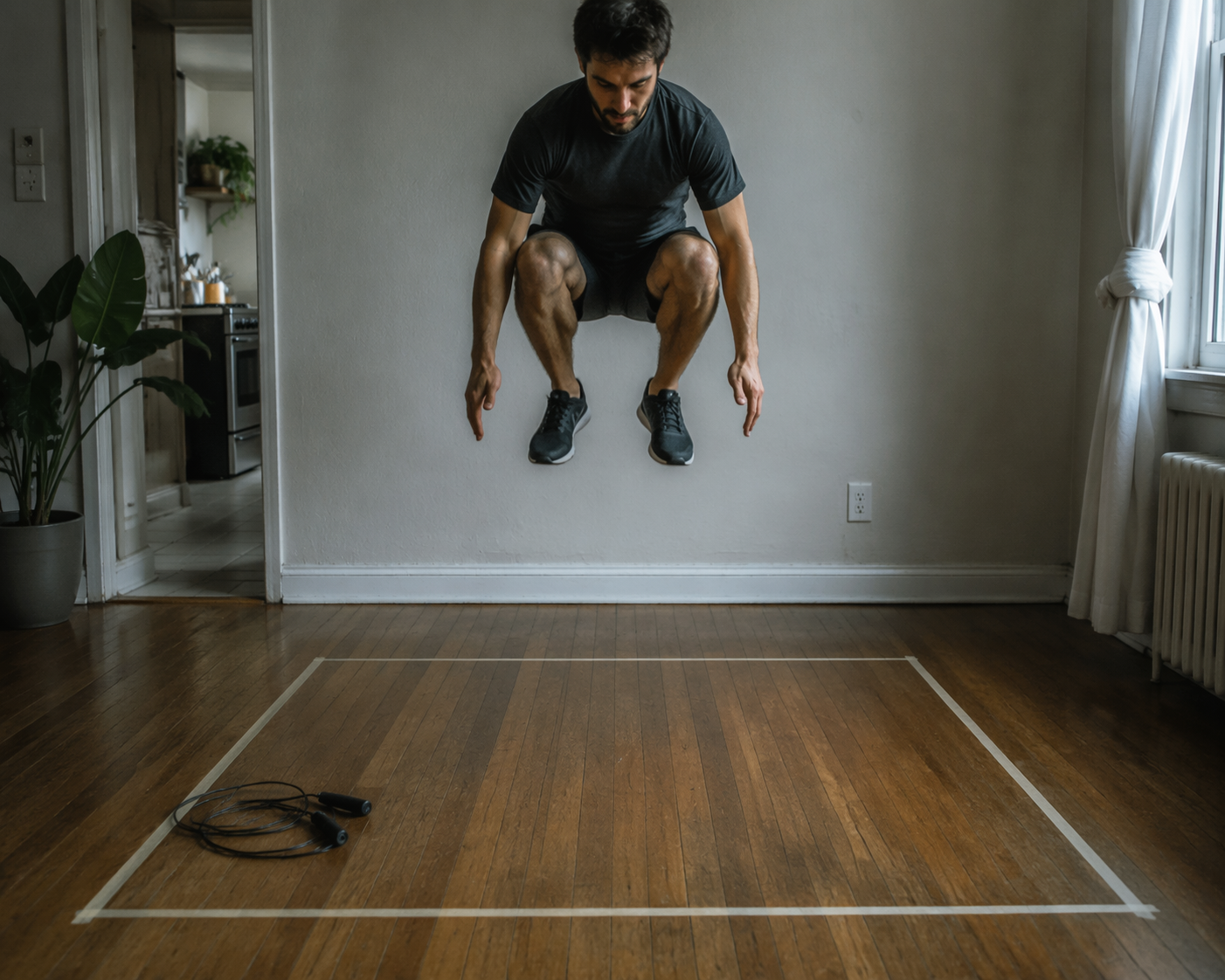
Round 3 is where the session gets ugly in the useful way. Rotate through sprawls, squat jumps, mountain climbers, and explosive push-ups. The exact order matters less than the standard: every rep should still look like something you meant to do. If sprawls are too loud or too hard on the wrists, step the feet back instead of jumping them. If explosive push-ups turn into neck-bobbing, switch to fast strict push-ups or incline push-ups against a stable surface.
The core finish is not decoration. Trunk stability is what lets the shoulders punch, the hips turn, and the feet recover without the whole body leaking force. Planks, hollow holds, dead bugs, and slow mountain climbers are enough. The goal is not to invent a brutal ab circuit. The goal is to leave the session with the center still organized.
Where Guskov Fits, and Where He Does Not
Guskov is not a random name pasted onto a home workout. His public background includes training at GOR MMA Moscow under Gor Azizyan, work connected with American Top Team and the UFC Performance Institute, Master of Sport titles in Boxing and MMA, and a brown belt in Brazilian jiu-jitsu.[7][8][9][10] That context matters because short-notice minimalism only works for a fighter who already has a base.
It also sets the boundary. A two-week camp for Guskov is not the same thing as a two-week beginner transformation. He is sharpening existing skills under a deadline. A home athlete is borrowing the structure: timed rounds, low equipment, repeatable conditioning, and bodyweight power. Those are useful. Claiming to reproduce his exact camp would be false precision.
Mike Swick’s bodyweight-only example is a good supporting case if it stays in its lane. UFC.com described Swick’s personal no-machine regimen as 5 sets of max-rep push-ups, 5 sets of max-rep chin-ups, and 2 sets of 100 bodyweight squats; the article also connected that approach with his 4% body fat and a Knockout of the Night bonus.[6] That is Swick’s philosophy and Swick’s case, not proof that every UFC fighter trains the same way or that every home athlete should chase those numbers.
How to Run It for Two Weeks Without Turning It Into Camp Fantasy
For 14 days, the simplest schedule is three hard sessions per week, two lighter technical sessions, and enough rest to keep joints and sleep from falling apart. The hard sessions use the full rope-round-circuit format. The lighter sessions keep the jump rope easy and spend more time on shadow boxing, mobility, and core control. If the legs are cooked, do not add more squat jumps to prove a point. Replace them with controlled squats, step-back sprawls, or extra shadow boxing.
- Use a marked square of floor so space stays honest.
- Keep the 3×5-minute structure even when the movements change.
- Stop a set when landings get loud, push-ups collapse, or footwork turns sloppy.
- Treat the jump rope as the only purchase; the rest should be bodyweight.
- Write down only what matters: rounds completed, rope trips, movement quality, and recovery.
The two-week frame changes the standard for success. You are not trying to become unrecognizable. You are trying to show up fitter, sharper, and less wasteful than you were at the start. That is the part of Bogdan Guskov’s short notice UFC training preparation worth carrying into a small room: not the illusion that an apartment workout can copy a professional camp, but the discipline to keep only what still works when time, space, and equipment all get tight.
References
- Bogdan Guskov says nobody wanted Magomed Ankalaev fight on short notice, Yahoo Sports
- Big weight cuts and no sleep: The challenge of taking short-notice UFC fights, The Athletic
- The Fight Camp | How To Train Like a Fighter, FightCamp
- Chris Camozzi's MMA Workout, Verywell Fit
- Evidence-Based MMA Home Conditioning Program, 369MMAFIT
- UFC Gym Training: No Machines, Just Muscle, UFC.com
- Bogdan Guskov Q&A, UFC.com
- Bogdan Guskov Fighter Profile, Sherdog
- Bogdan Guskov Fighter Profile, Fightomic
- Bogdan Guskov, Wikipedia
Don't have the gear this routine assumes? Find the build that covers it.
Wondering how much rest you need after this? Read our ACSM-cited recovery reference.
Questions about form, substitutions, or a correction? Leave it below.
Comments
Join the discussion with an anonymous comment.