
Build Bogdan Guskov's Finishing Ability at Home With Minimal Gear
Learn how Bogdan Guskov's 100% finish rate is built on three neuromuscular patterns you can train at home with minimal gear. This article breaks down the science behind his knockout power and gives you a structured approach using resistance bands and a jump rope.
Before you start
- Equipment required
- resistance bands, jump rope, light dumbbells, wall target
- Assumes build tier
- No specific tier required
- Duration
- 35 minutes
- Difficulty
- intermediate
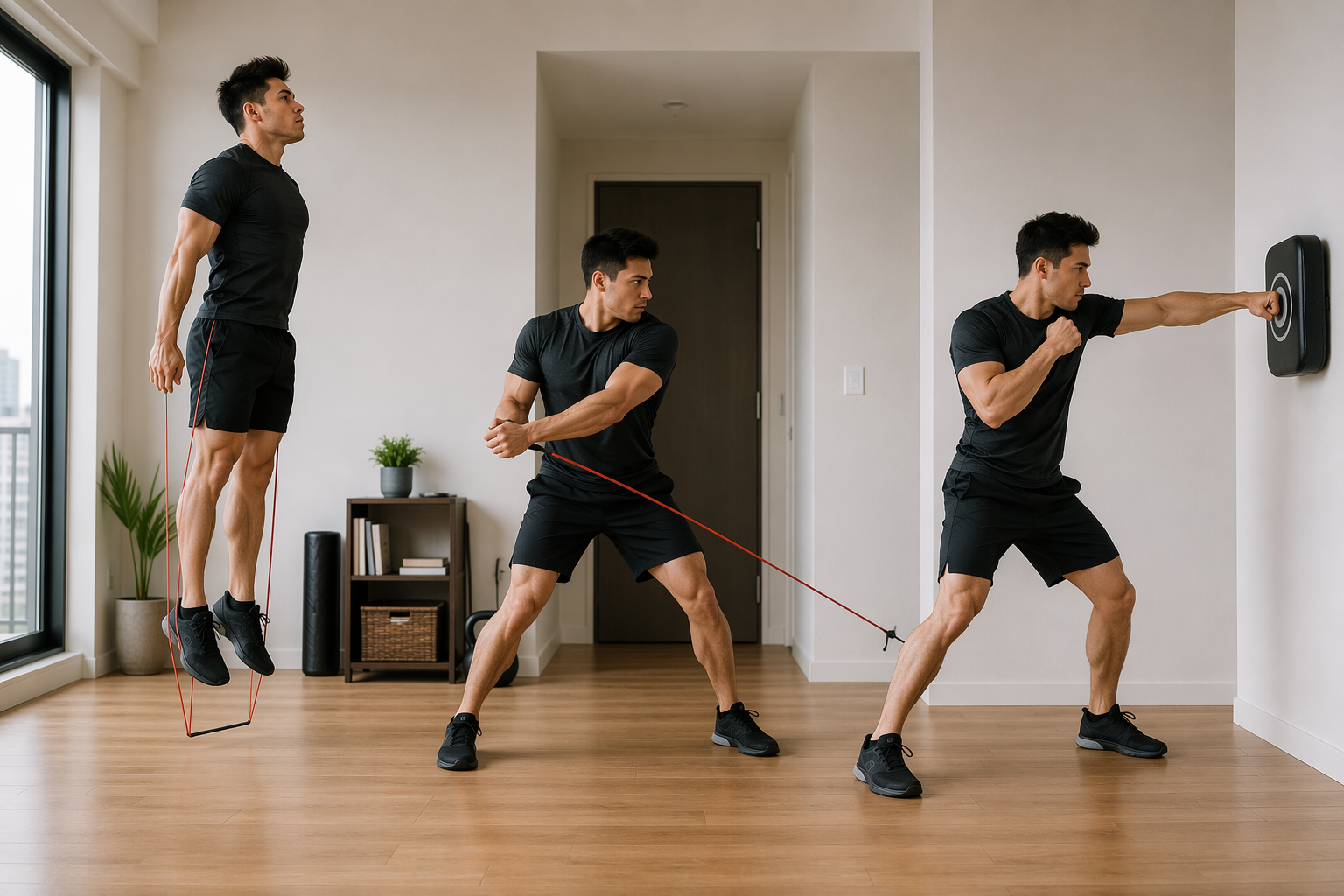
Start with the constraint, because it decides whether training around Bogdan Guskov's finishing ability is useful or just fight-poster decoration. The assumed setup here is a $100-300 apartment kit: resistance bands, a jump rope, light dumbbells, and either a small wall target or focus mitts if you have a partner. The floor footprint is about 5 x 5 ft. No heavy bag, no rack, no sled, no crash mat. If you are still building that base, the cleanest fit is the small apartment home gym budget phases approach, because it keeps the first buys compact instead of turning a living room into a half-finished garage gym.
That matters because Guskov is a terrible athlete to imitate literally and a useful athlete to study mechanically. You cannot copy his sparring rounds, his opponent reads, or the timing he has built through years of combat-sport training. What you can copy is narrower and more honest: the way finishing power depends on lower-body force, rotational transfer, and accurate punch placement when fatigue is rising.
Why Guskov Is Worth Studying Without Turning Him Into a Template
Guskov's pro record is unusually clean for this kind of analysis: 18 wins, 0 decisions, 15 knockouts, 3 submissions, 13 first-round finishes, and 7 wins under 87 seconds, with the UFC listing him as a 51% significant-striking accuracy fighter and noting two Performance of the Night bonuses.[1][2] Those numbers do not prove that a home routine creates UFC finishing ability. They do show why the right question is not simply, "How does he hit hard?" It is, "How does power arrive on target quickly enough to end exchanges?"
The distinction is important. An 83% knockout share across his wins is not just an aggression stat; paired with 51% significant-striking accuracy, it points toward placed force rather than volume for volume's sake.[1][2] A punch that misses is conditioning work. A punch that lands weakly is contact. A punch that lands with the hips, trunk, shoulder, and hand arriving in sequence is the thing apartment training can at least prepare.
His background also keeps the method grounded. Guskov is listed as a Master of Sport in Boxing and a K-1 silver medalist, which means his finishing profile sits on a striking base, not on a generic weight-room identity.[3] That does not make bands magical. It does make structured striking drills, force-transfer work, and repeatable mechanics more relevant than buying the biggest object you can squeeze next to a sofa.
As of July 20, 2026, his scheduled fight with Magomed Ankalaev on July 25 is still a pre-fight reference point, not evidence of anything that has happened. The useful material is his known finishing record and the training principles that can be separated from fight-night mythology.
The Three Patterns That Transfer Best to a Small Room
For a small apartment routine, Guskov's finishing ability translates into three trainable neuromuscular patterns. They are not his private camp program. They are the pieces of finishing power that can be trained without pretending your hallway is a fight gym.
| Pattern | What It Trains | Apartment Tools |
|---|---|---|
| Explosive hip extension and ground-force transfer | The lower-body push that starts a hard punch before the hand moves | Jump rope, squat jumps, band-resisted hip drive |
| Rotational conditioning under fatigue | The ability to keep transferring force through the trunk late in a round | Resistance bands, timed circuits, light dumbbells |
| High-volume striking precision | Landing power on a chosen target instead of just throwing fast | Shadow boxing, wall target, focus mitts |
The first two deserve the most work because they are where a home setup can replace size with intent. A heavy bag gives feedback, but it is not the source of power. The source is how force moves from the floor, through the hips and trunk, into a strike that still has shape when breathing gets ugly.
Pattern 1: Build the Punch From the Floor
Boxing Science reports that amateur boxers can generate about 2500 N of punch force, roughly 3.5 times body mass, and connects higher punch force with lower-body force production measured through jump performance.[4] That number comes from boxing contexts, not MMA finishing exchanges. Different gloves, stance choices, cage movement, clinch threats, and shot selection can all change the absolute force picture. The useful part for home training is the relationship: better lower-body force production supports harder punching.
In apartment terms, that means the jump rope is not just warm-up equipment. It teaches elastic foot contact, rhythm, ankle stiffness, and repeated low-level spring. It will not make someone punch like Guskov, but it prepares the lower leg and timing qualities that let a harder movement start cleanly instead of leaking into a flat-footed arm punch.
- Jump rope: 3-5 short rounds of relaxed bounce work, switching between regular bounce, boxer step, and brief high-knee bursts.
- Squat jump: low-volume sets focused on fast takeoff and quiet landing, stopping before the jump height drops.
- Split-stance pogo: small, quick contacts in fighting stance to train spring without needing space.
- Band-resisted hip drive: band behind the hips, step into stance, and drive the rear hip forward without overreaching the shoulder.
The band-resisted hip drive is the most directly useful movement in the set. Anchor a band behind you at hip height, step forward until there is tension, and settle into your stance. From there, practice driving the rear hip through as if beginning a cross or rear hook. The arm can stay folded at first. If the hip cannot move without the shoulder lunging, adding punches only hides the leak.
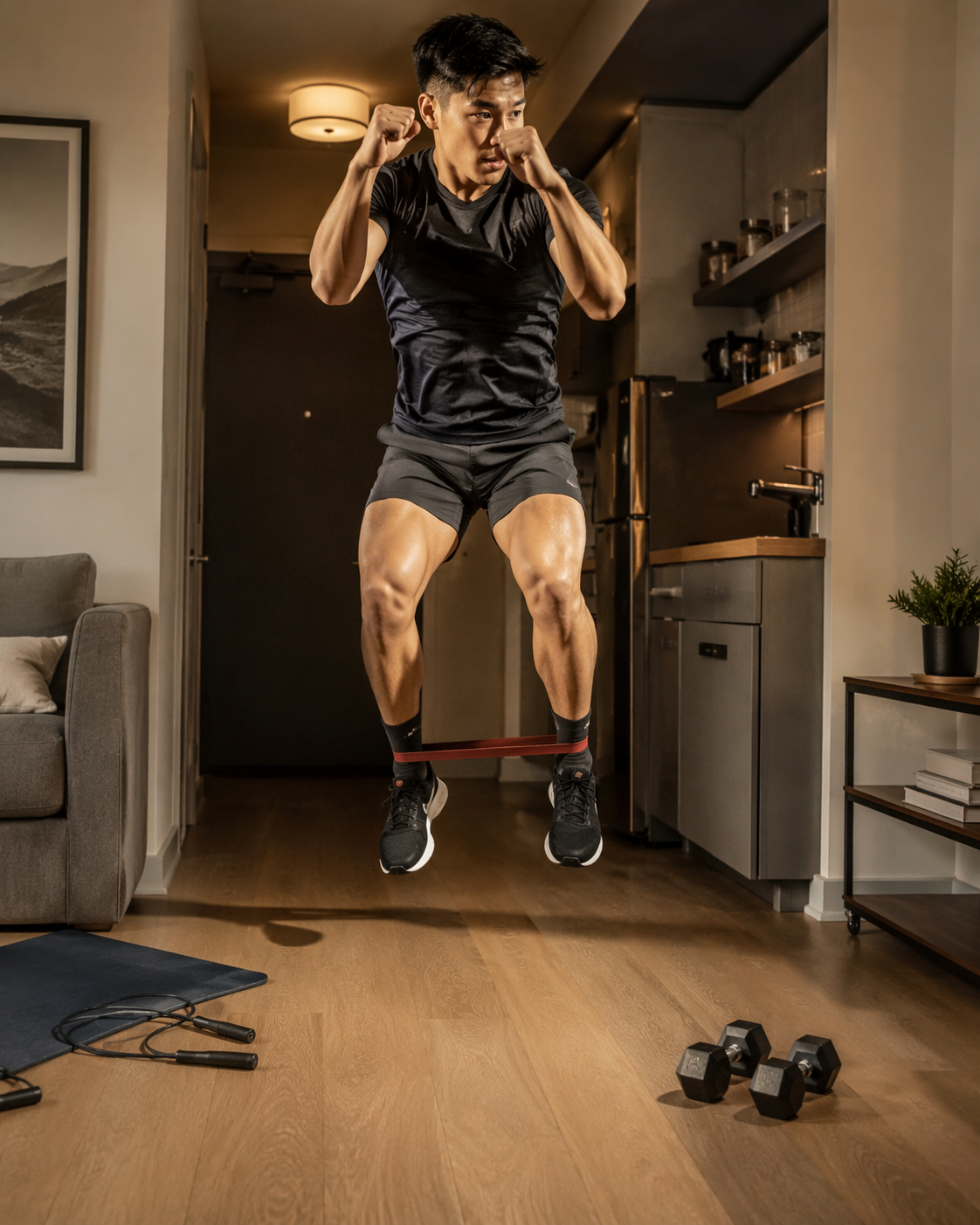
A compact lower-body power block can stay short: rope, jump, hip drive, rest. The goal is not to turn the session into a leg-burn challenge. For finishing power, the useful reps are the ones where the floor push is sharp enough to organize the rest of the body. Once every rep turns slow, you are training fatigue tolerance, not explosiveness.
A Small-Space Power Block
| Exercise | Work | Rest | Coaching Point |
|---|---|---|---|
| Jump rope | 45 seconds | 15 seconds | Stay light and rhythmic, not frantic |
| Squat jump | 5 controlled reps | 30-45 seconds | Stop if takeoff speed drops |
| Band hip drive | 6 reps per side | 30 seconds | Move the hip before the shoulder |
| Shadow cross from stance | 20 seconds | 40 seconds | Feel the same floor-to-hip sequence without the band |
Run that block for 3-4 rounds when power is the priority. If you live above someone, replace squat jumps with fast bodyweight calf raises or split-stance snap-downs. The principle is ground-force transfer, not annoying the building.
Pattern 2: Keep Rotation Alive When the Round Gets Messy
The next layer is rotation. Boxing Science's core pillar testing places rotational strength in the chain that links lower-body force to upper-body punch output.[4] That sounds obvious until fatigue shows up. Early in a round, almost anyone can rotate cleanly for a few shadow-boxing combinations. Late in a hard interval, the pattern often collapses into arm slaps, squared hips, and head movement that no longer connects to the feet.
This is where resistance bands earn their place in a $100-300 setup. They are not heavy enough to mimic a clinch or a wrestling exchange, but they can load the exact quality a finisher needs: rotating from the ground without letting the rib cage, pelvis, and shoulder separate into three unrelated movements.
- Low-to-high band rotation: anchor low, rotate from the rear foot and hip, and finish with the chest turned rather than the arm yanked across.
- High-to-low band rotation: train the chopping angle used in overhands, body shots, and level-changing strikes.
- Anti-rotation hold: press a band straight out from the chest and resist being pulled sideways.
- Rotational shadow boxing: throw short combinations while checking that the rear heel, hip, and shoulder still arrive in order.
Chris Camozzi's UFC veteran home MMA protocol, described by Verywell Fit, uses timed intervals and fight-style conditioning that can be done without a gym.[5] That is the useful validation here: you can structure home conditioning around rounds instead of treating home workouts like random exercise snacks. The round format creates a simple test. Can your rotation still look like rotation after two minutes, or has it become survival movement?
A practical round does not need much variety. In fact, too much variety makes it harder to see whether power transfer is holding up. One band, one stance, one timer, and one clear standard are enough.
| Minute | Work | Purpose |
|---|---|---|
| 0:00-1:00 | Band rotations, alternating sides every 5 reps | Load the trunk while the legs stay active |
| 1:00-2:00 | Shadow boxing at moderate pace | Transfer the same rotation into punches |
| 2:00-2:30 | Jump rope or fast stance bounce | Raise fatigue without needing space |
| 2:30-3:00 | Power shadow combinations | Check whether force still starts from the floor |
Rest one minute and repeat for 3-5 rounds depending on your current conditioning. The last 30 seconds are the honest part. If the hips stop turning, lower the pace. If the hands stay fast but the feet die, lower the pace. The point is not to win the timer; it is to keep the force pathway intact while breathing hard.
Light dumbbells can be used, but carefully. Holding 1-3 lb weights during long punching rounds often turns into shoulder endurance with sloppy mechanics. They are better used for short guard holds, controlled uppercut paths, or slow technical reps. Bands give clearer feedback for rotation because they pull you out of position when the trunk stops doing its job.
Pattern 3: Put the Power Somewhere
Precision is the part most home fighter workouts rush. They tell you to shadow box harder, add sprawls, and pretend the sweat proves transfer. Guskov's numbers argue for a narrower standard: if 83% of his wins are knockouts and his UFC significant-striking accuracy is listed at 51%, the interesting quality is not just power production. It is power placement.[1][2]
A wall target is enough to begin. It can be a commercial pad, a taped square, or a small soft target placed where your straight punches, hooks, and body-shot lines would naturally finish. Do not smash the wall. The target is for aim and distance calibration, not impact testing.
- Round 1: throw single shots at low pace, returning to guard after each rep.
- Round 2: throw two-punch combinations, changing level or angle after the second shot.
- Round 3: add a pace increase for 10 seconds at a time while keeping the target small.
- Round 4: combine one power shot with one reset step, so the punch does not pull you out of stance.
The wall target also exposes a common apartment-training lie. If your punch only feels powerful when it travels too far, crosses your feet, or leaves your chin in the air, it is not a finishing mechanic; it is a balance problem with a dramatic ending. A smaller target forces cleaner distance. Cleaner distance makes the hip and rotation work visible.
This is where related fighter routines can be useful without becoming clones. The Terence Crawford home workout is a better reference for rhythm and stance-switching, while the Crawford and Canelo 30-minute home workout gives a compact resistance-band striking format. For a no-equipment contrast, the PFL fighter workout at home keeps the conditioning side even simpler.
A Full Apartment Session Built Around the Three Patterns
The cleanest version is a 30-40 minute session. It should feel more like a technical power practice than a punishment circuit. If you finish with your shoulders smoked and no idea whether your hips were involved, the routine has drifted away from the point.
| Phase | Time | Work |
|---|---|---|
| Warm-up | 5-7 minutes | Jump rope, stance bounce, hip circles, shoulder mobility |
| Power transfer | 8-10 minutes | Squat jumps or quiet alternatives, band hip drives, short shadow crosses |
| Rotational conditioning | 10-15 minutes | 3-5 timed rounds of band rotations, shadow boxing, and stance bounce |
| Precision | 6-8 minutes | Wall-target singles, combinations, and short pace increases |
| Cooldown | 3-5 minutes | Easy footwork, nasal breathing, trunk and hip mobility |
Use the same session twice per week at first. Add a third day only if the jumps stay crisp and the shoulder joints feel normal the next morning. Combat-sport conditioning can seduce people into adding rounds before the mechanics are worth repeating. More tired reps are not automatically more fight-specific.
If noise is the limiting factor, keep the rope imaginary, swap jumps for fast calf raises or split-stance pulses, and use bands for most of the power work. If storage is the limiting factor, bands, a rope, and a flat wall target are still enough. A broader list of compact options is covered in the guide to home exercise equipment for small spaces, but this routine does not require much beyond the basics.
What This Does Not Reproduce
Guskov has described a general training day structure that includes a morning run, lunch training, and evening training, but publicly available material does not verify a detailed GOR MMA rep scheme that can be copied responsibly.[6] That should end the fantasy version of this premise. A home routine is not his camp. It is not sparring, cage wrestling, opponent preparation, or the decision-making that decides whether a finishing opening is real.
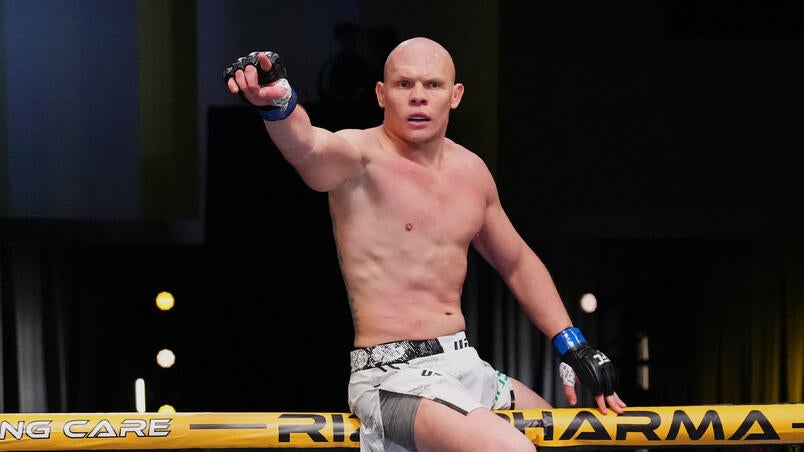
The home version can still be real if it stays inside its lane. It can train lower-body force production through jumps and spring work. It can train hip drive with bands. It can train rotation while fatigue rises. It can train accuracy against a small target at increasing pace.
That is the practical judgment: a 5 x 5 ft apartment setup cannot reproduce Bogdan Guskov's fight IQ, pressure, sparring environment, or camp workload. It can train the force-transfer, rotation, and accuracy patterns that make finishing power more than random explosiveness.
References
- Bogdan Guskov Fight Finder, Sherdog, https://www.sherdog.com/fighter/Bogdan-Guskov-240109
- Bogdan Guskov, UFC.com, https://www.ufc.com/athlete/bogdan-guskov
- Bogdan Guskov, Wikipedia, https://en.wikipedia.org/wiki/Bogdan_Guskov
- How to Punch Harder: Punch Force and Jump Height, Boxing Science, https://boxingscience.co.uk/how-to-punch-harder-punch-force-and-jump-height/
- A Home Boxing Workout You Can Do Without Equipment, Verywell Fit, https://www.verywellfit.com/a-home-boxing-workout-you-can-do-without-equipment-4161280
- Bogdan Guskov Q&A, UFC.com, https://www.ufc.com/news/bogdan-guskov-q-and-a
Don't have the gear this routine assumes? Find the build that covers it.
Wondering how much rest you need after this? Read our ACSM-cited recovery reference.
Questions about form, substitutions, or a correction? Leave it below.
Comments
Join the discussion with an anonymous comment.