
How to Improve Your Mile Time with Stair Climbing at Home
A structured stair workout plan that uses your building's stairs to lower your mile time — no treadmill, track, or equipment required. Backed by research and physical therapist guidance, the three-level plan shows how stair climbing can improve running performance from home.
Before you start
- Equipment required
- no equipment
- Assumes build tier
- No specific tier required
- Duration
- 15 minutes
- Difficulty
- Beginner to Advanced
One staircase is enough
If you can open your apartment door and get to one or two flights of stairs, you already have a workable way to train your mile without a treadmill, a track, or any gear purchase. The best claim here is not that stairs are magic; it is that they are a credible zero-cost substitute when running access is the limiting factor. That is a narrow claim, but the evidence is strong enough to support it: in a 1993 study of physically active college women, 75 minutes of stair climbing four days per week for nine weeks improved VO2max by 12% and cut 2414-meter run time by 8%.[1] A 2019 study in sedentary young adults found that brief stair bouts, done three times a day, three days a week for six weeks, improved cardiorespiratory fitness by 5%.[1]
| Level | What it looks like | Best use |
|---|---|---|
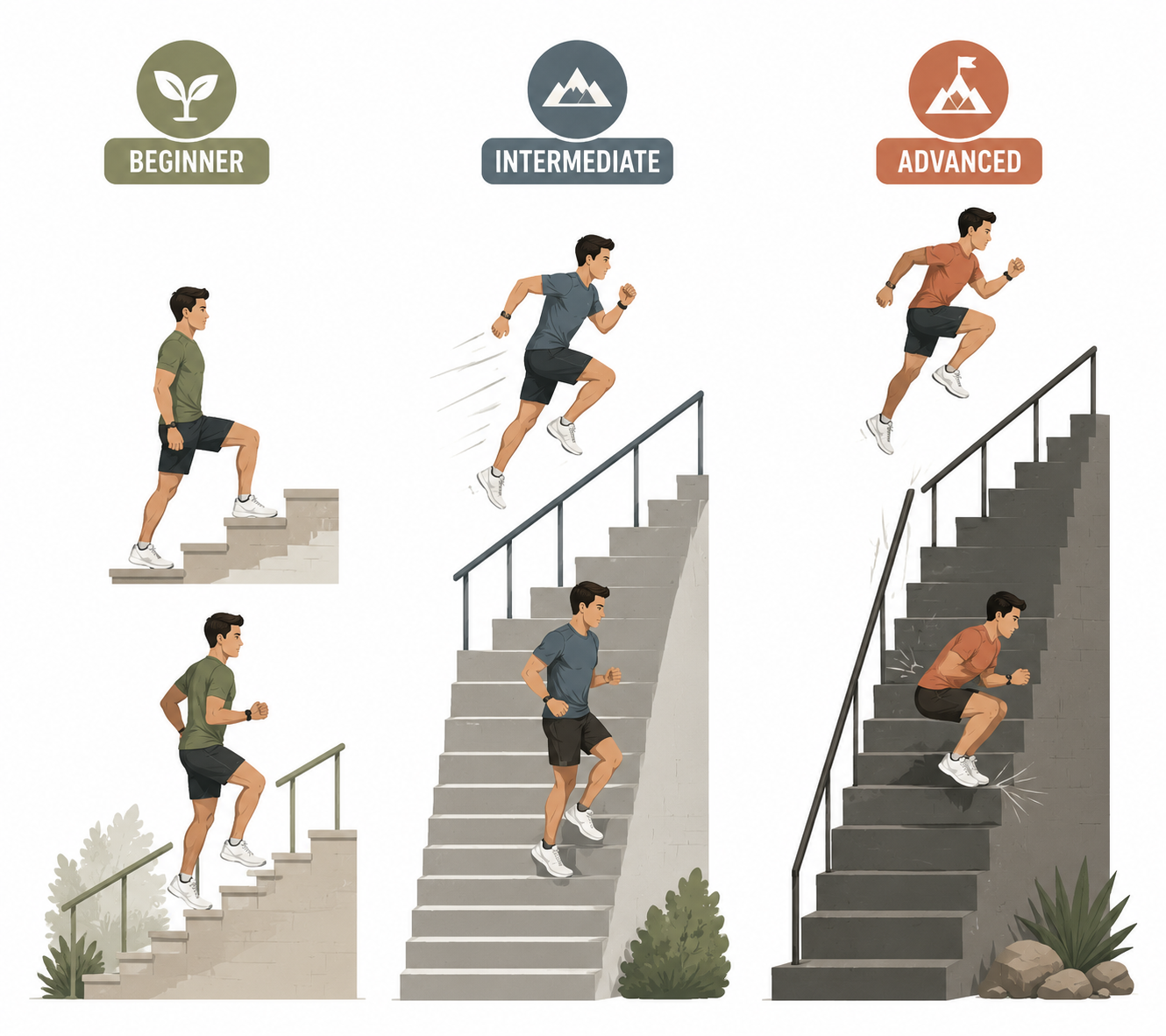
| Beginner | Warm up, then 2 rounds of 2 minutes of continuous stair running, 15 single-leg hops per leg, and 20 double-leg hops, followed by a cool-down. | Learning pace, foot placement, and breathing control. |
| Intermediate | 6 x 20-second hard stair runs with full jog-down recovery; add 4 x 100m strides if you have a safe flat stretch. | Building stronger repeat efforts without turning the session into a grind. |
| Advanced | Hard stair intervals paired with a short bodyweight plyometric finisher. | Adding more power only after the basic work feels repeatable. |
For most apartment runners, the sweet spot is not a huge workout. It is 2 to 3 stair sessions per week, often only 5 to 10 minutes of real work, done early in the session before fatigue changes your mechanics. Dr. Caitlin Glenn Sapp's guidance for stair work is practical: keep the dose modest, use breathing or heart rate to judge intensity, and stop before the reps get sloppy.[2]
Why stairs carry over to a faster mile
Stairs ask for the same things a mile race asks for, just in a steeper package: repeated leg drive, a controlled aerobic push, and enough hip stability to keep your stride from collapsing when you are tired. Runner's World notes that stair climbing recruits the quadriceps, hamstrings, glutes, and calves while reducing joint impact compared with running, and that it also works the gluteus medius, a hip stabilizer often tied to lower-body running problems.[1] That does not prove a stair-only program will beat a well-built running plan for every person, but it does explain why the transfer is plausible instead of wishful.
Keep the mechanics clean
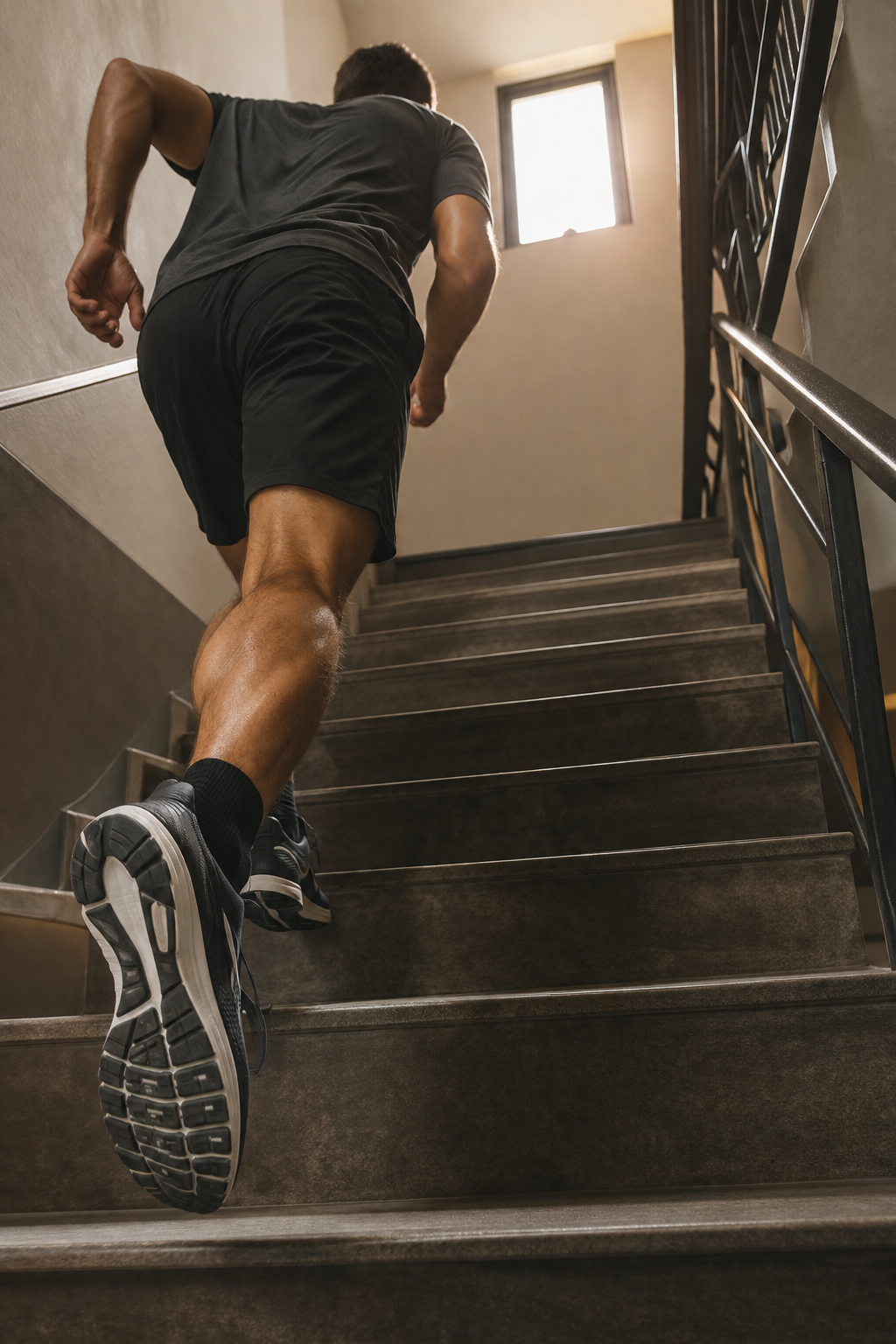
Use the stairs like training, not like a dare. Stay tall, lean slightly from the ankles, and keep the foot strike quiet and controlled. Drive the arms without twisting the torso. On the way down, recover enough to repeat the next effort with the same shape. If your knees cave inward, your steps get loud, or your breathing is so far gone that the next rep is just survival, the session has already gone past useful.
A simple weekly rhythm
A clean week usually looks boring on purpose: two stair sessions, one day between them when possible, and one or two lighter strength or recovery days around them. If you already run elsewhere, let the stairs be the harder work and keep the other sessions easy enough that you can actually repeat this for several weeks. Progress by changing only one thing at a time: add a round, make the hard parts a little sharper, or move from the beginner version to the intermediate one. That is how a home workout can support a faster mile without pretending that soreness is the same thing as fitness.
References
- Benefits of the Stair Climbing for Runners — Runner's World
- The Dos And Don'ts Of Stair Workouts For Runners — Polar
Don't have the gear this routine assumes? Find the build that covers it.
Wondering how much rest you need after this? Read our ACSM-cited recovery reference.
Questions about form, substitutions, or a correction? Leave it below.
Comments
Join the discussion with an anonymous comment.