
Match Tour de France Stage Profiles to Home Cycling Workouts
Learn how to turn every type of Tour de France stage — flat, hilly, mountain, individual time trial, team time trial — into a home cycling workout under 45 minutes. Each workout maps the real stage's demands to specific intervals, cadence, and resistance you can do on your bike or smart trainer.
Before you start
- Equipment required
- Stationary bike, spin bike, or smart trainer
- Assumes build tier
- No specific tier required
- Duration
- 30 minutes
- Difficulty
- Intermediate
Rest day 2 is a useful moment to stop watching the Tour only as scenery. The race has already asked for sprint timing, rolling tempo, climbing torque, and pacing discipline; the final week will ask for more of the same. For a home rider, the practical move is simple: find the stage type, copy the matching effort pattern, and finish before the towel on the bars is soaked through.
Using the official 2026 Tour de France route as the reference point, this race is built from 7 flat stages, 4 hilly stages, 8 mountain stages, 1 team time trial, and 1 individual time trial, across 3,320.7 km and 54,450 m of vertical gain.[1] Those figures matter because they keep the workouts anchored to the race rather than to vague “Tour-inspired” cardio.
One caveat belongs up front: stage labels are a framework, not physics. Some stages sit on the border between categories, and published classifications do not always agree; Stage 4, for example, is labeled hilly by letour.fr and mountainous by Cyclingnews. The safest approach for home training is to use the official ASO breakdown for the big map, then look at the actual profile before choosing the workout.
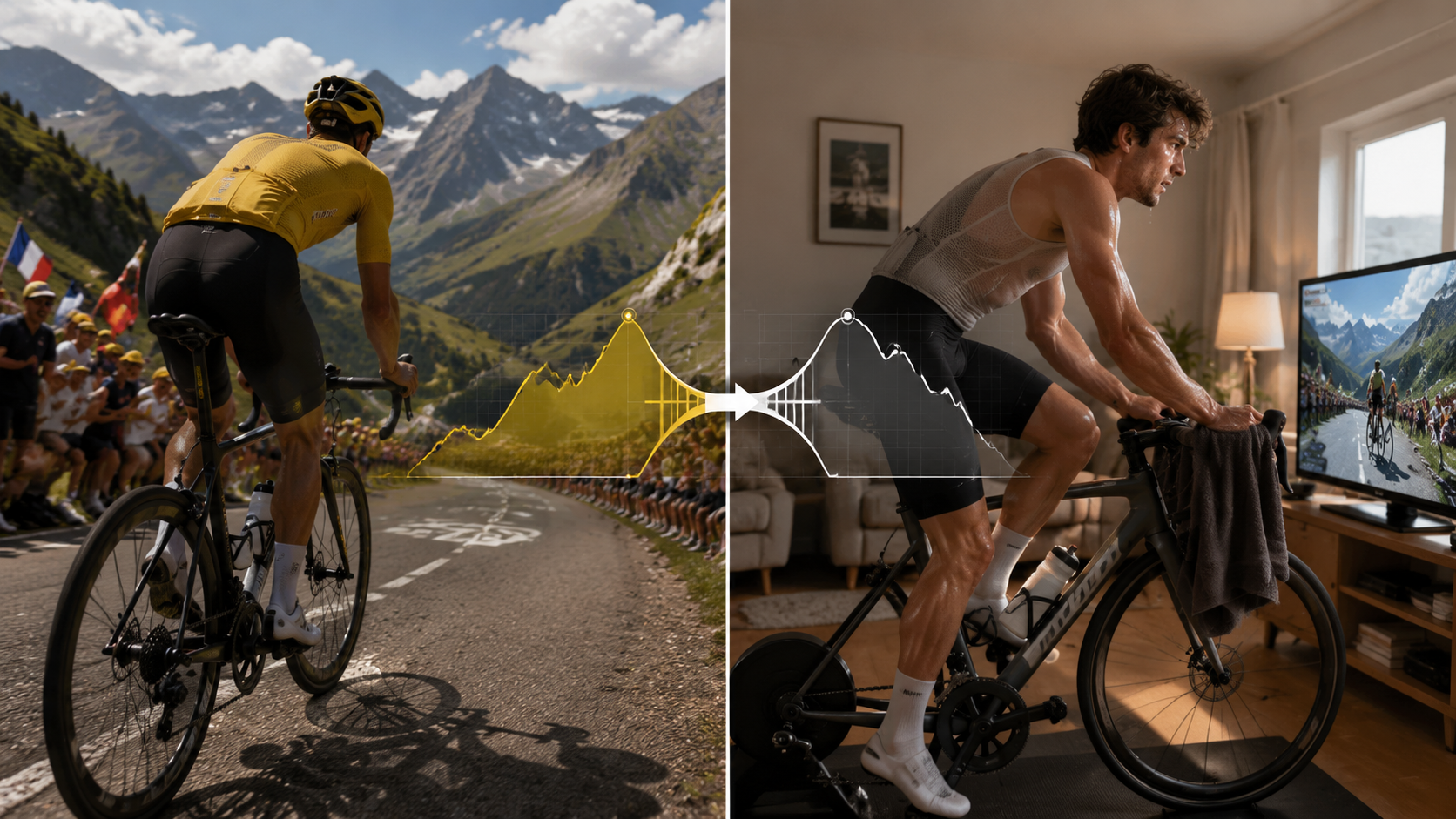
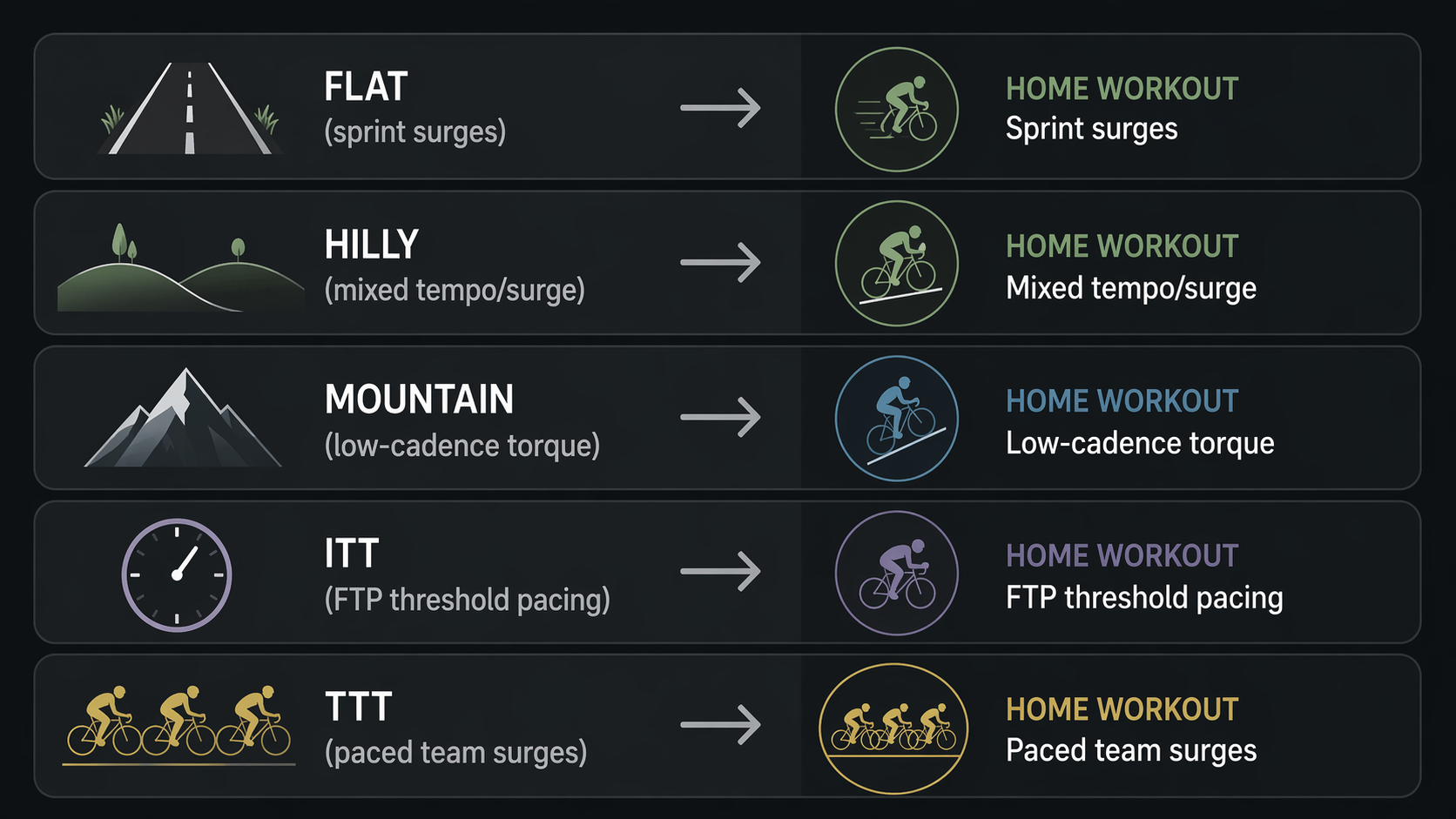
Match the stage profile to the workout
This is the quick chooser. If you are watching highlights, use the stage label. If you are watching live and the road profile looks different from the label, trust the terrain: flat run-in, rolling climbs, summit finish, solo time trial, or team pacing.
| Tour stage type | Race demand | Home workout | Duration | Cadence target | Resistance / RPE | Equipment fit |
|---|---|---|---|---|---|---|
| Flat | Lead-out control, sprint surges, high-cadence finishing speed | Progressive sprint intervals | About 20 min | 95-110+ rpm on surges | RPE 8-10 on surges, easy between | Works on basic bike, spin bike, or smart trainer |
| Hilly | Repeated tempo pressure with short punchy climbs | Mixed tempo and surge ride | About 30 min | 80-95 rpm tempo, 90-105 rpm surges | RPE 6-8 with brief spikes | Works on any bike with adjustable resistance |
| Mountain | Long climbing load, low-cadence torque, limited recovery | Low-cadence climbing repeats | About 35 min | 50-60 rpm on climbs | RPE 7-9, heavy but controlled | Best on smart trainer or sturdy spin bike |
| Individual time trial | Steady threshold pacing without hiding in a group | FTP-style threshold block | About 25 min | 85-100 rpm | RPE 7-8, hard but even | Smart trainer helps; basic bike works by feel |
| Team time trial | Smooth group speed, short pulls, controlled surges | Rotating-pull surge intervals | About 30 min | 90-105 rpm | RPE 6-8, never all-out early | Works on any bike; smart trainer adds precision |
Flat stage: sprint surges without pretending the whole ride is easy
A flat Tour stage can look relaxed for long stretches because the peloton is rationing effort before the final fight. That does not make it an easy template. The home version should not be a sleepy spin; it should feel like waiting, positioning, then launching.
Stage 5, Lannemezan to Pau, is a clean 2026 anchor for this workout: a 158 km flat stage in the stage-profile data.[2] At home, the useful translation is not the distance. It is the repeated jump from controlled pedaling into high-cadence force, then the discipline to recover without stopping.
20-minute flat-stage workout
- Warm up 5 minutes at 85-95 rpm, RPE 3-4.
- Ride 3 minutes at 95-100 rpm, RPE 6, as the “lead-out” effort.
- Sprint 30 seconds at 105-115 rpm, RPE 9-10.
- Recover 2 minutes very easy at 80-90 rpm after the first two sprints.
- Complete the 3-minute lead-out plus 30-second sprint three times total.
- Cool down 3 minutes, letting cadence fall naturally.
The interval logic here lines up with indoor Tour-style sprint sessions that use controlled riding before short, hard accelerations.[3] On a basic resistance bike, set the lead-out at a resistance you can hold without rocking your hips, then add one or two turns for the sprint. On a smart trainer, use resistance or slope mode rather than ERG if ERG makes the sprint feel delayed.
Apartment note: this is the noisiest workout in the set because high cadence exposes drivetrain noise and floor vibration. Put the bike on a dense mat, sprint seated if the floor is thin, and avoid stomping out of the saddle unless you know your setup is stable.
Hilly stage: tempo that keeps getting interrupted
A hilly stage is where a home rider can stop thinking in neat zones for a few minutes. The road does not stay flat long enough for pure sprint work, and it does not climb long enough to become a mountain grind. The useful feeling is unsettled tempo: a firm pace, a short rise, a partial recovery, then another rise before you feel completely ready.
30-minute hilly-stage workout
- Warm up 6 minutes, building from RPE 3 to RPE 5.
- Ride 4 minutes at 80-90 rpm, RPE 6-7.
- Surge 45 seconds at 95-105 rpm, RPE 8.
- Recover 75 seconds easy, but keep pedaling.
- Repeat that 4-minute tempo, 45-second surge, 75-second recovery block three times.
- Cool down 4 minutes.
This one works well on nearly any exercise bike because the resistance changes are moderate. You do not need exact watts; you need a repeatable tempo setting and a surge setting you can reach quickly. If your bike has a heavy flywheel and manual knob, make the surge by adding cadence first, then resistance. If your bike responds instantly, add resistance before the surge so the acceleration has something to push against.
Space note: this is the best compromise session for a small apartment. It is structured enough to feel like training, but it does not require violent sprinting or long out-of-saddle climbing.
Mountain stage: low-cadence torque, not living-room heroics
Mountain stages tempt people into overdoing the drama: standing, swaying, burying themselves for half an hour. The better home translation is quieter and harder to fake. Heavy resistance, low cadence, steady hips, and no bouncing on the saddle.
Stage 15 gives the obvious 2026 climbing anchor, with the Plateau de Solaison summit finish and an 11 km climb at 9% in the stage-profile data.[2] A home bike cannot recreate the mountain air or the road pitch under the wheels, but it can reproduce the muscular demand of turning a heavy gear at a controlled cadence.
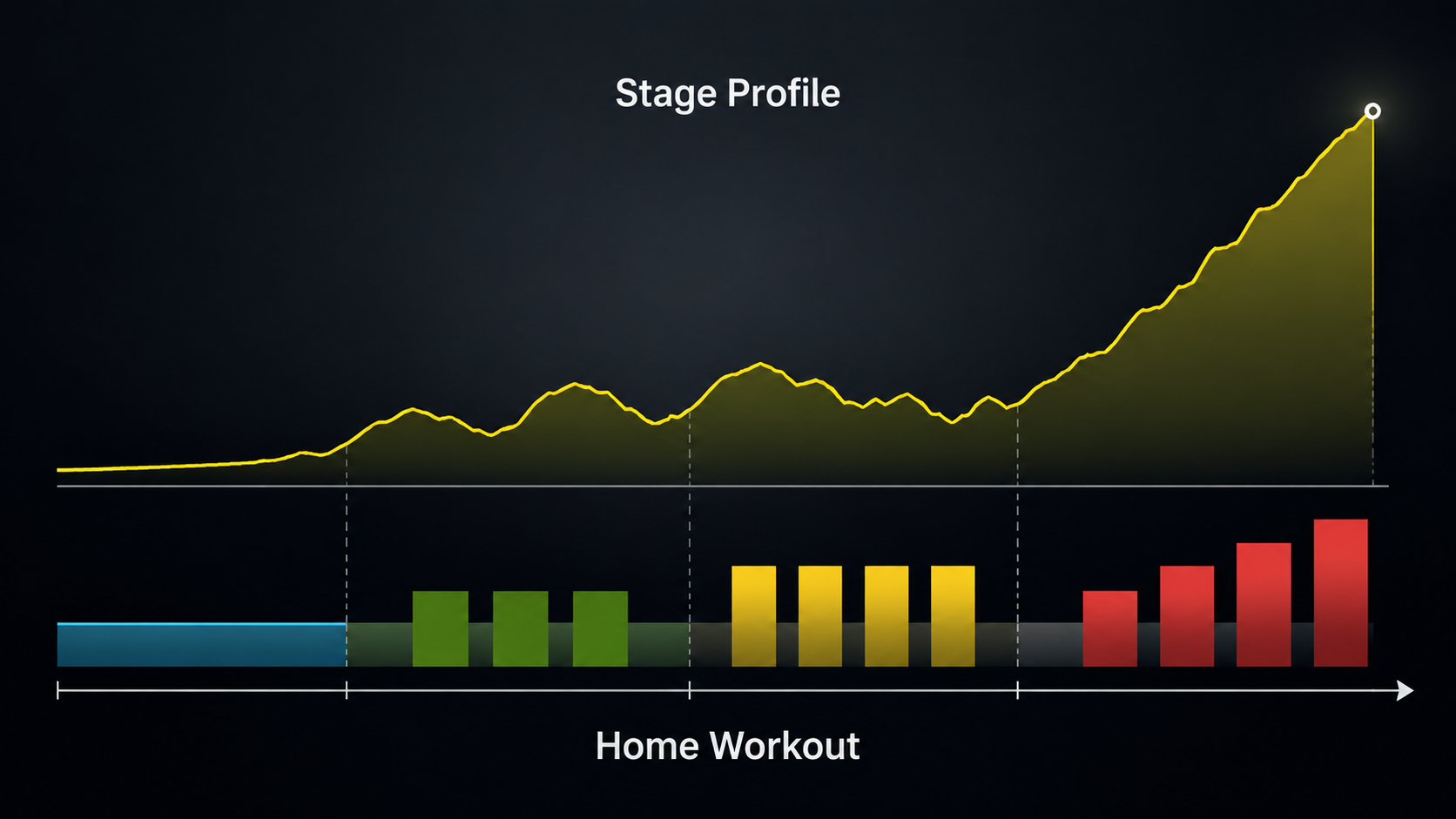
35-minute mountain-stage workout
- Warm up 6 minutes, gradually increasing resistance.
- Climb 4 minutes at 50-60 rpm, RPE 7-8.
- Recover 3 minutes at 80-90 rpm, RPE 3-4, after the first three climbs.
- Complete the 4-minute climb four times total.
- On the final repeat only, lift the last 30 seconds to RPE 9 without letting cadence jump above 65 rpm.
- Cool down 4 minutes.
Low-cadence climbing repeats appear frequently in structured indoor Tour-style sessions because they mimic sustained climbing load better than frantic spinning does.[3][4] If you have a smart trainer, this is where it earns its floor space: slope mode or a controlled resistance target keeps the climb honest. A spin bike can also work if the frame is stable and the resistance knob allows fine adjustment. A lightweight upright exercise bike may feel vague at this load, but it is still usable if you stay seated and judge by RPE.
Noise note: this session is usually quieter than sprint work because cadence is low. The risk is frame movement. If the bike rocks, lower the resistance slightly and keep the effort seated. A quiet bad climb is better than a dramatic one that walks the bike across the mat.
Individual time trial: one hard line you have to hold
An individual time trial removes the hiding places. No wheel to sit on, no bunch easing off, no excuse to surge every time the effort feels boring. The home version should feel controlled early, uncomfortable in the middle, and mentally narrow at the end.
Stage 16 is the 2026 individual time trial reference, listed at 26.1 km in the stage-profile data.[2] For most home riders, copying the distance is less useful than copying the pacing demand, so the session becomes a short threshold test rather than a long simulation.
25-minute ITT workout
- Warm up 5 minutes, ending around RPE 5.
- Ride 3 minutes at RPE 7 to settle into the effort.
- Ride 12 minutes at RPE 7-8, cadence 85-100 rpm, with no surges.
- If you use power, aim for the hardest output you can keep even from minute 1 to minute 12.
- Cool down 5 minutes.
Wattbike’s Tour-style training material includes threshold-focused pacing work, which is the right model here: the session is won by restraint as much as effort.[4] On a smart trainer, ERG mode can help if you already know your threshold range. If you do not, use resistance mode and keep the effort even. On a basic bike, cover the console if the numbers make you chase spikes; breathing and cadence stability are better guides than a random calorie estimate.
Apartment note: this is the best workout for low noise. The cadence is moderate, the effort is seated, and nothing requires a sudden stomp. The discomfort is mostly internal, which is considerate of the downstairs neighbor.
Team time trial: controlled surges, not five solo sprints
A team time trial is easy to misunderstand from the sofa. The spectacular part is speed, but the training lesson is control. One rider pulls, the others recover just enough, and the line survives because nobody turns the early kilometers into a private attack.
Stage 1 is the 2026 team time trial anchor, listed at 19.6 km in the stage-profile data.[2] At home, the group becomes an interval rhythm: pull, sit in, pull again. You are not simulating teammates; you are simulating the cost of taking repeated turns at the front.
30-minute TTT workout
- Warm up 6 minutes at 85-95 rpm.
- Ride 90 seconds at RPE 7, cadence 90-100 rpm.
- Ease 60 seconds to RPE 5 without dropping below 85 rpm.
- Surge 30 seconds at RPE 8, cadence 100-105 rpm.
- Recover 90 seconds easy.
- Repeat the full block four times, then cool down 5 minutes.
The best version of this workout feels almost too easy in the first two rounds. That is the point. Indoor Tour templates that use repeated controlled efforts are more useful here than all-out sprint protocols because the team time trial punishes ragged pacing.[3][4]
Equipment note: a smart trainer makes the rhythm cleaner if you build the blocks in an app, but it is not required. A spin bike or resistance bike works as long as you can move between three repeatable settings: steady pull, light draft, and short surge.
Use the bike you have, unless the workout exposes the wrong limitation
The wrong purchase for a small apartment is usually the one bought for an imaginary version of training. If you mostly want flat, hilly, and time-trial sessions under 45 minutes, a basic resistance bike or spin bike can be enough. If mountain repeats and power-based threshold work are the reason you are watching the race with training shoes nearby, a smart trainer becomes easier to justify.
The practical split is straightforward: basic bikes are quiet and simple but less precise; spin bikes feel sturdy under surges and climbing resistance; smart trainers give the best control for slope, power, and structured intervals but add setup complexity. If you are still choosing, compare the tradeoffs in Exercise Bike vs. Smart Trainer vs. Spin Bike before buying the machine that looks most like the Tour and fits least well in your room.
If the bike is already on the mat, do not overcomplicate the decision. Today’s stage profile tells you enough. Flat means sprint surges. Hilly means tempo with interruptions. Mountain means low-cadence torque. ITT means one steady threshold line. TTT means repeated controlled pulls.
References
- Overall route, letour.fr
- Tour de France 2026, intervals.icu
- Indoor Rides Inspired by the Tour de France, Bicycling
- Tour de Wattbike with Alex Dowsett, Wattbike
Don't have the gear this routine assumes? Find the build that covers it.
Wondering how much rest you need after this? Read our ACSM-cited recovery reference.
Questions about form, substitutions, or a correction? Leave it below.
Comments
Join the discussion with an anonymous comment.