
Structure Your Indoor Cycling Like Tour de France Stages
Learn how to translate mountain, sprint, time trial, and flat stages into a structured weekly indoor training rotation. This plan fits 5–8 hours on your home trainer and covers aerobic endurance, threshold power, VO2max, and neuromuscular power without needing pro-level volume.
Before you start
- Equipment required
- Indoor bike trainer (wheel-on, direct-drive, or smart bike), fan, towel, optional device
- Assumes build tier
- No specific tier required
- Difficulty
- Intermediate
The easiest way to waste a good indoor trainer is to ride every session at the same vague medium-hard pace. No scenery changes, no group rolling through, no climb forcing your hand, no sprint point appearing at the town sign. Just a fan, a towel, a screen, and forty-five minutes that somehow feel longer than an outdoor century.
A better answer to how to structure cycling training like Tour de France stages is not to copy the Tour’s volume. It is to copy its alternation of demands. One day asks for sustained pressure. One asks for violence and patience between efforts. One asks for clean, steady output. One asks you to stay aerobic long enough for the quiet work to matter.
| Tour-style stage | Indoor training translation | Main demand |
|---|---|---|
| Mountain stage | 4–6 minute low-cadence climbing intervals at 90–105% FTP | Sustained muscular pressure and threshold control |
| Sprint stage | 15–30 second max-power efforts at high cadence with full recovery | Neuromuscular power and repeatable acceleration |
| Time trial | Long steady work near FTP, commonly 2×20 minutes at 95–100% FTP | Pacing, position, and uninterrupted threshold output |
| Flat/endurance stage | Mostly Zone 2 riding, longer than the hard sessions when possible | Aerobic base, durability, and recovery capacity |
That translation is deliberately simple. Real Tours have hilly transition days, crosswinds, cobbles, breakaway chaos, descents, and team tactics. For a home rider with 5–8 hours a week, the four dominant handles are enough: climb, sprint, time trial, and endure.
The 2026 Tour de France route is a useful reminder that even the real race is not one heroic effort repeated for three weeks. It is listed as 21 stages with 7 flat stages, 4 hilly stages, 8 mountain stages including 5 summit finishes, 2 time trials, and 2 rest days.[1] The useful pattern is the variation, not the mythology.

Set Up the Room Before You Set Up the Week
Indoor cycling is brutally honest about small practical mistakes. A bad fan angle can ruin a threshold workout faster than a bad playlist. A towel you cannot reach becomes a puddle. A trainer wedged too close to a wall makes out-of-saddle work feel like a furniture accident waiting to happen.
A workable home setup starts with about a 4×8 ft floor space, a wheel-on or direct-drive trainer or smart bike, a fan, a towel, and a device if you want an app or workout file in front of you.[2] That is enough. The bike does not need a team bus around it.
Put the fan in front of you or slightly off-center so it moves air across your torso, not just your front wheel. Keep the towel and bottle within reach. If the room runs hot, treat airflow as training equipment, not comfort décor; indoor heat changes how hard a session feels and how much fluid you lose. For a deeper setup check, see how to exercise safely in a hot home gym.
The Four Stage Types as Workouts
FTP appears throughout the plan because it gives indoor work a shared ruler. If you do not know your FTP, use perceived effort or heart-rate zones conservatively until you have a current estimate. The point is not to chase a professional wattage number. The point is to put the right kind of stress in the right place.
Mountain Stage: Pressure You Have to Hold
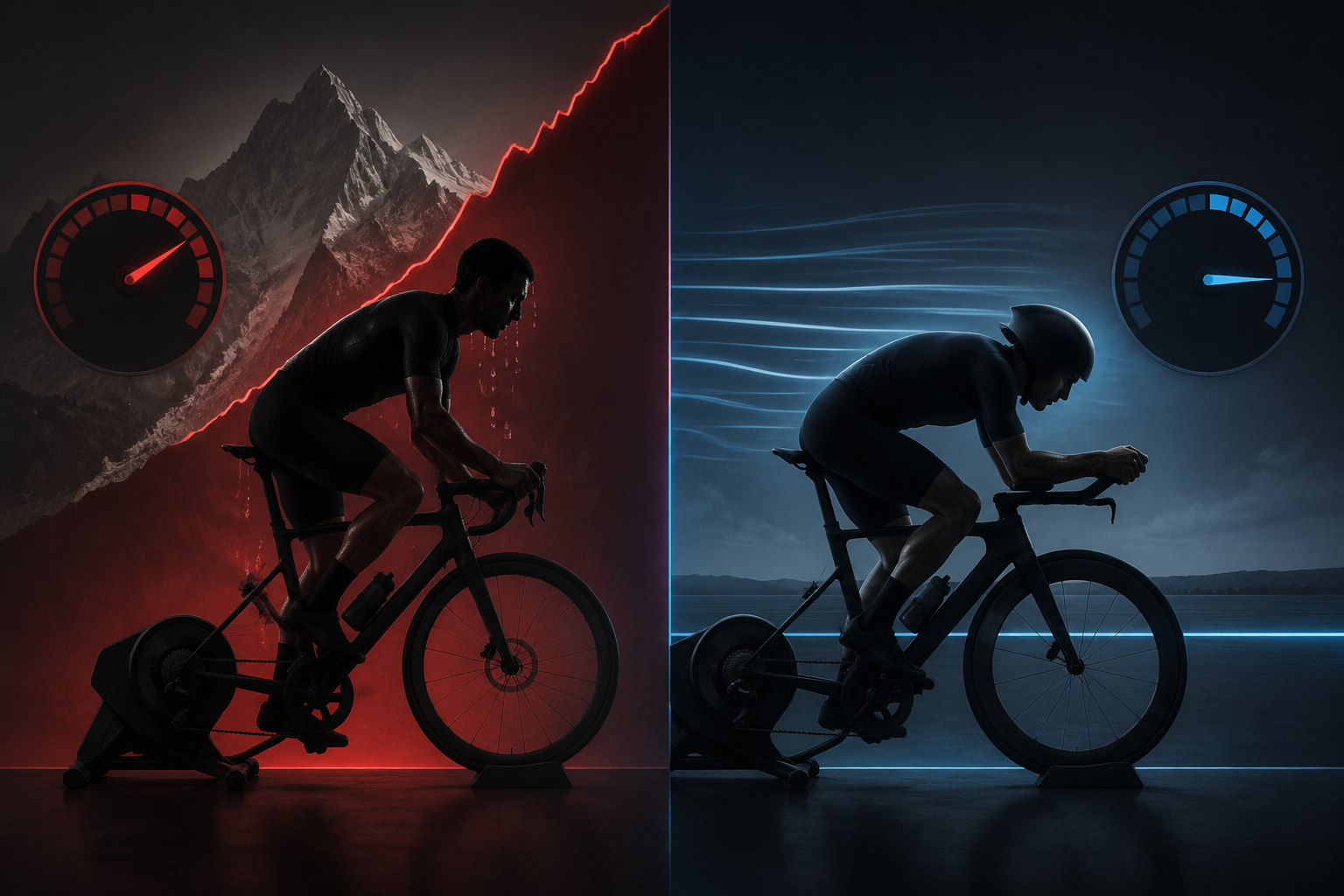
The indoor mountain session is not a fake Alpine epic. It is a compact way to practice sustained pressure when cadence drops and the pedals feel heavier. The useful prescription is 4–6 minute climbing intervals at 90–105% FTP, usually around 60–80 rpm, with 2 minutes of recovery between efforts.[3]
That low-cadence detail matters. A 5-minute interval at 75 rpm feels different from a 5-minute interval spun at 100 rpm, even at the same power. It asks more of muscular endurance and torque control. On a smart trainer, resistance mode or a simulated climb can help; on a basic trainer, shift into a harder gear and keep the effort controlled rather than grinding yourself into bad form.
Sprint Stage: Very Hard, Then Actually Easy
A sprint day is not a 30-minute HIIT fog where every recovery becomes secret tempo. The useful version is short and sharp: 15–30 seconds at max power, often at 120 rpm or higher, followed by 3–5 minutes of full recovery.[3][4]
The recovery is the workout’s guardrail. If you shorten it to feel more productive, you stop training peak power and start making another messy anaerobic session. For home riders, 6–10 clean sprints can be plenty, especially if the next hard day is a mountain or time-trial session.
Time Trial: No Hiding From the Number
The time-trial workout is where indoor training shines because there are no stop signs and no soft-pedaled corners. A standard threshold format is 2×20 minutes at 95–100% FTP with 10 minutes of recovery between the two efforts.[5] It is not uniquely a Tour workout; it is a reliable indoor way to train the same steady-output demand that a time trial exposes.
This is where many riders blur the line with the mountain day. Both can sit near threshold. They should not feel identical. The mountain session breaks the work into shorter, heavier, lower-cadence blocks. The time trial is flatter, smoother, and less forgiving: choose a power you can hold, settle into position, and avoid surging every time the effort gets emotionally boring.
Flat Stage: The Work Most People Under-Ride
The flat/endurance day is the least dramatic and probably the most important for a recreational indoor cyclist. Analyses and coaching guides commonly describe professional road cyclists spending roughly 80% of training in Zone 2 or low-intensity work.[6][7] That does not mean an amateur should copy professional hours. It does mean the easy aerobic ride is not filler.
Indoors, a flat stage can be 60–120 minutes mostly in Zone 2. If you only have 45 minutes, keep it honest and easy rather than turning it into tempo because you feel guilty. If you can ride longer on the weekend, this is the session that deserves the extra time. For rides that stretch past the short-workout range, pair the session with practical fueling; Pogačar’s diet plan for endurance training at home is a useful continuation.
A Repeatable 5–8 Hour Indoor Week
The cleanest version of this plan uses two truly hard anchors, one neuromuscular day, two endurance days, and two recovery or rest days. Time-crunched weekly frameworks often emphasize anchoring the week with key hard sessions rather than scattering intensity everywhere.[8] That matters indoors, where it is too easy to make every ride moderately hard because the trainer never stops you.
| Day | Stage type | Session | Typical duration |
|---|---|---|---|
| Monday | Rest day | Off-bike mobility or full rest | 0–20 min |
| Tuesday | Mountain stage | 4–6×4–6 min at 90–105% FTP, 60–80 rpm, 2 min easy between | 45–75 min |
| Wednesday | Flat/endurance stage | Zone 2 ride, relaxed cadence, no hidden tempo | 45–75 min |
| Thursday | Sprint stage | 6–10×15–30 sec max power at high cadence, 3–5 min easy between | 45–60 min |
| Friday | Rest or recovery spin | Off, or very easy Zone 1–low Zone 2 | 0–45 min |
| Saturday | Time trial | 2×20 min at 95–100% FTP, 10 min easy between | 60–75 min |
| Sunday | Flat/endurance stage | Longer Zone 2 ride if schedule and heat allow | 75–120 min |
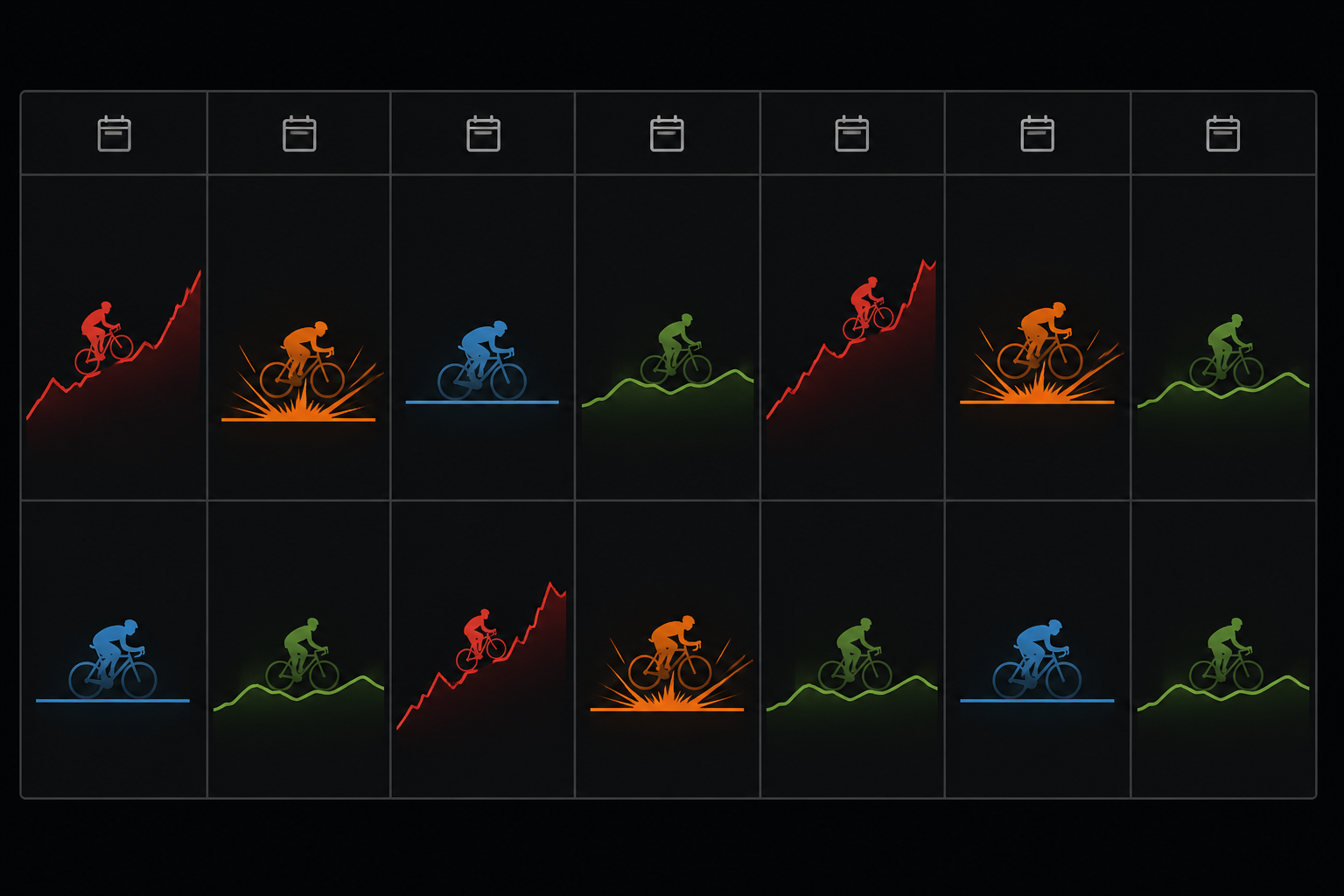
At the low end, this week can fit around 5 hours if you keep the endurance rides shorter and take Friday off. At the high end, it approaches 8 hours by extending Wednesday and Sunday endurance time and adding a short recovery spin. The hard work does not expand first; the aerobic work does.
If your week has only four riding days, keep Tuesday mountain, Thursday sprint, Saturday time trial, and Sunday endurance. If your week has five riding days, add Wednesday endurance. If your legs are stale, remove the sprint day before you remove both endurance days; power work done tired usually becomes noisy pedaling instead of speed.
How to Ride Each Session Without Turning It Into the Same Session
Tuesday Mountain Stage
Warm up for 10–15 minutes, including two or three short builds so the first interval is not a shock. Then ride 4–6 repeats of 4–6 minutes at 90–105% FTP, holding 60–80 rpm and taking 2 minutes easy between repeats.[3] Finish with 5–10 minutes easy.
A 45-minute version might be 4×4 minutes. A 75-minute version might be 5×6 minutes with a longer warmup and cooldown. Do not make the longer version harder by creeping above the target every interval. The mountain day is about being able to keep pressure on the pedals while still controlling the finish.
Wednesday Flat Stage
Keep this ride mostly Zone 2. You should be able to breathe steadily and finish feeling like you could continue, not like you salvaged the day by winning an imaginary breakaway. If you use an app, this is a good place to turn off racing cues and watch the average power stay boring.
Logging helps here because easy rides are easy to misremember. If you want a simple way to track stage type, power, duration, and how the room felt, see how to choose a workout tracker app by training style.
Thursday Sprint Stage
Warm up longer than you think you need: 15–20 minutes with a few short spin-ups. Then complete 6–10 sprints of 15–30 seconds at max controlled power, aiming for very high cadence, with 3–5 minutes of easy pedaling between efforts.[3][4]
The first sign the session is finished is not exhaustion. It is loss of snap. If your peak power drops badly, your cadence bogs down, or you start bracing against the bars just to survive, stop the sprint set and cool down. Sprint quality is perishable.
Saturday Time Trial
After a progressive warmup, ride 20 minutes at 95–100% FTP, recover for 10 minutes, then repeat the 20-minute effort.[5] The second interval is the honesty check. If the first one required constant surging, the second will tell you.
Use this day to practice stillness. Keep your upper body quiet, watch cadence drift, and notice whether your power rises every time you stand or sit up. A time trial indoors is as much about removing leaks as it is about producing watts.
This is also the best day for structured workout files if you like apps. A trainer screen can be genuinely useful when the work is long enough that attention wanders. For options by goal, see best exercise apps by training goal.
Sunday Flat Stage
Sunday is the ride that makes the rest of the week work better. Keep it aerobic and longer than the midweek endurance ride if your schedule allows. A 75-minute ride is useful. A 90–120 minute ride is even better if the room is cool, you have fluids nearby, and the rest of life permits it.
There is no prize for turning the last 20 minutes into threshold because you got bored. Put on a route video, a race replay, or a podcast if that keeps the effort steady. The training effect comes from accumulating aerobic time without adding another recovery debt.
Progress the Rotation Without Chasing Pro Volume
Run the same weekly pattern for 3–4 weeks before changing much. Periodized training frameworks commonly organize training into smaller weekly cycles inside larger blocks, so the point is not to invent a new workout every Tuesday.[5][7] Repeatability is what lets you see whether the mountain intervals are getting smoother or the time-trial power is becoming less ragged.
- Progress endurance first by adding 10–15 minutes to one flat ride when recovery is good.
- Progress mountain work by adding one interval or extending intervals before raising intensity.
- Progress sprint work cautiously by improving peak quality, not by cutting recovery.
- Progress time-trial work by making both 20-minute efforts steadier before nudging FTP targets.
- Use every fourth week as a lighter week if fatigue is accumulating.
The most tempting mistake is to upgrade all four stage types at once. Add more endurance, harder climbing, extra sprints, and a sharper time trial in the same week, and you no longer have a Tour-inspired structure. You have a small indoor pileup.
If you want a different structured approach after trying this rotation, Tadej Pogačar’s home training plan in 4 weeks gives a more explicitly polarized template. The same caution applies there: borrow the structure, not the professional workload.
What This Plan Covers
A good indoor week does not need to feel epic every day. In this rotation, the mountain stage covers sustained pressure and muscular endurance. The sprint stage keeps top-end acceleration alive. The time trial builds steady threshold discipline. The flat stages give the week enough aerobic weight to support the harder work.
That is the honest amateur translation. You are not training like a Tour de France rider in volume. You can structure indoor cycling like the Tour in purpose, variety, and physiological coverage, using the trainer space you already have and the hours you can actually protect.
References
- Tour de France — Wikipedia
- 5 Tips for Setting Up an Effective Indoor Cycling Space — CTS/TrainRight
- How to Train For Tour de France Stages — Wattbike US
- Indoor Rides Inspired by the Tour de France — Bicycling
- Training Periodization: Macro, Meso, & Microcycles of Training — TrainerRoad
- Pro Cyclist Power Output: Train Like a Tour de France Rider — EVOQ.BIKE
- Cycling Periodisation Plan — Structure Your Training Year — Roadman Cycling
- Time-Crunched? Here's the Training Week Framework That Works — CTS/TrainRight
Don't have the gear this routine assumes? Find the build that covers it.
Wondering how much rest you need after this? Read our ACSM-cited recovery reference.
Questions about form, substitutions, or a correction? Leave it below.
Comments
Join the discussion with an anonymous comment.