
How to Train for a 1-Mile Run at Home Without a Treadmill
This 5-week training plan uses bodyweight cardio moves to take you from zero to a continuous 1-mile run, all within a small apartment without a treadmill. It offers a $0 equipment path and a $10-15 jump rope upgrade for added options.
Before you start
- Equipment required
- None (bodyweight only)
- Assumes build tier
- No specific tier required
- Duration
- 15 minutes
- Difficulty
- Beginner
You can train for your first mile at home without a treadmill, a hallway, or a heroic amount of space. Clear about a 6-by-6-foot patch of floor, set a timer, and use indoor cardio moves during the “run” intervals: running in place, high knees, low-impact fast marching, mountain climbers, or, if your floor and joints allow it, jump rope.
The $0 version uses only your bodyweight. A $10-15 jump rope is the optional upgrade, usually treated as a small-budget runner’s tool rather than a required purchase; budget runner equipment guides commonly place it in the cheap home-gym category, and this plan works whether you buy one or not.[1] If you eventually want a broader setup, the better next step is not a treadmill by default but a phased small-apartment home gym budget plan that starts with the floor space you already have.
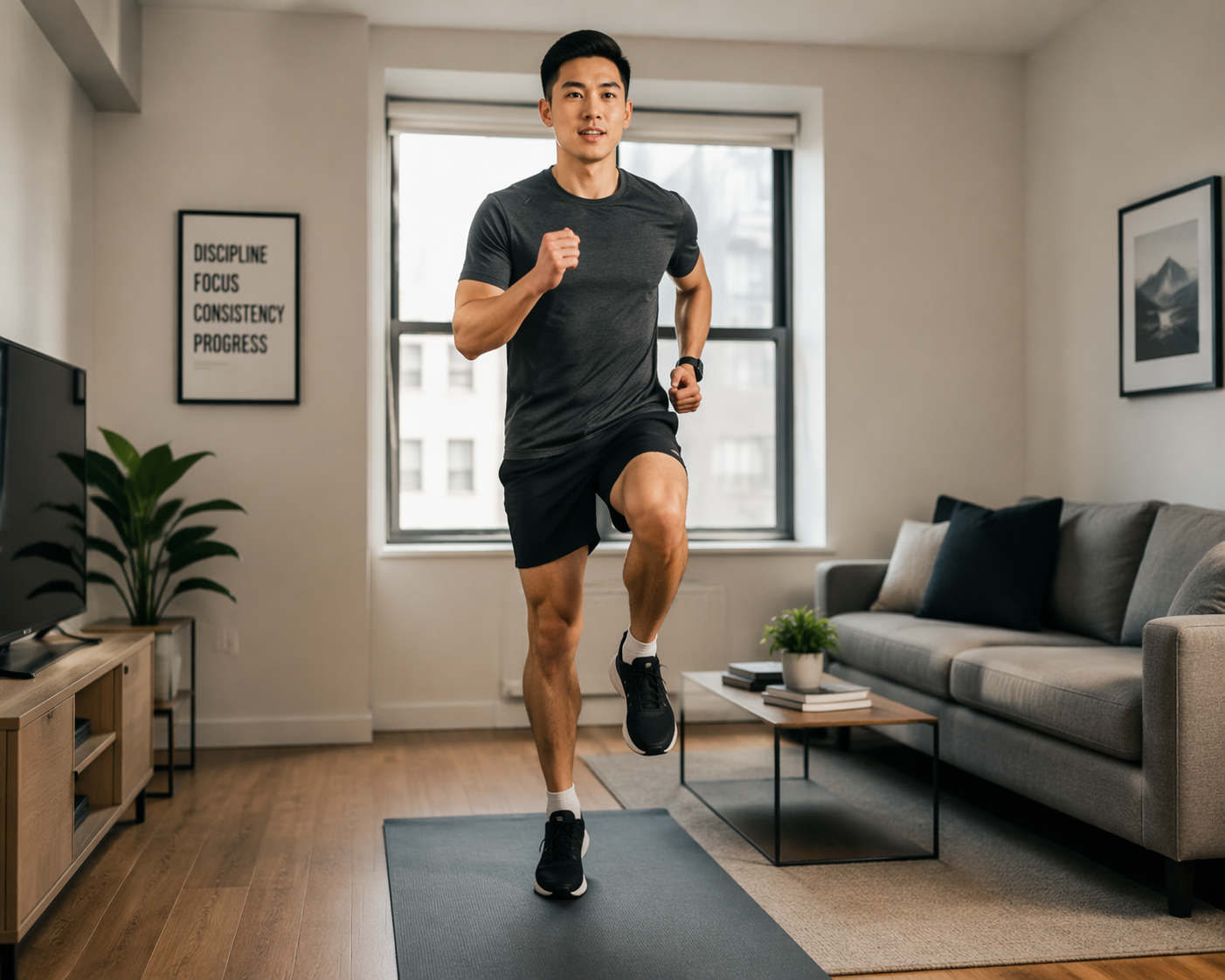
The 5-Week Mile Run Training Plan at Home
Beginner mile plans usually use run/walk intervals before asking for a continuous run. Verywell Fit’s beginner mile plan uses a four-week run/walk progression, while Middle Trail Running publishes a five-week couch-to-1-mile structure.[2][3] This version keeps that logic but changes the location: every “run” happens in one small footprint, and every “walk” becomes an easy indoor recovery move.
| Week | Do this 3 days per week | Run interval | Recovery interval | Goal for the week |
|---|---|---|---|---|
| 1 | 8 rounds | 30 seconds easy run-in-place | 60 seconds march or step-touch | Learn the rhythm without chasing speed |
| 2 | 8 rounds | 45 seconds run-in-place or low high knees | 75 seconds march or mobility | Build slightly longer working intervals |
| 3 | 6 rounds | 90 seconds run-in-place, high knees, or mixed cardio | 90 seconds march | Match work and recovery without rushing |
| 4 | 5 rounds | 2 minutes steady indoor running | 1 minute easy march | Spend more time moving than recovering |
| 5 | 2 practice days, then 1 test day | Practice: 4 rounds of 3 minutes. Test: continuous 1-mile run-in-place effort | Practice: 1 minute march. Test: no planned recovery | Complete a continuous mile-style benchmark at home |
Train on nonconsecutive days if you can, such as Monday, Wednesday, and Saturday. On the other days, take a walk if outdoor movement is available, do light mobility, or rest. If one minute of running in place feels shockingly hard, that does not mean you chose the wrong plan. It means the first week is doing its job: finding your current starting line.
The Week 5 test is not a laboratory-certified mile and it is not the same as covering 1 mile on a measured road. Treat it as a continuous run-in-place benchmark: roughly the amount of uninterrupted effort a beginner is trying to build before moving to an outdoor mile, a treadmill mile, or a more formal training plan.
How to Translate “Run” and “Walk” Indoors
The timer matters more than the exact move. Runner’s World and RunToTheFinish both use indoor cardio exercises such as high knees, mountain climbers, jump rope, and bodyweight circuits as at-home running substitutes, but those exercises are not interchangeable for every body or every apartment.[4][5] Choose the option that lets you keep moving for the full interval without pounding the floor or spiking your effort too early.
| Plan word | Best $0 option | Quieter option | Harder option | Use it when |
|---|---|---|---|---|
| Run | Easy run-in-place | Fast march with arm drive | High knees | You need the closest indoor feel to jogging |
| Run | Alternating knee lifts | Low-impact high knees | Jump rope | You want more rhythm and calf work |
| Run | Mountain climbers from an elevated surface | Slow mountain climbers | Floor mountain climbers | Your legs need a break from upright bouncing |
| Run | Squat-to-calf raise | Step-back squat | Restrained burpee without a jump | You want a full-body cardio interval |
| Walk | March in place | Step-touch | Gentle mobility | You are recovering while staying in the same footprint |
For a true beginner, the first “run” choice should usually be easy run-in-place or fast marching, not burpees. Keep your elbows bent, let your arms swing naturally, and lift your feet only as high as needed. You are not trying to win the living room. You are trying to finish the interval with enough control to start the next one.
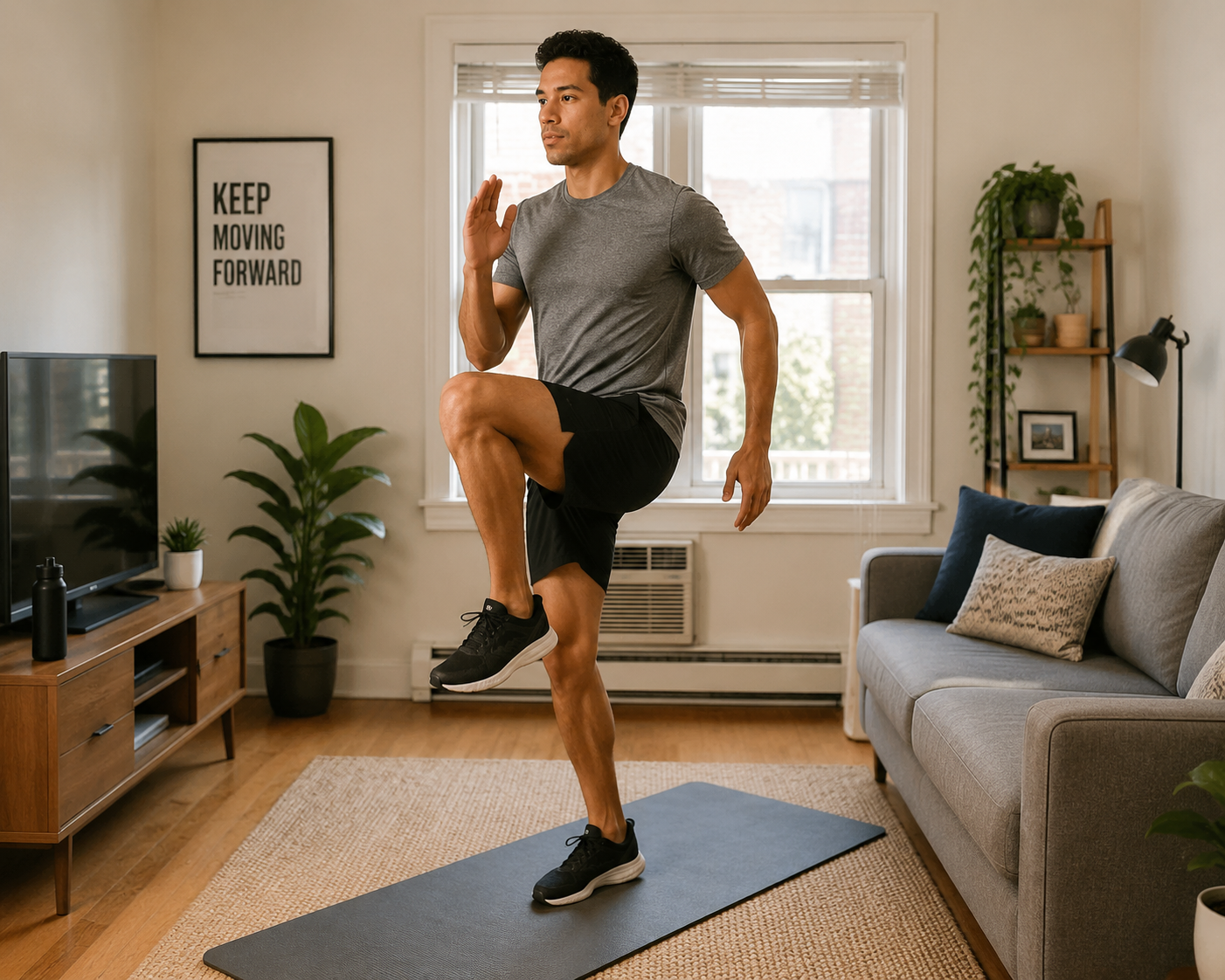
Running in Place
Running in place is the default move for this plan because it is simple, needs almost no space, and lets you practice running posture. Keep your torso tall, land softly under your hips, and use short, quick steps. General exercise estimates suggest running in place can create a cardiovascular demand in the same broad category as jogging, but that does not make it a perfect outdoor-running duplicate. There is no forward travel, wind, terrain, or normal stride length.
If your calves tighten, lower the bounce and turn it into a fast march for the rest of the interval. That is still training. The mistake is not modifying; the mistake is turning every interval into a sprint because the floor is small and the clock feels loud.
High Knees
High knees are useful, but they are easy to overdo. In Week 1 or Week 2, think “slightly taller knee lift,” not a full gym-class sprint. If your breathing falls apart after 15 seconds, switch back to run-in-place and finish the interval at a pace you can repeat.
Jump Rope
A jump rope can make the plan feel smoother because the rope gives you cadence. It also adds impact and noise. Use it only if your ceiling, floor, downstairs situation, ankles, knees, and calves all say yes. In the early weeks, you can rope for part of the run interval and finish with quiet marching.
Mountain Climbers and Restrained Burpees
Mountain climbers and restrained burpees are backup tools, not proof that the workout is more serious. Use them when upright running feels repetitive or when you want a full-body option. For mountain climbers, put your hands on a couch, sturdy bench, or countertop to reduce the load. For burpees, remove the jump, step back one foot at a time, and stand tall at the top.
What Each Week Should Feel Like
Week 1 should feel almost too modest at the start and noticeably real by the final rounds. Use the easiest version of running in place. During the 60-second recoveries, march slowly enough that your breathing settles before the next interval. If you cannot complete all 8 rounds, do 5 or 6 rounds and repeat Week 1 next time.
Week 2 adds time, not drama. The 45-second run interval is where many beginners discover they have been starting too fast. Begin each interval at a pace that feels almost restrained. If the last 10 seconds are ugly every time, keep the same week for another round before moving on.
Week 3 asks for 90 seconds of work and 90 seconds of recovery. This is a good week to mix moves: 45 seconds of run-in-place followed by 45 seconds of fast marching or low high knees. The workout still counts if your “run” interval is split between two indoor cardio moves.
Week 4 is the first week where the recovery starts to feel short. Keep the run intervals boring on purpose. Short stride, soft landing, steady arms. If your knees object to the repeated bounce, alternate 30 seconds of run-in-place with 30 seconds of fast march until the 2-minute interval is done.
Week 5 has two practice days and one test day. On the practice days, complete 4 rounds of 3 minutes steady and 1 minute easy. On the test day, clear the same space, set your timer, and begin at a pace that feels almost too easy. The goal is continuous effort, not a pretty pace chart.
Pacing, Breathing, and Repeating a Week
Verywell Fit’s mile-running guidance emphasizes pacing and breathing because many first-mile attempts fail before the legs are truly done.[6] Indoors, that problem can get worse. Without scenery or distance markers, beginners tend to run the first interval like a dare. Use the first 10 seconds to settle, not to prove anything.
- Use the talk test: during early-week run intervals, you should be able to say a short phrase, even if you would rather not.
- Breathe in a rhythm instead of holding your breath when the timer starts.
- Keep your shoulders low; tense shoulders make a small workout feel harder than it is.
- End the first half of the workout feeling under control, then let the final rounds be the challenge.
- Repeat a week if you miss intervals, need extra recovery, or finish with joint pain instead of normal effort.
Repeating Week 2 is not a character flaw. It is usually the cleanest fix. A beginner who repeats a week and finishes the next attempt smoothly is progressing better than a beginner who drags sore knees into the next level just because the calendar says so.
Quiet Modifications for Apartments
Apartment training has a second audience: whoever lives below you. The plan still works if you remove jumping. Nerd Fitness’s small-space training guidance supports the broader point that meaningful bodyweight work can happen in a very small footprint, but your version has to respect your floor, neighbors, and joints.[7]
| If the plan says | Choose this quieter version | Watch for |
|---|---|---|
| Run in place | Fast march with strong arm swing | Slapping feet or bouncing too high |
| High knees | Alternating knee lifts without a hop | Leaning backward or yanking the knee up |
| Jump rope | Invisible rope or calf raises | Calf tightness and floor noise |
| Mountain climbers | Hands elevated, step one foot at a time | Hips sagging or shoulders taking over |
| Burpees | Step-back burpee, no jump | Rushing the floor transition |
A yoga mat can reduce the harshness of foot contact, but it will not magically soundproof jumping. If noise is the main obstacle, use the no-jump substitutions from the start and save jump rope for a ground-floor space, a gym, or a time when impact is not a problem. For a full quiet-cardio session, pair this plan with a no-jumping HIIT workout for small apartments.
How to Run the Week 5 Mile Test
For the final test, do not try to convert every step into an exact distance. Pick a continuous time target that represents your first mile effort. Many beginners use a slow-mile window rather than a pace watch when they are starting; indoors, that is more honest than pretending a living-room stride equals a measured road stride.
- Warm up for 5 minutes with easy marching, ankle circles, gentle squats, and light run-in-place.
- Set one timer for the full continuous effort instead of watching every few seconds.
- Start with fast marching or very easy running in place for the first minute.
- Settle into the quietest sustainable version of your indoor run.
- If you need to lower impact, switch to fast marching without stopping the timer.
- Cool down with 3 to 5 minutes of slow marching and relaxed breathing.
If you complete the continuous effort, you have earned the practical result this plan is built around: enough aerobic capacity and confidence to keep moving for a first-mile benchmark at home. If you stop early, look at where it happened. Stopping in the first few minutes usually points to pacing. Stopping late usually means you are close and may need one more week of Week 5 practice.
After Your First At-Home Mile
Once you finish the Week 5 test, choose the next move based on your actual constraint, not on what running culture says should come next. Repeat Week 5 if you want the mile to feel calmer. Move outdoors when safety, weather, and routes allow. Add the jump rope if impact and noise are not problems. If you want guided timers, a free interval app can help; start with a list of free workout apps for home rather than buying a watch before you know what you need.
This is not a claim that running in place replaces outdoor running forever. It is a way to stop waiting for the perfect route, the perfect treadmill, or the perfect confidence level before you begin. A small patch of floor is enough for the first mile-style effort. After that, you can decide whether to repeat it, take it outside, or build a slightly better apartment setup around the habit you have already started.
References
- Cheap Home Gym Exercise Equipment for Runners, Run for Good
- How to Train to Run 1 Mile in 4 Weeks, Verywell Fit, May 2024
- Couch to 1 Mile Training Plan, Middle Trail Running
- At-Home Cardio Workouts: Make the Most of Your Living Room, Runner's World
- 7 Indoor Workouts To Try When You're Stuck At Home, RunToTheFinish
- How to Run a Mile Without Stopping: 8 Tips for Runners, Verywell Fit
- How to Work Out in Small Spaces (The 'No Space' Workout), Nerd Fitness
Don't have the gear this routine assumes? Find the build that covers it.
Wondering how much rest you need after this? Read our ACSM-cited recovery reference.
Questions about form, substitutions, or a correction? Leave it below.
Comments
Join the discussion with an anonymous comment.