Three Altitude Training Methods for Home Runners
This article compares three methods for simulating altitude training at home—breath-holding, altitude masks, and hypoxic tents—by cost, apartment footprint, and evidence of performance benefit, giving home runners a clear decision framework for their budget and space.
Before you start
- Equipment required
- None (breath-holding)
- Assumes build tier
- No specific tier required
- Duration
- 10 minutes
- Difficulty
- Intermediate
Altitude training for home runners sounds attractive until it becomes a shopping problem. One option costs nothing and fits on a yoga mat. One sits in the impulse-buy range, usually around $50–150, and looks serious enough to make treadmill miles feel like a mountain session. One can cost $3,000–6,000, takes over the bed, and is the only one of the three that really starts to resemble the oxygen-drop mechanism people associate with altitude training.[1]
That difference matters more than the branding. A real altitude camp is not magic; it is prolonged exposure to lower oxygen, enough daily time at elevation, and then training that is not wrecked by the same thin air. The classic live-high-train-low idea is usually discussed in the context of expensive mountain stays, with RunnersConnect citing camp costs around $3,000–8,000 per month and performance gains in the 1–2% range.[1] At home, the question is smaller and more useful: which method gives a runner a real enough adaptation to justify its money, space, and hassle?
| Method | Typical Cost | Apartment Footprint | What It Actually Trains | Buying Read |
|---|---|---|---|---|
| Breath-holding | $0 | No equipment; floor or chair space | Hypoxic stress and anaerobic tolerance signals, especially lactate buffering | Best stimulus per dollar and square foot, but not a VO2max shortcut |
| Altitude mask | $50–150 | Small drawer item | Respiratory muscle loading, not meaningful altitude simulation | Easy to buy, easy to overcredit |
| Hypoxic tent | $3,000–6,000 | Bed-space commitment plus generator | Sustained low-oxygen exposure that can drive hematological adaptation | Real mechanism, real cost, real chance of poor fit |
The $0 Method: Breath-Holding Is Efficient, Not Miraculous
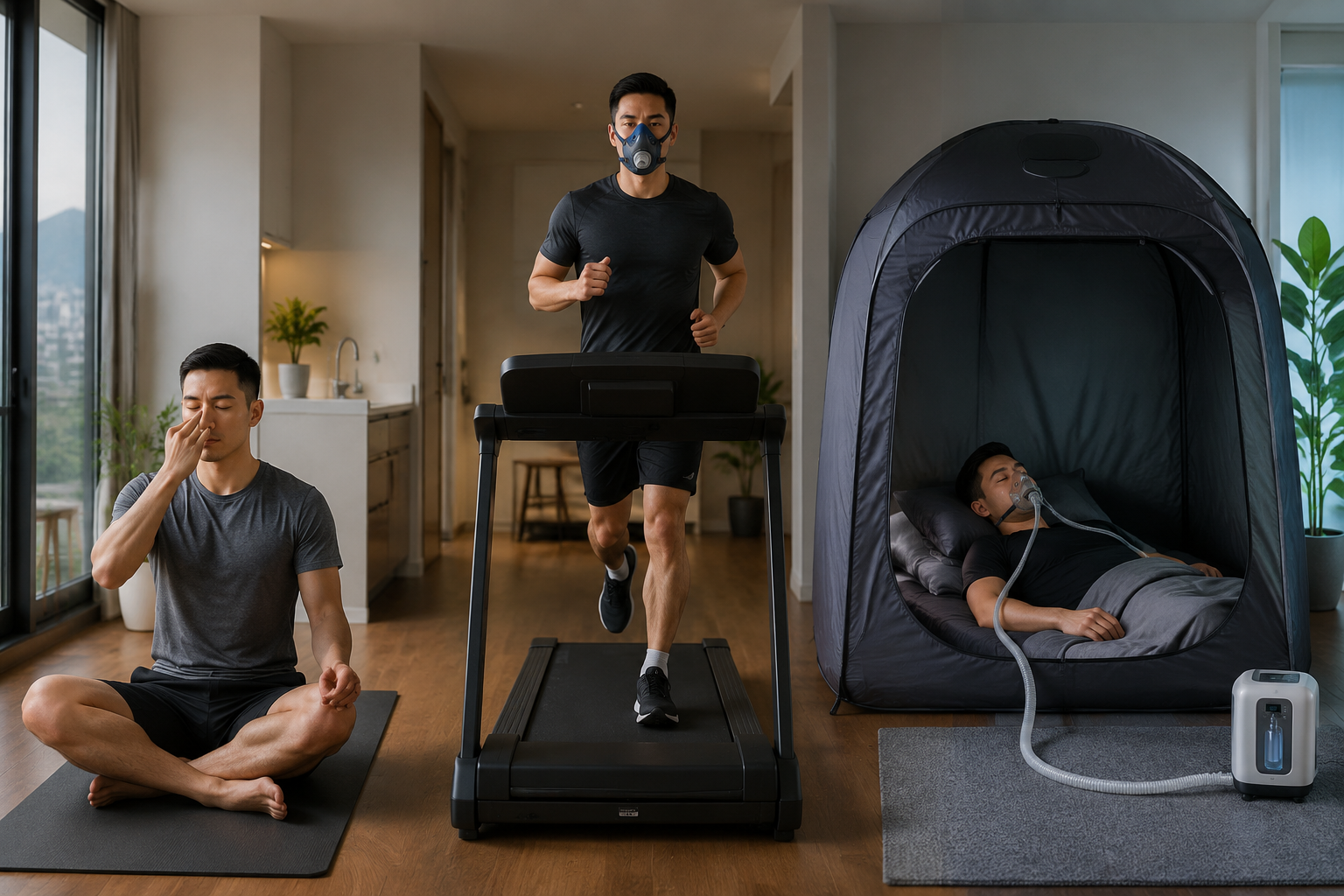
Breath-holding is the only method here that does not ask the runner to buy, store, assemble, charge, clean, or explain anything. For apartment training, that is not a small advantage. A runner can sit on the floor after an easy run, lie down on a mat, or use a chair; when the session is over, the room returns to being a room.
It also creates a real hypoxic stress. In the evidence summarized for apnea-style training, maximal breath-holds can drive blood oxygen saturation far lower than a casual buyer would expect, and a 2022 Frontiers in Physiology review found peak blood lactate improved by 1.89 mmol/L across 7 randomized controlled trials.[2] That is not the same as proving a runner suddenly becomes a better marathoner. It points more cleanly toward anaerobic tolerance and lactate-buffering capacity than toward a broad aerobic upgrade.
This is where breath-holding is easy to oversell. The same research direction does not support treating it as a home replacement for a carefully run altitude block. The 2022 meta-analysis did not find a significant VO2max improvement, and RunnersConnect’s synthesis places the likely performance gain from breath-hold work in the modest 0.5–1.0% range.[1][2] For a runner chasing a faster 5K finish, that may still be interesting. For someone expecting the red-blood-cell story of altitude camp in a five-minute living-room drill, it is the wrong expectation.
The more honest use case is narrow: short, controlled dry-land breath-hold work as a no-cost supplement for runners who already have the basics in place. It belongs after the obvious things, not before them: consistent mileage, appropriate intensity, sleep, strength work, and enough recovery to absorb training. It is not a replacement for aerobic volume, and it should not be used to make every run feel more dramatic.
Safety Is Not a Footnote
The correct setting is boring on purpose: seated or lying down, on dry land, away from water. Never do breath-hold training in a pool, bath, open water, or any setting where fainting would become a drowning risk. Oxygen Advantage also flags contraindications including hypertension, epilepsy, diabetes, pregnancy, and cardiovascular conditions.[3]
- Use only dry-land positions where falling is unlikely: seated, reclined, or lying down.
- Stop the session if you feel faint, confused, panicked, or unusually unwell.
- Do not combine breath-holds with hard treadmill running, cycling, lifting, driving, or water exposure.
- Skip it unless cleared by a clinician if you have any listed contraindication or a relevant medical history.
For the home runner with almost no space and no gear budget, breath-holding wins the cost-to-space comparison. It wins on that specific definition of “worth it.” It does not win because it delivers the same adaptation as altitude living.
The $50–150 Mask Problem
Altitude masks are tempting because they solve the wrong problem beautifully. They are compact, visible, relatively cheap, and unpleasant enough to feel productive. In a small apartment, a mask is easier to justify than a treadmill, a second pair of shoes, or one more foam roller. The trouble is that “harder to breathe through” is not the same thing as “training at altitude.”
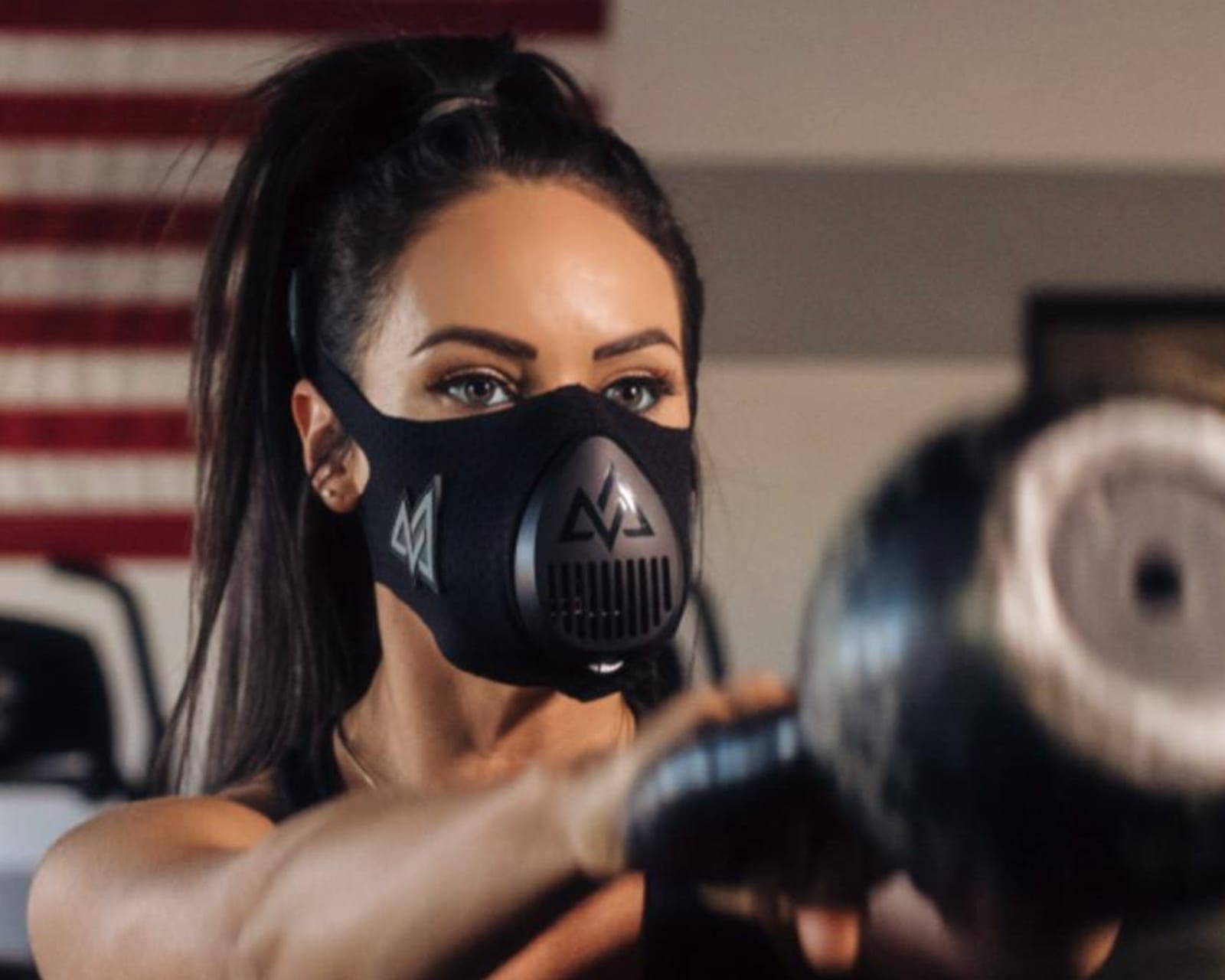
The basic mechanism is mechanical restriction. The mask makes inhaling and exhaling harder by limiting airflow. That can load the respiratory muscles, but it does not meaningfully reproduce the lower oxygen pressure of altitude. In the ACE-sponsored study discussed by RunnersConnect, the mask reduced oxygen saturation by only about 2%, compared with the 10–15% drop associated with real altitude exposure.[1]
The performance result is just as deflating for the buyer. In that same ACE-sponsored study, VO2max improved in both the mask group and the control group, with no meaningful advantage that could be credited to the mask rather than the training itself.[1] That is the sentence that should sit on the product page. The runners got fitter because they trained, not because the mask turned a sea-level room into Flagstaff.
Science for Sport reaches the same practical distinction: elevation training masks are better understood as respiratory muscle trainers, not altitude simulators, and the transfer to sport performance remains mixed.[4] That does not make every mask useless. It makes the name misleading. A respiratory trainer can have a place in some programs; it just should not be purchased as a budget hypoxic chamber.
There is also a training-quality cost. Jagim and colleagues reported that training with an elevation mask decreased alertness and peak velocity during lifting.[5] The study was not a distance-running trial, so it should not be stretched into a universal claim about all workouts. But it does underline a practical concern: if a device makes a session feel harder while reducing output, the runner may be paying for fatigue theater.
For most home runners, the mask is the easiest skip in the comparison. It takes little space, but it also fails the main test: it does not create the altitude-style oxygen drop most buyers think they are buying. If the goal is respiratory muscle loading, call it that and judge it against other respiratory trainers. If the goal is altitude training at home, the evidence does not justify the romance.
Hypoxic Tents Are the Real Thing, With Real Strings Attached
A hypoxic tent is harder to mock because the mechanism is finally pointed in the right direction. Instead of making the mouth work harder, the system changes the air environment around the bed. Used long enough, that can resemble the live-high side of live-high-train-low: sleep in lower-oxygen air, then train in normal conditions so pace and mechanics do not collapse.
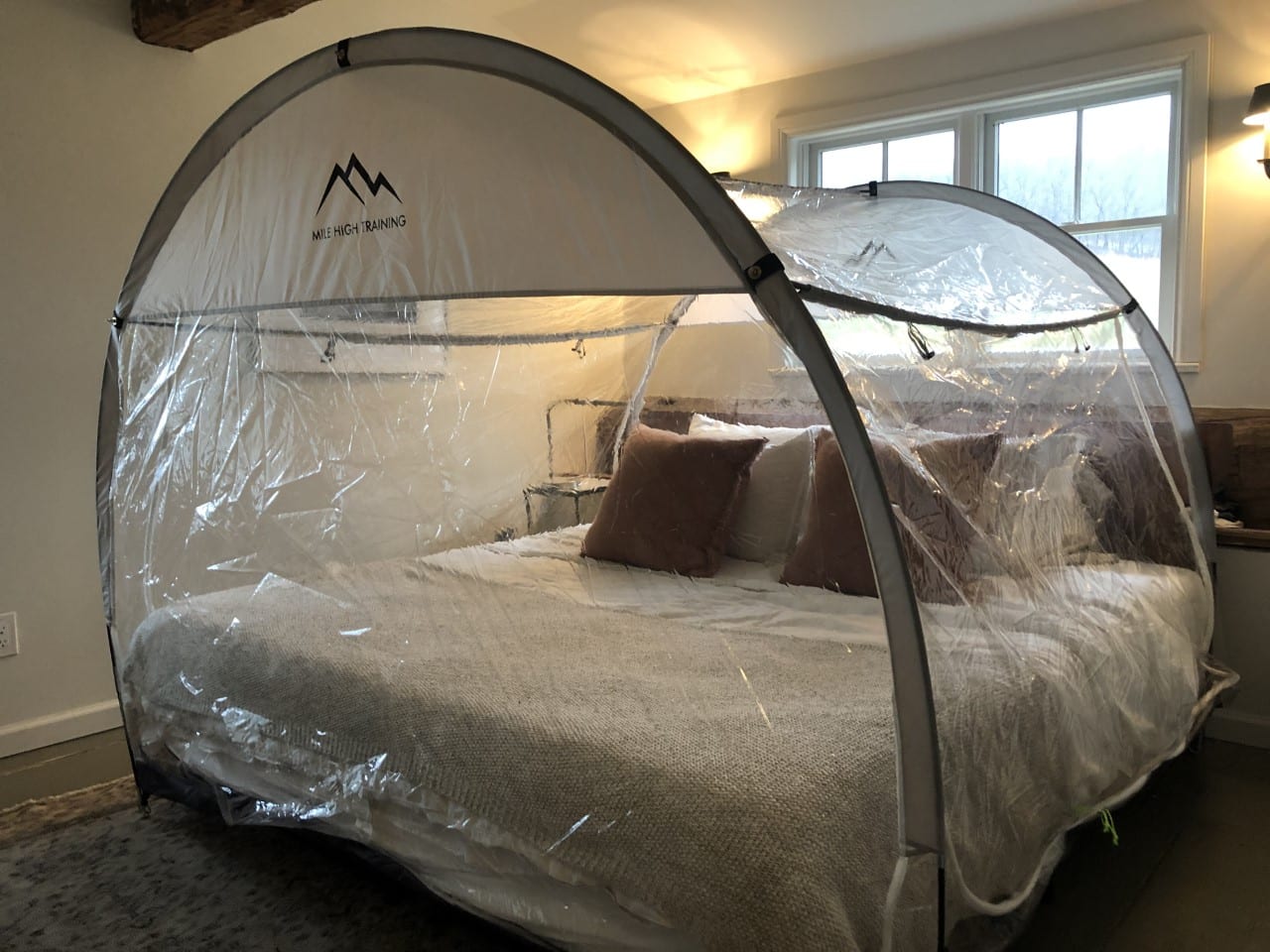
The strongest claim here is hematological. RunnersConnect summarizes evidence that hemoglobin mass can increase by more than 3% when athletes use a hypoxic tent for 9 hours per night at a simulated 10,000 feet for 3 weeks.[1] That is a different category of adaptation from breath-hold lactate tolerance or mask-based respiratory resistance. It is the one method in this set that plausibly delivers the blood-side altitude adaptation people usually have in mind.
The catch is exposure. A tent is not a gadget you use for twenty hard minutes while watching a workout video. The broader altitude-training literature points toward long daily exposure demands, often discussed around 12–14 hours per day.[1] Even the 9-hour-per-night protocol is not a casual add-on; it asks the runner to spend every night inside a controlled sleep environment and then trust that sleep quality, recovery, and household tolerance will survive the experiment.
That sleep caveat is not cosmetic. RunnersConnect notes polysomnographic findings that hypoxic tent use can degrade sleep quality.[1] A runner who gains a hematological signal but sleeps worse may not get the race-day benefit they imagined. In an apartment, the practical irritation is layered on top: the tent encloses the bed, the generator needs space, the setup changes the bedroom, and the whole thing can start behaving less like training equipment than a second roommate.
There is also no guarantee of response. Chapman and colleagues’ work is commonly cited for the finding that roughly 20–30% of athletes may be non-responders to altitude training.[1] That matters more when the method costs thousands of dollars and occupies the bed. A $0 experiment that does not move the needle is annoying. A $3,000–6,000 sleep-environment commitment that does not move the needle is a different category of mistake.
So the tent earns respect without earning a blanket recommendation. It is the closest home method here to genuine altitude adaptation, and it is also the one most likely to exceed the budget and space logic of a normal home gym. Within a FitAtHome-style budget framework, it sits beyond the upper $300–800+ equipment tier and belongs to runners treating the bedroom as part of the training plan, not runners trying to keep fitness from colonizing the apartment.
How to Decide Without Buying the Fantasy
The cleanest decision is not “which altitude method is best?” It is “which method’s mechanism matches the adaptation I actually want?” Those are different questions. The first invites a product ranking. The second prevents a runner from paying for a story.
| If You Want | Best Fit | Avoid |
|---|---|---|
| A no-cost, no-storage hypoxic stress supplement | Careful dry-land breath-holding | Treating it as a VO2max or marathon-fitness replacement |
| True altitude-style hematological adaptation | Hypoxic tent, if budget, space, sleep, and non-response risk are acceptable | Expecting a small device to mimic prolonged altitude exposure |
| A compact respiratory muscle challenge | A mask only if judged as respiratory loading | Calling it simulated altitude |
| The best apartment-runner value | Breath-holding, narrowly and cautiously | Spending $50–150 on a mask because it feels harder |
Most home runners should skip altitude masks. They are too good at looking like a solution and too weak at producing the oxygen environment their marketing implies. If a runner wants respiratory muscle loading, there may be more precise ways to pursue it, but that is a different article than altitude training for home runners.
Breath-holding is worth considering only with the right label attached: a cautious, dry-land, low-cost anaerobic supplement. Its appeal is brutally practical. It costs nothing, stores nowhere, and can create a real hypoxic stimulus. Its ceiling is just as important: the clearest evidence points toward lactate-related adaptations rather than a reliable VO2max lift.
Hypoxic tents are for a narrower runner: someone with the money, the bed space, the sleep tolerance, and the patience to accept a possible non-response. They are not silly. They are serious enough that the decision should feel serious. If the setup would make the apartment revolve around one training experiment, that cost belongs in the calculation.
For the average sea-level runner training at home, the practical verdict is plain: skip the mask, treat breath-holding as a careful supplement rather than an altitude camp in miniature, and consider a tent only if the cost, exposure demands, sleep trade-off, and space commitment all still make sense after the novelty wears off.
References
- Altitude Training for Runners, RunnersConnect, https://runnersconnect.net/altitude-training/
- Effects of apnea training on physiological and performance outcomes: a systematic review and meta-analysis, Frontiers in Physiology, 2022, https://pmc.ncbi.nlm.nih.gov/articles/PMC9551563/
- Holding Your Breath: Benefits and Science, Oxygen Advantage, https://oxygenadvantage.com/blogs/science/holding-your-breath-benefits-and-science
- Elevation Training Masks, Science for Sport, https://www.scienceforsport.com/elevation-training-masks/
- The effects of the elevation training mask on strength and power performance in recreational weight lifters, Journal of Strength and Conditioning Research, 2018
Don't have the gear this routine assumes? Find the build that covers it.
Wondering how much rest you need after this? Read our ACSM-cited recovery reference.
Questions about form, substitutions, or a correction? Leave it below.
Comments
Join the discussion with an anonymous comment.