
Five Cooling Fixes Under $50 for Home Workouts Without AC
Working out in a hot room without air conditioning is uncomfortable and risky. This guide ranks five low-cost purchases—box fan, hygrometer, cooling towel, spray bottle, and yoga mat—totaling under $50, in priority order, to help you exercise safely at home during hot weather, and identifies popular products like ice packs and salt tablets that aren't worth the money.
Before you start
- Equipment required
- none
- Assumes build tier
- No specific tier required
- Duration
- 20 minutes
- Difficulty
- beginner
The first problem in a no-AC home workout is not motivation. It is the room: still air, trapped humidity, a warm floor, and a body that has not yet had time to adapt. Heat acclimatization usually takes 7 to 14 days of progressive exposure, which is exactly why the first serious hot spell of the season is a bad time to “push through” a stagnant apartment workout as if nothing changed.[1][2]
If you have one under-$50 shot to make home workouts in hot weather without AC less risky, spend it in this order:
| Priority | Buy | Typical Cost | What It Solves |
|---|---|---|---|
| 1 | Box fan | $15–30 | Airflow, sweat evaporation, cross-ventilation |
| 2 | Digital hygrometer | $8–15 | Humidity and heat decision-making |
| 3 | Continuous spray bottle | $3–8 | Skin wetting for evaporative cooling |
| 4 | Cooling towel | $5–15 | Thermal comfort, especially between sets |
| 5 | Yoga mat | $10–20 | Floor insulation and lower-heat exercise options |
Prices vary, and you may not fit all five into one cart if you buy nicer versions. The hierarchy matters more than the exact receipt. A fan plus a hygrometer does more for the workout than a drawer full of branded cooling accessories.
Start With Airflow, Not a Fitness Accessory
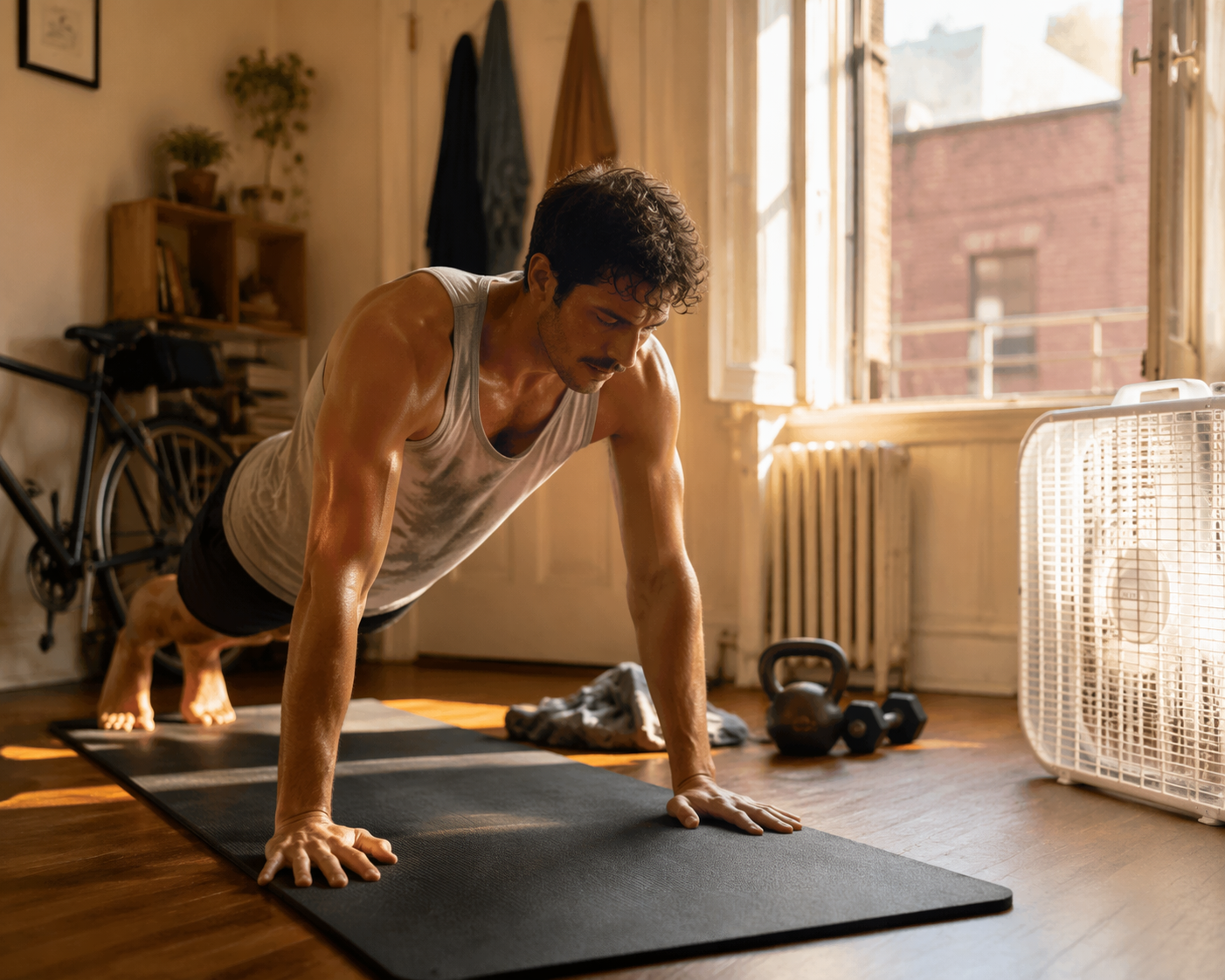
A cheap box fan is the load-bearing purchase because sweat only cools you well when it can evaporate. In a small room, moving air across skin is not a luxury; it is the difference between sweat doing useful work and sweat just soaking your clothes.
The basic setup is simple: place the fan near one opening and create an exit path across the room, ideally through an opposing window or door. Apartment-cooling guidance commonly treats cross-ventilation as one of the most effective no-AC moves, and a fan-supported cross-breeze can produce a perceived cooling improvement of about 5 to 10°F when conditions cooperate.[3]
That last clause matters. If the outdoor air is hotter than the indoor air, pulling it directly into the room can make the workout space worse. In that case, use the fan to circulate indoor air across your body, exhaust hot air when the outside temperature drops, and avoid treating an open window as automatically helpful.
- Best case: cooler outdoor air enters from one side, warmer indoor air leaves from another.
- Decent case: the fan blows across your body during low- or moderate-intensity work.
- Bad case: the fan pulls hotter outdoor air into a room that was already cooler than outside.
- Worst case: no air movement, closed room, rising humidity, and a workout plan that still includes jumps or intervals.
A small-apartment setup does not need to look clever. A box fan on a chair, pointed at the workout zone, with a second opening cracked on the other side of the room, beats a photogenic towel if the room was airless five minutes ago.
Buy a Hygrometer So the Room Gets a Vote
A hot room and a humid room are not the same training problem. High humidity slows evaporation, so your fan has less sweat to work with. A digital hygrometer gives you the number you cannot reliably feel: relative humidity.
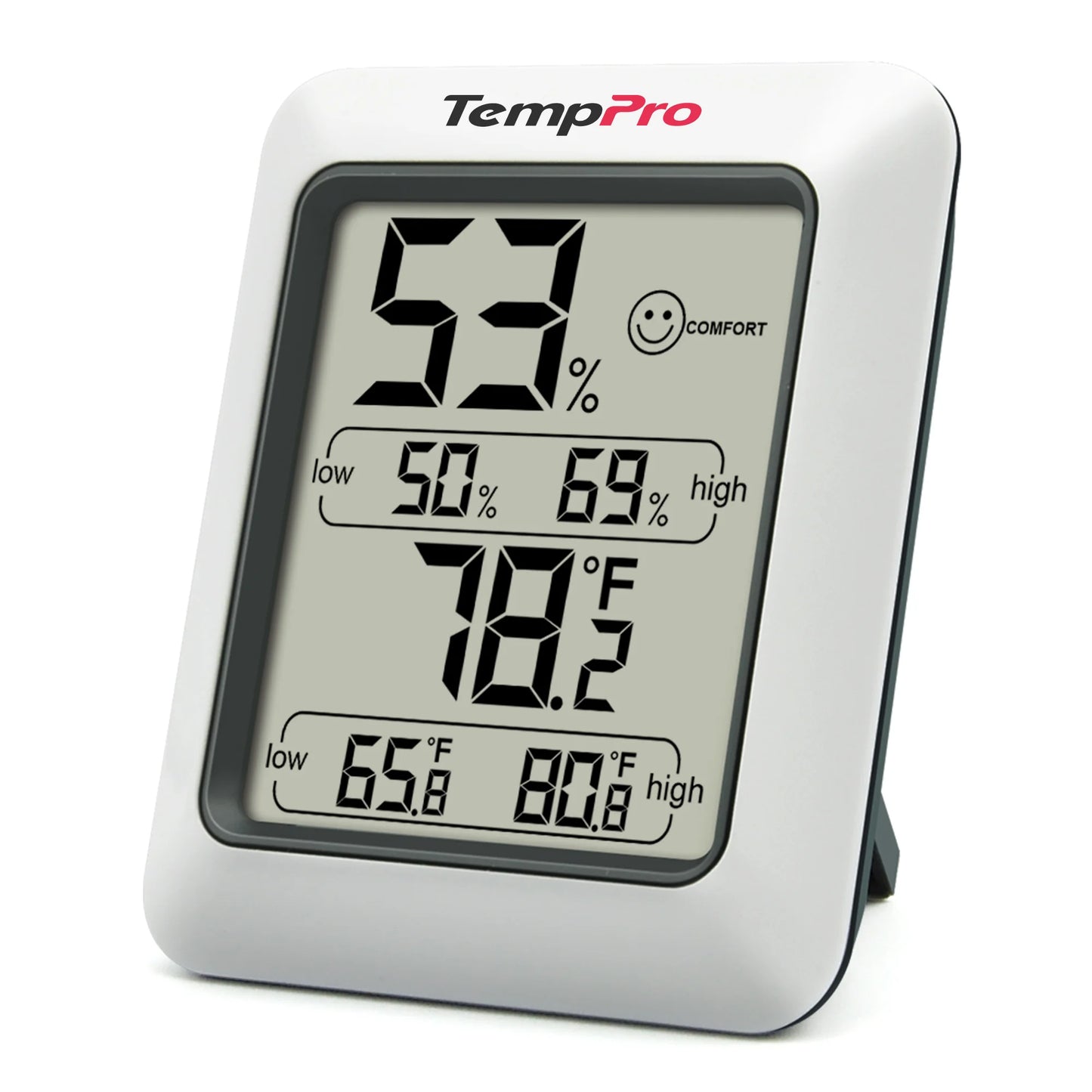
For home use, the point is not to turn your apartment into a sports-medicine lab. It is to stop making workout decisions from vibes. Wet-bulb globe temperature, or WBGT, is a heat-stress measure used in athletic settings because it accounts for more than air temperature. Princeton Sports Medicine describes a four-tier exercise-safety system: low risk under 77°F WBGT, moderate risk from 77 to 81°F, high risk from 81 to 84°F, and extreme risk above 84°F.[4]
Those numbers are adapted here, not presented as official indoor home-workout standards. No major authority has published a clean “no-AC apartment workout” WBGT chart. But the logic still helps: as heat and humidity rise together, shorten the session, lower intensity, or skip the workout rather than trying to out-discipline the room.
| Room Reading | Practical Home-Workout Decision |
|---|---|
| Warm but dry, fan working | Keep the workout moderate and watch symptoms. |
| Warm and humid | Shorten the session and avoid intervals or jumping. |
| Hot, humid, little airflow | Do mobility, very light floor work, or stop. |
| You feel dizzy, chilled, confused, nauseated, or unusually weak | Stop exercising and cool down; do not negotiate with symptoms. |
This is where the hygrometer earns its eight or ten dollars. It does not cool anything by itself. It prevents the more expensive mistake: buying comfort gear while continuing to train in a room that should have been a rest-day room.
Add Water to the Skin After You Have Air Moving
A continuous spray bottle is not glamorous, which is partly why it is useful. Lightly misting your arms, legs, neck, or shirt gives the fan more moisture to evaporate. PBS heat-wave guidance includes evaporative cooling with a spray bottle and fan among practical no-AC cooling strategies.[3]
Use it between sets or before a low-intensity circuit, not as permission to turn a brutal room into a HIIT studio. Spray plus fan is a support system for reasonable exercise. It is not a medical device, and it is not a substitute for stopping when heat symptoms show up.
- Good use: mist exposed skin, stand in the fan path, resume when you feel settled.
- Messy use: soak the floor before lunges, planks, or anything that needs traction.
- Overconfident use: spraying yourself while ignoring a high-humidity room that is not letting sweat evaporate.
Use a Cooling Towel for Comfort, Not as Proof You Are Safe
A cooling towel can be worth five to fifteen dollars if you understand its job. Wet it, wring it out, place it around the neck or over the shoulders between sets, and it may make the workout feel more tolerable. A Western Kentucky University study published in the International Journal of Exercise Science found that multi-site cooling towels improved thermal sensation during exercise, but did not significantly improve performance metrics; the study setting was thermoneutral, not a lived-in hot apartment.[6]
That distinction is the whole purchase decision. Better thermal sensation is valuable. Feeling less awful can help you pace yourself and stay calm. But “I feel cooler” is not the same as proven core-temperature reduction, and it should not overrule a bad hygrometer reading, poor airflow, or symptoms.
Buy the plain towel before the fancy one. If the product page leans on fabric names and dramatic before-after language but cannot explain how it works beyond being wet, cold, or evaporative, you do not need the premium version for a small apartment workout.
The Yoga Mat Is for the Floor and the Exercise Menu
A yoga mat is the least dramatic cooling fix on the list, and it belongs last for that reason. It will not change the room temperature. It can, however, insulate you from a hot floor and make it easier to choose movements that produce less heat than standing jumps, burpees, or fast circuits.
When the room is borderline, the mat lets you move the workout toward glute bridges, dead bugs, bird-dogs, side planks, slow pushups, breathing drills, and mobility work. That is not a consolation prize. It is a way to keep the habit alive without forcing high-output exercise into a room that cannot support it.
For hot-weather use, skip thick, plush mats that trap heat and feel unstable under sweaty hands. A basic grippy mat is enough. If you already own one, do not rebuy it because a summer version has better branding.
What Not to Buy First
The worst hot-weather purchases are the ones that feel decisive while leaving the main bottleneck untouched. In a small room, that usually means they cool too little skin, hide the need to measure humidity, or add a safety risk.
Ice Packs
Ice packs feel intuitive because cold contact is obvious. The problem is coverage. BBC Future, citing Rebecca Stearns of the Korey Stringer Institute at the University of Connecticut, notes that ice packs have a “surprisingly low cooling rate” because they cover only a small skin area; wetting the skin and using a fan can cool more effectively.[1]
That does not make an ice pack useless for every purpose. It makes it a poor first purchase for exercising in a hot room. If the air is still and humid, a cold rectangle on your neck is not fixing the room.
Salt Tablets
Salt tablets do not belong in this under-$50 kit. The American Heart Association advises against them for warm-weather activity, and MedlinePlus warns that salt tablets can increase dehydration risk.[2][5]
For most short home workouts, water and a cooler room setup are the priority. Electrolyte drinks become more relevant when exercise lasts longer than an hour, but that is a different problem than making a small no-AC room safe enough for today’s low-equipment session.[2]
Overpriced Cooling Gear
A vest, sleeve, headband, or premium towel can make you feel prepared. That feeling has value, but it should not take the first dollars away from airflow and measurement. If the room has no fan and no humidity reading, the cart is out of order.
The Under-$50 Setup That Actually Changes the Workout
Set the fan first. Check the hygrometer before you start. Use the spray bottle and towel to support evaporation and comfort once air is moving. Shift to floor-based, lower-heat movements when the room is borderline. Stop when the room or your body gives you a clear no.
Under $50 can meaningfully reduce heat stress during home workouts without AC, but only if the purchases solve the right problems in the right order. Airflow first. Measurement second. Comfort after that.
References
- How to exercise safely in hot weather, BBC Future, June 18, 2026
- How to Be Active Safely in Warm Weather, American Heart Association
- How to stay cool and safe in a heat wave, even without air conditioning, PBS News
- Wet Bulb Temperature and Exercise Safety, Princeton Sports Medicine
- How to avoid overheating during exercise, MedlinePlus
- Multi-site cooling towel thermal sensation study, Western Kentucky University / International Journal of Exercise Science
Don't have the gear this routine assumes? Find the build that covers it.
Wondering how much rest you need after this? Read our ACSM-cited recovery reference.
Questions about form, substitutions, or a correction? Leave it below.
Comments
Join the discussion with an anonymous comment.