
Do a PFL Fighter Workout at Home With No Equipment
Train like a PFL fighter at home with a 6-week progressive bodyweight circuit designed for a 2x2 meter space and zero equipment. Based on PFL Fighting Fit modalities and MMA conditioning protocols, this routine delivers fighter-level conditioning in a tiny apartment.
Before you start
- Equipment required
- No equipment (bodyweight only)
- Assumes build tier
- No specific tier required
- Duration
- 20 minutes
- Difficulty
- Beginner
You can run a PFL fighter workout at home with no equipment if you start with the real constraint: clear a 2x2 meter patch of floor, about 4 square meters, and keep the work compact. That is enough for stationary shadow boxing, sprawls, planks, wall sits, bear crawls, crab walks, and fight-round conditioning. A 3x3 meter area gives you more room for lateral shuffles and cleaner penetration-step entries, but it is not required for this 6-week plan.[1]
Equipment assumption: $0 bodyweight. Shoes are optional if your floor is safe. A jump rope is the only add-on worth considering later, usually a low-cost upgrade for calf endurance, rhythm, coordination, and foot speed, but this program does not require one.
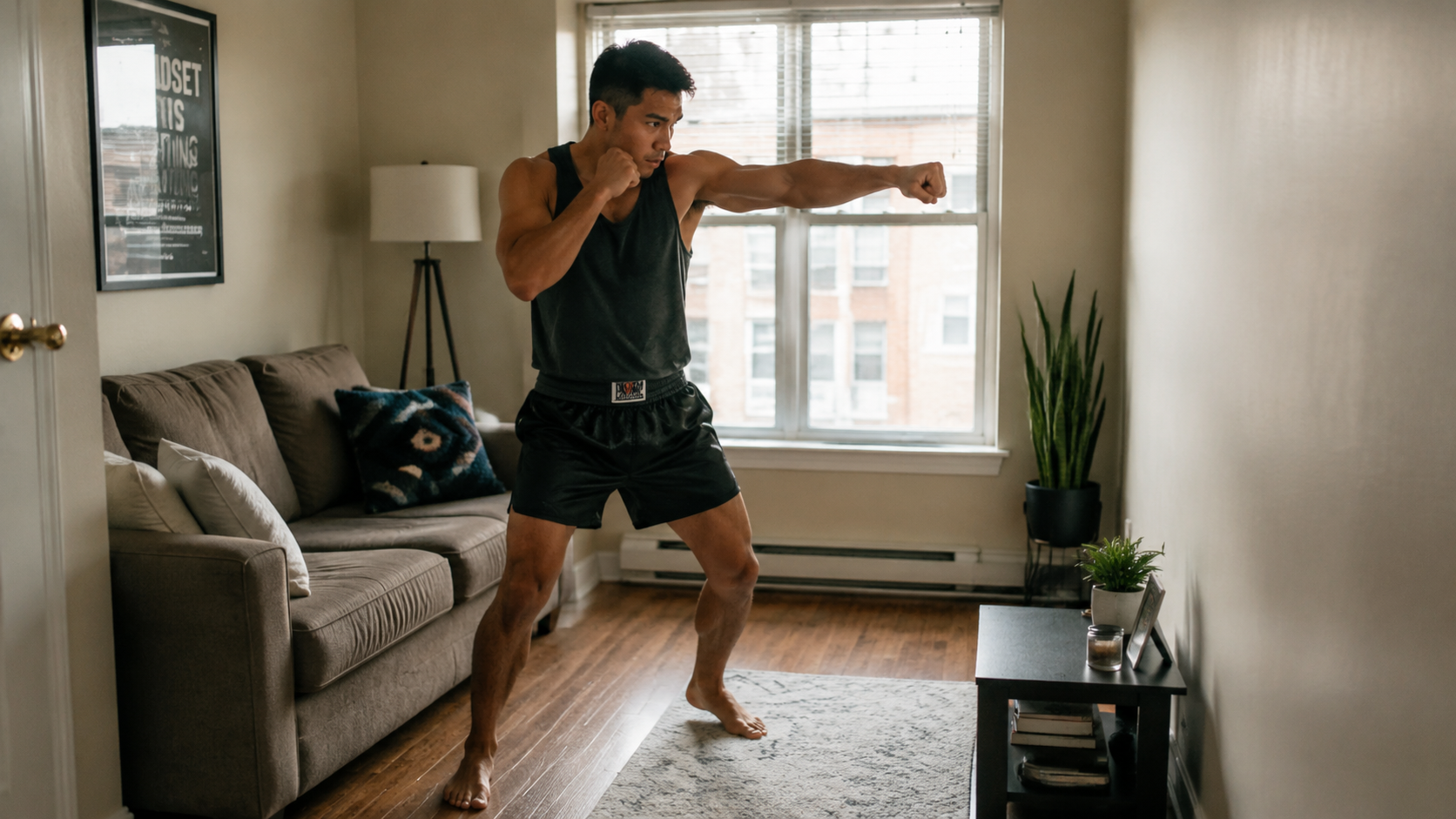
This is not a leaked PFL camp program, and it should not pretend to be. PFL athletes train under coaches, with sparring partners, equipment access, recovery support, and fight-specific game plans. What you can borrow at home is more modest and more useful: the broad conditioning qualities emphasized in PFL-style training, translated into movements that work between a bed, a desk, and a wall.
What This Borrows From PFL Training
The PFL Fighting Fit series gives this workout its anchor without turning it into fantasy. The official series has covered core strength, medicine ball work, animal flow, battle ropes, box jumps, isometric strength, and balance, with Caroline Pearce hosting episodes tied to sports science and physiology credentials.[2][3] Most apartment dwellers do not have battle ropes, a box, a medicine ball, or a clear gym lane. That does not make the training quality unusable; it means the movement has to be translated honestly.
| PFL-style training quality | No-equipment apartment translation | Why it belongs |
|---|---|---|
| Striking conditioning | Shadow boxing, stance switches, slips, rolls, compact combinations | Builds rhythm, shoulder endurance, trunk rotation, and breathing under movement |
| Wrestling demand | Sprawls, penetration steps, hip escapes, technical get-ups | Trains level change, floor-to-stand transitions, and repeated bursts |
| Isometric strength | Planks, side planks, wall sits, glute bridge holds | Builds bracing and position control without needing load |
| Animal flow | Bear crawls, crab walks, frog jumps in short lanes | Adds shoulder loading, hip mobility, and whole-body coordination |
| Fight-round fatigue | Timed circuits using 3-minute work blocks and controlled rest | Makes the body manage repeated efforts instead of one isolated exercise |
There is also a useful reality check from actual fighters: bodyweight training in improvised spaces is not a consolation prize. Matt Marsden has described bodyweight-only MMA workouts as normal for fighters who are traveling or stuck without a gym.[4] Ray Cooper III, a PFL welterweight champion with a published 23-7-1 record at the time of the cited profile, has been reported as training exclusively in his garage.[5] Those examples do not prove that your apartment circuit equals an elite camp. They do knock down the idea that serious conditioning only starts once you have a commercial gym.
The 6-Week Plan at a Glance
The structure below follows a 6-week, no-equipment combat-conditioning progression: foundation in Weeks 1-2, build in Weeks 3-4, and peak fight-simulation work in Weeks 5-6.[1] Train 4 days per week through the first 4 weeks. In Weeks 5-6, train 4 days if recovery is average and 5 days only if your joints, sleep, and motivation are holding up.
| Phase | Weeks | Weekly frequency | Main target | Intensity guide |
|---|---|---|---|---|
| Foundation | 1-2 | 4 days/week | Movement quality, aerobic base, light striking rhythm | Conversational pace; you can speak in full sentences |
| Build | 3-4 | 4 days/week | Anaerobic capacity, combinations, sprawl complexes | Hard but controlled; you can speak short phrases |
| Peak | 5-6 | 4-5 days/week | Explosive efforts and fight-simulation rounds | Short-speech intensity; 2-3 words at a time during hard rounds |
Use a simple weekly layout: Day 1 striking and core, Day 2 wrestling transitions, Day 3 rest or mobility, Day 4 animal flow and legs, Day 5 mixed conditioning, Day 6 optional easy shadow boxing or rest, Day 7 rest. If your week is chaotic, protect the order more than the calendar. Do not stack all four hard days back-to-back just because the apartment is finally quiet.
Before You Start: Mark the Space
Stand in the middle of your cleared space and make one slow turn with your arms extended. If you hit a lamp, desk chair, bed frame, or door handle, move something. Then lie down in a plank position and step one foot outside your hands. If your knee or toes hit furniture during that transition, your sprawls and get-ups will get sloppy when you are tired.
- For shadow boxing: keep combinations mostly in place, using small pivots instead of long advances.
- For sprawls: step or hop the legs back only as far as your floor allows, then return to stance under control.
- For bear crawls and crab walks: move forward two to four hand steps, reverse, then repeat.
- For quiet hours: replace squat jumps with fast bodyweight squats and replace burpees with step-back sprawls.
Quiet training is not just politeness. Small-space workout guidance commonly uses low-impact substitutions when neighbors, floors, or ceilings make jumping a bad choice.[6] If you live above someone, your best fighter workout is the one you can repeat without turning every session into a lease negotiation.
Weeks 1-2: Build the Base Without Rushing the Fight Fantasy
The first two weeks should feel almost too controlled. That is intentional. You are learning how to breathe while your hands are up, how to sprawl without crashing into the floor, and how to hold a plank after your shoulders are already tired. If you turn every round into a max-effort test now, Weeks 3-6 become damage control.
| Day | Session | Work |
|---|---|---|
| Day 1 | Shadow boxing + core | 3 rounds: 2 min shadow boxing, 45 sec rest. Then 3 rounds: 30 sec plank, 30 sec dead bug, 30 sec rest. |
| Day 2 | Wrestling transitions | 4 rounds: 6 step-back sprawls, 8 penetration steps total, 6 technical get-ups total, 60 sec rest. |
| Day 4 | Animal flow + legs | 3 rounds: 30 sec bear crawl lane, 30 sec wall sit, 30 sec crab hold or crab walk, 60 sec rest. |
| Day 5 | Mixed conditioning | 4 rounds: 45 sec light shadow boxing, 8 bodyweight squats, 6 mountain climbers per side, 60-75 sec rest. |
Shadow boxing here is not air-punching until your shoulders burn. Work simple combinations: jab-cross, jab-cross-slip, cross-hook-cross, jab-low kick motion if your floor allows the pivot. Keep the chin tucked, hands returning to guard, and feet quiet. If the floor squeaks under every reset, shrink the stance adjustment rather than forcing footwork you cannot use.
Use the talk test as your governor. In Weeks 1-2, you should be able to speak in full sentences during most work. That does not mean the session is useless. It means you are building the base that lets harder rounds later look like training instead of panic.
Weeks 3-4: Add Complexes and Make the Rounds Less Comfortable
Weeks 3-4 keep the same apartment footprint but change the density. Movements start linking together: punch, level change, sprawl, stand, punch again. This is where the workout begins to feel more like MMA conditioning and less like a list of bodyweight exercises.
| Day | Session | Work |
|---|---|---|
| Day 1 | Combination striking | 4 rounds: 2 min 30 sec shadow boxing, 45 sec rest. Every 20-30 sec, add a slip, roll, or stance reset. |
| Day 2 | Sprawl complex | 5 rounds: 3 punches in stance, 1 sprawl, 2 penetration steps total, 1 technical get-up, 45-60 sec rest. |
| Day 4 | Isometric and animal-flow circuit | 4 rounds: 30 sec bear crawl, 30 sec plank shoulder taps, 30 sec wall sit, 30 sec crab walk or hold, 60 sec rest. |
| Day 5 | Compact conditioning | 5 rounds: 30 sec mountain climbers, 30 sec shadow boxing, 30 sec squat jumps or fast squats, 60 sec rest. |
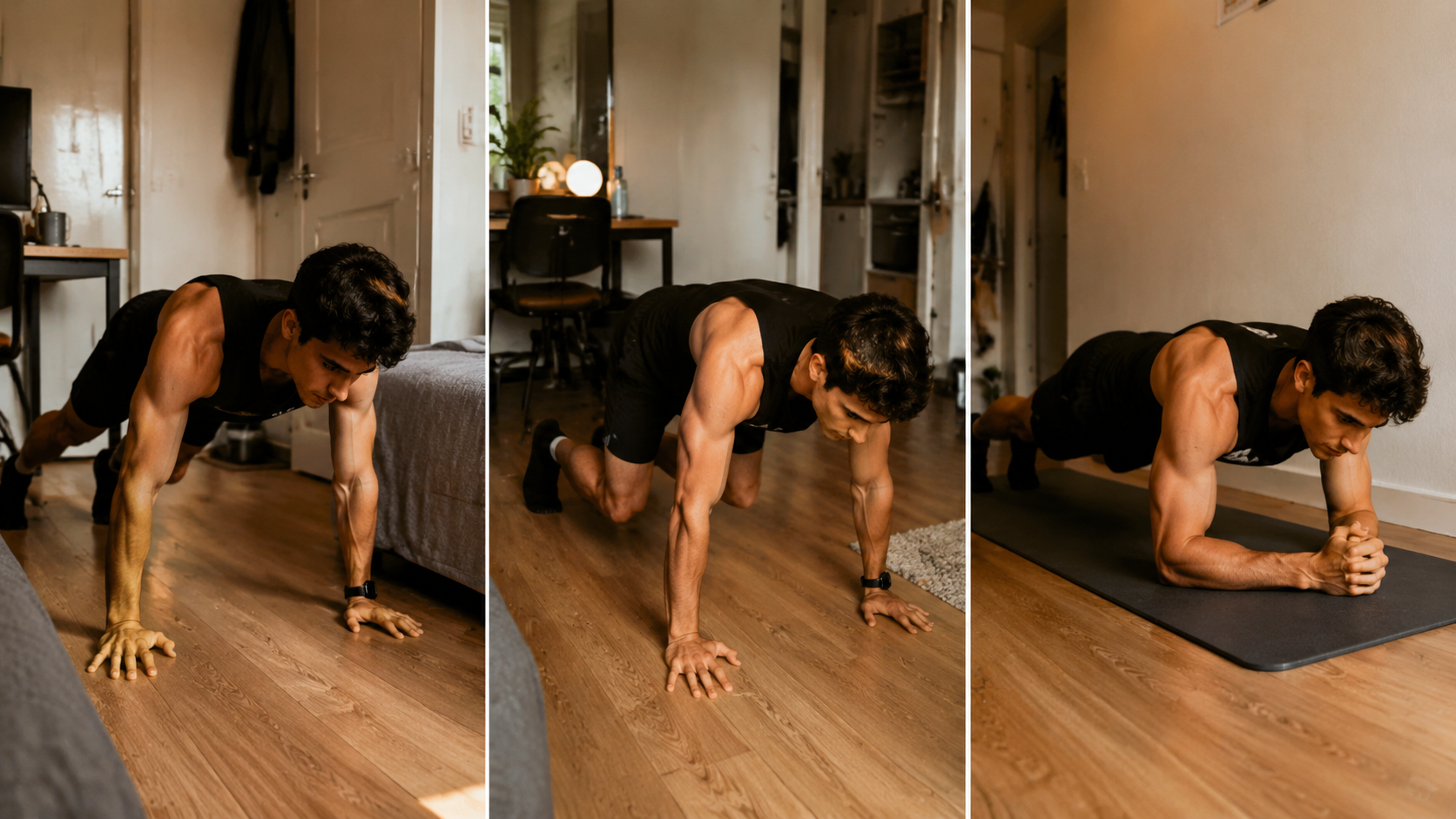
The sprawl complex is the hinge of this phase. Start in stance, throw a short combination, drop the hands, send the legs back, return to stance, then step into a penetration step on each side. In a larger room, you might travel. In a 2x2 meter square, you reset under yourself. That restriction is useful: it punishes lazy feet and overlong steps.
Intensity now moves from conversational to hard but controlled. You should be able to speak in short phrases during work, not full paragraphs. If your punches turn into arm flailing, your sprawls get loud, or your lower back takes over during mountain climbers, increase rest before you increase effort.
Weeks 5-6: Fight-Simulation Rounds Without Losing the Room
The peak phase uses 3-minute work rounds with 1-minute rest, a format used in the 6-week combat-conditioning structure that informs this plan.[1] The mistake is treating “fight simulation” as permission to go blind. At home, no coach is watching your knee angle, your breathing, or whether your sprawl is turning into a belly flop. These rounds should be intense, not reckless.
| Day | Session | Work |
|---|---|---|
| Day 1 | Striking round simulation | 5 rounds: 3 min shadow boxing with slips, rolls, pivots, and stance resets; 1 min rest. |
| Day 2 | MMA transition rounds | 4-5 rounds: 30 sec shadow boxing, 30 sec sprawls, 30 sec penetration steps, 30 sec mountain climbers, 30 sec technical get-ups, 30 sec shadow boxing; 1 min rest. |
| Day 4 | Strength endurance rounds | 4 rounds: 45 sec wall sit, 45 sec plank, 45 sec bear crawl, 45 sec glute bridge hold; 1 min rest. |
| Day 5 | Peak conditioning circuit | 5 rounds: 20 sec fast punches, 20 sec squat jumps or fast squats, 20 sec sprawl, repeat for 3 min; 1 min rest. |
| Optional Day 6 | Easy technical flush | 15-20 min relaxed shadow boxing, mobility, and breathing only. |
Use short-speech intensity for the hard rounds. You should be able to get out two or three words, not hold a conversation. If you cannot recover enough in the 1-minute rest to start the next round with clean technique, cut one round or lower the movement impact. The goal is repeatable pressure, not one heroic round followed by four ugly ones.
For the optional fifth training day, do not sneak in another hard circuit. Keep it easy: slow shadow boxing, hips, ankles, thoracic rotation, breathing, and maybe a few technical get-ups. If your resting energy is poor, skip it. Four good sessions beat five sessions that make your knees and wrists hate the program.
How to Scale the Movements When No Coach Is Watching
Solo training needs rules that are boring enough to work. The harder the round, the less you should improvise. Pick the version you can repeat cleanly under fatigue, then earn the faster version later.
| Movement | Make it easier | Make it harder |
|---|---|---|
| Shadow boxing | Stay in place and use 2-punch combinations | Add slips, rolls, stance switches, and 3-5 punch combinations |
| Sprawl | Step back one leg at a time | Hop both legs back and return directly to stance |
| Penetration step | Step shallow and reset | Lower the level more and add a rear-leg drive |
| Bear crawl | Hold bear position or crawl two steps forward and back | Crawl continuously with quiet knees hovering close to the floor |
| Wall sit | Hold higher than parallel | Hold closer to parallel or add alternating heel raises |
| Mountain climber | Step the feet slowly | Drive the knees faster while keeping hips level |
A useful rule for apartment MMA conditioning: noise often reveals loss of control. A loud sprawl, heavy jump, or stomping pivot usually means fatigue has beaten coordination. Switch to the quiet version before the round becomes joint stress with fight branding.
Warm-Up and Cooldown That Fit the Same 2x2 Meter Space
Before each session, spend 5-7 minutes raising temperature and rehearsing the positions you will use. You do not need a separate warm-up area. You need ankles, hips, shoulders, and breathing to come online before the first timed round.
- 60 seconds easy bounce or marching in stance.
- 60 seconds arm circles, scapular push-ups, and shoulder rolls.
- 60 seconds hip hinges, bodyweight squats, and alternating reverse lunges if space allows.
- 60 seconds slow shadow boxing with only jabs, crosses, and guard returns.
- 60-120 seconds practicing the first circuit movement at half speed.
After the session, walk the room, breathe through the nose if you can, and let your hands drop. Then use two or three easy positions: child’s pose, couch hip-flexor stretch, forearm wall stretch, or a relaxed squat hold. The cooldown is not magic recovery. It is a simple way to stop carrying fight-round tension into the rest of your evening.
Common Problems in a Tiny Apartment
| Problem | Fix |
|---|---|
| Your wrists hurt during sprawls or bear crawls | Use fists if comfortable, slow the transition, reduce crawl time, and add more wall sits or shadow boxing instead. |
| Your downstairs neighbor can hear jumps | Replace squat jumps with fast squats and hop-back sprawls with step-back sprawls. |
| You run out of room during footwork | Use pivots, stance switches, and quarter-turn resets instead of forward-back movement. |
| Your shoulders gas out before your lungs | Lower punching volume for one round and keep hands returning to guard instead of hanging high nonstop. |
| You cannot recover during 1-minute rests | Cut one round, extend rest to 90 seconds for the day, or return to the Week 3-4 format. |
The best adjustment is usually the smallest one that restores clean movement. Do not rewrite the entire program because one exercise is noisy or one round ran too hot. Swap the impact, shorten the range, or reduce the round count, then continue.
What to Do After Week 6
After Week 6, choose based on how you recovered, not how motivated you feel on the final day. If the peak rounds were hard but clean, repeat Weeks 5-6 once more. If your joints feel beat up or your sleep dipped, deload for a week with only Foundation-style sessions. If you want the same idea without the PFL-specific framing, move to a general 6-week no-equipment home MMA workout program. If you want your first equipment upgrade, a jump rope is the simplest addition before you start buying larger gear.
In 4 square meters, with no equipment, you can train the same broad conditioning qualities that PFL-style programming emphasizes: striking rhythm, level changes, isometric control, animal-flow coordination, and repeat-round fatigue. The ceiling is not the same as a coached fight camp. The floor, if you follow the progression and regulate intensity, is much higher than another random living-room sweat circuit.
References
- MMA Home Workout Plan: 6 Weeks No Equipment Combat Conditioning, 369mmafit
- PFL Fighting Fit: Core Strength, Professional Fighters League
- Caroline Pearce shows off battle rope exercise in latest PFL Fighting Fit workout, MMA Junkie, 2018
- The MMA Workout You Can Do at Home, Verywell Fit
- Ray Cooper III Is Ready to Take Over the PFL, Muscle & Fitness
- The Small Space Workout, Nerd Fitness
Don't have the gear this routine assumes? Find the build that covers it.
Wondering how much rest you need after this? Read our ACSM-cited recovery reference.
Questions about form, substitutions, or a correction? Leave it below.
Comments
Join the discussion with an anonymous comment.