
Run a Preseason Double Session at Home With No Equipment
This 4-6 week plan uses bodyweight progressions for AM strength and PM conditioning in a 6x6 ft space, proving you can build preseason fitness with zero equipment through tempo and unilateral loading.
Before you start
- Equipment required
- none
- Assumes build tier
- No specific tier required
- Duration
- 20 minutes
- Difficulty
- beginner
This is a preseason double session training routine for home fitness with the least romantic setup possible: no equipment, a roughly 6x6 ft apartment space, one morning strength session, one later conditioning session, and a 4-6 week ramp. It is not a secret pro-club protocol, and it is not a claim that your living room can replace a field, court, mat, hill, or full-speed team practice. It is a structured synthesis of established preseason timing, two-a-day spacing, home athletic training principles, and bodyweight progression methods.
The useful promise is narrower and more believable: if you can recover from two short sessions per day, you can build a real base of strength, muscular endurance, trunk control, and repeat-effort conditioning before your season starts. Catapult describes preseason as a 4-6 week period with progressive load increases, which is exactly the window this plan uses rather than trying to cram fitness into one heroic week [1].

The Apartment Rules
Before the workouts, set the rules. The training area is about 6x6 ft, furniture can be pushed aside, and the floor should allow lunges, planks, push-ups, glute bridges, squat variations, mountain climbers, and quiet burpee modifications. That space target is a practical apartment guideline supported by small-space bodyweight workout guidance from 12 Minute Athlete and TRX, not a lab-tested threshold [6][7].
Equipment means none. No dumbbells, bands, pull-up bar, treadmill, sliders, box, jump rope, or weighted vest. Shoes are optional depending on your floor and joints. A towel and a timer are useful, but they are not training equipment.
The neighbor rule matters. Conditioning here uses low-impact density: fast step-backs, mountain climbers, squat-to-calf-raise patterns, bear plank shoulder taps, reverse lunges, and walk-out variations. You can still breathe hard without turning every evening session into a jumping test for the ceiling below you.
How the Double Sessions Work
The morning session is the more controlled session: mobility, strength, trunk work, and a small amount of power when appropriate. The evening session is conditioning: repeated efforts, short rests, and controlled fatigue. That split follows two practical ideas. NIFS frames at-home athletic training around mobility, power, strength, and conditioning, while two-a-day guidance from Verywell Fit and Breaking Muscle recommends leaving about 4-6 hours between sessions and generally placing the harder or more technical workout earlier in the day [4][2][3].
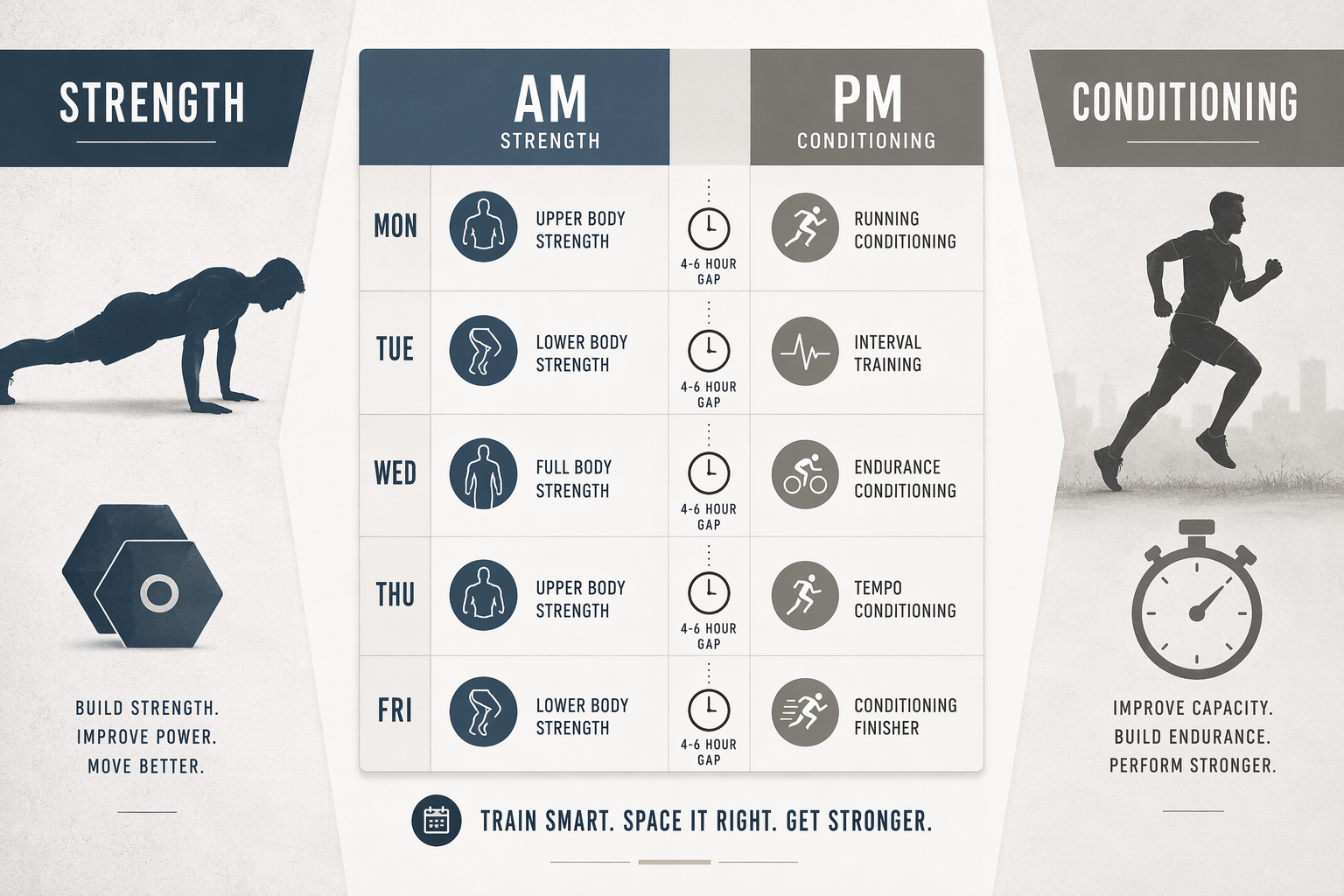
If the morning session starts at 7:00 a.m., the evening session should usually land no earlier than late lunch and preferably after work. If life only gives you two hours between sessions, do one session. The plan works because the exposures accumulate; it does not work better because you ignored recovery.
| Day | AM session | PM session | Purpose |
|---|---|---|---|
| Monday | Lower-body strength + trunk | Low-impact intervals | Start the week with legs while fresh |
| Tuesday | Upper-body strength + mobility | Aerobic density circuit | Build repeatable work without pounding |
| Wednesday | Single session only: mobility + easy core | Off | Protect the middle of the week |
| Thursday | Lower-body unilateral strength + trunk | Tempo conditioning circuit | Progress strength and repeat-effort tolerance |
| Friday | Upper-body strength + low-level power | Short interval finisher | Add intensity before the weekend |
| Saturday | Optional single mixed session | Off | Use only if recovery is good |
| Sunday | Off | Off | Full recovery |
That gives you four true double-session days, one light single-session day, one optional single-session day, and one full day off. Most recreational athletes with jobs, apartments, and actual evenings should start there. If you already play pickup or attend sport practice during the week, count that as conditioning and remove the PM session that day.
Check Recovery Before You Earn More Work
Twice-daily training is not automatically advanced, but it does give you twice as many chances to misjudge soreness, sleep, appetite, and motivation. Verywell Fit and Breaking Muscle both discuss the need to manage recovery and the risk of doing too much when training twice in a day [2][3].
- Step down to one session if performance drops for two workouts in a row.
- Step down if soreness changes your squat, lunge, push-up, or plank form.
- Step down if sleep gets worse for more than a night or two.
- Step down if the PM session becomes something you dread rather than something you can start calmly.
- Skip all hard sessions if pain feels sharp, joint-based, or different from normal training fatigue.
There is no prize for completing a home preseason plan while getting slower, sorer, and worse at your sport. The first adjustment is not to quit. It is to keep the AM strength session and drop the PM conditioning session for a few days.
The 4-6 Week Ramp
Run the plan for four weeks if your season is close. Extend it to six weeks if you have more runway and can keep the increases modest. The point is not to make every week harder in every possible way. Pick one main progression lever at a time: more controlled tempo, a harder unilateral version, one extra set, a few extra reps, or slightly denser conditioning.
| Phase | Weeks | Strength emphasis | Conditioning emphasis |
|---|---|---|---|
| Base | Week 1 | Learn the movements, stop with reps in reserve | Moderate circuits, generous rest |
| Build | Week 2 | Add reps or one set to main movements | Slightly shorter rest or one more round |
| Load | Week 3 | Use slower eccentrics and more unilateral work | Harder intervals, still quiet |
| Consolidate | Week 4 | Hold quality while fatigue rises | Best repeatable effort, not all-out collapse |
| Extend | Week 5 | Optional: add difficulty only if recovery is strong | Optional: add density, not impact |
| Taper into sport | Week 6 | Reduce volume, keep crisp movement | Shorter sessions, fresher legs |
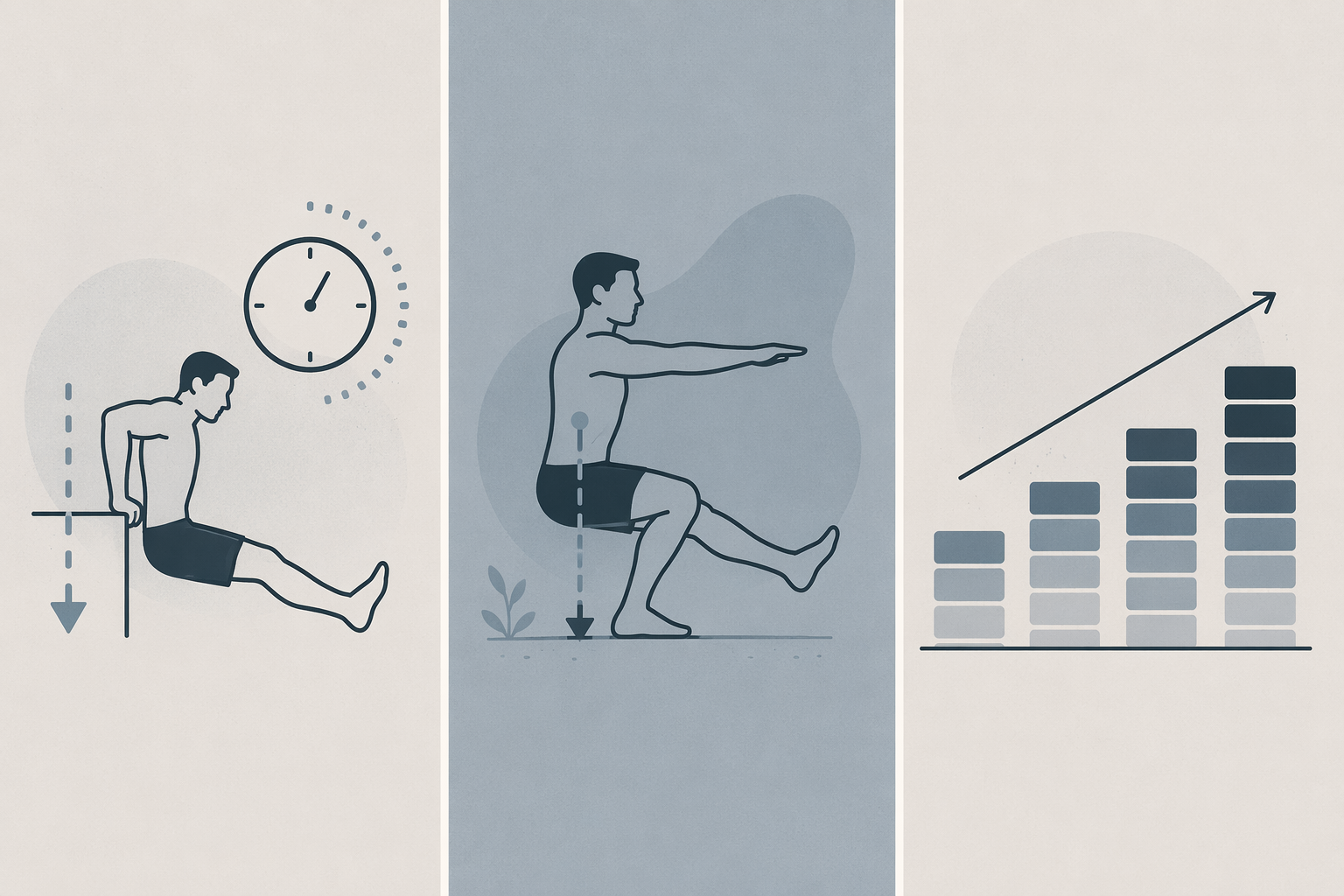
For bodyweight strength, tempo is your first weight room. Healthline notes that slow eccentric tempos, including 3-4 second lowering phases, can increase time under tension and help bodyweight movements become more demanding [5]. In practice, that means a push-up with a controlled 4-second descent is no longer the same exercise as a rushed push-up. A split squat with a slow lower, full pause, and clean drive up will expose a leg that was hiding during fast bodyweight squats.
Progression Lever 1: Tempo
Use tempo when a movement feels too easy but you do not have weight to add. Start with a normal controlled rep. Then move to a 3-second lower. Then a 4-second lower. Then add a 1-second pause at the hardest position. Do not use slow tempo on everything in the same workout unless you want the session to double in difficulty without admitting it.
| Movement | Week 1 | Week 2 | Week 3-4 progression |
|---|---|---|---|
| Push-up | Normal controlled reps | 3-second lower | 4-second lower plus pause near the floor |
| Squat | Smooth bodyweight squat | 3-second lower | 4-second lower plus pause at depth |
| Glute bridge | Two-leg bridge | 2-second squeeze at top | Single-leg bridge or longer top hold |
| Plank | Standard hold | Longer hold | Shoulder taps or long-lever plank |
Progression Lever 2: Unilateral Loading
One-leg and split-stance work is the closest thing this plan has to adding plates. A reverse lunge asks more from one leg than a squat. A split squat with a slow lower asks more again. A single-leg glute bridge makes the hip do work that a two-leg bridge can spread around. This is also where apartment training stays useful for field and court athletes: most sport positions are not perfectly symmetrical.
- Lower body path: squat, reverse lunge, split squat, slow split squat, rear-foot-free single-leg squat to a comfortable range.
- Hip path: glute bridge, long-lever bridge, single-leg bridge, single-leg bridge with longer top hold.
- Upper body path: incline push-up if needed, floor push-up, slow eccentric push-up, close-grip push-up, pause push-up.
- Core path: plank, long plank, shoulder tap plank, bear plank, slow mountain climber.
Progression Lever 3: Sets, Reps, and Density
Add volume conservatively. If Monday lower body uses 3 sets of 8 reverse lunges per side in Week 1, Week 2 can become 3 sets of 10 or 4 sets of 8. It should not become 5 sets of 15 plus a harder evening circuit. Conditioning progresses by density: the same work in less time, slightly more work in the same time, or a cleaner pace with the same rest.
The American Heart Association gives 150 minutes or more of moderate-intensity aerobic activity per week as a general adult benchmark; this plan's PM conditioning sessions usually land around 80-100 minutes per week, so treat them as preseason conditioning work, not a complete claim about weekly cardiovascular health targets [8]. If you also practice, walk, run, cycle, or play pickup, your total weekly activity will sit higher.
AM Strength Templates
Morning sessions should feel deliberate, not frantic. Keep most sets one or two good reps away from failure. The session should leave you feeling like you trained, not like you need to lie on the floor before your first meeting.
Lower Body + Trunk
| Block | Exercise | Week 1 dose | How to progress |
|---|---|---|---|
| Mobility | Hip circles, ankle rocks, world's-greatest-stretch variation | 4-5 minutes | Keep it easy; improve range, not fatigue |
| Strength A | Reverse lunge or split squat | 3 x 8 each side | Add reps, then slow the lower, then add a pause |
| Strength B | Bodyweight squat | 3 x 12 | Slow the lower or use 1.5 reps |
| Posterior chain | Glute bridge | 3 x 12 | Move to single-leg bridge |
| Trunk | Plank or bear plank | 3 x 25-40 seconds | Add time, shoulder taps, or longer lever |
Upper Body + Mobility
| Block | Exercise | Week 1 dose | How to progress |
|---|---|---|---|
| Mobility | T-spine rotations, scapular push-ups, shoulder circles | 4-5 minutes | Use smooth range |
| Strength A | Push-up variation | 4 x 6-10 | Lower incline, add reps, or slow eccentric |
| Strength B | Prone Y-T-W raises | 3 x 8 each shape | Add slow holds without shrugging |
| Strength C | Close-grip push-up or eccentric push-up | 3 x 5-8 | Only progress if elbows feel good |
| Trunk | Side plank | 3 x 20-35 seconds each side | Add time or top-leg lift |
There is no pulling substitute here that fully replaces rows, pull-ups, or climbing. Prone raises and plank variations help shoulder control, but if your sport demands strong pulling, grappling, or repeated contact, bodyweight-only apartment training has a ceiling. That ceiling is not a failure of discipline; it is a limitation of the tool.
PM Conditioning Templates
The evening sessions should raise breathing rate without turning into stomp conditioning. Use a timer. Keep transitions tight. If you live above someone, choose step-back burpees instead of jump burpees, reverse lunges instead of jump lunges, and fast walk-outs instead of broad jumps.
Low-Impact Interval Session
| Round format | Exercises | Week 1 | Progression |
|---|---|---|---|
| 30 seconds work / 30 seconds rest | Mountain climbers, reverse lunges, plank shoulder taps, squat to calf raise | 3 rounds | Add a 4th round or move to 35 seconds work |
| Optional finisher | Step-back burpee without jump | 4 x 20 seconds easy-hard | Add reps only if landing stays silent |
Aerobic Density Circuit
Set a 16-20 minute clock. Move through the circuit at a pace you could sustain without form getting sloppy: 10 squats, 8 push-ups or incline push-ups, 10 reverse lunges per side, 20 mountain climbers, 20 seconds side plank per side. Rest when needed. In Week 1, learn the pace. In Week 2, complete a little more total work. In Week 3 or 4, keep the same total work and make the rests shorter.
Tempo Conditioning Circuit
This one feels deceptively hard because the movements slow down before they speed up. Do 40 seconds of slow squats, 20 seconds rest, 40 seconds of mountain climbers, 20 seconds rest, 40 seconds of slow reverse lunges, 20 seconds rest, 40 seconds of plank shoulder taps, 60 seconds rest. Repeat for 3-5 rounds depending on the week. The goal is pressure, not panic.
A Sample Week You Can Actually Run
| Day | Morning | Evening |
|---|---|---|
| Monday | Lower body + trunk template | Low-impact interval session |
| Tuesday | Upper body + mobility template | Aerobic density circuit |
| Wednesday | 10-20 minutes mobility, easy core, breathing | Off |
| Thursday | Lower body with unilateral emphasis | Tempo conditioning circuit |
| Friday | Upper body + trunk, slightly lower volume | Short low-impact intervals |
| Saturday | Optional 20-30 minute mixed easy session | Off |
| Sunday | Off | Off |
For Weeks 1-2, keep the optional Saturday session easy or skip it. For Weeks 3-4, use Saturday only if your legs feel normal by the time you wake up. For Weeks 5-6, the choice depends on the calendar: if sport practice is starting, reduce home volume; if you are still waiting for the season, keep the structure and stop chasing extra fatigue.
How to Adjust Without Guessing
The simplest rule is to adjust the evening first. AM strength work gives the plan its structure. PM conditioning gives it its preseason feel. When recovery slips, remove the PM session before you start watering down every movement in the morning.
| If this happens | Change this week | Do not do this |
|---|---|---|
| Legs stay heavy for more than 48 hours | Drop one PM conditioning session | Add more burpees to push through |
| Push-ups regress across two sessions | Reduce upper-body sets by one-third | Keep adding tempo |
| Sleep gets worse | Run single sessions for 3-4 days | Train later and harder |
| Joints feel irritated | Remove impact and shorten range temporarily | Use soreness logic for joint pain |
| Everything feels easy | Progress one lever only | Add sets, tempo, unilateral work, and shorter rest at once |
A good home preseason build should make you more available for sport, not more attached to the plan. If practice, pickup, or games return during this block, they take priority over another living-room circuit. Replace the nearest PM conditioning session with the sport session and keep the next morning lighter.
What This Plan Does Not Replace
This routine can build useful preseason fitness: stronger legs relative to bodyweight, better trunk stiffness, more tolerance for repeated submaximal efforts, and a clearer rhythm of training twice in a day. It does not replace sprint mechanics, cutting at speed, contact preparation, ball work, tactical rhythm, sparring, skating, swimming, or the strange timing that only comes from other people moving around you.
If you recover well, continue the double-session plan for the full 4-6 week window and progress one lever at a time. If you are already missing sleep or dragging through the second session, step down to a simpler no-equipment beginner plan before building back up. If the site has a verified $0 build tier, that is the right next place for readers who want the same apartment-first logic with more equipment and space decisions.
References
- Preseason Training 101: Four Elements of Success, Catapult Sports.
- Two-a-Day Workout Plans for Fitness and Weight Loss, Verywell Fit, 2023.
- Two-A-Day Workouts Explained, Breaking Muscle, 2022.
- The Stay-at-Home Athlete, NIFS, 2020.
- 30 Moves to Make the Most of Your At-Home Workout, Healthline, 2024.
- The Cozy Training Plan, 12 Minute Athlete, 2024.
- The Small Space Workout, TRX Training, 2025.
- Try the 10-Minute Home Workout, American Heart Association, 2024.
Don't have the gear this routine assumes? Find the build that covers it.
Wondering how much rest you need after this? Read our ACSM-cited recovery reference.
Questions about form, substitutions, or a correction? Leave it below.
Comments
Join the discussion with an anonymous comment.