
Build Johnny Eblen Knockout Power at Home Without a Heavy Bag
Develop Johnny Eblen–style knockout power at home using only bodyweight drills, resistance bands, and household objects in a 6×6 ft space. No heavy bag or gym membership required.
Before you start
- Equipment required
- bodyweight, resistance bands, household objects (e.g., loaded backpack)
- Assumes build tier
- No specific tier required
- Duration
- 40 minutes
- Difficulty
- intermediate
You can build Johnny Eblen-inspired knockout power at home without hanging a heavy bag, drilling holes into a ceiling joist, or convincing a downstairs neighbor that thudding is part of your wellness routine. The working setup here is deliberately small: a 6×6 ft clear floor area, a $0–100 equipment tier, and only bodyweight, resistance bands, or careful household-object substitutes like a loaded backpack.
This is not Eblen’s private camp, an endorsed program, or a promise that you will start starching people with one right hand. It is a home routine built around the trainable mechanics that show up in his fighting: foot-to-fist force transfer, fast force production, and the conditioning to keep applying pressure after the first clean burst.
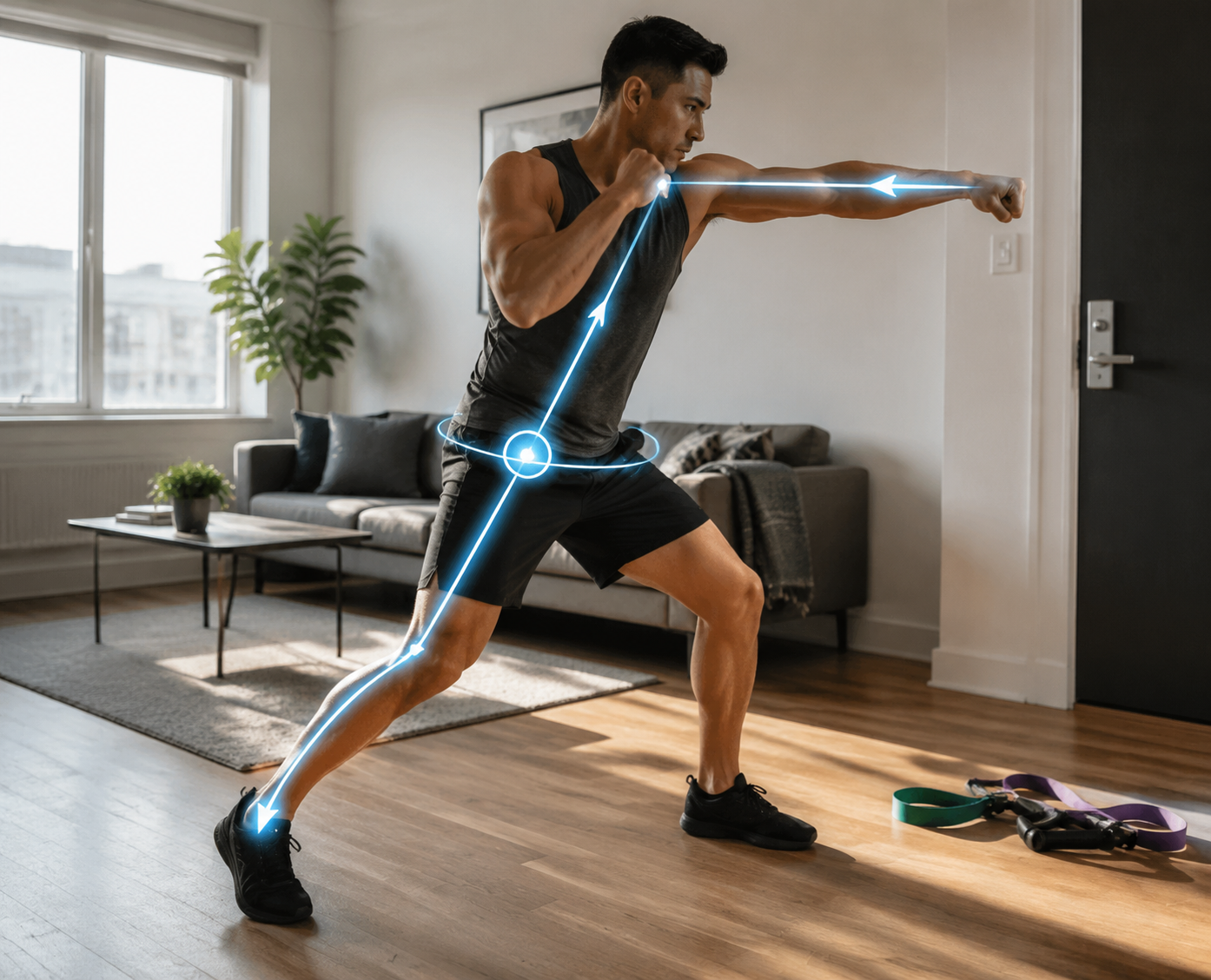
What Eblen-style power is made of
Eblen’s record gives the idea some weight without turning this into mythology. He is listed at 18-1 as a professional, with 7 KO/TKO wins, including a third-round finish of Fabian Edwards by right hook and follow-up ground-and-pound.[1] That finish matters for home training because the visible weapon was not a magical punch in isolation. It was position, balance, rotation, and the ability to keep forcing exchanges until a short opening appeared.
His coach Mike Brown has described him as “blessed with amazing cardio and conditioning” and said he has “a natural feel for footwork and striking.”[2] Those are not decorative compliments. For a small-space routine, they point toward the three qualities worth training: the feet must organize the punch, the hips and trunk must deliver force quickly, and the engine has to preserve snap when the session gets ugly.
The broader boxing-science frame lines up with that. Boxing Science describes punching power through kinetic chain sequencing, rate of force development, and the way fatigue compromises force output. It also cites amateur-boxing punching forces around 2,500 N, roughly 3.5 times body mass, delivered in about 60 ms.[3] Those numbers are not Eblen’s lab results, and they come from amateur boxing straight-punch contexts rather than MMA ground-and-pound. Use them as a reference for how fast and coordinated punching force needs to be, not as a claim about one fighter’s measured output.
The parts you can train without impact equipment
A heavy bag is useful because it gives feedback: distance, impact quality, shoulder fatigue, and whether your balance survives contact. It is not the only way to train the ingredients of power. In a small apartment, you can still rehearse the sequence that makes a punch worth throwing.
| Fight quality | Home-training target | No-bag drills |
|---|---|---|
| Foot-to-fist force transfer | Press the floor, rotate the hip, deliver the hand without leaking balance | Step-in shadowboxing, band-resisted crosses, slow-to-fast hip turns |
| Explosive force production | Apply force quickly instead of merely pushing hard | Plyometric pushups, fast stance switches, backpack or medicine-ball slams |
| Pressure-sustaining conditioning | Keep the punch sharp while tired | Short striking intervals, sprawl-to-punch rounds, low-noise density circuits |
The difference between “punching in the air” and training power is intent plus sequencing. If the rear foot is lazy, the hip opens late, the shoulder reaches, and the hand floats back slowly, shadowboxing becomes choreography. If the floor contact starts the strike and the hand returns before the next beat, it becomes useful.

The 6×6 ft home power routine
Run this routine two or three times per week, leaving at least a day between hard sessions if the plyometric work beats up your wrists, elbows, or shoulders. Clear the floor first. Socks on slick flooring are a bad trade; bare feet or training shoes on a stable surface are safer.
| Block | Time | Purpose |
|---|---|---|
| Warmup | 6–8 minutes | Raise temperature, open hips and shoulders, rehearse stance |
| Sequencing drills | 10–12 minutes | Teach the floor-to-hip-to-hand path |
| Explosive block | 8–10 minutes | Train fast force production |
| Pressure intervals | 8–12 minutes | Keep punching mechanics under fatigue |
| Cooldown | 3–5 minutes | Bring breathing down and unload shoulders |
Warmup: make the floor available
Start with two quiet minutes of bouncing in stance, step-drag footwork, or marching if noise is an issue. Then move through hip circles, thoracic rotations, scapular pushups, and easy shadowboxing. The goal is not to sweat for its own sake. The goal is to get the ankles, hips, trunk, and shoulders ready to fire in order.
- 30 seconds: fight-stance bounce or quiet march
- 30 seconds each side: hip circles with hands on ribs
- 8 reps each side: slow rear-foot pivot into hip turn
- 10 reps: scapular pushups
- 60 seconds: light jab-cross shadowboxing at half speed
If your shoulders feel cold, do not start with clap pushups. If your hips feel jammed, do not force hard pivots on carpet. Power work only helps if the joints are ready to accept speed.
Block 1: footwork-to-hip shadowboxing
This is where the Eblen idea becomes useful for a living room. His game is built on pressure, not posing. You are training the first inch of that pressure: the rear foot grips, the hip turns, the trunk carries the rotation, the shoulder stays loose, and the hand snaps out and back.
- Round 1: 3 minutes of jab-cross with a small step-in, 45 seconds rest
- Round 2: 3 minutes of cross-hook-cross, 45 seconds rest
- Round 3: 2 minutes of rear-hand feint to right hook, 45 seconds rest
Keep the steps short enough that you never leave your 6×6 ft box. After each combination, recover your stance before throwing again. The return is part of the rep. A punch that strands your weight over the front foot is not pressure; it is a receipt waiting to happen.
Noise modification: replace bouncing resets with a heel-light step-drag. If the floor is thin, work barefoot on a mat and remove any jumping from the round.
Block 2: band-resisted punches without turning them into cable presses
Bands can teach the body to connect the ground to the hand, but only if the resistance is light enough to preserve speed. FightCamp describes resistance-band work around the lower body as a way to force kinetic-chain engagement from the ground up, and its no-equipment power work also places shadowboxing in the zero-equipment category.[4]
Anchor a light band behind you only if the anchor is safe. A closed door is not automatically safe; the band should pull from the hinge side, and the attachment point should not be able to fly loose. If that setup is questionable, loop the band around your upper back and hold the ends in your hands.
- 2 sets of 8 slow crosses each side: feel foot, hip, ribs, shoulder, fist
- 3 sets of 5 fast crosses each side: full snap, full return, no grinding
- 2 sets of 6 hook motions each side: rotate the body; do not yank with the arm
The mistake is loading the band until the punch becomes slow strength work. For knockout-style training, the rep should still look like a punch. If the elbow flares, the shoulder hikes, or your stance skids backward, reduce the resistance.
Block 3: explosive force without a bag
Rate of force development is the difference between being strong eventually and being dangerous immediately. Boxing Science identifies RFD as central to punching power, and it notes that punching force drops with fatigue when the nervous and muscular systems cannot produce force as quickly.[3]
Use low reps, clean landings, and long enough rest to keep the work explosive. Evolve Daily lists plyometric pushups, including clap-pushup variations, among drills used to build the upper-body explosiveness that carries over to punching snap.[5]
| Drill | Sets and reps | Quiet option |
|---|---|---|
| Plyometric pushup | 4 sets of 3–5 reps | Fast hand-release pushup |
| Fast hip turn | 4 sets of 5 each side | Slow pivot, fast hip snap, no hop |
| Backpack or medicine-ball slam | 3 sets of 5 reps | Rotational backpack squeeze-and-turn without release |
For the backpack slam, load it lightly and make sure nothing hard can shift inside. A towel, soft clothing, or a partially filled bag is safer than a dense object with corners. If you have a medicine ball and a floor that can take it, slams and rotational core work can train the hip-and-trunk action used in hard hooks; Evolve Daily also includes medicine-ball slams and rotational power drills in its punching-power recommendations.[5]
For the plyometric pushup, stop before the rep gets sloppy. A quiet fast pushup done sharply is better than a loud clap rep that collapses the elbows and irritates the wrists.
Block 4: pressure intervals that protect the punch
Eblen’s dominance has not only shown up in finishes. Against Gegard Mousasi, he won 50-45 on all three judges’ scorecards over five rounds, which is the kind of result that points to sustained output rather than one clean moment.[6] He has also described his mentality as wanting to “win every second of every minute of every round” and to finish the fight as quickly as possible.[6]
The home version is not to flail for twelve minutes. It is to keep the punch organized while breathing hard. Use intervals that make fatigue arrive, then demand technical restraint.
| Interval | Work | Rest |
|---|---|---|
| Round 1 | 20 seconds fast jab-cross, 20 seconds sprawl or step-back squat, repeat 3 times | 60 seconds |
| Round 2 | 15 seconds cross-hook-cross, 15 seconds stance switch or quiet march, repeat 4 times | 60 seconds |
| Round 3 | 30 seconds pressure shadowboxing, 30 seconds nasal-breathing footwork, repeat 3 times | Done |
If sprawls are too loud, use step-back squats or reverse lunges. If jumping bothers the floor, keep both feet close to the ground and raise the hand speed instead. For a full low-impact conditioning substitute, use a quiet HIIT structure like HIIT without jumping in a small apartment and keep this routine’s sequencing drills intact.
Form cues that matter more than adding equipment
The room is small, so the feedback has to be precise. You do not have a bag telling you that the punch landed heavy or that your wrist bent on impact. Use these cues to keep the work honest.
- Start every power punch from the floor: feel the rear foot press before the hand leaves.
- Let the hip lead the hand: if the arm arrives first, the punch becomes a reach.
- Snap back to guard: power that cannot recover is not repeatable pressure.
- Keep the jaw and shoulders loose: tension should spike on delivery, not live there for the whole round.
- Stop explosive sets early: speed loss is the sign to rest, not to prove toughness.
For hooks, imagine the ribs turning the arm instead of the fist dragging the body behind it. That distinction is especially important when copying the look of a right-hook finish. The home drill is not a reenactment; it is a way to teach the hip and trunk to deliver the hand on time.
How to progress for four weeks without buying a bag
Progress this routine by improving quality under slightly harder conditions, not by turning every drill into a longer punishment round. Punching power depends on speed and coordination; burying those under fatigue too early defeats the point.
| Week | Sequencing progression | Explosive progression | Conditioning progression |
|---|---|---|---|
| 1 | Half-speed shadowboxing, light bands, clean pivots | Low plyometric volume or fast pushups | Two pressure rounds |
| 2 | Add one extra band set per side | Add one set to one explosive drill | Three pressure rounds |
| 3 | Add feint-to-punch entries | Keep reps low but increase intent | Shorten one rest period by 15 seconds |
| 4 | Mix combinations while staying balanced | Test best-quality reps only | Repeat week 3 with cleaner punch recovery |
A useful test is simple: film ten seconds of jab-cross at the start of the session and ten seconds near the end. If the late punches still start from the floor, rotate cleanly, and return to guard, the conditioning work is supporting power. If the late punches become arm swings, reduce the interval demand until the mechanics survive.
Readers who want a wider combat-sports structure can plug this routine into a broader 6-week no-equipment home MMA workout program. If the wrestling-to-MMA side of Eblen’s style is what caught your attention, the question of MMA wrestling training at home deserves its own lane.
Where Eblen’s wrestling background fits
Eblen was a former NCAA Division I wrestler before his transition into MMA, and that background is part of why his pressure and ground-and-pound finishing ability make sense.[7] Wrestling teaches force into the floor, hip control, positional pressure, and the habit of working while someone is trying to break posture. Those are not the same as punching mechanics, but they feed the body awareness behind them.
At home, the wrestling carryover is best kept compact: stance motion, sprawls or quiet step-backs, hip turns, and get-up mechanics. You do not need to shoot double-legs into drywall to borrow the useful part. The useful part is learning to make the floor part of the strike and to recover position after effort.
Equipment: stay in the $0–100 tier until the room proves you need more
For this routine, the best first purchases are boring: a light resistance band, a medium band, and floor protection if your surface is slick or unforgiving. A jump rope is optional, but many apartment readers will get more mileage from quiet footwork than from slapping a rope against the floor.
- $0: shadowboxing, pushups, stance work, step-back squats, towel-loaded backpack rotations
- $10–40: light and medium resistance bands
- $20–80: basic matting if the floor is slippery, hard, or loud
- $100–300 later: freestanding bag or fuller small-space setup only if noise, footprint, and budget make sense
If flooring is the limiting factor, solve that before adding harder drills. A renter-friendly guide to home gym flooring for apartments is more useful than a bag you cannot hit at full speed. If you eventually want a bigger upgrade path, use a small-space home gym build to decide whether a freestanding bag actually belongs in the room.
The honest ceiling of this routine
This routine can meaningfully train the mechanics behind Eblen-style power: sequencing, explosiveness, and fatigue resistance. It cannot give you Eblen’s exact sparring rounds, wrestling scrambles, coaching environment, or fight experience. It also cannot guarantee knockout ability, because finishing power depends on timing, accuracy, opponent behavior, durability, and context.
That still leaves plenty worth doing. If you can clear a 6×6 ft square, warm up, use bands or a loaded backpack safely, and repeat the drills with attention to speed and recovery, you do not need to wait for a heavy bag before training power. Run the routine, film a few rounds, clean up the sequence, and only move into a larger equipment build when your space, noise situation, and budget stop fighting you.
References
- Johnny Eblen, Wikipedia
- Coach: Johnny Eblen ‘the best middleweight on the planet’, MMA Fighting, February 2, 2023
- Improve Punching Power, Boxing Science
- 3 Exercises To Increase Punching Power (No Equipment Needed), FightCamp
- 10 Drills That Will Increase Your Punching Power, Evolve Daily
- Johnny Eblen brings streak of dominance to Bellator 299, NY Post, September 19, 2023
- Bellator 218’s Johnny Eblen Is Not Your Average Wrestler, FloCombat
Don't have the gear this routine assumes? Find the build that covers it.
Wondering how much rest you need after this? Read our ACSM-cited recovery reference.
Questions about form, substitutions, or a correction? Leave it below.
Comments
Join the discussion with an anonymous comment.