The best home exercise equipment for an apartment has to pass a test most product pages barely acknowledge: after the workout, can the room become a room again? A machine can be powerful, connected, and heavily reviewed, but if it blocks the balcony door, shakes the downstairs ceiling, or needs holes in a wall you do not own, it is not a small-space solution.
This is not a fringe problem. Nearly 39 million Americans live in apartments, which means compact home fitness is not just a workaround for people without garage gyms; it is a mainstream buying category with different rules.[1] In a small apartment, the useful standards are stored depth, working footprint, noise, setup friction, user-weight capacity, resistance ceiling, and whether the equipment can be used without permanent installation.
The goal is not to recreate a commercial gym in miniature. The better target is a complete strength and cardio setup that can work inside roughly 30 square feet, then fold, roll, stack, or slide out of the way.

The Apartment Test Comes Before the Spec Sheet
For small spaces, “compact” should mean more than “smaller than the gym version.” A folding rack that still needs wall studs, a walking treadmill that stores flat but hums through the floor, or a narrow machine that needs three feet of clearance on both sides can all be technically compact and still wrong for the room.
Before comparing brands, measure two footprints: the stored footprint and the working footprint. Stored depth tells you whether the equipment can live behind a couch, beside a wardrobe, or under a bed. Working footprint tells you whether you can actually use it without hitting a coffee table, dragging cables across a walkway, or doing lunges into a bookshelf.
| Apartment criterion | What it changes |
|---|---|
| Stored depth | Whether the equipment disappears after training or becomes permanent furniture |
| Working clearance | Whether you can move safely around pedals, handles, cables, or dumbbells |
| Noise and vibration | Whether the gear is realistic for upstairs use and shared walls |
| Setup friction | Whether you will actually use it on busy days |
| Installation | Whether it needs drilling, landlord approval, or a doorframe that can handle anchors |
| Capacity and resistance ceiling | Whether the equipment fits your body size and training strength now, not just in product photos |
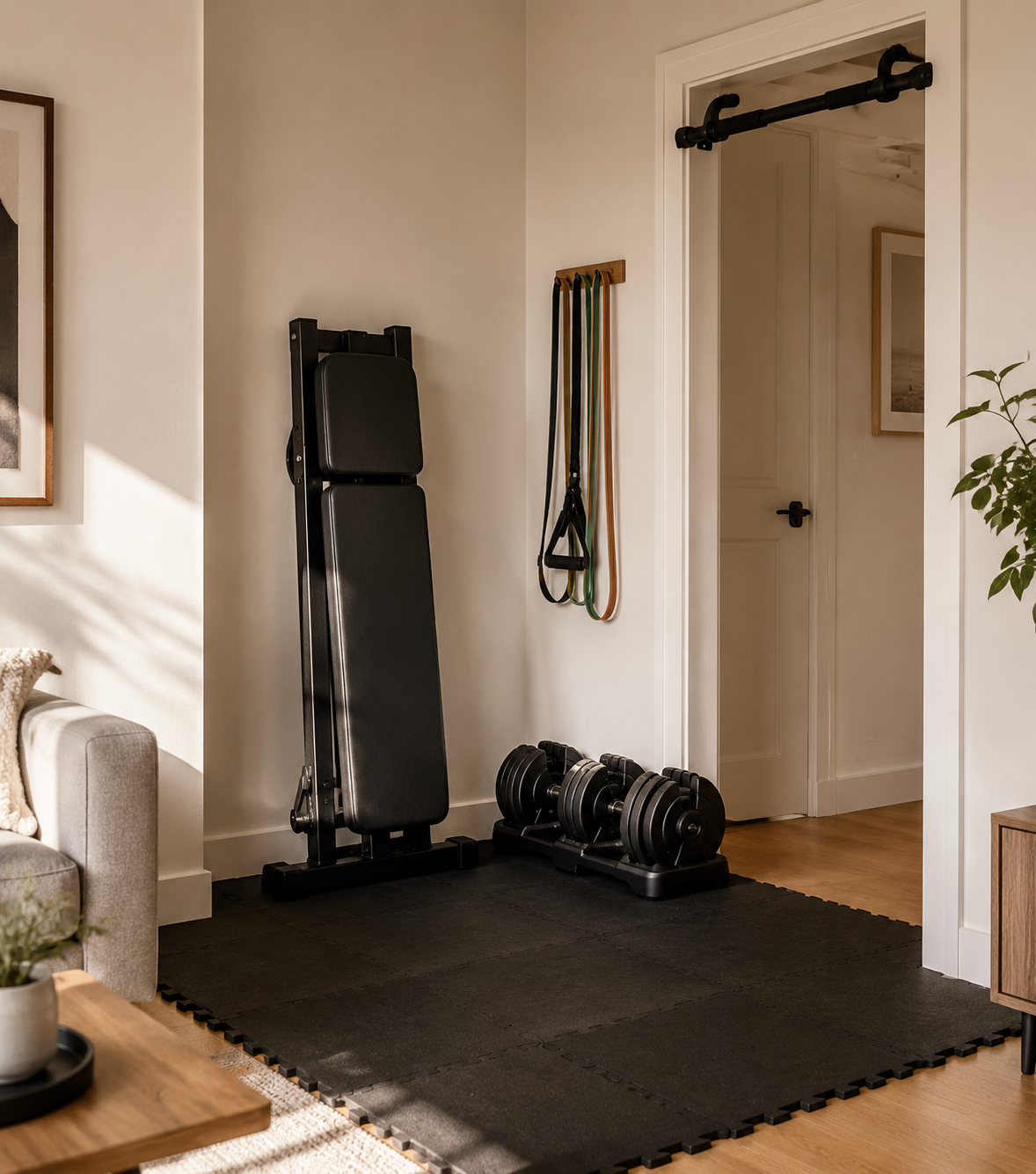
A simple apartment setup can be built from five roles: adjustable free weights, portable resistance, compact cardio, bodyweight pulling or suspension work, and flooring. You do not need a separate machine for every movement pattern. You need equipment that covers enough patterns without demanding a dedicated room.
A Complete Small-Apartment Setup Under 30 Square Feet
The cleanest small-space setup starts with a zone, not a shopping cart. A 6-by-5-foot area is enough for most dumbbell work, band work, a folding bike in use, and a mat if the rest of the gear can be moved quickly. That does not mean every item occupies the zone at once. It means the room can rotate between strength, cardio, and floor work without a full furniture reset.
- Strength base: adjustable dumbbells or a portable resistance system.
- Cardio base: a magnetic-resistance folding bike, compact elliptical, or walking treadmill chosen for noise as much as storage.
- Pulling option: suspension trainer, doorway pull-up bar, or freestanding cable tower if the room can support it.
- Floor layer: foam or rubber placed where impact, pedals, or dropped handles touch the floor.
- Storage habit: one shelf, cradle, or corner where every item returns immediately after use.
That last point sounds boring until the equipment has been sitting in front of the sofa for three weeks. Small-space fitness fails less often because the exercises are bad and more often because the reset is annoying.
Compact Strength Gear: Free Weights, Bands, Digital Resistance, and Cables
Strength equipment is where apartment buying gets interesting, because every option saves space in a different way. Adjustable dumbbells compress a full rack into two cradles. Band systems reduce noise and storage. Digital resistance removes plates and stacks but raises the price sharply. Cable towers preserve the feel of gym cable work while asking for more floor planning.

Adjustable Dumbbells Are the Easiest Strength Upgrade
For most apartment lifters, adjustable dumbbells are the first serious purchase because they solve the ugliest storage problem: fixed pairs. NÜOBELL adjustable dumbbells run from 5 to 80 pounds and replace 16 pairs of fixed dumbbells in the footprint of two cradles, with a listed price around $595.[2] That matters in a living room because the alternative is not usually a beautiful dumbbell rack; it is weights creeping under chairs and beside radiators.
The tradeoff is that adjustable dumbbells are still dumbbells. They can clack, they can be dropped by mistake, and they require enough open floor to hinge, press, squat, row, and set them down safely. If your lease, floors, or downstairs neighbor makes dropped weight a serious risk, dumbbells need flooring and discipline, not just a clever selector dial.
Snode AD80 dumbbells cost about $795 and are positioned around a more drop-proof design, while TYZDMY adjustable dumbbells are a budget alternative at about $270 with magnetic auto-adjust.[1] Those price differences should not be read as a clean quality ladder for every buyer. In an apartment, the better question is how often the dumbbells will be moved, how carefully they can be set down, and whether the adjustment mechanism feels fast enough that you will use the full range instead of avoiding changes.
Band Resistance Is Quiet, but It Feels Different
The X3 Bar is the kind of apartment equipment that makes sense once you stop expecting every strength tool to feel like iron. It offers up to 300 pounds of band resistance, costs about $550, and fits in less space than a yoga mat.[3] There are no plates to store, no dumbbells to lower onto the floor, and very little noise if the user controls the bar and bands.
The limitation is not whether bands “count.” They do. The limitation is the resistance curve and exercise feel. Band tension changes through the range of motion, which some lifters like and others never fully enjoy. For presses, rows, squats, hinges, and travel-friendly training, the storage-to-resistance ratio is excellent. For someone who wants exact dumbbell loading and familiar free-weight feedback, it may feel like a separate training style rather than a direct replacement.
Digital Resistance Is the Premium Space Saver
Beyond Power’s Voltra I is the expensive but genuinely compact option in this group. It delivers 200 pounds of digital resistance from a shoebox-sized unit, with no weight stack and no plate storage, at about $2,199.[4] The appeal is obvious in an apartment: resistance that can be stored on a shelf is different from resistance that has to live as metal in the room.
The catch is that digital resistance still needs anchoring, setup space, and a buyer who will use enough of its modes to justify the price. It is not automatically better than dumbbells or bands. It is best for people who want cable-style loading, quiet operation, and precise resistance changes without dedicating floor space to a tower.
Suspension and Pulling Work Need an Anchor Plan
TRX Home2 costs about $200 and can provide full-body suspension training from a single anchor point.[1] It is one of the rare tools that stores like an accessory but trains like equipment. Rows, assisted squats, presses, hinges, core work, and single-leg progressions can all happen from a bag that fits in a drawer.
The anchor is the part to inspect, not wave away. A door anchor can be renter-friendly if the door closes securely in the right direction and the frame is sound. A ceiling or wall anchor is a different category because it involves permanent installation. Doorway pull-up bars, including Perfect Fitness models under $40, solve the drilling issue for some renters, but they still depend on doorframe shape, trim strength, and careful use.[1]
If cable work is non-negotiable, a freestanding tower is usually less lease-sensitive than a wall-mounted system. The Bells of Steel Cable Tower is listed from $435 to $1,000 and does not require drilling.[1] It gives more familiar cable movement than bands, but it is not invisible. Even when the footprint is modest, cable travel requires side clearance and a traffic pattern that does not cross the living room.
Quiet Cardio Is Mostly About Resistance Type and Vibration
Cardio machines are where small-space buyers get punished for trusting photos. The machine may fold. The noise may not. In apartments, the sound problem is usually a combination of motor noise, belt slap, foot impact, frame vibration, and whatever frequency travels through the floor into someone else’s ceiling.
Magnetic-resistance bikes are the safest starting point because they avoid the repeated foot strike of running and are generally among the quietest cardio options for home use.[5] The LEIKE X Bike is a good example of why folding bikes keep showing up in apartment setups: it folds to 9 inches deep, weighs under 40 pounds, uses magnetic resistance, and can fit behind a couch.[1]
That does not make every folding bike ideal. Check the maximum user weight, saddle comfort, handlebar position, and whether the folded shape is actually stable in the place you plan to store it. A bike that folds narrowly but has to be dragged across a rug every morning may still become a nuisance.
Compact ellipticals can work well for people who want a standing, low-impact motion without a treadmill belt. The Niceday Elliptical is listed under $600 and has a 400-pound capacity, which is notable because compact cardio equipment often comes with lower weight limits than full-size alternatives.[1] Capacity is not just a durability number; it affects who can use the machine safely and how much frame flex or noise you might notice.
Walking treadmills are tempting because they slide under furniture and make workday steps easier. The Bluefin Fitness Task 2.0 costs about $160 and folds, making it one of the more accessible compact cardio options.[1] But treadmills are also the equipment most likely to reveal whether your building transmits vibration. A walking belt can be tolerable on a concrete slab and irritating in an older wood-frame apartment. If you already worry about downstairs noise, a magnetic bike is usually the less dramatic first purchase.
Flooring Is Not Decoration
Flooring is the least glamorous piece of apartment equipment and one of the most useful. Foam interlocking flooring can cost about $25 for 24 square feet, while 3/4-inch rubber stall mats from IncStores are about $79 per piece.[5] Foam is easier to move and often looks more apartment-friendly. Rubber handles heavier impact and equipment better, but it is heavier, denser, and more noticeable in a living area.
Do not expect any mat to make jumping, running, or dropped dumbbells silent. Flooring reduces impact and protects surfaces; it does not repeal building physics. A better apartment strategy is to combine quieter equipment with flooring: magnetic resistance instead of pounding impact, controlled dumbbell lowering instead of drops, and a mat placed only where vibration actually happens. Readers comparing flooring types can go deeper with an apartment flooring guide for noise, leases, and aesthetics.
The Equipment That Usually Belongs on the Skip List
Some equipment is not bad; it is just badly matched to apartment life. Full-size treadmills are the obvious example. They can be excellent training tools, but they bring motor noise, impact, awkward delivery, and a footprint that is hard to hide. If the room cannot absorb both the machine and the clearance around it, the treadmill becomes a hallway negotiation.
Standalone weight-stack machines over 6 feet wide are also usually poor small-space purchases.[1] They solve exercise selection while creating a permanent furniture problem. Single-purpose gadgets have the opposite issue: they may store easily, but they often do too little to justify even a small amount of clutter. In a tight apartment, every item should cover multiple movements or solve a recurring problem.
Wall-mounted racks sit in the middle. The PRx Profile PRO folds to 9 inches deep and costs about $1,100, which is impressive for reclaiming floor space.[1] It still requires wall drilling. For an owner in a condo, that may be acceptable. For a renter, it means landlord permission, correct studs, and a willingness to patch or explain the wall later. Fold-flat is not the same as renter-neutral.
Hidden Costs: Clearance, Subscriptions, and Outgrowing Compact Gear
Manufacturer footprint claims are useful, but they are rarely the full room cost. Cable systems, suspension trainers, dumbbell benches, ellipticals, and bikes all need working clearance. A machine that occupies a neat rectangle when photographed can require 2 to 3 feet around it once a person is moving, especially with cables, handles, pedals, or lateral steps.[1]
Connected compact systems need a second price check. Smart machines such as Tonal 2 at $4,295 and Speediance-style systems can carry monthly subscription costs in the $40 to $50 range, which changes the total cost of ownership.[1] That does not make them poor choices. It does mean the monthly fee should be treated like part of the equipment, not an optional footnote.
Compact equipment can also be outgrown. Stronger lifters may exceed an 80-pound dumbbell pair or want a barbell pattern that a band system cannot satisfy. Heavier users may need to rule out cardio machines with lower capacities before considering storage. The right small-space setup should feel constrained by the room, not by a spec you already know you will exceed.
How to Build the Shortlist
Start with the room, then choose the equipment. If you have one open corner and a couch gap, a folding magnetic bike plus adjustable dumbbells is a stronger foundation than a “compact” all-in-one machine that never moves. If noise is the main constraint, bands, suspension work, digital resistance, and magnetic cardio rise to the top. If drilling is off limits, remove wall-mounted racks and fixed anchors from the list before falling in love with their folded dimensions.
| Constraint | Better first choices | Be careful with |
|---|---|---|
| Very limited storage | Adjustable dumbbells, X3 Bar, TRX, Voltra I | Wide benches, full racks, standalone stacks |
| Downstairs neighbors | Magnetic bike, bands, controlled dumbbell work, flooring | Running treadmills, jumping workouts, dropped weights |
| No drilling allowed | Door anchors, doorway bars, freestanding cable towers | Wall racks, permanent suspension anchors |
| Heavier user needs | Higher-capacity ellipticals or bikes, verified weight ratings | Compact cardio machines with low capacities |
| Progressive strength focus | Adjustable dumbbells, cable tower, digital resistance | Single-purpose gadgets with limited loading |
A realistic apartment gym can be as simple as adjustable dumbbells, a folding magnetic bike, a suspension trainer, and flooring in the high-impact zone. Someone with more budget and less tolerance for clutter might swap dumbbells or cables for digital resistance. Someone with a strict lease might choose only equipment that can be carried out with no trace. For more detailed room-by-room planning, use a small-space compact home gym setup guide before buying anything heavy.
The best home exercise equipment for a small apartment is the gear that trains well, stores cleanly, and does not make the home harder to live in. If it clears that test, the workout has a much better chance of surviving ordinary apartment life.
References
- Best Workout Equipment for Apartments (2026), Garage Gym Reviews, 2026.
- NÜOBELL Adjustable Dumbbells Review, Garage Gym Reviews.
- X3 Bar Review, Garage Gym Reviews.
- Beyond Power Voltra I Review, Garage Gym Reviews.
- Summer 2026 Home Gym Buying Guide, Fitness Outlet, 2026.
Comments
Join the discussion with an anonymous comment.