
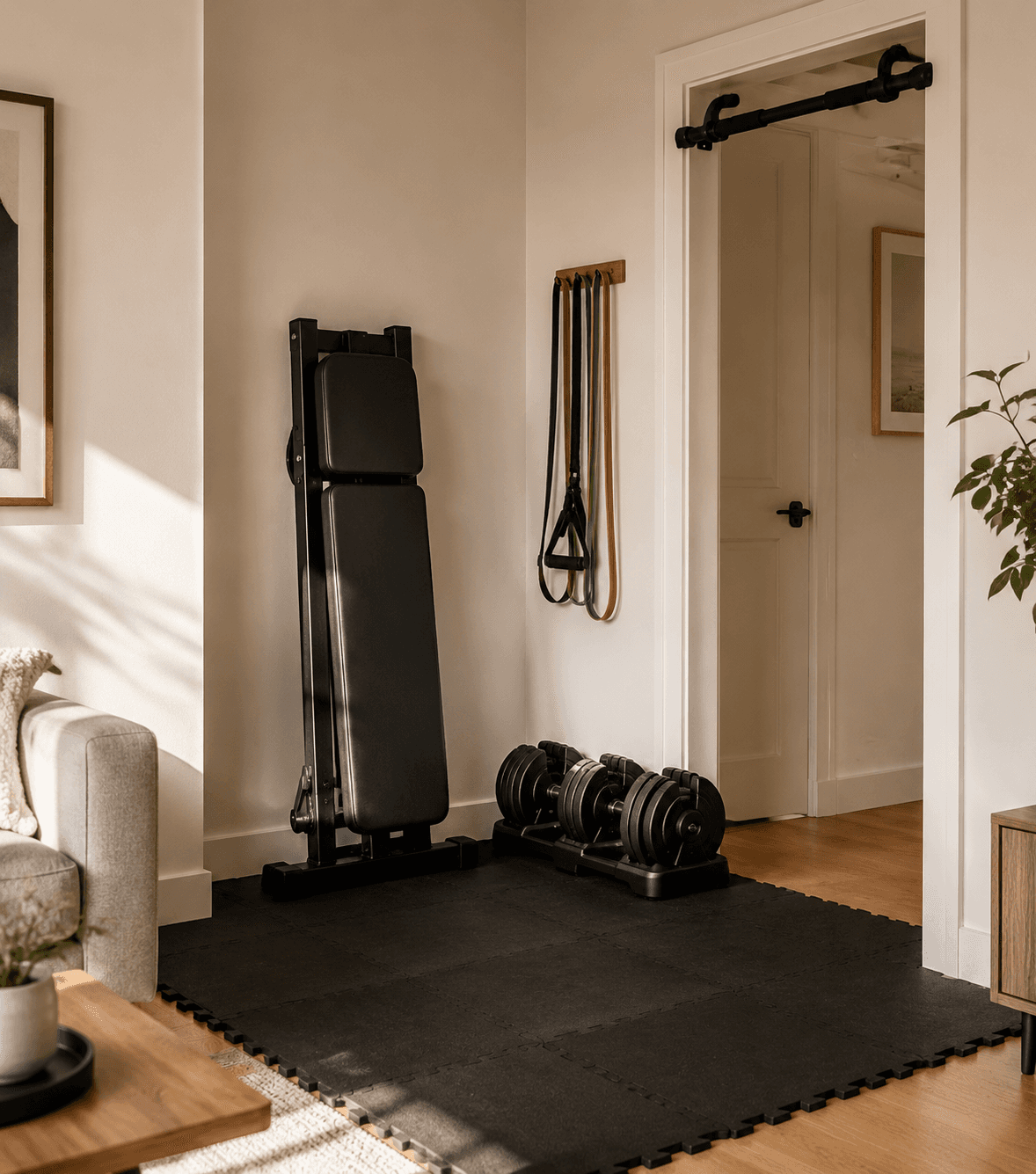
With about $1,000 and less than 12 square feet to work with, the cleanest-looking answer is often a single compact machine. One frame, one footprint, one purchase. That appeal is real. It also gets weaker the moment the machine has to cover pressing, pulling, squatting, hinging, carries, progression, storage, noise, and lifetime cost.
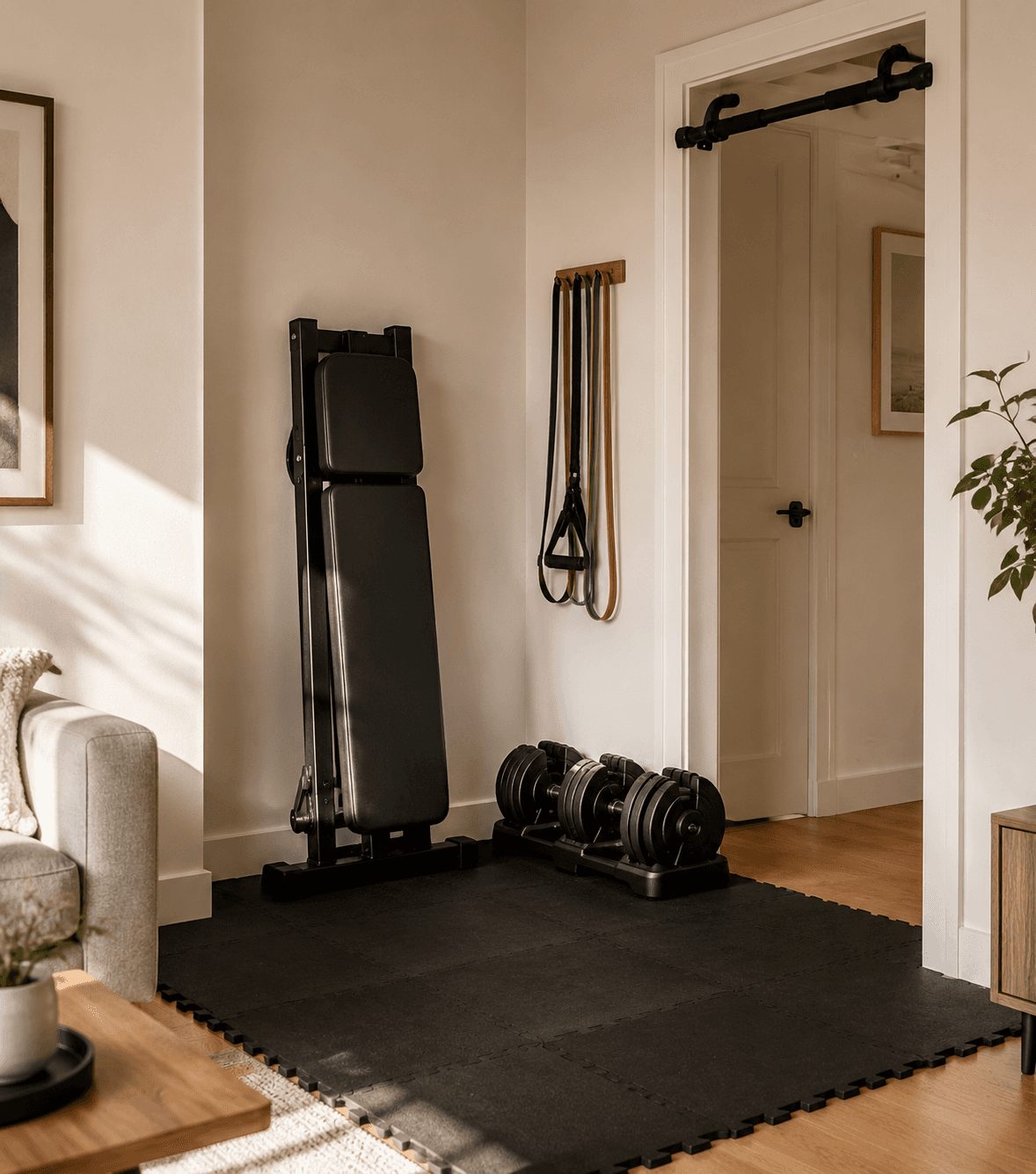
The better buy at this budget is a coordinated set of compact home gym equipment: adjustable dumbbells, a folding bench, resistance bands, a doorway pull-up bar, and proper flooring. It is less glamorous than a screen-backed machine, but it gives more usable training options, fits a normal apartment corner, and does not add a monthly bill after the credit card charge clears.
| Piece | Role in the system | Budget |
|---|---|---|
| NÜOBELL adjustable dumbbells | Main loading tool for presses, rows, squats, hinges, lunges, carries, and isolation work | $595 |
| Folding adjustable bench | Flat, incline, and supported positions for pressing and rows | About $250 |
| Resistance bands | Cable-like work, warmups, assisted movements, joint-friendly accessories | About $40-$70 |
| Doorway pull-up bar | Vertical pulling without using floor space | Under $40 |
| Interlocking foam flooring | Noise and surface protection for apartment training | $25 for 24 sq ft |
That list is not random. It is a small-room strength system with each item carrying a different job. The adjustable dumbbells supply progressive load. The bench changes angles. The bands add cable-style resistance and setup flexibility. The pull-up bar handles the movement pattern most small machines quietly skip. The flooring makes the setup livable above neighbors and protects the room you are borrowing from the rest of your apartment.
For readers still deciding whether to buy in phases or all at once, the broader home exercise equipment purchase-sequence guide is a useful detour. If the question is specifically what beats a sub-$1,500 all-in-one machine in a small apartment, the answer starts here.
The Core System
The NÜOBELL adjustable dumbbells are the expensive part, and they earn that position. The 5-to-80-pound-per-hand range covers light accessory work, beginner strength training, and enough loading headroom for many intermediate lifters. Garage Gym Reviews lists the pair at $595 and notes that the set replaces 16 pairs of fixed dumbbells, with each dumbbell occupying a 17-inch by 7.5-inch footprint.[1]
That replacement math matters more than the usual marketing phrase “space-saving.” Sixteen pairs of fixed dumbbells are not an apartment problem; they are a garage-wall problem. A pair of adjustables can sit on a stand, under a desk, or along a wall without turning the room into a storage aisle.
The bench is the second priority because floor presses and standing work run out of angles quickly. A compact folding bench around the $250 mark gives flat pressing, incline pressing, chest-supported rows, split squats, step-ups if the model is stable enough for that use, and seated shoulder work. Garage Gym Reviews’ bench category pricing places many adjustable home-gym benches in this general range, though final price and folded dimensions should be checked before purchase because benches vary widely in storage behavior.[2]
The doorway pull-up bar is the cheapest piece that changes the whole system. A Perfect Fitness doorway bar is listed under $40 with a 300-pound capacity, and it uses no floor space while adding pull-ups, chin-ups, hanging knee raises, slow negatives, and band-assisted vertical pulling. The capacity is a product specification and should be verified against the exact model and doorway before anyone treats it as a universal limit.
Bands are not a substitute for the dumbbells; they fill the gaps dumbbells leave. They let you do face pulls, pulldown variations from a doorway anchor, Pallof presses, assisted pull-ups, lateral walks, curls, triceps pressdowns, and warmup work without adding another large object to the room.
The foam tiles are the least exciting line item and one of the easiest to regret skipping. A $25 pack covering 24 square feet is enough for the active training area and a little margin around it. In an upstairs apartment, that is not just about protecting laminate or hardwood. It softens dumbbell set-downs, reduces vibration, and gives the bench and feet a consistent surface.
What Under 12 Square Feet Actually Means
The system does not need a dedicated room. It needs an active rectangle large enough for the bench, a person lying or lunging, and safe dumbbell movement. The stored footprint can be much smaller than the training footprint because the bench folds, the dumbbells consolidate load, the bands hang, and the pull-up bar lives in a doorway.
This is where many “compact” products get sloppy. A machine may have a tidy base measurement, but the user still needs clearance for arms, cables, a bench, entering and exiting the machine, and any accessories that end up leaning beside it. Before buying anything, measure the training rectangle, not just the storage rectangle. If that has not happened yet, use this budget home gym space-measurement primer before comparing products.
- Measure the open floor area where the bench will actually unfold.
- Check whether dumbbells can move beside the bench without hitting furniture.
- Confirm door trim and frame conditions before using a doorway pull-up bar.
- Leave a storage path so the bench does not become a permanent obstacle.
- Account for flooring thickness if doors, closets, or balcony entries are nearby.
The Movement Coverage Is the Point
A compact home gym is not good because it owns many objects. It is good when those objects cover the movements a real training week needs. This build can cover more than 150 exercise variations across press, pull, squat, hinge, and carry patterns, which is the practical reason it beats a single budget machine.
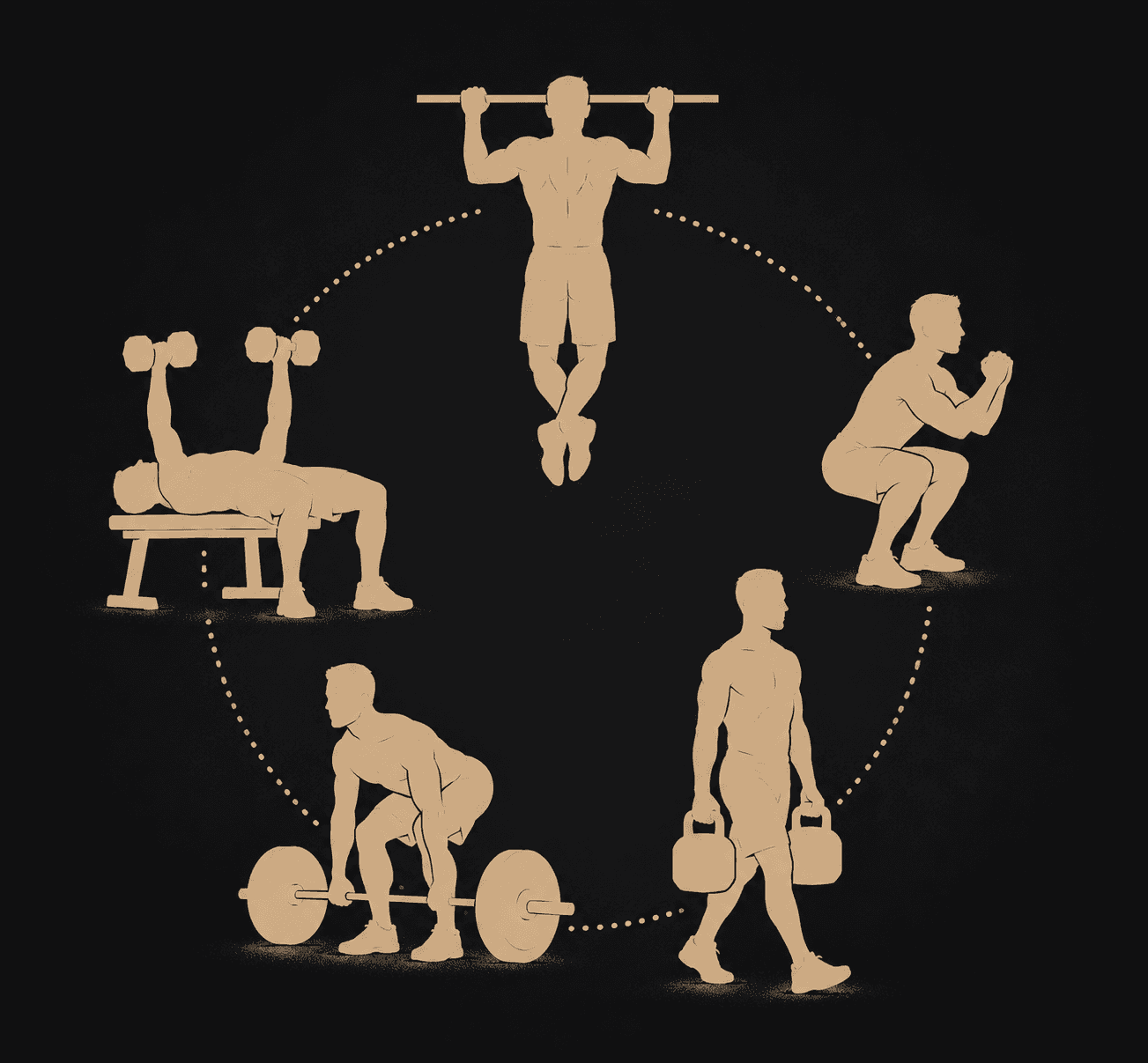
| Movement pattern | What the $1,000 setup can train |
|---|---|
| Press | Flat dumbbell press, incline press, floor press, standing shoulder press, seated press, push-up variations, band press |
| Pull | Pull-ups, chin-ups, band-assisted pull-ups, one-arm dumbbell rows, chest-supported rows, band rows, band pulldowns, face pulls |
| Squat and lunge | Goblet squats, split squats, reverse lunges, step-back lunges, front-foot-elevated split squats, dumbbell squat variations |
| Hinge | Romanian deadlifts, single-leg RDLs, dumbbell deadlifts, hip thrusts, glute bridges, banded good mornings |
| Carry and core | Farmer's carries, suitcase carries, front-rack carries, dead bugs, planks, Pallof presses, hanging knee raises |
The hidden advantage is not the long exercise menu. It is that progression stays simple. Add weight to the dumbbells. Change the bench angle. Slow the lowering phase. Add a pause. Move from two-leg to single-leg variations. Use a stronger band. Reduce band assistance on pull-ups. None of that requires a subscription tier or a proprietary accessory.
This matters most after the first month, when novelty is gone and the setup has to keep working. A beginner may start with goblet squats, incline push-ups, band rows, and assisted chin-ups. Months later, the same corner can support heavier dumbbell RDLs, split squats, incline presses, chest-supported rows, farmer's carries, and stricter pull-up progressions. The system does not become useless just because the owner gets stronger.
Where All-in-One Machines Lose Under $1,500
All-in-one machines are attractive for a good reason. They look organized. The buying decision feels contained. Some include guided screens or app-based coaching that removes planning friction. For someone who mainly wants instruction and a tidy interface, that simplicity has real value.
The problem is the under-$1,500 price band. At that level, no single all-in-one machine matches the movement pattern diversity of the modular setup described above. Most budget machines compromise somewhere important: no true pull-up option, limited horizontal pressing, awkward lower-body loading, capped resistance, or a cable path that is useful for some accessories but not a full strength program.
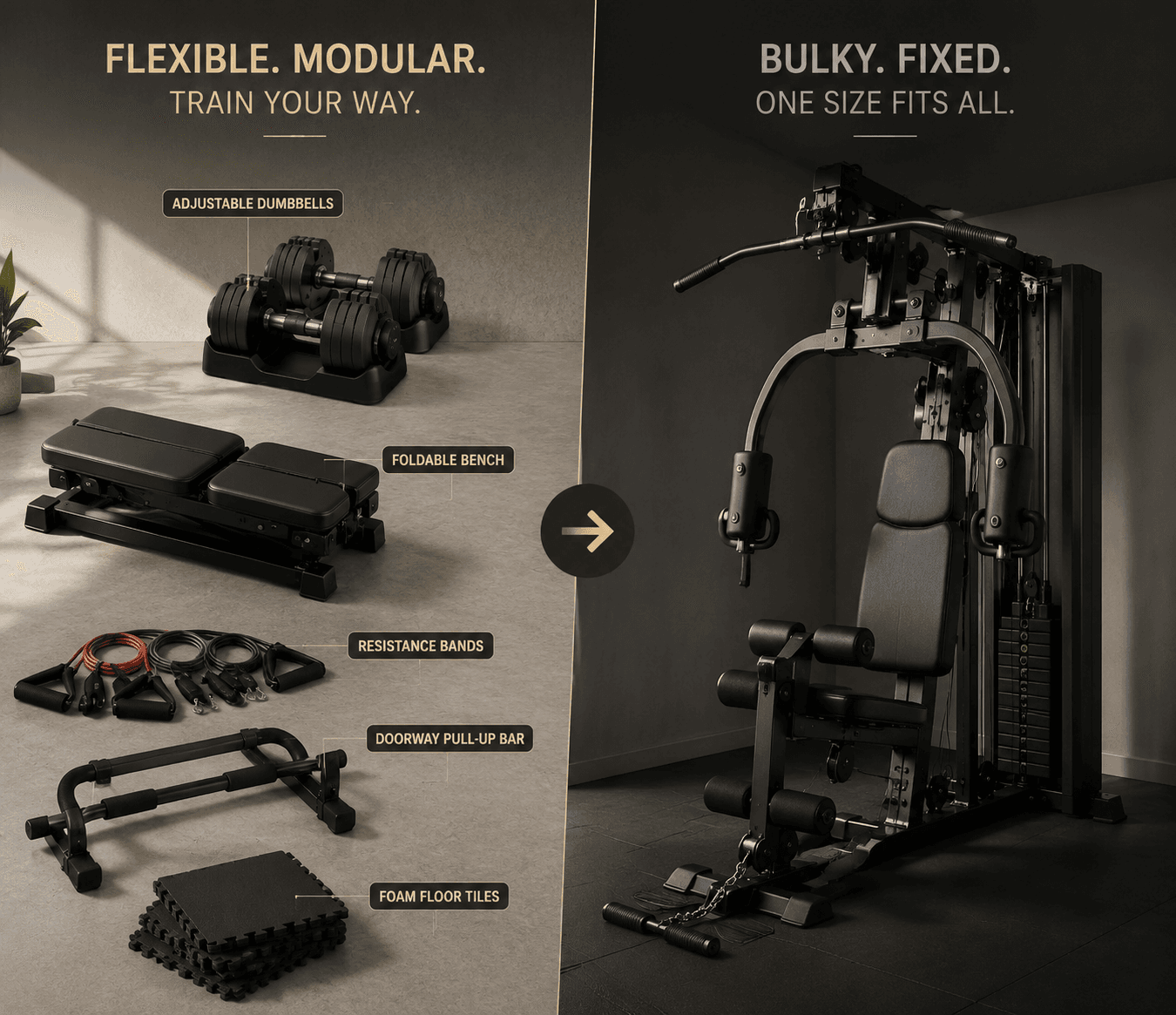
| Option | Approximate cost position | Main tradeoff |
|---|---|---|
| $1,000 modular build | About $1,000 upfront | More setup decisions, but broad movement coverage and no recurring fee |
| Sub-$1,500 all-in-one machine | Under $1,500 upfront | Cleaner single purchase, but weaker movement diversity |
| Speediance Gym Monster 2 | Starts at $3,749 | Much higher upfront price than the modular build |
| Tonal 2 | $4,295 plus $60/month | Premium smart coaching ecosystem with a major recurring cost |
The higher-end smart systems sit in a different financial category. Innerbody Research lists the Speediance Gym Monster 2 starting at $3,749, while Trail & Kale lists Tonal 2 at $4,295 plus a $60 monthly membership.[3][4] Those systems may make sense for someone who wants guided digital training and has the budget for it. They are not really competing with a $1,000 apartment build on ownership cost.
That is the cleanest dividing line. Under $1,500, buy movement diversity. Above that, if coaching, interface design, and digital resistance matter more than free-weight flexibility, then compare premium smart systems directly using an all-in-one home gym decision framework.
The Cost Benchmark Is Useful, With Limits
Fitness Avenue’s 2026 statistics article gives $2,530 as an average home gym cost, which is useful as a rough benchmark for how quickly home gym spending can climb.[5] It should not be treated as a precise U.S. buyer average, though; the figure is presented in a North American context and is better used as a blended reference point than a hard target.
The same caution applies to demand signals. CivicScience reported that 63% of under-30s planned to buy home fitness equipment, which points to purchase intent among younger consumers, not proof that every apartment buyer should rush into a machine.[6] Intent surveys tell you where attention is moving. They do not tell you whether a specific piece of equipment will survive contact with your lease, closet, knees, budget, and neighbors.
The Cardio Add-On Is Optional
A folding bike can make sense after the strength system is settled, especially for someone who wants low-impact conditioning without leaving the apartment. The LEIKE X Bike is a good example of the category: under $200, 38.5 pounds, and listed as folding to 46 inches by 16 inches by 9 inches, which is small enough to store behind some couches or along a wall.[7]
It should stay an add-on, not the core of the build. The bike gives conditioning. It does not replace progressive loading, pulling strength, lower-body strength, or the basic movement pattern coverage that makes the $1,000 system work. If the budget is strict, buy the strength pieces first and add cardio later.
What to Verify Before Buying
The buying decision is straightforward, but the product details still deserve a final check. Prices move with promotions, bundles, and retailer inventory. The NÜOBELL price used here is a June 2026 figure from a product guide, not a permanent price guarantee.[1] Bench dimensions, bike folded dimensions, pull-up bar fit, and weight capacities often come from manufacturer or retailer listings, so treat them as specifications to confirm against the exact SKU before ordering.
- Choose the modular $1,000 build now if strength variety, no subscription, and apartment fit matter most.
- Postpone and compare higher-budget compact systems if guided coaching and a screen-based experience are central to staying consistent.
- Revisit the training goal before buying if the room is not measured, the doorway cannot support a pull-up bar, or cardio matters more than strength.
Readers considering a bigger compact setup can compare higher-budget options in compact home gym systems for small spaces. Readers who are still unsure whether they are training for strength, fat loss, mobility, or general conditioning should start with a goal-first compact home gym setup instead.
Once the equipment is in place, the next decision is programming, not shopping. A home gym workout plan that grows with your equipment is the natural next step for turning the corner setup into actual training weeks.
References
- Best Adjustable Dumbbells, Garage Gym Reviews, https://www.garagegymreviews.com/best-adjustable-dumbbells
- Best Weight Benches, Garage Gym Reviews
- Tonal vs Speediance, Innerbody Research, https://www.innerbody.com/tonal-vs-speediance
- Best Tonal Alternatives, Trail & Kale, https://trailandkale.com/best-tonal-alternatives/
- How Many People Have a Home Gym? 2026 Statistics, Fitness Avenue, https://www.fitnessavenue.ca/blogs/post/how-many-people-have-a-home-gym-2026-statistics
- CivicScience home fitness equipment purchase-intent survey, CivicScience
- LEIKE X Bike product data, Amazon
Comments
Join the discussion with an anonymous comment.