
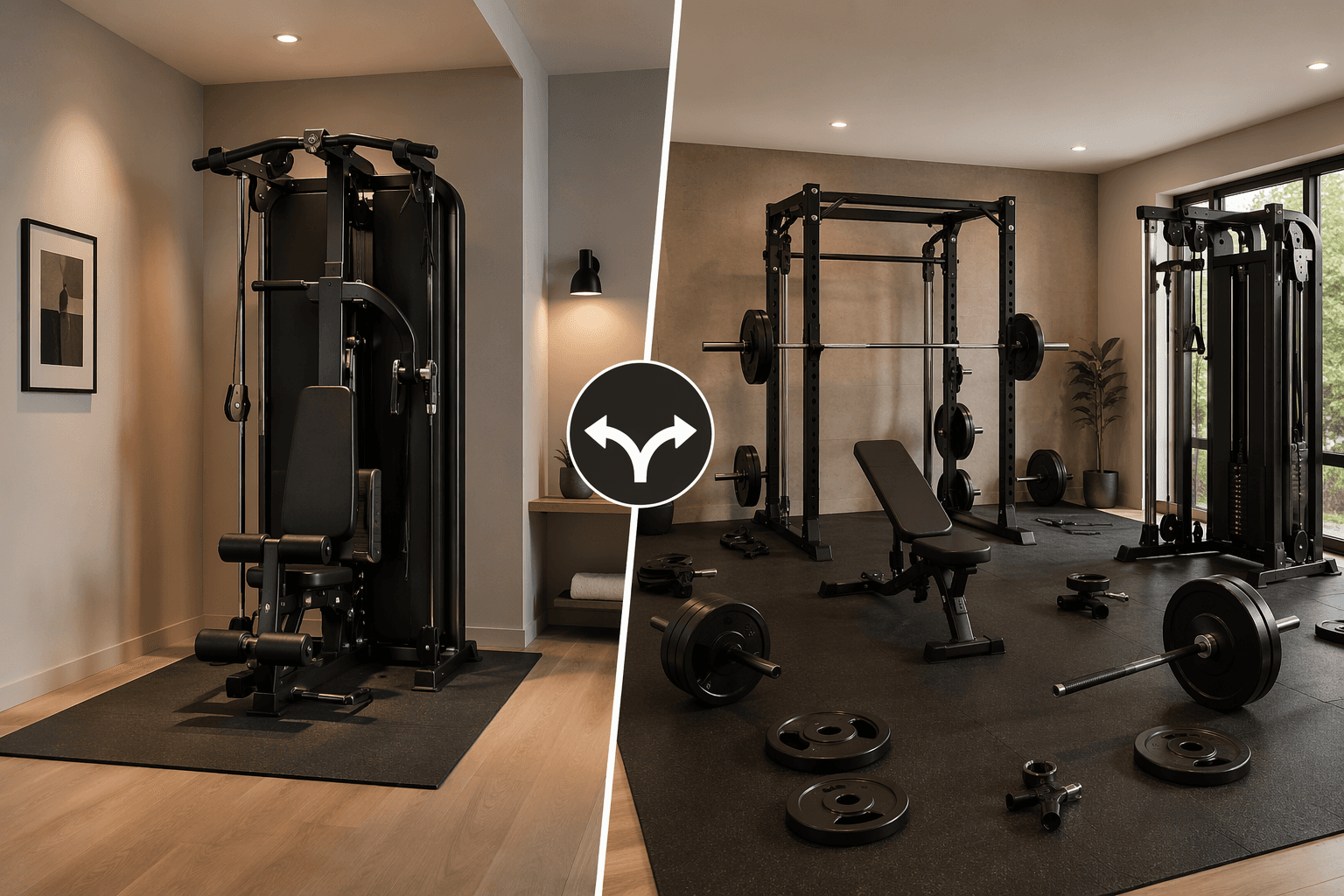
An all in one home gym is not automatically the smarter buy, and building your own setup is not automatically the serious lifter’s answer. The useful question is narrower: which constraints are you actually trying to solve? For most buyers comparing a single integrated machine against a rack, barbell, bench, plates, and cable option, the decision comes down to four pressures: floor space, resistance type, upgrade flexibility, and whether more than one person needs to train comfortably on the same setup.
Pick the two constraints that matter most. If floor space and a clean, consolidated training station matter most, an all-in-one can be the better answer. If component quality and long-term control matter most, separate equipment often makes more sense. If digital coaching and compact resistance matter more than traditional machine feel, smart gyms need to be judged in their own category, because the subscription and resistance model change the ownership math.
Price Alone Does Not Settle It
The common mistake is assuming one path is the budget path. In 2026 testing data, the average all-in-one home gym price was about $1,855, while a comparable separate setup with a rack, bar, plates, bench, and cable tower was estimated around $1,400 to $2,800 depending on the quality tier.[1] Those ranges overlap too much to support a simple “all-in-ones are cheaper” or “separate equipment is always better value” rule.
That overlap matters because two buyers can spend the same amount and get very different strengths. One may get a compact machine with a Smith station, dual cables, pull-up bar, storage, and rack functions in one frame. Another may get a sturdier basic rack, a better bench, a barbell they actually like, and a cable tower that can be replaced later. The receipt total may look similar; the ownership experience will not.
| Constraint | All-in-one home gym tends to help when | Separate setup tends to help when |
|---|---|---|
| Floor space | You need rack, cable, and machine-style options in one compact training zone | You have enough room to spread a rack, bench, plates, and cable station without constant rearranging |
| Resistance type | You like integrated cables, Smith work, guided stations, or digital resistance | You want traditional barbell loading, plate choice, and independent cable selection |
| Upgrade flexibility | You want a coherent station now and do not plan to keep swapping parts | You expect your strength, exercises, or preferences to change over time |
| Multi-user fit | Users have similar training needs and can share the same adjustment pattern | Users differ enough that separate stations, bars, benches, or cable heights will reduce friction |
The Space Win Is Real
Floor space is the strongest argument for a well-designed all-in-one. A Bells of Steel All-in-One or Major Fitness B17 can consolidate a power rack, functional trainer, and Smith machine into under 40 square feet, while a separate setup covering similar capabilities typically needs 60 or more square feet once the rack, bar path, plates, bench movement, and cable tower are accounted for.[1][2]
That is not a small difference. In an ordinary spare room or garage corner, 20 square feet can be the difference between leaving the gym assembled and having to drag a bench, plates, or cable handles into position every session. It can also decide whether the room remains usable for anything else. People often measure the equipment footprint and forget the working footprint: the space needed to unrack a bar, walk plates around, incline a bench, pull a cable without hitting storage, and move safely when tired.
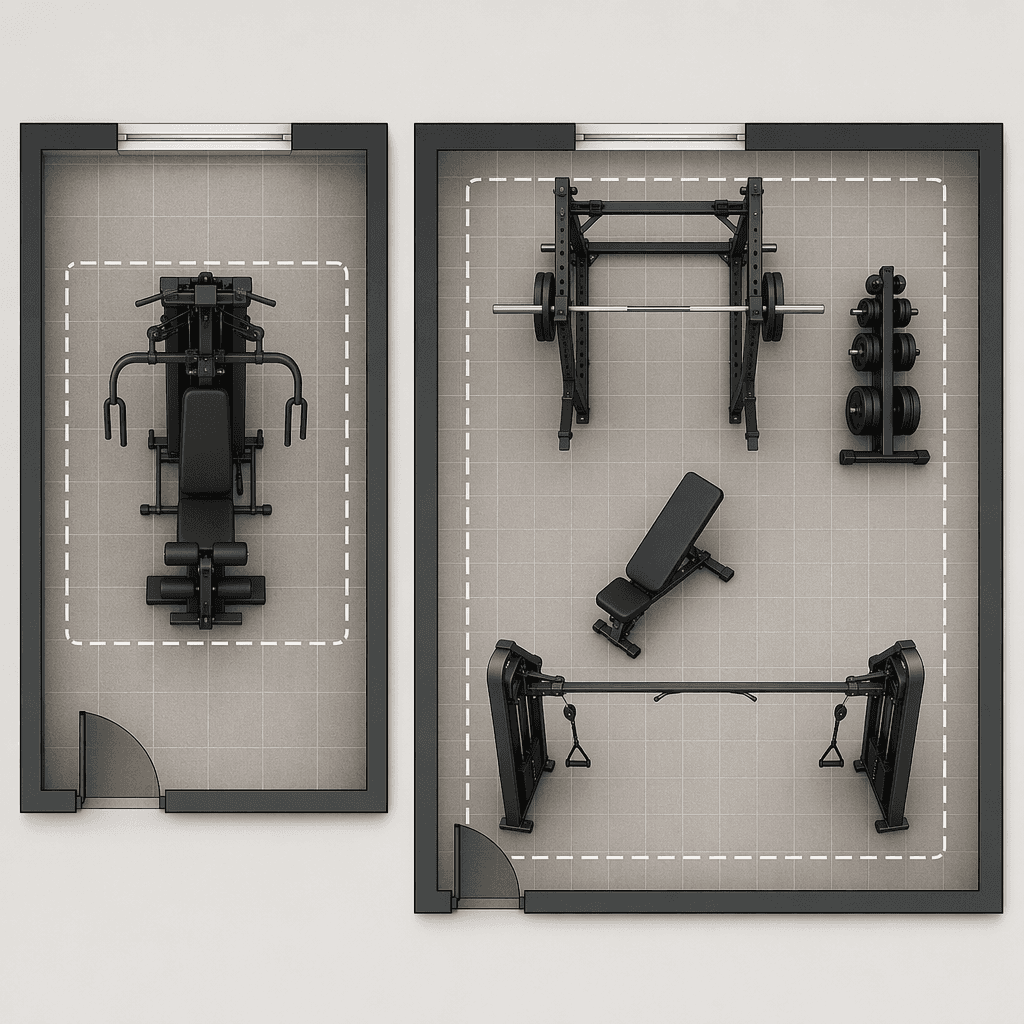
This is where a compact integrated unit earns its praise. If the alternative is a rack squeezed too close to a wall, a cable tower jammed behind a bench, and plates stored wherever they fit, the all-in-one may produce better training simply because it removes setup friction. A workout plan that technically fits on paper can become annoying enough that it gets skipped.
The caveat is that under 40 square feet is not the same as unlimited capability. Cable travel, bench clearance, storage placement, pull-up height, and whether the Smith path interferes with other work still matter. Before treating a compact unit as solved space planning, tape out the machine dimensions and then mark where your body, bench, and loaded bar will actually move. For a deeper look at compact layouts, see all-in-one home gym machines for small spaces.
Resistance Type Is a Preference, Not a Spec Sheet Trophy
Traditional all-in-ones usually depend on plate-loaded or weight-stack resistance, plus barbell, Smith, or cable paths. That makes them feel familiar: plates move, cables have friction, and loading is visible. The better question is not whether the machine offers “full-body training,” because nearly every product page says that. The better question is whether the resistance you will use most feels good enough to repeat every week.
Cable quality deserves more attention than it usually gets. A functional trainer that looks impressive but feels sticky, light, or awkward at the bottom of the range will quietly lose value. The same goes for Smith machines that bind, pulley arms that adjust poorly, or plate-loaded systems that make small jumps difficult. Versatility only counts if the stations are pleasant enough to use after the novelty is gone.
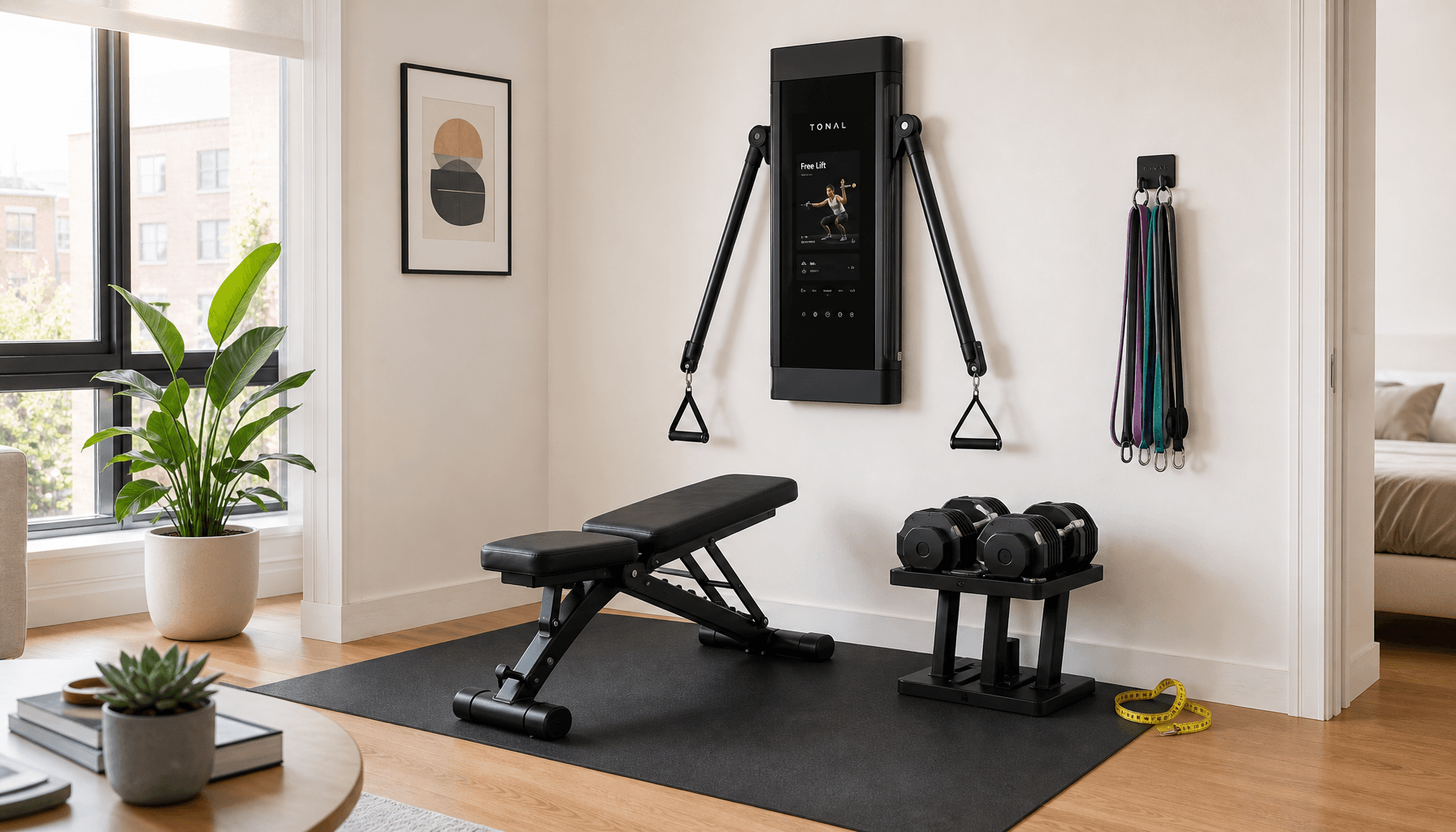
Smart gyms such as Tonal 2 and Speediance Gym Monster belong in a separate mental bucket. Tonal 2 was listed at $4,295 plus a monthly subscription in the $49 to $59 range, while Speediance Gym Monster was listed at $3,199 with no subscription in the research set.[1][3][4] Their promise is not just compactness; it is digital resistance, guided programming, and software-driven training. That can be valuable, but it is not the same thing as buying a cable machine with a screen attached.
The subscription is not a footnote. A $49 to $59 monthly fee adds roughly $600 to more than $3,000 over five years depending on the exact monthly price and subscription duration.[1][3] Anyone comparing smart gyms against traditional equipment should run the five-year ownership cost, not just the checkout price. For that narrower question, use the subscription-focused comparison of smart vs. traditional all-in-one home gyms.
Upgrade Flexibility Is Where Separate Equipment Pulls Ahead
Separate equipment has an unglamorous advantage: one weak piece does not condemn the whole gym. If the bench wobbles, replace the bench. If the barbell sleeves are annoying, buy a better bar. If the cable tower feels limiting, upgrade that station and keep the rack. This matters because home gyms tend to evolve after the first few months. People discover which lifts they actually do, which attachments they ignore, and where their strength outgrows the original plan.
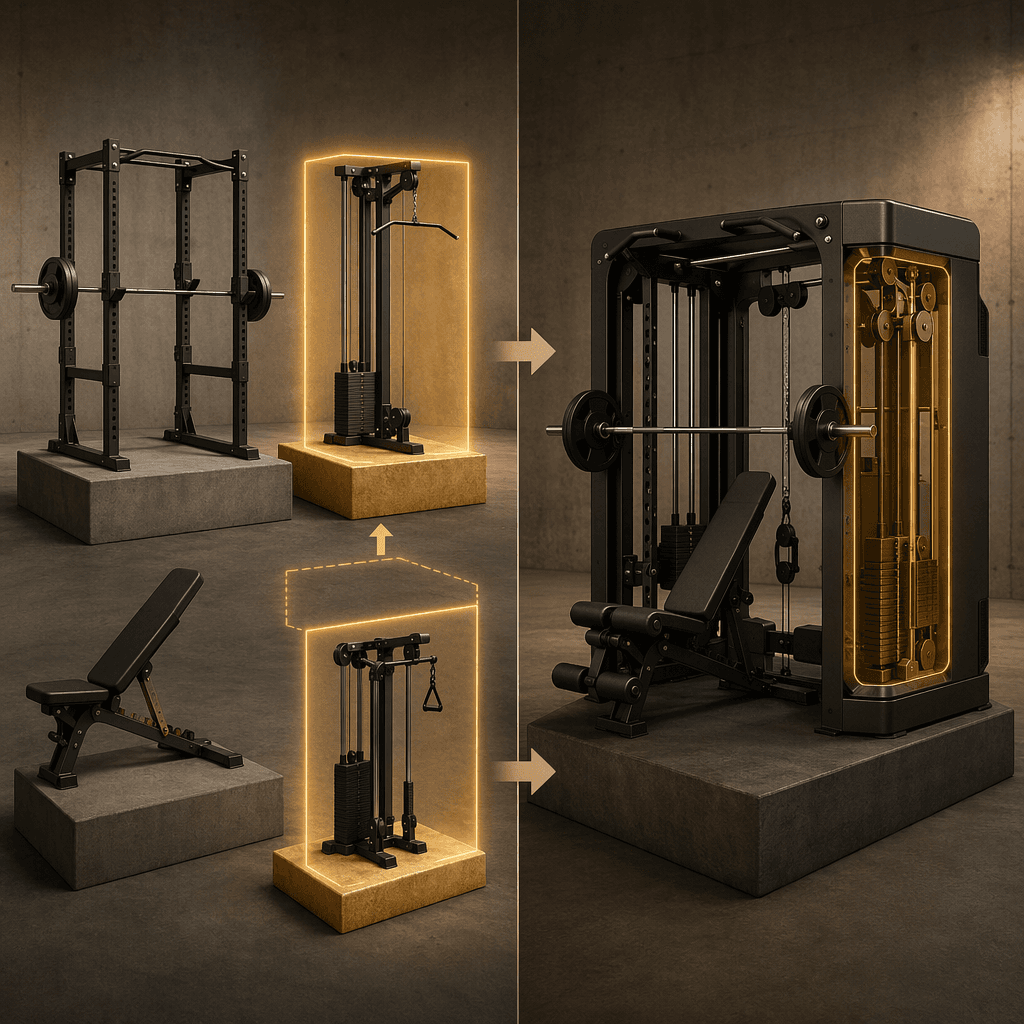
An all-in-one compresses the system. That is useful for space, but it also ties your future choices together. If the cables become the limiting factor, the Smith station may still be fine. If the rack dimensions stop working for your lifts, the functional trainer may still be fine. The problem is that the machine is one purchase, one frame, and often one replacement decision. A failure or mismatch in one station can turn into a full-system compromise.
This is especially important below the midrange price point. Testing notes in the research set found that all-in-ones under $1,000 often use 14-gauge steel and carry more wobble risk, while the move toward more rigid 12-gauge construction appears around the $1,200 to $1,500 range.[1] In the same broad budget zone, a separate rack such as the Fitness Reality 810XLT can give a sturdier base and leave room to upgrade around it over time.[1]
That does not make every separate setup better. A pile of mismatched budget gear can be worse than a thoughtfully engineered integrated station. Bells of Steel’s All-in-One, for example, was noted in testing for 12-gauge steel and aluminum pulleys at roughly $1,299 to $1,900, construction signals that compare well against some more expensive units.[1] The point is that “all-in-one” does not tell you enough. Steel gauge, pulley hardware, rack stability, hole spacing, attachment compatibility, and parts support matter more than the category label.
A good practical test is to identify the first thing you are likely to outgrow. If the answer is weight capacity, cable feel, bench quality, barbell preference, or attachment compatibility, separate equipment gives you more room to correct course. If the answer is simply that you do not want to research five separate purchases, and your expected training fits the machine’s limits, an all-in-one can still be the calmer choice.
Multi-User Fit Can Break an Otherwise Good Choice
A home gym for one person can be optimized tightly. A home gym for two or more people has to absorb differences: height, strength, preferred exercises, injury history, patience for adjustments, and whether one person wants barbell progression while another wants guided cable work. This is not a minor detail if the equipment will sit in the middle of a shared room for years.
All-in-ones can work well for shared use when the users want similar training and the adjustments are fast. Dual cables, a Smith station, pull-up bar, and rack functions may cover a lot of ground without forcing anyone to move across the room. But the same integration can create bottlenecks. If one person is using the cables, another may not be able to squat inside the rack. If the bench has to move for nearly every station change, the machine may feel less convenient than it looked online.
Separate equipment can be easier to share because it creates independent zones. One person can bench while another uses a cable tower, or one can deadlift while another adjusts a bench. It also lets each user care about different upgrades. The stronger lifter can add plates or a better bar without forcing the other person into a more complex machine. The trade-off is obvious: more stations need more floor space.
How to Sort Your Choice
Start with the room, not the catalog. If a separate rack, bench, plates, and cable station would crowd the room or make setup annoying, the all-in-one has a real advantage. If you have the space and expect to keep improving the gym over time, separate equipment deserves serious consideration even when an integrated machine looks more complete on paper.
- Choose an all-in-one home gym when floor-space efficiency and a consolidated training station are your two strongest constraints.
- Build your own setup when upgrade control, component quality, and long-term repairability matter more than keeping everything in one frame.
- Evaluate smart gyms separately when guided programming, digital resistance, and compactness are appealing enough to justify a different cost model.
- Be cautious with very low-cost all-in-ones unless the frame, pulley system, warranty, and user reviews support the kind of training you will actually do.
For readers who want a broader equipment sequence before committing, the home gym equipment decision framework is the better starting point. For a wider market scan beyond this all-in-one versus separate question, use the 2026 constraint-based buying guide. If the larger question is whether to invest in a home gym at all, compare the ownership math against a commercial gym in the home gym vs. gym membership cost breakdown.
One final housekeeping point for a 2026 purchase: recheck current prices, shipping, warranty terms, and subscription requirements before buying. The pricing used here comes from June 2026 research and may shift with sales, model updates, or new releases.[1]
References
- GGR testing data, Garage Gym Reviews, June 2026
- Force USA buyer's guide, Force USA
- Smart home gym coverage, CNET
- Speediance Gym Monster information, Speediance Blog
Comments
Join the discussion with an anonymous comment.