
Home Gym vs. Gym Membership: The Full Cost Breakdown for 2026
Thinking about building a home gym but unsure if the upfront cost is worth it? This data-driven cost comparison breaks down average gym membership costs versus home gym equipment expenses, showing when a home gym pays for itself — and when a membership still wins.
You are staring at two numbers: $86 a month for the gym, or $2,837 once for a squat rack, bench, dumbbells, plates, and a bike. Which leaves you richer after ten years? The headline answer – home gym by a landslide – is true only if both numbers are real for you. They probably are not.
What the $86 and $2,837 Actually Measure
The $86 monthly average comes from exactly five commercial gyms: Planet Fitness, LA Fitness, and a few others. It does not include boutique studios, CrossFit boxes, or premium chains where dues run $150–$250. If you belong to one of those, the $86 figure understates your real cost by a lot. I would not use it to decide anything.
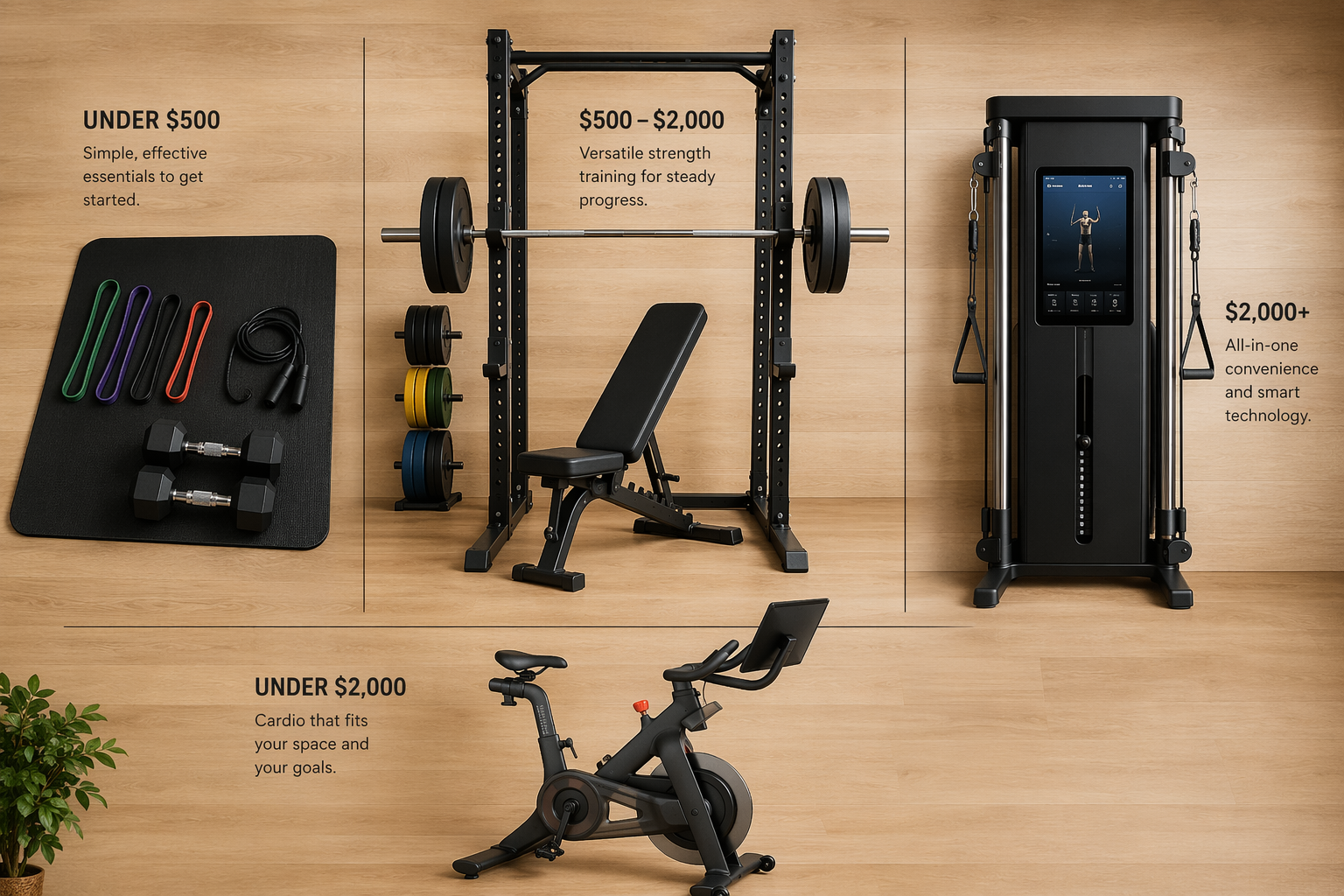
The $2,837 home gym number is also a specific configuration: a squat rack, an adjustable bench, 100 pounds of dumbbells, 140 pounds of plates, and an exercise bike. That is not the setup everyone needs. A $500 pair of resistance bands, a jump rope, and a mat is a legitimate home gym. A $5,000 all-in-one machine with a touchscreen is also a home gym. The $2,837 is a midpoint, not a truth.
Ten Years of Membership: $10,320 (or More)
Eighty-six dollars a month feels small. Over a decade it is $10,320 – paid in 120 installments, no way to skip a payment without losing access. And that assumes the price never rises.
It does rise. Gym membership costs have climbed 65% in ten years. If that trend continues, the average monthly rate in 2036 will be around $142. A decade of membership bought in 2026 would cost well over $13,000. The cheapest option – Planet Fitness at $15/month – stays below $2,000 over ten years, but that plan gives you basic machines, no heavy free weights, and limited access.
| Scenario | Monthly Cost | 10-Year Total | Notes |
|---|---|---|---|
| Average gym membership | $86 | $10,320 | Based on 5 commercial gyms, 2024 data |
| With 65% price trend | Starts $86, ends ~$142 | ~$13,700 | Assumes linear growth; actual may differ |
| Planet Fitness basic | $15 | $1,800 | No heavy free weights, limited hours |
The range is wide: $1,800 to $13,000. Most people fall somewhere in between. The point is that the recurring cost is larger than the monthly line item suggests.
Breakeven: Three Years (If Nothing Goes Wrong)
Compare the one-time home gym cost to cumulative membership. At $2,837 and $86/month, the home gym reaches cost parity in under three years. After that, every year of use is savings.
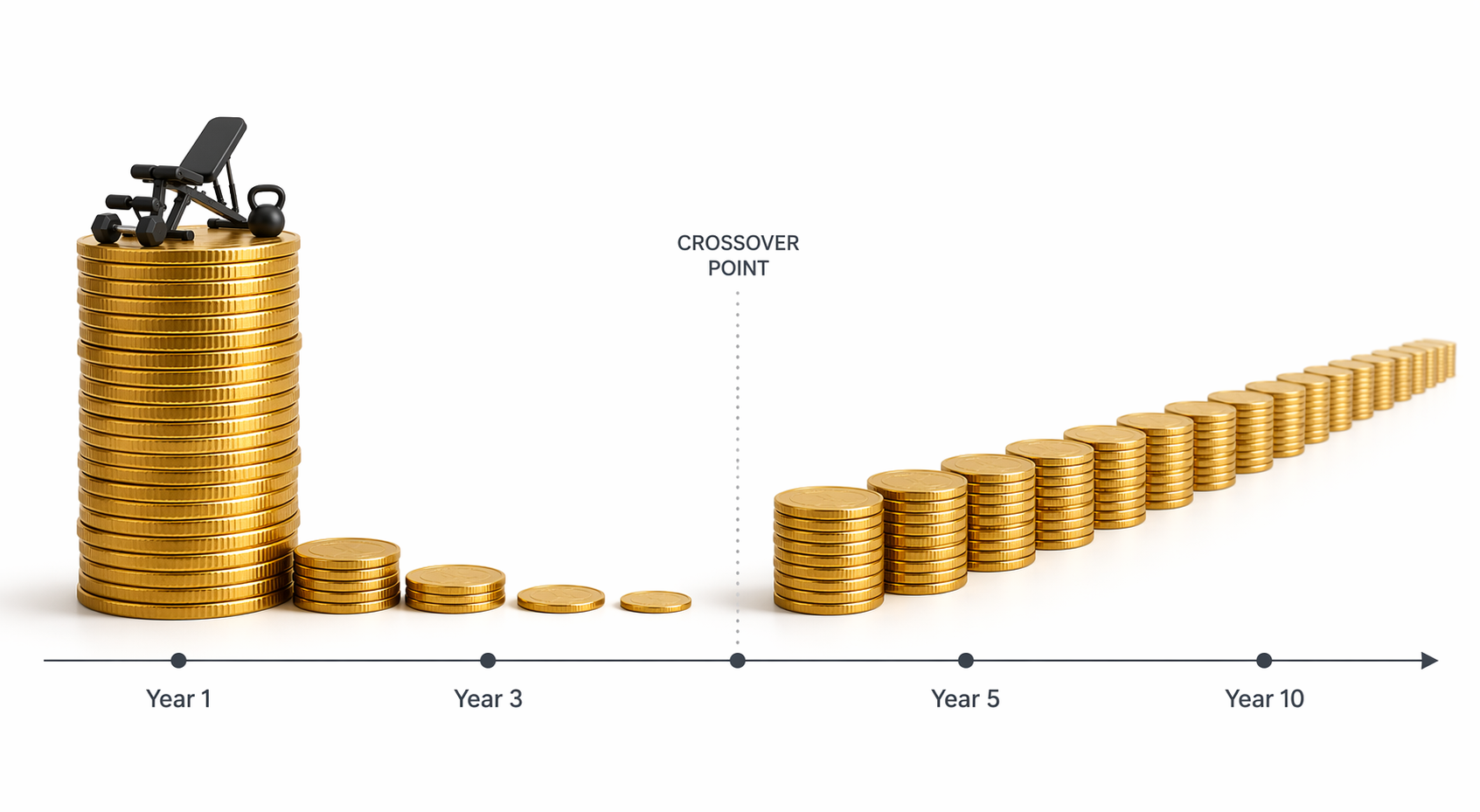
Over a full decade, the savings add up to roughly $7,000. That is the headline number – and for many people it is real. But it assumes the equipment lasts ten years without a major replacement. Gym equipment typically lasts 5 to 12 years with proper care. A cheap exercise bike may need replacing halfway through a decade. A squat rack will probably outlast you. The $7,000 figure is a best-case projection – achievable, but not guaranteed. I would not treat it as a promise.
If you buy a $500 rack and a used set of weights, your crossover point is closer to one year. If you buy a $4,200 all-in-one smart gym with a $60 monthly subscription, the crossover stretches to five or six years – and the savings shrink considerably.
Hidden Costs That Flip the Equation
The simple math treats a home gym as a one-time purchase and a gym membership as a pure recurring expense. In reality, both carry hidden costs that can reverse the breakeven.
Smart-Gym Subscriptions
A growing share of home gym equipment comes with a required monthly subscription. Peloton All-Access costs $49.99/month. Tonal charges $59.95/month with a 12-month commitment. NordicTrack's iFIT is $39/month. Add that to the equipment cost and the breakeven stretches or disappears.
| Smart Gym | Equipment Cost | Monthly Fee | 10-Year Total (equipment + subscription) | Breakeven vs $86/mo gym |
|---|---|---|---|---|
| Tonal 2 | $4,295 | $59.95 | $4,295 + $7,194 = $11,489 | Never – more expensive |
| Peloton Bike+ | $2,495 | $49.99 | $2,495 + $5,999 = $8,494 | ~6 years |
| NordicTrack S22i + iFIT | $1,999 | $39 | $1,999 + $4,680 = $6,679 | ~4 years |
If you buy a $1,200 all-in-one machine like the Bells of Steel all-in-one (no subscription) your ten-year cost stays near $1,200. That beats the gym by a mile. But if you buy a Tonal 2, you will spend more over ten years than the average gym membership – and you still have to maintain the machine.
Maintenance and Replacement
Gym equipment wears out. A cheap exercise bike may need a new belt or resistance pads after a few years. Dumbbell handles can rust. An all-in-one machine's cables and pulleys lose tension. Most home gym owners will spend a few hundred dollars on repairs or replacements over a decade. The $7,000 savings figure does not subtract those costs. I would budget at least 10% of the original purchase price for maintenance and part replacements over ten years – $284 on a $2,837 setup, more like $500 on a premium machine.
Commute Time
The gym also costs time. A 20-minute drive round trip, five days a week, adds up to 87 hours a year – nearly four full days of driving. If you value your time at $20/hour, that is $1,740 a year in lost time, making the gym far more expensive than the $86/month suggests. A home gym eliminates that cost entirely.
When the Gym Still Wins
The financial case for a home gym assumes you have space for equipment. If you live in a studio apartment with no room for a squat rack, the math is irrelevant. A small-space setup with resistance bands and a mat might cost $200, but you cannot compare that to a full commercial gym experience.
The gym also offers what a home gym cannot: variety of equipment, group classes, sauna, social atmosphere, and the accountability of showing up. Those are not financial benefits – they are experiential. If you value them, the membership fee is buying something the home gym cannot replicate. The $7,000 savings figure is purely financial; it does not account for intangibles. The article All-in-One Home Gym vs. Separate Components covers the trade-offs in detail.
How to Run Your Own Numbers
Here is what you actually need to do.
- Estimate your actual monthly gym cost. Include your membership fee, annual fees, gas or transit, and the value of commute time. Do not use the $86 average unless you actually go to one of those five gyms.
- Decide what home gym setup you actually want. Browse the Best Home Exercise Equipment for Every Budget article to find a realistic price for your needs. Do not assume you need $2,837 worth of gear.
- Check whether your preferred equipment requires a subscription. If it does, add that monthly fee to the total and recalculate the breakeven.
- Plan for maintenance. Add 10% of the equipment cost as a repair fund over ten years.
- Calculate your personal breakeven using the table below.
| Item | Your Estimate |
|---|---|
| Current gym monthly cost (including commute) | ___ |
| Projected yearly increase (3–6%) | ___ |
| 10-year gym total (with trend) | ___ |
| Home gym equipment cost | ___ |
| Subscription monthly fee (if any) | ___ |
| 10-year home gym total (equipment + subscriptions + maintenance) | ___ |
| Breakeven year | ___ |
For most consistent exercisers with space for a basic setup, a home gym saves thousands over a decade. For people with tight space, a love of classes, or a preference for a smart gym with a subscription, the membership may still win. The key is to run the numbers on your own situation – not on the headline figures.
If you need help prioritizing what to buy first, the Garage Gym Equipment Priority Tier List can guide you through the upgrade path. Whatever you choose, ignore the averages. The math will lie to you if you do not look at the assumptions behind them.
This result comes from one real apartment under the stated conditions — it is a strong signal, not a guarantee your space will measure identically.
Builds this evidence supports
Cable Machine Alternatives That Save Space and Money
Compare the best cable machine alternatives for home gyms – from resistance bands and pulley systems to suspension trainers and compact digital units – and find the right option for your space and budget.
How to Choose a Compact Home Gym That Works for Your Space, Budget, and Noise Tolerance
This article provides a structured decision framework for apartment dwellers and small-space residents to match their specific floor footprint, noise sensitivity, and budget to the most suitable compact home gym strategy — whether that's an all-in-one machine, modular build, smart digital system, or band/bodyweight setup.
The Garage Gym Reality Check: What Equipment Actually Fits in a Single-Car Garage
Most garage gym guides assume a two-car space. This article uses real dimensions, real equipment footprints, and three layout templates to show what fits—and what doesn't—in a single-car garage (10x20 to 12x20 ft).
Spot something off?
If this result didn't match your own space, let us know — floor-damage and noise claims carry real deposit-risk consequences if we get them wrong.