
Your Compact Home Gym in an Apartment: Train Heavy Without Losing Your Deposit
Most compact home gym advice treats apartments like mini garages — but renters face a unique set of constraints: noise, floor protection, no-drill installation, and equipment that can be disassembled for moves. This guide provides a selection framework built around those realities, with quiet equipment rankings, flooring solutions, and complete apartment gym packages at $500, $1,000, and $1,500.
I lost part of my security deposit to floor dents before I ever dropped a plate. The noise complaint came two weeks after I set up my gym — not from dropping weights, but from the thud of a deadlift set down just a little too hard. That complaint cost me the neighbors' goodwill and a weekend of rearranging everything. I started writing because I could not find advice that actually addressed the constraints I faced: a second-floor apartment, no drilling allowed, and a landlord who inspects annually.
Most compact home gym content treats apartments like mini garages. It recommends the same gear, the same setups, the same noise assumptions. But the renter's reality is fundamentally different. You are not just choosing equipment by footprint and budget. You are deciding by noise transmission through a floor slab, by whether the rack requires bolting into concrete, by whether the bench can be stored upright and the dumbbells disassembled for a move. I call these the five renter constraints: noise, floor protection, no-drill installation, storage when not in use, and portability for the next apartment.
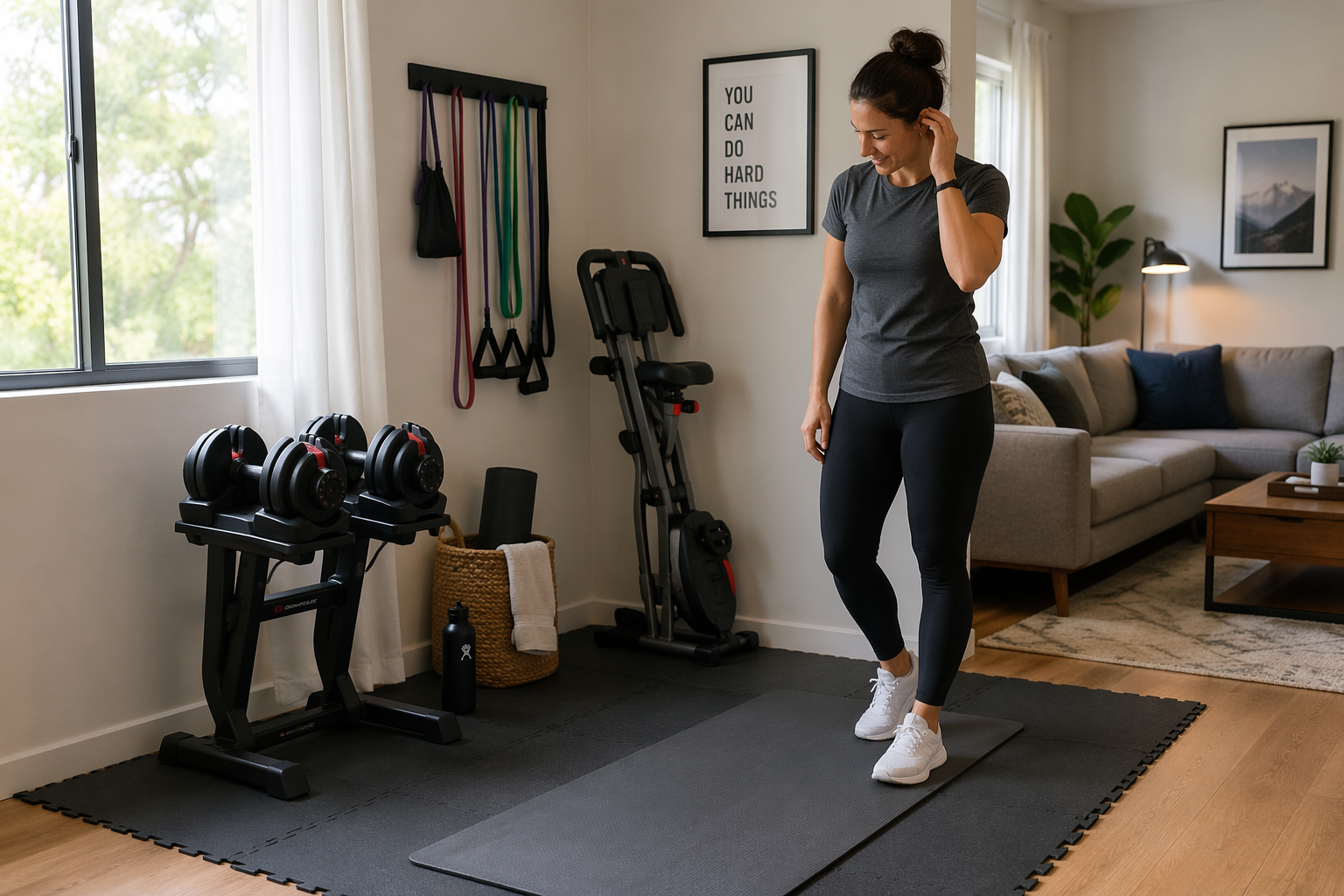
What Actually Makes Noise
Airborne noise from your music or grunting is not the issue. The problem is structure-borne noise — the vibration from a weight hitting the floor traveling through the building frame into your downstairs neighbor's ceiling. Most apartment floors are not rated for repeated impact loading above roughly 300 lbs. Even a 185-lb deadlift dropped from lockout can generate that much force on impact.
The most common solution is silencer pads. User reports claim they cut impact noise by 60–80%, and they do reduce the thud. But I have not found any controlled decibel testing — the Bells of Steel source that recommends them only says they "cut noise dramatically." Treat that range as a guess. The pads themselves cost about $30 for a 2x2 ft set and work best under rubber gym mats, not on bare carpet.
The deeper answer is that noise reduction depends more on your movements than your gear. That is why I built the exercise substitution guide later in this article — it is the single most actionable piece of advice I can give.
Floor Protection: One Thing You Cant Skip
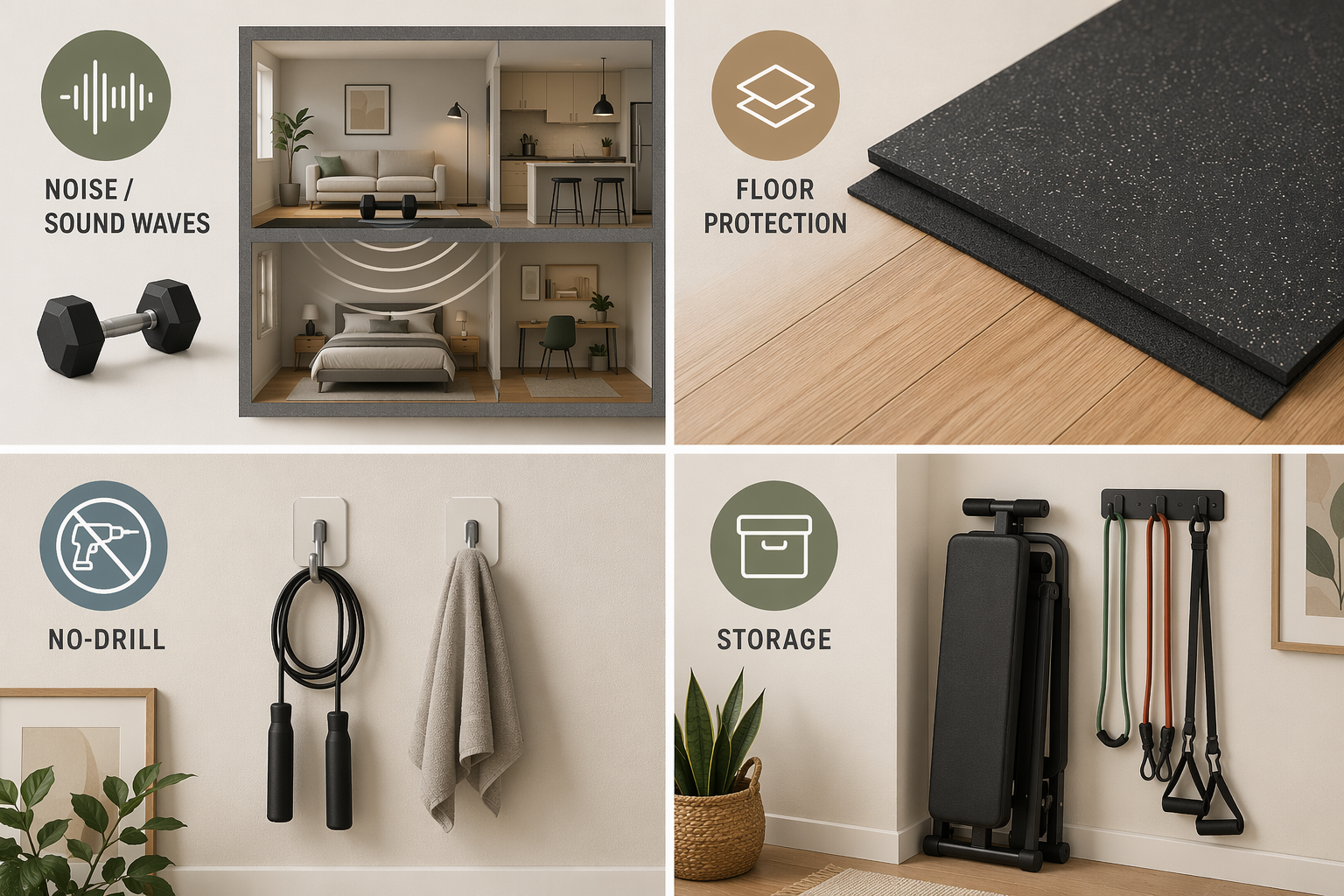
A yoga mat will not protect a hardwood floor from a 100-lb dumbbell on a rack. You need rubber gym mats — at least 3/8-inch thick for moderate weights, 1/2-inch or more if you plan to drop anything. Foam tiles work for bodyweight and light bands but compress under heavy loads and transfer the impact straight through.
I used 3/8-inch rubber mats from a local flooring store and laid them across a 4x6 ft area. That piece cost me about $60 and has saved my deposit three times over. For a deeper breakdown of thickness and material choices, see the Home Gym Flooring for Small Spaces and Apartments guide.
Lift Heavy Without Drilling
Every wall-mounted rack I looked at required bolting into studs — a dealbreaker in a rental where you cannot patch a 3/8-inch hole without leaving a mark. The alternative is a flat-foot, bolt-free rack.
The Bells of Steel Hydra Flat Foot power rack claims a 1,000-lb capacity without any floor or wall anchoring. The design uses a wide base and the weight of the rack itself for stability. I have not tested it personally, but the engineering checks out — the base is 48" wide and 30" deep, which is far more stable than a standard rack's feet alone. The manufacturer's site shows it handling 1,000 lbs in their testing. You still have to set the bar down gently; no bolt-free rack absorbs a drop like a bolted-in one.
An even more space-efficient option is the PRx Profile PRO Squat Rack. At $1,099.99, it holds 1,000 lbs and folds to a depth of 9 inches when not in use. But it is wall-mounted — and requires drilling into studs. For renters, the PRx only works if you are willing to patch and repaint before move-out (a small enough job for a tube of spackle and a paint match). If you cannot drill at all, stick with a flat-foot model.
I want to flag a gap: I have not found third-party verification that the Hydra maintains full stability at 1,000 lbs without any anchoring. The manufacturer's claim seems reasonable given the base dimensions, but if stability is critical for your lifts, consider a foldable wall-mounted rack with bolt-in installation. The deposit cost of repairing a few holes is far less than the cost of a rack tipping over.
Storage and Disassembly: Fold It, Move It
The best equipment for an apartment gym is the kind you can put away in under a minute and pack into a car when you move. Two items stand out.
The REP QuickDraw adjustable dumbbells (starting at $335.99) sit in a cradle that takes up just 1.2 square feet and replaces up to 12 pairs of fixed dumbbells. That is the single highest space-efficiency purchase for apartment strength training. The REP Nighthawk adjustable bench (retail $399) takes about 9 square feet when flat but stows upright in 1.8 square feet. And the Concept2 RowErg ($990) stores vertically, taking up maybe 2 square feet of floor space when leaned against a wall.
When I moved last year, my entire gym — dumbbells, bench, bands, mats, and a flat-foot rack — loaded into the back of a hatchback. The rack came apart with four bolts. The dumbbells went into a duffel bag. If your gym cannot be packed into a car in 30 minutes, you have chosen wrong.
Quietest Equipment: A Practical Ranking
Not all equipment produces the same noise. Here is a rough ranking based on impact and structure-borne noise, from quietest to loudest, with specific examples from my research.
| Category | Examples | Noise Level |
|---|---|---|
| Resistance bands | Living.Fit Resistance Bands ($128.94, up to 250 lbs) | Near-zero impact noise |
| Digital resistance | Tonal 2 ($4,295, 250 lbs, $59.95/mo), Speediance ($3,199, 220 lbs, no subscription) | Low — no weight stacks to rattle |
| Cable towers with silencer pads | Bells of Steel Cable Tower ($434.99) | Moderate — weight stack clatter is dampened but not eliminated |
| Plate-loaded with rubber flooring | Barbell + bumper plates on rubber mats | High — controlled lowering still produces vibration; dropping prohibited |
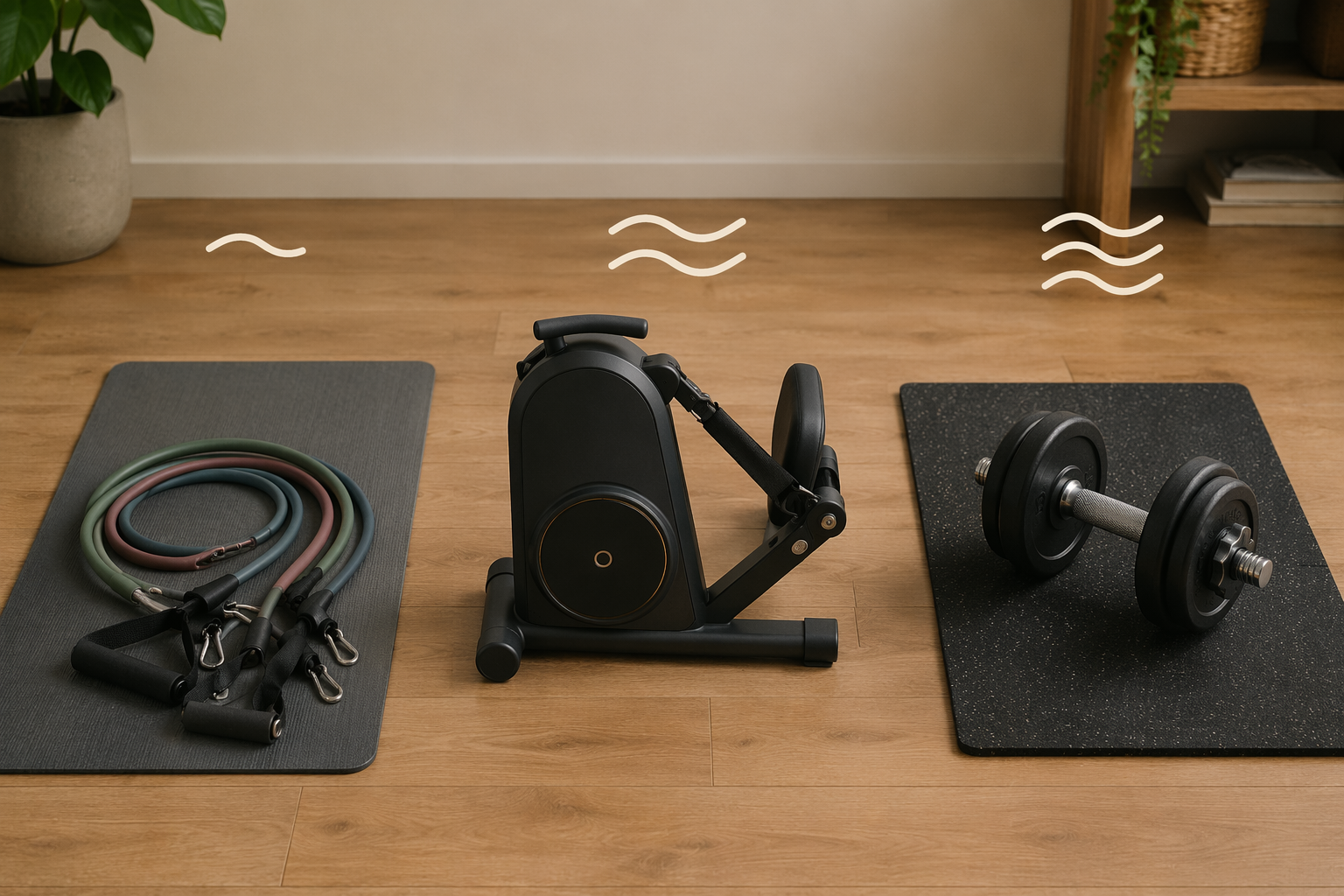
The Living.Fit bands are the quietest option because they generate no impact whatsoever. For up to 250 lbs of resistance and a lifetime warranty at $128.94, they are a no-brainer for apartment beginners or as auxiliary equipment. Digital resistance machines like Tonal and Speediance eliminate clanging weight stacks, but they come with a premium price — Tonal's $59.95/month subscription adds up over time. The Bells of Steel cable tower is the most affordable way to get cable-based training, and you can place silencer pads under its base to reduce floor vibration. Plate-loaded training is possible, but only with strict control and rubber flooring; I do not recommend it on a second floor unless you use tempo lifts.
Exercise Substitutions That Keep the Peace
This is the most actionable part of the article. The mechanism behind each substitution matters more than the list itself.
- Tempo deadlifts instead of conventional deadlifts. By taking 3–4 seconds to lower the bar, you eliminate the impact of dropping from lockout. The eccentric phase becomes a controlled movement, not a free fall. This single change reduces structure-borne noise by an order of magnitude.
- Strict pull-ups instead of kipping pull-ups. Kipping creates a swinging motion that transfers to the ceiling mount or doorframe, causing rattling and vibration. Strict pull-ups are silent if your bar is mounted securely.
- Step-ups instead of box jumps. Box jumps land with a thud that travels. A step-up onto the same box builds quad strength without the impact.
- Slow, deep squats instead of jump squats. The same principle: control the landing and you eliminate the noise.
- Floor press instead of bench press (if the bench itself rattles). Some adjustable benches squeak or shift under heavy weight. Lifting on the floor removes that variable entirely.
These substitutions let you run a full strength program — squats, deadlifts, presses, pull-ups — without a single dropped plate. I use tempo deadlifts for 315-lb sets on a second floor with no complaints.
Three Apartment Gym Packages That Don't Break Rules or Budgets
The average price of a home gym in Garage Gym Reviews' testing — across 13 products — is $1,855. That is a directional benchmark, not a statistically representative average. I have broken down three packages at $500, $1,000, and $1,500 that respect all five renter constraints. Each item is chosen because it addresses noise, floor protection, no-drill setup, storage, or ease of disassembly.
| Item | $500 Package | $1,000 Package | $1,500 Package |
|---|---|---|---|
| Resistance bands | Living.Fit Bands ($128.94) | Living.Fit Bands ($128.94) | Living.Fit Bands ($128.94) |
| Adjustable dumbbells | — | REP QuickDraw ($335.99) | REP QuickDraw ($335.99) |
| Adjustable bench | — | REP Nighthawk ($399) | REP Nighthawk ($399) |
| Cable tower | — | Bells of Steel Cable Tower ($434.99) | Bells of Steel Cable Tower ($434.99) |
| Foldable rack | — | — | PRx Profile PRO ($1,099.99) |
| Barbell + plates | — | — | Barbell + 255 lbs bumper plates ($600 est.) |
| Flooring | Rubber mat 4x6 ft ($60) | Rubber mat 4x6 ft ($60) | Rubber mat 4x6 ft ($60) |
| Total (approx.) | $190 | $1,260 | $2,350 |
The $500 package is a bands-only starter setup, enough for a solid full-body routine and about $190 total, well under budget. The $1,000 package adds real dumbbells and a cable tower — I consider this the minimum for a complete gym that hits every major movement pattern. The $1,500 package includes a foldable rack and barbell for dedicated powerlifting work, but you will need the discipline to use tempo lifts with bumpers. The PRx rack is wall-mounted, so add a few dollars for spackle and paint before move-out.
For a more detailed catalog of specific picks, see the Compact Home Gym Equipment Guide for Apartments.
So, Can You Deadlift 300 Lbs on a Second Floor?
Yes — but conditions apply.
You need a bolt-free, flat-foot power rack (or a foldable wall-mounted rack with patched holes on move-out) to hold the weight up, not to catch a drop. You need rubber mats over silencer pads to absorb the vibration of a controlled lower. You need tempo deadlifts — a 4-second eccentric, no drops. And you need the discipline to never let the bar free-fall.
If you do not want to commit to a full rack and barbell setup, the cable tower and adjustable dumbbell package ($1,000) covers deadlifts via cable pull-throughs and Romanian deadlifts with dumbbells — both virtually silent.
For the full picture on designing your apartment gym around space constraints, The Apartment Dweller's Compact Home Gym Setup covers the broader layout and noise control strategies.
The gym in a rental is not a compromise. It is a different engineering problem. Solve for the right constraints, and you can train heavy without losing a dime of your deposit.
This result comes from one real apartment under the stated conditions — it is a strong signal, not a guarantee your space will measure identically.
Builds this evidence supports
Cable Machine Alternatives That Save Space and Money
Compare the best cable machine alternatives for home gyms – from resistance bands and pulley systems to suspension trainers and compact digital units – and find the right option for your space and budget.
How to Choose a Compact Home Gym That Works for Your Space, Budget, and Noise Tolerance
This article provides a structured decision framework for apartment dwellers and small-space residents to match their specific floor footprint, noise sensitivity, and budget to the most suitable compact home gym strategy — whether that's an all-in-one machine, modular build, smart digital system, or band/bodyweight setup.
The Garage Gym Reality Check: What Equipment Actually Fits in a Single-Car Garage
Most garage gym guides assume a two-car space. This article uses real dimensions, real equipment footprints, and three layout templates to show what fits—and what doesn't—in a single-car garage (10x20 to 12x20 ft).
Spot something off?
If this result didn't match your own space, let us know — floor-damage and noise claims carry real deposit-risk consequences if we get them wrong.