
Why Most 'Compact' Guides Are Useless for Apartments
A foldable treadmill arrives. You unbox it, set it up in the living room, and suddenly half the space is gone. The Echelon Stride 6s-10 folds flat for under-bed storage, but when you run on it you need about six feet of clear floor length. "Foldable" does not mean "usable in a studio." It means you can tuck it away — after you finish sweating. I’ve learned to ignore the word "compact" and look at two numbers: the footprint when it’s in use and when it’s stored. That gap is where most buying guides flatten the problem.
Same with squat racks. The PRx Profile PRO stores at 12 inches deep against the wall, but pull it out and it opens to 39.5 inches deep and 53 inches wide. That is a lot of floor. A guide that lists "compact" without asking whether you can leave it open during a workout — or whether you have the wall space to mount it — is not serving you.
Three real constraints matter for apartment dwellers: the footprint in use versus stored, the noise the equipment transmits through floors, and how many functions each square foot delivers. Most reviews treat these as afterthoughts. They should be the starting point.
First, How Will You Store It?
Once you look beyond the word "compact," apartment equipment falls into three categories that dictate what you can actually own.
Stowable and foldable
This tier is for people who cannot leave equipment out. Everything packs away when not in use. Adjustable dumbbells like the REP QuickDraw (5–60 lbs per pair, $335.99) replace up to 12 pairs of fixed dumbbells in a shoebox footprint. A folding bench like the Ironmaster Super Bench Pro V2 ($499, 1,000‑lb capacity) has transport wheels and folds flat. The Concept2 RowErg ($990, 57 lbs) stores vertically in about two square feet — it is the gold standard for a cardio machine that disappears after use. Resistance bands take almost no space at all.
Wall-mounted permanent
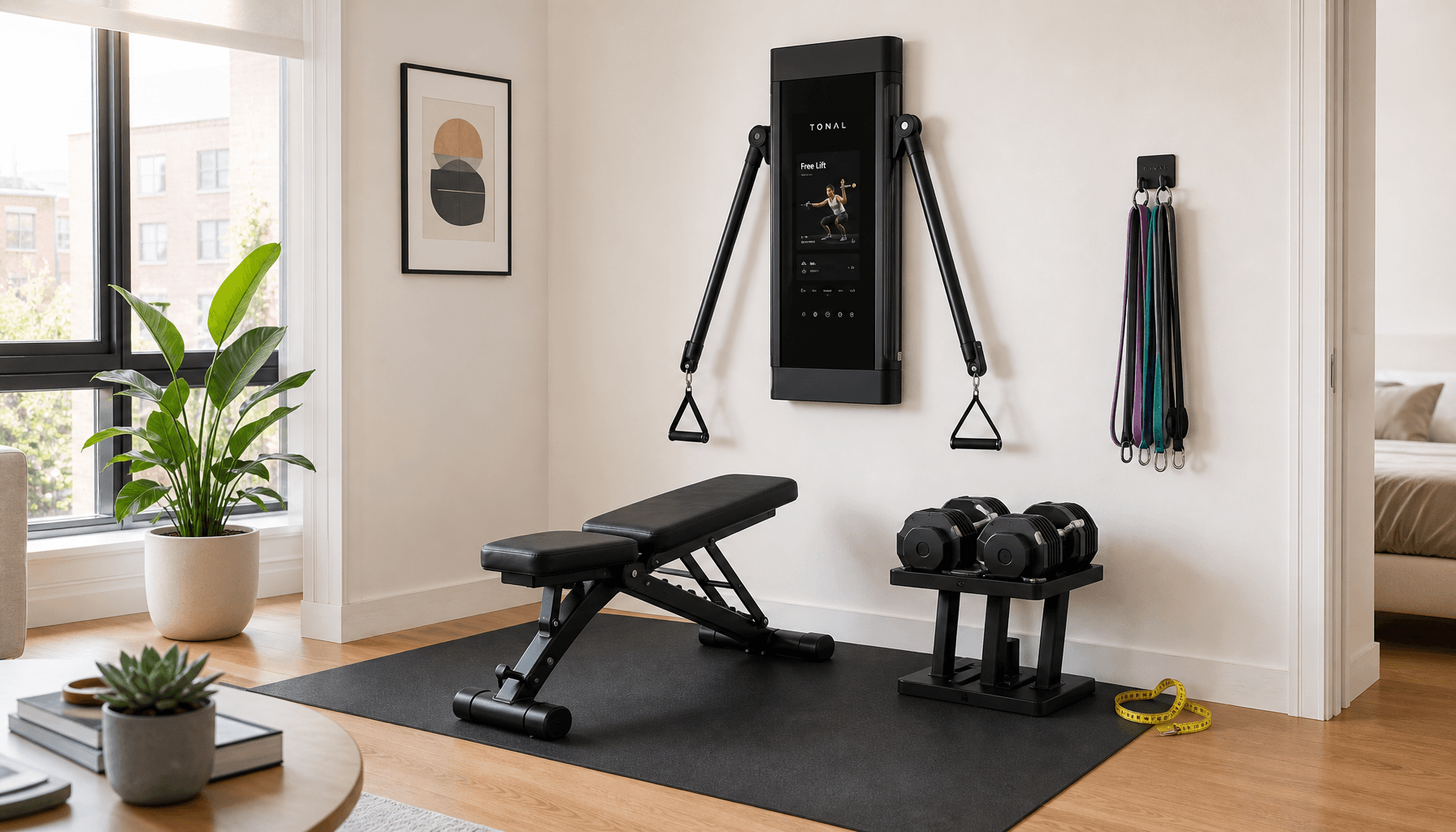
If you have a wall you can drill into and a clear floor space, wall-mounted equipment stays on the wall and folds or retracts when not needed. The PRx Profile PRO squat rack ($1,099.99, 1,000‑lb capacity, 10‑year warranty) folds to 12 inches deep. The Tonal 2 ($4,295, 5.25″ deep, 21.5″ wide) is a digital resistance system with 250 lbs of load, but it requires a 7‑foot wall space and professional installation. Wall-mounted gives you more floor space during a workout, but you are committing to a permanent fixture.
Compact stationary
Some equipment is small enough to leave out. The NordicTrack X24 exercise bike occupies 8.54 square feet, weighs 205 lbs, costs $2,799 — it is always there. Adjustable dumbbells and a folding bench can live in a corner. This tier works best when you have a dedicated nook or spare room that you are willing to convert into a semi-permanent gym.
The Real Footprint: In-Use vs. Stored
The table below shows what each piece of equipment looks like when you are using it, and what it looks like when you put it away. "Stored" means the floor area or wall space it consumes when not in use. For wall-mounted, that is the depth off the wall plus the wall width required.
| Equipment | In-Use Footprint | Stored Footprint | Noise Level | Weight |
|---|---|---|---|---|
| PRx Profile PRO (rack) | 39.5" D x 53" W | 12" depth (wall) | Low (no moving parts) | — |
| Echelon Stride 6s (treadmill) | ~6 ft long x 30" wide | Flat under bed / vertical | Moderate | ~200 lbs |
| Concept2 RowErg | 8 ft long x 2 ft wide | ~2 sq ft vertical | Moderate (air fan) | 57 lbs |
| NordicTrack X24 (bike) | 8.54 sq ft | Same (always out) | Low to moderate (magnetic) | 205 lbs |
| REP QuickDraw (dumbbells) | ~1.5 sq ft (shoebox) | Same | None (no impact) | ~60 lbs total |
| Ironmaster Super Bench | ~3 sq ft | Folds flat, ~1 sq ft | None | 65 lbs |
| Tonal 2 (digital resistance) | 5.25" D x 21.5" W (wall) | 5.25" depth (wall) | Very low (magnetic) | ~150 lbs (installed) |
Notice the trap: the Echelon treadmill folds flat, but its in-use length is about six feet. In a studio apartment, that may mean moving furniture every time you run. The PRx rack stores at a slim 12 inches, but when you unrack a barbell you need the full 39.5 inches of depth plus clearance. For wall-mounted equipment, the wall space requirement is often the binding constraint — not the stored depth.
Noise: The Downstairs-Neighbor Dimension
Noise is not a checklist item. The type of resistance determines how sound travels: magnetic is quietest, air resistance is moderate, plate-loaded is the loudest because of drops and bangs. Impact noise — a dropped dumbbell or a barbell unloaded — travels through floors differently than continuous fan noise. I’ve seen too many reviews list "quiet" without specifying the type of resistance. That matters.
The Tonal 2 uses digital magnetic resistance. CNET confirms it is quiet enough not to disturb neighbors. Magnetic rowers (like the WaterRower or silent magnetic models) are similarly quiet. The Concept2 RowErg, by contrast, is 'pretty loud compared to magnetic rowers' according to Garage Gym Reviews — the air fan makes a whoosh with every stroke, but it is a steady sound, not impact. Your downstairs neighbor will hear every thud from dropped weights. Even with a quality mat, plate-loaded exercises (deadlifts, barbell rows) will transmit vibration.
If you are on a ground floor or have very tolerant neighbors, you have more room. But for anyone living above someone else, the resistance type should be one of the first filters you apply.
What Fits Your Floor Plan?
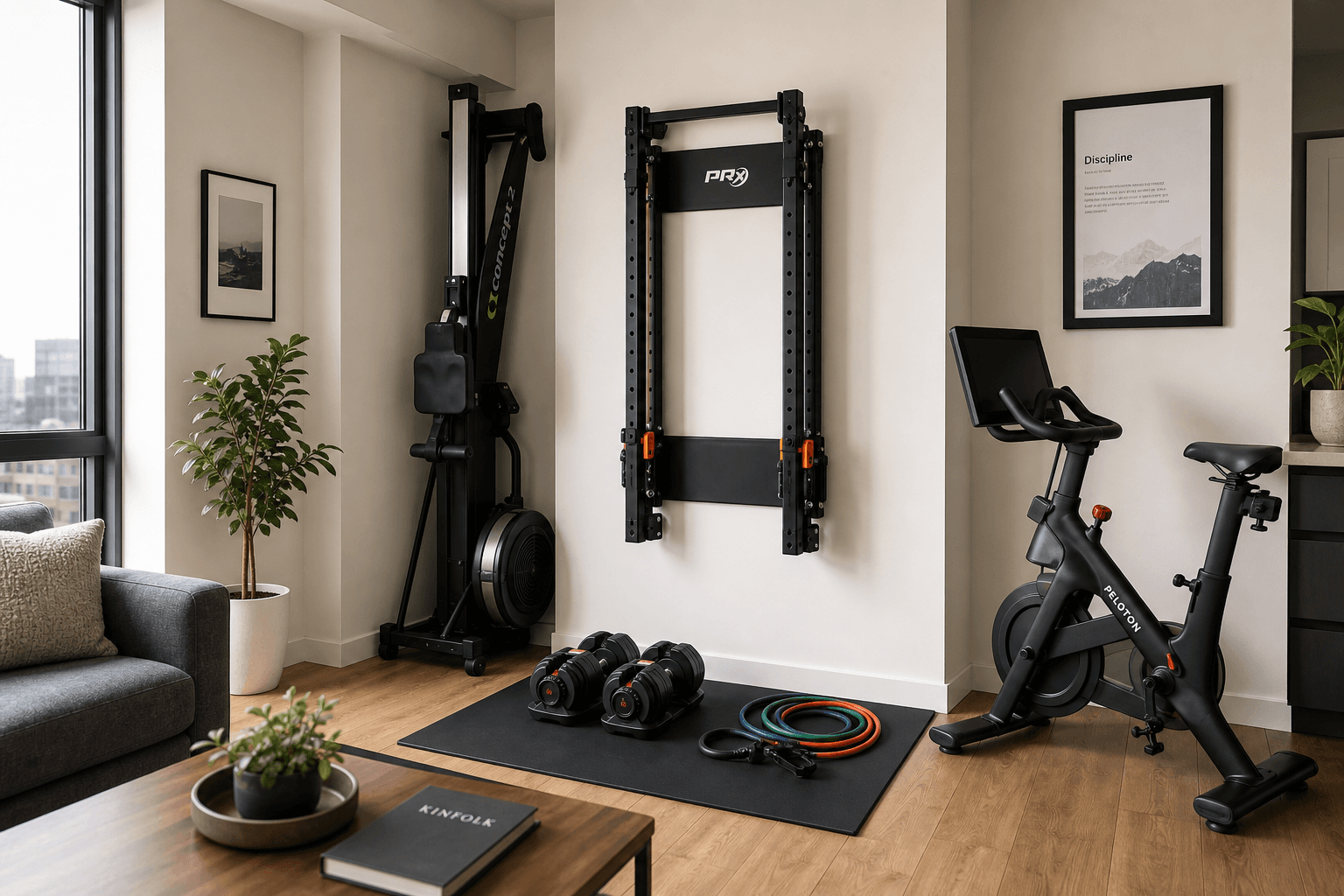
The three storage tiers and noise types work together to shape what you can realistically own in different floor plans.
Studio apartment (300–400 sq ft)
Every piece of equipment must be stowable. No wall-mount because you likely have no spare wall space that is not already furniture. Your setup: adjustable dumbbells, resistance bands, a folding bench, a vertical-storage rower, and a mat. That is it. The trade-off is clear: you lose the ability to do heavy compound lifts (no barbell, no rack) but you gain the ability to pack everything away and reclaim your living space in five minutes.
One-bedroom (600–700 sq ft) with an alcove or closet
You have a bit more room and may be able to dedicate a corner. If you can mount a wall rack or smart gym on a wall that is not shared with a neighbor (or is in a small den), you can add one permanent piece. The stowable core stays the same, but now you can do barbell squats with the PRx or digital resistance with the Tonal. The trade-off: you must commit to drilling, and the wall space is no longer available for other uses.
Spare room or den (100+ sq ft dedicated)
This is the luxury scenario. You can leave equipment out. A compact stationary bike like the NordicTrack X24, a folding bench, and adjustable dumbbells can live there permanently. You may even add a wall-mounted rack without worrying about drilling into a living room wall. The trade-off: the room is always a gym. Visitors sleep on the couch. But for training, it is the most capable setup.
If you want more detail on exact square-footage planning, our space-tier guide breaks down what you can fit in 10, 30, 50, and 100 square feet.
Verdict: Map Your Constraints First, Then Your Equipment
The pattern is simple: most apartment dwellers start by looking at price and brand. That is backwards. Start with storage mode: can you stow everything, do you have a wall to mount, or can you leave equipment out? Then assess noise tolerance: are you on the first floor or above someone sensitive? Only after those two answers should you look at budget and brand.
A five-piece all-stowable starter kit looks like this: REP QuickDraw dumbbells, resistance bands (Rogue Monster Bands go from 9 to 225 lbs), Ironmaster Super Bench, Concept2 RowErg, and a Manduka PRO mat ($144). That covers strength, cardio, and floor exercises in a footprint that disappears. If you have wall space, add a PRx Profile or a Tonal and you unlock compound lifts without losing the stowability of the rest.
A complementary article compares the four broad strategies for compact home gyms — wall racks, all-in-ones, smart gyms, and minimalist setups. This article gives you the tiered filter to decide which strategy even fits your apartment. Measure your space, test your noise, and buy accordingly.
Comments
Join the discussion with an anonymous comment.