
Why the Online vs. In-Store Decision Matters for Exercise Equipment
Buying a treadmill or squat rack is not like buying a pair of running shoes. The stakes are higher — the price tag is larger, the item is heavier, and the wrong choice can mean a machine that sits unused or, worse, causes discomfort every time you step on it. The decision of where to buy is as important as what to buy, and it breaks down along four axes: the type of equipment you need, how flexible your budget is, whether you need to test the equipment before committing, and how much effort you are willing to put into delivery and assembly.
For large cardio machines and heavy strength equipment, the advantages of buying from a specialty fitness dealer often outweigh the higher upfront price. For smaller, simpler items, online shopping offers savings and convenience that are hard to beat. This article builds a decision matrix that maps specific equipment types to the best buying channel, so you can match your purchase to the right store — not the other way around.
What You Gain by Shopping In-Store: Testing, Expertise, and White-Glove Delivery
Walking into a physical store — especially a specialty fitness dealer — gives you three things that online shopping cannot replicate: the ability to test ergonomics, access to knowledgeable staff, and professional delivery and assembly.
Testing Ergonomics Before You Buy
The most cited risk of buying sight-unseen applies to ellipticals. Consumer Reports explicitly warns against purchasing ellipticals online without trying them first, noting that "the wrong ergonomics can wreak havoc on your pedaling stride." A machine that feels fine during a five-minute test in a showroom can reveal stride-length issues, awkward handlebar positioning, or uncomfortable pedal spacing only after extended use. The same logic applies to exercise bikes (seat comfort, handlebar reach) and treadmills (belt feel, cushioning, console readability).
Specialty dealers typically carry multiple models from several brands, allowing you to compare side by side. Big-box stores like Dick's Sporting Goods also offer floor models, though the selection is narrower and the staff may not have the same depth of product knowledge.
Expert Staff and After-Sale Support
A knowledgeable salesperson can answer questions about resistance types, motor horsepower, weight capacity, and warranty coverage in a way that product descriptions and customer reviews cannot. Specialty dealers have been in the business for decades — Fitness Gallery, for example, has been selling fitness equipment since 1997. Their staff can explain why a machine with thicker steel tubing or a heavier flywheel is worth the extra cost, and they often provide in-house service for repairs and maintenance.
Professional Delivery and Assembly
Large cardio machines and power racks are heavy, awkward, and complex to assemble. Consumer Reports estimates that specialty dealers typically charge about $150 for delivery and installation, and notes that this "might be money well-spent given the weight of these machines and their often complex assembly." For a treadmill that weighs 300 pounds or a power rack with dozens of bolts, that fee covers unpacking, assembly, placement, and removal of packaging — a service that can save hours of frustration and reduce the risk of damaging the machine during setup.
What You Gain Online: Lower Prices, Wider Selection, and Customer Reviews
Online shopping opens up a much larger market. You are not limited to the brands and models that a local store chooses to stock, and you can often find significant savings — especially on refurbished or open-box equipment.
Savings on Refurbished and Closeout Equipment
Online retailers like Fitness Superstore advertise 40–70% off MSRP on refurbished equipment, with a free year of warranty on refurbished items and the option to extend coverage up to five years on parts and accessories. Gym Pros offers up to 75% off on select products and has maintained an A rating with the Better Business Bureau since 2003. Titan Fitness runs a scratch-and-dent program for certified, slightly used equipment. These savings can make higher-end brands accessible to budget-conscious buyers who would otherwise have to settle for entry-level models.
Wider Selection and Customer Reviews
Online retailers carry brands and models that local stores simply do not have floor space for. Fitness Factory, for instance, has been in business for over 30 years and stocks a broad range of commercial-grade and home-grade equipment. Customer reviews — especially detailed ones that discuss assembly difficulty, noise levels, and long-term durability — provide a form of collective testing that no single shopper can replicate in a 10-minute store visit.
Low-Risk Categories for Online Buying
Resistance bands, yoga mats, jump ropes, foam rollers, and small accessories carry minimal risk when bought online. They are lightweight, inexpensive, and do not require ergonomic testing. The same applies to dumbbells and weight plates if you already know the weight increments you need and are comfortable with the material (rubber hex vs. iron vs. urethane). For these categories, online is almost always the better choice.
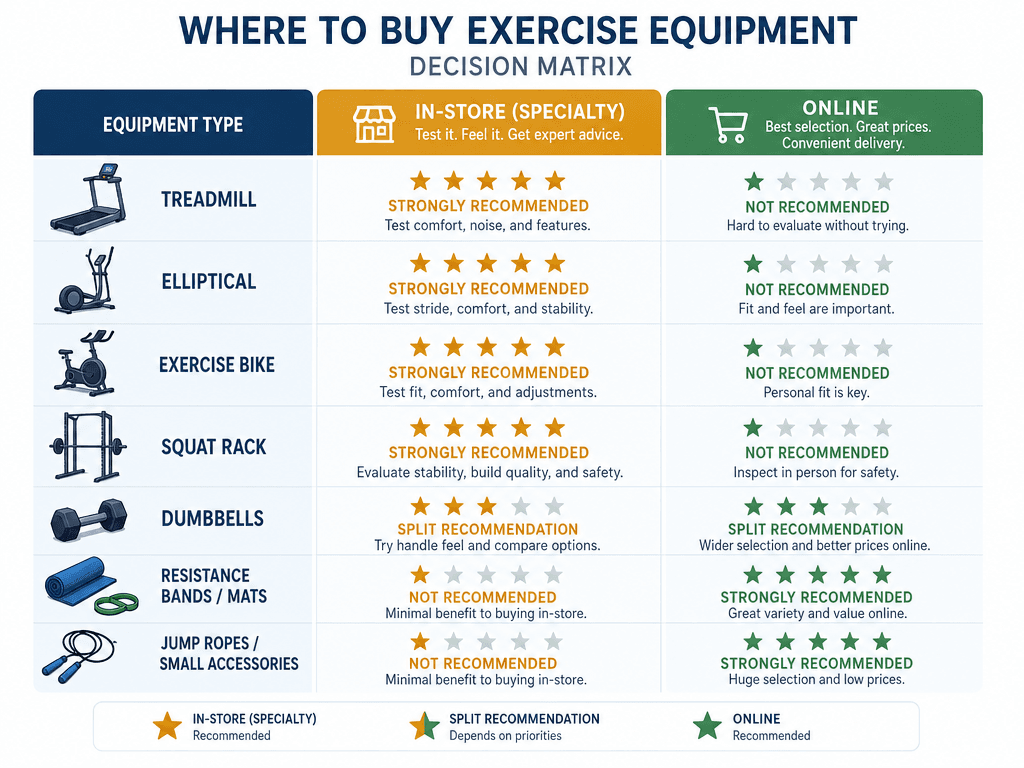
Decision Matrix: Where to Buy by Equipment Type
The table below maps common home gym equipment types to the recommended buying channel, with reasoning tied to the four decision factors.
| Equipment Type | Recommended Channel | Key Reasoning |
|---|---|---|
| Treadmill | Specialty dealer or big-box (test first) | Belt feel, cushioning, and console layout vary significantly by model. Testing is valuable, but budget treadmills under $1,000 (like the Horizon 7.0 AT at $1,000) are available at big-box stores. |
| Elliptical | Specialty dealer strongly recommended | Ergonomic risk is highest here. Consumer Reports warns against buying sight-unseen due to stride-length and pedaling issues. |
| Exercise bike (high-end, $1,000+) | Specialty dealer | Seat comfort, handlebar reach, and resistance feel require in-person testing. Peloton and similar brands are available in showrooms. |
| Exercise bike (budget, under $500) | Online or big-box | Lower investment reduces risk. Assembly is simpler than treadmills or ellipticals. |
| Squat rack / power rack | Specialty dealer for quality; online for budget | Thicker steel and better welds matter for safety. Online retailers like Titan Fitness offer budget options, but inspect weld quality if possible. |
| Dumbbells and weight plates | Online or big-box | Low ergonomic risk. Online offers better selection and pricing on rubber hex and iron sets. |
| Resistance bands, mats, jump ropes, small accessories | Online | Minimal risk, lightweight, easy to return. Online selection and pricing are superior. |
This matrix is a starting point, not a rigid rule. A buyer who is comfortable with assembly and has a clear understanding of their ergonomic needs may successfully buy a treadmill online. Conversely, a buyer who values hands-on service above all else may prefer a specialty dealer for every purchase. The matrix helps you identify where the risks and benefits are concentrated.
Delivery and Assembly: DIY vs. Professional Installation
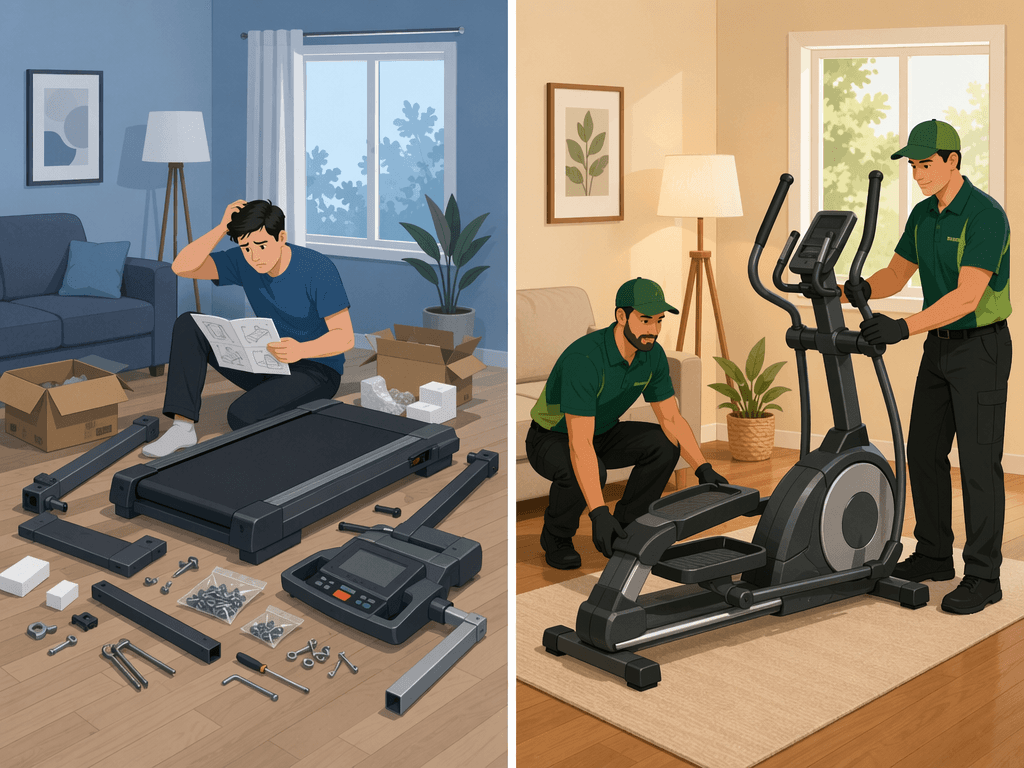
The cost of delivery and assembly is often the hidden variable that shifts the total cost of ownership between channels. A treadmill that costs $200 less online may end up costing more once you factor in shipping fees, the value of your time for assembly, and the potential cost of damage during setup.
| Factor | DIY (Online or Big-Box) | Professional (Specialty Dealer) |
|---|---|---|
| Delivery cost | Often free or low-cost for small items; $50–$150 for large items | Included in the ~$150 installation fee (per Consumer Reports) |
| Assembly time | 1–3 hours for a treadmill; 30–60 minutes for a bike; 2–4 hours for a power rack | Handled by professionals in 30–60 minutes |
| Risk of damage | Moderate — heavy boxes can be dropped, bolts can be stripped, electronics can be damaged during assembly | Low — professionals have experience and proper tools |
| Packaging disposal | You handle it | Professionals remove packaging |
| Total cost (treadmill example) | $1,000 (machine) + $100 (shipping) + 2 hours of your time = ~$1,100 + time | $1,200 (machine) + $150 (installation) = $1,350, zero time |
The DIY approach makes sense for buyers who are mechanically inclined, have a helper available, and are purchasing equipment that is relatively simple to assemble — like a set of dumbbells, a resistance band kit, or a folding exercise bike. For complex machines like treadmills, ellipticals, and power racks, the $150 professional installation fee from a specialty dealer is often a worthwhile investment.
Warranty and Long-Term Value: What Each Channel Offers
Warranty coverage varies significantly by channel, and it directly affects the long-term cost of ownership. A machine with a weak warranty may cost less upfront but require expensive repairs within a few years.
| Channel | Typical Warranty Coverage | Service and Support |
|---|---|---|
| Specialty fitness dealer | Often 10+ years on frame, 2–5 years on parts, 1–2 years on labor. Brands like TuffStuff and TRUE Fitness (made in USA with commercial-grade components) offer strong warranties. | In-house service technicians; can perform repairs at your home or in their shop. |
| Big-box store (Costco, Walmart, Dick's) | Typically 1–3 years on parts, limited frame warranty. Fitness Gallery notes that volume-manufactured equipment often has "thinner steel and weaker warranties." | Limited or no in-house service; repairs handled through third-party contractors or manufacturer. |
| Online retailer (new equipment) | Varies by brand — typically 1–5 years on parts. Some online retailers offer extended warranties for an additional fee. | No in-house service; warranty claims go through the manufacturer. Shipping costs for returns may be your responsibility. |
| Online refurbished retailer (Fitness Superstore, Gym Pros) | Free 1-year warranty on refurbished items; up to 5-year extended warranty on parts and accessories (per FitSW). | Varies by retailer. Some offer phone support and replacement parts; few offer on-site service. |
For a serious investment like a treadmill or power rack, a stronger warranty from a specialty dealer can justify a higher upfront price. If the machine develops a problem in year three, a dealer with in-house service can often resolve it faster and at lower cost than a manufacturer-based warranty claim. For budget equipment under $500, the warranty is less critical because the replacement cost is low.
For a deeper look at how equipment quality and warranty affect long-term value, see our Commercial vs. Home Gym Equipment: A Cost-Per-Year Analysis for Serious Home Gym Buyers.
The Hybrid Approach: Research Online, Buy In-Store (or Vice Versa)
You do not have to commit entirely to one channel. A hybrid strategy lets you capture the advantages of both.
- Research online, test in-store: Identify the models that fit your budget and space requirements using online research and customer reviews. Then visit a specialty dealer or big-box store to test the ergonomics of your top two or three choices. Buy from the store if the price is competitive; if not, you now know exactly which model to buy online.
- Test in-store, buy refurbished online: Visit a store to confirm that a specific model feels right. Then search for a refurbished or open-box version of that same model from an established online retailer like Fitness Superstore or Gym Pros. You get the ergonomic confidence of an in-store test with the 40–70% savings of refurbished pricing.
- Buy the machine in-store, accessories online: Purchase the large, complex machine (treadmill, elliptical, power rack) from a specialty dealer to get professional delivery, assembly, and a strong warranty. Buy all accessories — mats, bands, foam rollers, jump ropes — online where selection and pricing are better.
- Use online pricing as leverage: Some specialty dealers will match or come close to online prices if you show them a competitor's quote. It never hurts to ask, especially if you are buying multiple pieces of equipment.
The hybrid approach works best when you know your budget and space constraints first. Our Home Gym Equipment Decision Framework: What to Buy Based on Your Budget, Space, and Training Goals can help you define those parameters before you start shopping.
Final Verdict: Matching the Channel to Your Equipment and Priorities
The choice between online and in-store exercise equipment shopping is not a single decision — it is a series of decisions, one for each piece of equipment you buy. The framework is straightforward:
- For large cardio machines (treadmills, ellipticals, high-end bikes) and heavy strength equipment (power racks, squat racks), specialty dealers offer advantages that can save money and frustration over the long term — even if the upfront price is higher. The ability to test ergonomics, the expertise of the staff, professional delivery and assembly, and stronger warranties all contribute to a lower total cost of ownership.
- For budget cardio machines (under $1,000), big-box stores are a reasonable compromise. You can still test the equipment in person, and the lower price reflects the thinner steel and weaker warranties that come with volume-manufactured equipment.
- For dumbbells, weight plates, resistance bands, mats, and small accessories, online is almost always the better choice. The selection is wider, the pricing is better, and the risk is minimal.
- For buyers who want the best of both worlds, a hybrid approach — research online, test in-store, buy from the channel that offers the best combination of price and service — is the most rational strategy.
Comments
Join the discussion with an anonymous comment.