
Searching for the “best home gym equipment” usually brings up racks, smart mirrors, cable machines, adjustable dumbbells, benches, bikes, apps, and bundles as if they all belong in the same shopping cart. They do not. The expensive mistake usually happens one step earlier: buying an equipment category that fails your actual constraints.
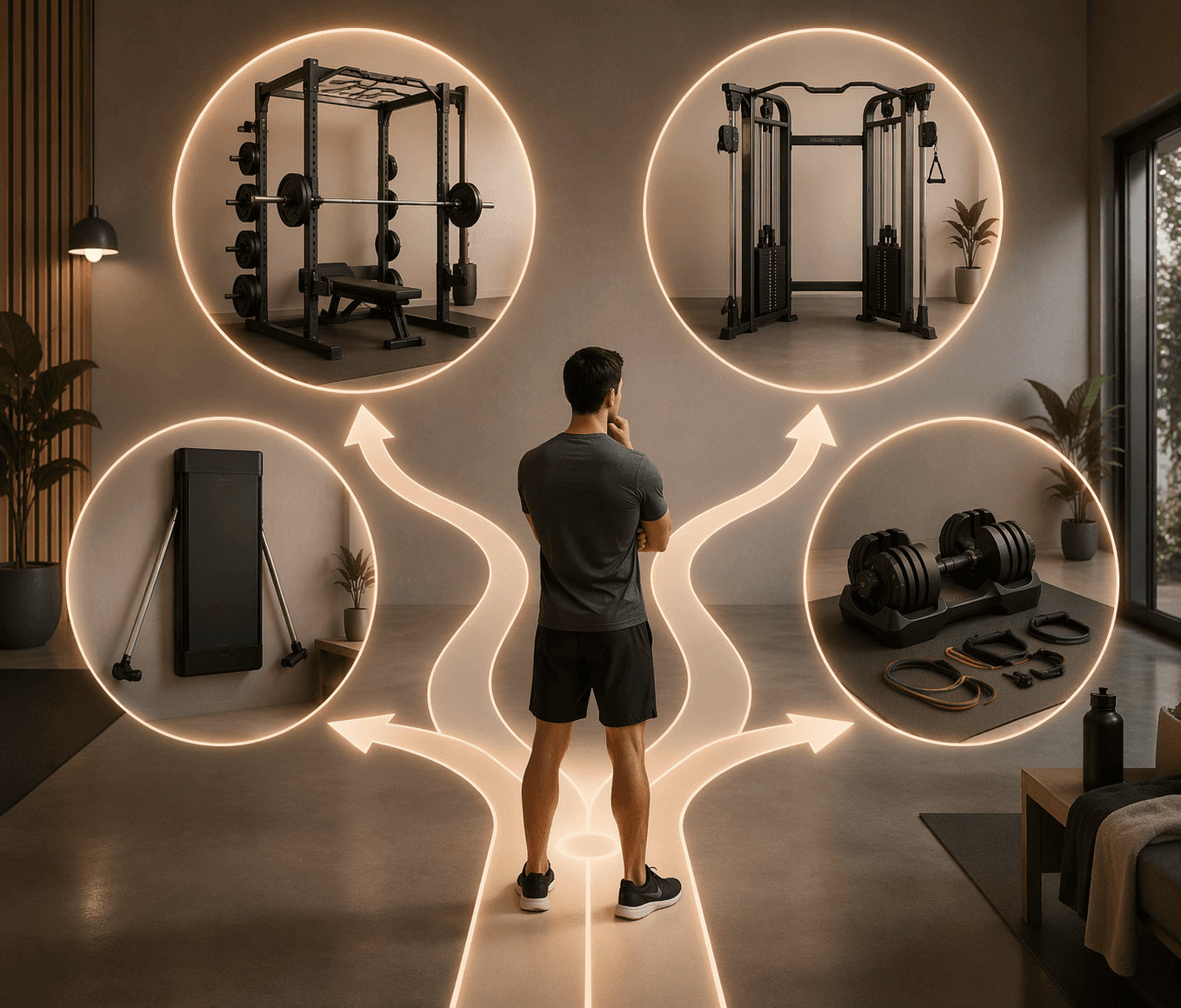
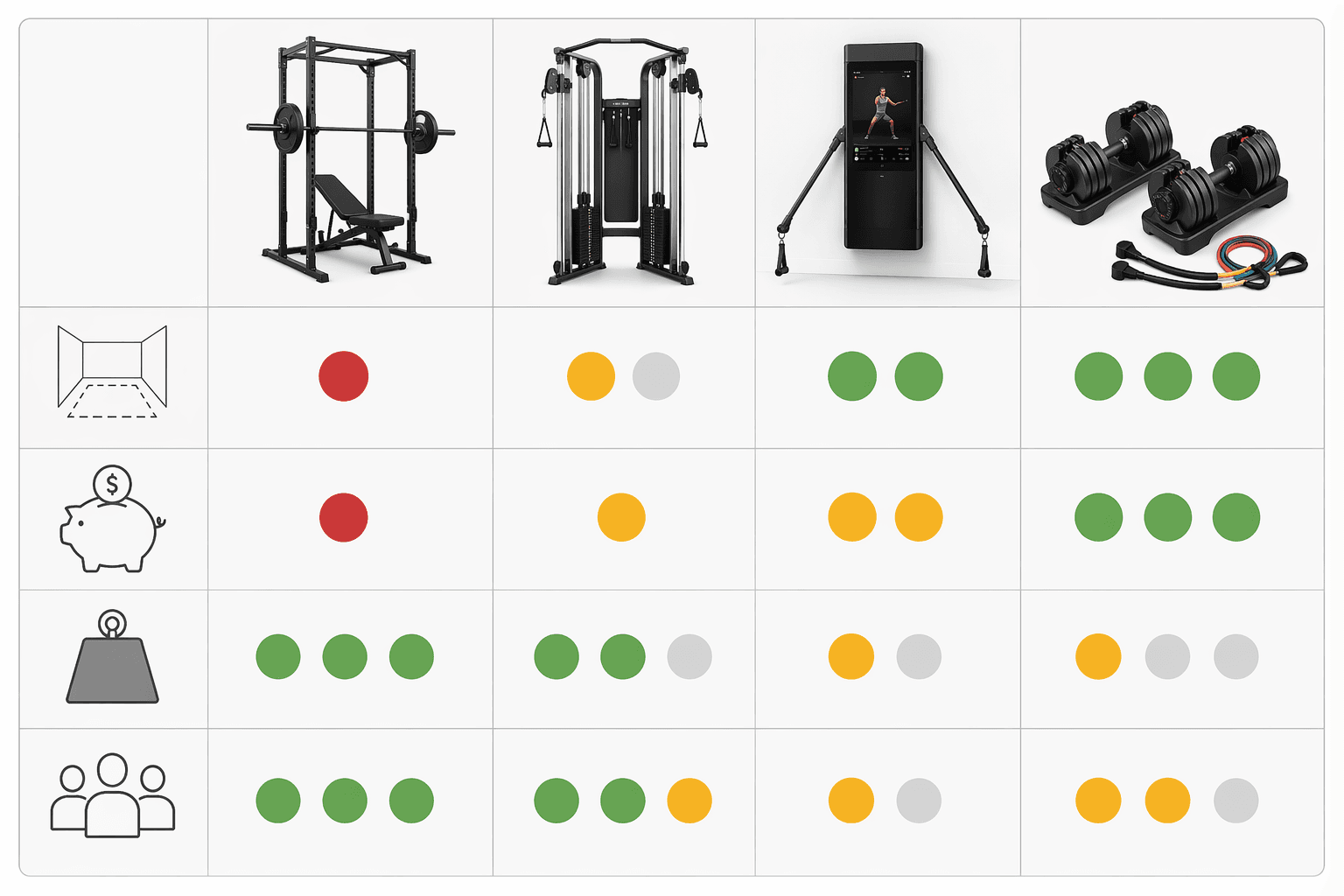
Before comparing brands, narrow the field by four axes: usable space, total cost, training ceiling, and number of people using the setup. Most first home gyms fit into one of four workable categories.
| Equipment category | Best fit | Space reality | Cost range as of mid-2026 | Training ceiling | Subscription |
|---|---|---|---|---|---|
| Power rack + barbell + bench | Long-term strength training, barbell lifts, gradual upgrades | Large. A rack can take roughly 16–25 sq ft before lifter clearance and plate handling are considered [1]. | $1,000–$2,500 for a capable starter-to-midrange setup; some racks start lower and grow through attachments [2]. | Highest. Many racks are built around 1,000+ lb capacities [1]. | No |
| All-in-one functional trainer | Cable exercises, shared households, people who want guided movement paths without digital coaching | Medium to large. More compact than a full rack zone in some rooms, but still furniture-sized. | $1,300–$4,200 depending on stack size, frame, and included stations [1]. | Moderate. Common resistance ranges sit around 200–400 lbs [1]. | No |
| Smart gym with digital coaching | Compact guided training, apartments, beginners who want coaching and low setup friction | Compact, often wall-mounted. | $3,000–$4,300 plus about $60/month for subscription access [1]. | Moderate. Digital resistance commonly sits around 250 lbs total [1]. | Usually yes; terms vary by brand |
| Adjustable dumbbells + resistance bands | Small spaces, low budget, beginners, simple progressive training | Minimal. Works in an alcove, bedroom corner, or shared room if storage is planned. | $200–$600 [2]. | Moderate. Dumbbells commonly top out around 90 lb per hand, with bands adding variable resistance. | No |
That table is the real shopping filter. Product features matter later. Right now, the question is which category survives your room, budget, strength goals, and household routine.
Start with usable space, not total room size
A 10-by-10 spare room is not automatically a 100 sq ft gym. Doors swing. Closets open. Kids cut through. A car may still need the garage. What matters is the space where you can lift, change weights, step back safely, and leave equipment without turning the room into an obstacle course.
If you have under 20 sq ft of reliable training space, a rack-and-barbell setup is usually the first category to remove. Typical rack footprints can land around 16–25 sq ft before accounting for the lifter, barbell sleeves, plate loading, and walking clearance [1]. That is why a rack that technically “fits” on a product page can still be miserable in a bedroom.
Under that threshold, adjustable dumbbells and bands become the cleanest first route. A wall-mounted smart gym can also make sense if the wall, ceiling height, floor surface, and subscription model all work. If you are deciding among small-room layouts, the space-tier guide at Compact Home Gym by Space Tier is the better next stop than a brand roundup.
At roughly 30–50 sq ft, the decision opens up. Adjustable dumbbells still work, smart gyms are still compact, and some functional trainers become plausible. A rack may fit if the room is shaped well and you are honest about barbell clearance. At 100 sq ft or more, space stops eliminating the rack and starts letting you think about lifting style, storage, and upgrades.
- Under 20 sq ft: keep adjustable dumbbells + bands and compact smart gyms alive; usually eliminate power racks.
- About 30–50 sq ft: consider adjustable dumbbells, smart gyms, some functional trainers, and carefully measured compact rack setups.
- About 100 sq ft or more: all four categories can remain in play, assuming budget and training goals match.
Then separate purchase price from ownership cost
Average home gym cost numbers are useful only until they flatten the differences between categories. CNET estimated an average home gym setup at $1,098, while Garage Gym Reviews places a typical midrange spend around $1,500–$2,500 [3][2]. Those baselines are helpful for expectation-setting, but they do not answer whether you should buy a rack, a cable machine, a smart system, or a dumbbell-and-band setup.
Adjustable dumbbells and resistance bands live in the lowest serious entry band, roughly $200–$600 as of mid-2026 [2]. That does not make them a compromise by default. A 2019 systematic review and meta-analysis in SAGE Open Medicine looked at 8 studies with 224 participants and found that elastic resistance produced similar strength gains to conventional resistance training in the included research [4].
That evidence is permission to start simple. It is not permission to pretend bands have the same long-term loading ceiling as a rack, barbell, and plates. The study compares elastic resistance with conventional resistance training such as weight machines and dumbbells in the included trials; it does not establish that bands replace every use case for heavy barbell training [4].
Power racks and functional trainers move into a different financial lane. A rack-based gym may start around $1,000 and climb as plates, storage, specialty bars, safeties, cables, and attachments enter the room. That can be annoying, but it is also the point: a rack can grow over years. Garage Gym Reviews notes examples such as the REP PR-4000 starting around $950 and being expandable through attachments, which is why this category often works for buyers who would rather add pieces slowly than replace the whole system [2].
Functional trainers often cost more upfront than a bare rack starter setup, but they include the convenience of selectorized cable work. Smart gyms are stranger financially: the hardware can sit around $3,000–$4,300, and the subscription can add about $60/month [1]. Over several years, that monthly fee becomes part of the equipment price, not a side note. If you are still deciding whether ownership beats a commercial gym for your situation, use the Home Gym vs Gym Membership Cost Breakdown before treating any purchase as “saving money.”
- $200–$600: adjustable dumbbells + bands are the main category still standing.
- $1,000–$2,500: rack-based setups become realistic, especially if you can upgrade gradually.
- $1,300–$4,200: functional trainers become plausible if cable versatility matters more than barbell loading.
- $3,000–$4,300 plus ongoing subscription: smart gyms stay alive only if coaching, compactness, and convenience justify the recurring cost.
For a deeper look at what each budget tier actually buys, including hidden costs, the more useful follow-up is Home Gym Cost Breakdown: $500 to $5,000+ or the broader Home Gym System Cost Breakdown.
Training ceiling decides whether the setup grows with you
“Total-body training” is not a ceiling. It only says you can train many muscles. It does not say how heavy you can train them, how easily you can progress, or whether the system still makes sense after two years of consistency.
This is where the rack separates itself. Power racks commonly support 1,000+ lb capacities, which is far beyond what most home lifters will ever load but useful because the frame is not the limiting factor [1]. Add a barbell, plates, safeties, a bench, and later attachments, and the system can support squats, presses, pulls, bench work, rows, pull-ups, and accessory movements for a long time.
Functional trainers sit lower but cover a different style of training. Their 200–400 lb resistance ranges are not the same as a heavy rack, but cable resistance is excellent for rows, pulldowns, presses, flyes, lateral raises, arm work, single-leg assistance, rotation, and rehab-style patterns [1]. If your training is more bodybuilding, general strength, or joint-friendly accessory work than heavy barbell progression, that ceiling may be enough.
Smart gyms deserve a fairer reading than they sometimes get from barbell people. Their real advantage is not beating a rack on maximum load. It is reducing friction: guided sessions, automatic resistance changes, form prompts or coaching features depending on the system, compact storage, and quick starts. For a beginner who is intimidated by programming and plate math, that can be the difference between using the gym and avoiding it.
The ceiling still matters. If a smart gym provides around 250 lb of total digital resistance, that may be plenty for many movements and many users, but it is not the same category as a rack designed around heavy barbell loading [1]. The buyer who wants to chase a stronger squat, deadlift, or bench over years should notice that before falling in love with the screen.
Adjustable dumbbells and bands land in a practical middle for beginners and many general fitness users. Dumbbells around a 90 lb-per-hand ceiling can last a long time for presses, rows, split squats, Romanian deadlifts, curls, carries, and floor work. Bands add pull-aparts, assisted mobility, rows, presses, and variable-resistance options. The ceiling is real, but so is the usefulness.
- If long-term barbell strength is the goal: keep the power rack alive; the other categories become secondary or accessory options.
- If cable versatility and moderate resistance are enough: keep functional trainers alive.
- If coaching and compactness matter more than maximum load: keep smart gyms alive, with the resistance ceiling clearly accepted.
- If the goal is starting strength training cheaply and consistently: keep adjustable dumbbells + bands alive.
Shared households change the convenience math
One person can tolerate more friction than three people can. Plate loading is fine when the bar is yours and the workout is yours. It gets old when one person is squatting, another wants pulldowns, and someone else just wants a 25-minute workout without undoing everyone’s setup.
This is where selectorized functional trainers earn their footprint. A weight stack lets different users change loads quickly, and the cable path gives shorter, taller, stronger, and newer lifters more ways to find usable exercises without rebuilding the station. Garage Gym Reviews’ multi-user testing observations favor selectorized stacks and smart gyms for shared homes because they reduce the constant loading and unloading that rack setups require [1].
Smart gyms can also work well in multi-user homes because profiles, saved settings, and guided workouts reduce the need for one household member to become the unofficial coach. The caution is subscription structure. Access may be per-user or household-friendly, so verify the terms before purchase.
Adjustable dumbbells can serve two people well if workouts are staggered. They are less graceful when multiple people train at the same time and keep needing different weights. A rack can serve a household beautifully if the users are bought into barbell training; it is less welcoming if only one person knows how to set safeties, load plates, and choose movements.
- One primary lifter: choose mainly by space, budget, and training ceiling.
- Two users with different strength levels: functional trainers and smart gyms gain value; adjustable dumbbells still work if sessions are separate.
- A family or shared space: prioritize fast adjustments, clear storage, and equipment that non-enthusiasts can use without instruction every time.
What to buy first by constraint profile
If you have the room, the budget, and serious long-term strength ambitions, start with a power rack, barbell, bench, and plates. It is the least cute answer and often the best one for progression. Buy fewer attachments at first. Spend the measuring effort on rack depth, bar clearance, plate storage, flooring, and whether the room still works when someone is actually lifting.
If you want cable-style versatility, quick weight changes, and a setup that multiple people can share without a subscription, look at an all-in-one functional trainer. This is especially sensible when your goals lean toward general strength, hypertrophy, accessories, and convenience rather than heavy barbell numbers.
If your space is tight and you want coaching built into the equipment, a smart gym can be the right first purchase. Do not buy it only because it looks clean on a wall. Buy it if the subscription cost, resistance ceiling, household account terms, and available exercise style all fit the way you will train. For a closer comparison of compact modular, all-in-one, and smart routes, use Compact Home Gym Approaches.
If your budget is low, your space is small, or you are still proving the habit, adjustable dumbbells and resistance bands are not a consolation prize. They are the cleanest first purchase for many beginners: low footprint, no subscription, enough exercise variety, and evidence that elastic resistance can support strength gains when programmed seriously [4]. If you need a beginner-specific route from first purchase to later upgrades, start with Best Home Workout Machine for Beginners.
The right first buy is the category that survives your constraints before brand preference gets involved: rack for room and long-term loading, functional trainer for cable convenience and shared use, smart gym for compact coaching if the recurring cost fits, and adjustable dumbbells plus bands for the smallest, cheapest evidence-supported start.
References
- Best Home Gyms. Garage Gym Reviews.
- How Much Does a Home Gym Cost?. Garage Gym Reviews.
- Think a Home Gym Is Cheaper Than a Gym Membership? We Did the Math to Find Out. CNET.
- Effects of training with elastic resistance versus conventional resistance on muscular strength: A systematic review and meta-analysis. SAGE Open Medicine. 2019.
Comments
Join the discussion with an anonymous comment.